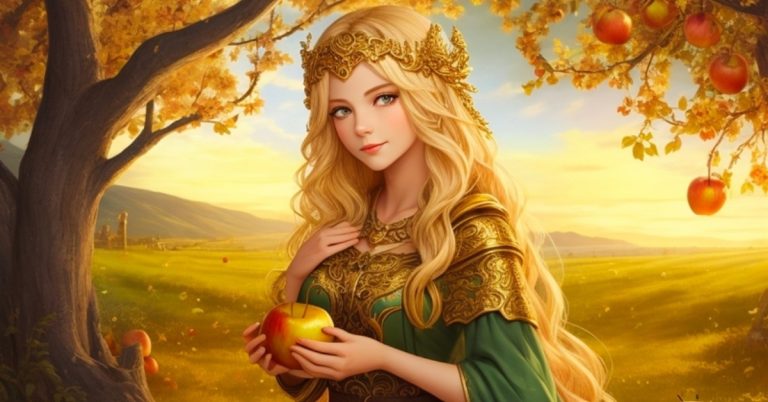
Gieddegeašgálgu: The Sami Old Woman at the Meadow’s Edge
Walk out past the last cleared ground, to the place where the home-field stops and the forest starts. Somewhere there, the North Sámi said, an old woman lives, and she knows all things.
That is close to the whole of what survives about her. Her name is Gieddegeašgálgu, and the blank space around her is the story.
Overview of Gieddegeašgálgu
Gieddegeašgálgu belongs to the Sámi, the Indigenous people of Sápmi, the northern reach of Norway, Sweden, Finland, and Russia’s Kola Peninsula. She is known from the North Sámi areas specifically, and the tradition around her is thin enough that the reference works give her two or three sentences each.
Those sentences agree. She is a wise female being who lives at the outer edge of the settlement, the boundary between the cleared land around the dwellings and the wild beyond. People turned to her when life got hard past the ordinary. She knows all things, and the one who reaches her can ask.
Her name is a map. In North Sámi, gieddi is the meadow or home-field, the tended ground around a dwelling. Geahči is the end or tip of something. Gálgu is an old woman. Put together: the old woman at the far end of the field. Finnish speakers call her Kentänpään eukko, the same idea word for word.
Online lists sometimes file her as a goddess of witchcraft or shamanism. The older material is plainer than that. She is a counselor at the threshold, a keeper of answers who lives exactly where the human world runs out.
Titles
- Gieddegeašgálgu, “the old woman at the end of the meadow” (North Sámi)
- Gieddegeasgalgu, the common Norwegian-text spelling
- Kentänpään eukko / Kentänpään akka, the Finnish rendering
- Skravlekjerring, “chatter crone,” a later Norwegian sense the word drifted into
Characteristics
The sources describe a role, and leave her looks to the imagination:
- An old woman, alone, at the edge of the inhabited ground
- Wise, and kindly toward the person who comes to her
- Placed where the yard ends and the forest begins, a spot children found a little frightening and still dared to visit
- Approached on foot, by walking out to the boundary
Abilities
- Knowledge of all things — the Siida Sámi Museum’s exhibition text puts it that simply
- Counsel in hardship — she is the one you turn to when trouble outgrows the household
- Answers to what is asked — reach her, speak to her, and she gives what she knows
- Guardianship of the threshold — she stands at the line between the familiar and the unknown
Symbols
- The field’s end — the boundary itself is her emblem; she has no attested object or animal
- The forest edge — the treeline that marks where her ground begins
- The walk out — leaving the dwellings to seek her is the whole gesture
Traits
- Wise and plain-spoken
- Kind to those in difficulty
- Solitary by placement, apart from the settlement and the sky-gods alike
- Liminal: neither of the house nor of the deep wild
Festivals and Rituals
No festival, offering, or rite for Gieddegeašgálgu was recorded. The women’s rites that the eighteenth-century writers did set down belong to the hearth goddess Sáráhkká, who received libations poured at the fire. Gieddegeašgálgu’s “ritual,” as far as anyone wrote it down, was a walk and a conversation.
Legends associated with Gieddegeašgálgu
Gieddegeašgálgu’s legends are small ones. Athena has a birth story and Persephone has a descent; the old woman at the field’s end has a practice, a place on the map, and a word that changed meaning. Those three are what survive, and in their way they are more intimate than a myth.
Going to the edge
The oldest thing the sources agree on is what people did. When a difficulty got past the household’s own resources, someone walked out to the end of the field, to where the cleared ground gave way to forest, to consult her.
Every detail matters here. The consultation happens on foot, at the boundary, away from the dwellings. She stays at the edge, and the seeker does the walking.
What she knows
The Siida Sámi Museum in Inari built a children’s exhibition around her in 2017, “Kentänpäässä,” “At the Field’s End.” Its text describes her as the one who knows all things and who can advise on life’s problems, small and large.
The museum’s framing rings true to the older entries. Her power is knowledge, and her gift is the answer.
The crone who became a gossip
Words that lose their sacred charge tend to fall, and hers fell into an insult. In more recent Norwegian usage, gieddegeasgalgu came to mean a “chatter crone,” a gossipy old woman.
Read that drift as a small history. A figure whose whole function was talk, the giving of counsel, survived as an insult about a woman who talks too much. The knowledge went out of the word and the talking stayed.
Her place among the áhkká
Sámi tradition places women at the structural points of the world. Máttaráhkká, the ancestral mother, and her daughters live in and under the dwelling; Sáráhkká sits beneath the hearth itself. Jábmiidáhkká rules the land of the dead below.
Gieddegeašgálgu is the horizontal counterpart to those vertical goddesses. They mark the center and the depth; she marks the rim. Set the three together and the North Sámi settlement reads like a diagram: a wise woman at the fire, a wise woman under the earth, and a wise woman at the edge of the trees.
An older Gieddegeašgálgu?
The missionaries who recorded Sámi religion were after bigger game: the drum, the noaidi, and the great gods of birth and death. An old woman consulted at the edge of a field was beneath their notice, which is why so little of her reached the page.
The core written sources are the reports of Danish-Norwegian missionaries working out of Trondheim between about 1715 and 1735: Thomas von Westen’s campaign, and the accounts of his colleagues Hans Skanke, Jens Kildal, Isaac Olsen, and Johan Randulf, along with Knud Leem a generation later. These men compelled noaidis to surrender their drums, ran mandatory mission schools, and documented the beliefs they were dismantling. The historian Håkan Rydving built his study of the period on the problem this creates: the most important sources are hostile secondhand accounts, and reading them takes constant source criticism. In Norway the death penalty for Sámi “sorcery” stayed on the books until 1726.
Those writers cared about the drum, the noaidi’s trance journey, and the death goddess Jábmiidáhkká, whom the noaidi bargained with for the sick. A wise old woman at the field’s end, consulted by ordinary people with ordinary troubles, held little interest for a mission bent on rooting out sorcery. So she slipped through, and what we have of her comes from later North Sámi folk tradition and the modern reference works that gathered it.
That gap invites a reading, offered here as one perspective among several. The crone at the boundary is one of the oldest figures people have imagined: the wise woman who lives where the known world stops and who gives knowledge to whoever walks out to ask. In the Sámi case the boundary is a physical line you can stand on, the edge of the home-field. A theology that places wisdom there, at the limit of what people have cleared and tended, says something about how the North Sámi mapped power. The center belonged to the hearth goddesses. The depth belonged to the dead. The edge belonged to her. Whether she was once a fuller deity flattened by neglect, or always a modest figure of local belief, the record declines to say, and this post declines to guess for it.
The living context matters more than the gap. Sámi cultural revival since the mid-twentieth century has brought back yoik, built a literature, and returned figures like this one to public life. Kerttu Vuolab’s North Sámi novel Bárbmoáirras (2008; Finnish translation Valon airut) uses Kentänpään eukko as a guide who leads the protagonist through ritual meetings on a mountaintop. The children who visited the Siida exhibition met her as a friendly presence at the treeline. She is being remembered forward by the people she belongs to, which is the one source in this post with no colonial filter on it.
Gieddegeašgálgu across cultures
The wise woman at the edge of the settled world keeps turning up under other names.
Slavic tradition puts Baba Yaga in a hut at the forest’s edge, dangerous and yet the one who hands the hero what he needs when he addresses her correctly. Greek Hecate stands at crossroads and doorways, the goddess of the threshold itself, a lantern-bearer for those passing between states. The Gaelic Cailleach is the old woman of the wild hills, a shaper of mountains and lochs from a time before anyone built on them.
The Sámi figure is gentler than Baba Yaga and smaller than Hecate, and each of the four grew up on her own ground. What they share is the placement. Each culture put an old woman at the line where human order ends and made her the keeper of what people at the center could learn only by walking out.
Final thoughts
Two things came through a century of drum burnings intact: the name of a place, and the old woman who lives there.
That is a thin inheritance and an honest one. What survived of her is a place and a role: an old woman you could go to for counsel. Anyone in the North Sámi world who had exhausted the household’s answers knew exactly where to go: out past the last cleared ground, to the end of the field, to the woman who knows.
Where would you walk, if the answer lived at the edge of everything you have tended?
Bibliography
- Johnsen, Stig Daniel, comp. “Samisk tro, om guder og gudinner.” Sjamanistisk Forbund. (Entry: Gieddegeasgalgu; sources Løøv 2012, Mebius 2007, Pollan 1993, Rydving 2003.)
- “Sami Gods, Goddesses and Mythical Entities.” Beneath Northern Lights.
- Sámi Museum Siida. “Mánnávuođa geasi ohcamin / Lapsuuden kesää etsimässä.” Saamelaismuseo Siidan blogi, 28 March 2017. (The “Kentänpäässä” exhibition.)
- Niskanen, Niina. “Saami Deities: List and Descriptions.” Myths and Folklore, Patheos.
- “Samisk religion.” Store norske leksikon.
- Rydving, Håkan. The End of Drum-Time: Religious Change among the Lule Saami, 1670s–1740s. Uppsala, 1993.
- Holloway, Alan “Ivvár.” “The Decline of the Sámi People’s Indigenous Religion.” Sámi Culture, University of Texas at Austin.
- Barclay, Emily. “The Sámi Traditional World View through Decline and Ascent.” Sámi Culture, University of Texas at Austin.
- “Isaac Olsen: The First Missionary among the Sami People in Finnmark?” Nordlit, UiT The Arctic University of Norway.
- “Kerttu Vuolab: Valon airut.” Kiiltomato.net. (Kentänpään eukko as guide.)
- “Sámi shamanism”, “Sámi drum”, “Baba Yaga”, “Hecate”, and “Cailleach”. Wikipedia.