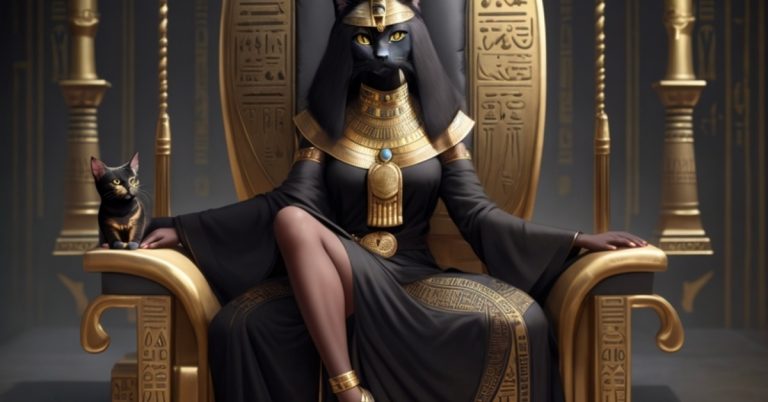
Beiwe: The Sami Goddess of the Sun
For the Sami, the sun has to be nursed back to health every winter.
Through the darkest weeks of the polar night, families smeared fat on their doorposts, an offering meant to feed the sun back to strength while she lay ill somewhere below the horizon. When she finally cleared the sky again, people went outside and bowed to her. It’s literal ritual logic behind Beiwe, the Sami goddess who is as much the sun itself as she is its ruler, not a metaphor for hope.
Beiwe belongs to the Sami, the Indigenous people of Sápmi, a region spanning what’s now northern Norway, Sweden, Finland, and Russia’s Kola Peninsula. Her name is also written Beaivi, Bievve, Beivve, or Biejje depending on the Sami dialect, and in all of them it carries a second, older meaning: it’s simply the word for “sun.”
Overview of Beiwe
That double meaning does real work. In traditional Sami religion, an animist framework in which rocks, rivers, and animals all carry their own spirit, many deities were never fully separated from the natural forces they represent. Beiwe is the clearest case of it: she and the sun are close to being the same thing wearing one name, not a distinct figure ruling it from a heavenly court the way Amaterasu presides over hers.
That makes her central to Sami survival in a concrete way. North of the Arctic Circle, the sun disappears for weeks at a time in winter. Beiwe is credited with fertility, the return of spring, and the health of the reindeer herds the Sami economy depended on. More strikingly, she’s credited with sanity itself: Sami tradition held that the depression and psychological distress of the sunless winter, what a modern clinician might recognize as seasonal affective disorder, eased only with her return, and prayers for the mentally ill accompanied her reappearance every year.
Titles
- Beiwe, Beaivi, Bievve, Beivve, or Biejje, regional dialect spellings of the same name
- Piäiváš, the form used in Inari Sami
- The sun itself, in most of the languages that name her
Abilities
- Ends the dark season and restores fertility to plants, reindeer, and people
- Tied to sanity and psychological healing, specifically relief from the depression of the sunless winter
- Travels across the sky inside a carriage, or sometimes an open enclosure, built from reindeer horns and antlers
Legends associated with Beiwe
Most of what survives about Beiwe is ritual, not narrative myth in the Greek or Norse sense: what people did to keep her alive through the winter, and who else shows up beside her when she returns.
The sun that has to be nursed back to health
During the darkest months, the Sami believed Beiwe herself fell ill. Fat was smeared on doorposts through the winter as sustenance for her convalescence; once the days lengthened toward summer, the offering switched to butter, so she’d have the strength to climb higher in the sky. At the summer solstice, people wove rings out of leaves and hung them in her honor. This reads as maintenance, not decoration, performed on a deity who could not be assumed to recover on her own.
Beaivi-nieida, the daughter who treats what her mother causes
Beiwe travels with a daughter, called Beaivi-nieida in some sources and Biejjenniejte, “Daughter of the Sun,” in others, a dialect difference rather than two separate figures. She’s typically pictured as a beautiful woman crowned with reindeer antlers, and reindeer are said to flourish wherever she passes. The detail that complicates the tidy picture: older folklore sources describe her specifically as a goddess of medicine, one whose healing is aimed above all at illnesses the sun itself causes, conditions like snow blindness or heat sickness that come directly from prolonged exposure to her mother’s light. A warmth-bringing sun goddess whose own daughter’s job is to treat the damage that warmth does isn’t the uncomplicated, purely nurturing figure most quick summaries reach for.
Solstice rites: reindeer, ribbons, and rings
At the winter solstice, a white female reindeer was the preferred sacrifice to Beiwe, specifically female, and specifically not sacrificed in summer, when the Sami believed the flames of the offering fire might outshine the sun and offend her. If no white reindeer was available, white ribbons were tied to a substitute animal instead. The meat was threaded onto sticks bent into rings and tied with ribbons, an offering shape that echoes the sun’s own form. Porridge rich with butter was also left for Beaivi-nieida, whose goodwill kept the herds healthy until the next sacrifice was due.
One sun, two genders, and the company she keeps
Modern retellings default to treating Beiwe as straightforwardly female, but the older sources don’t agree on that. She’s usually described as feminine, but the same 19th- and 20th-century ethnographic accounts that record her rituals also note she was sometimes cast as male. That’s in the earliest written record, not a modern reinterpretation grafted on after the fact. It fits the animist logic above: when a deity and a natural force share one name, the deity’s gender turns out to be less fixed than a modern reader, used to sun gods and sun goddesses staying in their separate lanes, might expect.
She also isn’t alone in that pattern. Norse Sól and Baltic Saulė are both female sun goddesses of northern Europe who travel across the sky with a daughter at their side, carry solar wheel and ring imagery, and are honored at midsummer, Saulė by chariot and gold horses where Beiwe rides in reindeer horn. None of this points to one shared origin goddess; the three traditions are culturally distinct and the resemblance may simply be what independent Arctic and sub-Arctic peoples arrive at when they build a religion around a sun that disappears for months at a time. It’s a resonance worth noting, not a claim about ancestry.
What Christianization tried to erase
Beiwe’s thin documentation is the direct result of a targeted campaign, not an accident of history.
In 1609, King Christian IV of Denmark-Norway issued a proclamation making the use of Sami drums, the primary instrument of Sami religious and shamanic practice, a crime punishable by death, prosecuted under witchcraft law. Between 1593 and 1695, more than 175 people were tried for witchcraft in Arctic Norway; at least 26 Sami were sentenced to death in the Finnmark trials alone. Missionaries organized raids across Sweden and Denmark-Norway through the 17th and 18th centuries to seize and burn the drums outright. The missionary Thomas von Westen, who led many of these campaigns, called the drums “the Bible of the Sámi,” and meant it as a reason to destroy them. One confiscated drum, taken by force from a noaidi named Anders Paulsen in 1691, wasn’t returned to the Sami people until March 2022, more than 330 years later.
The drums carried the cosmology, including whatever fuller stories once surrounded Beiwe, and they were the first thing targeted. What partial record survives in writing came from outside the tradition and arrived late: the Lutheran pastor Lars Levi Laestadius spent the 1838–1845 fieldwork seasons compiling Sami folklore into what became Fragments of Lappish Mythology, but the manuscript went missing after his death and wasn’t published in English until 2002, more than 150 years after he wrote it. Compared to a figure like Freya, whose myths survive in poems written down within a few centuries of their telling, Beiwe’s fuller story didn’t get the chance to reach paper before the people who could tell it were being prosecuted for doing so.
Beiwe today
Beiwe shares the tradition with a cluster of female deities tied to the practical work of survival: Máttaráhkká, who receives a child’s soul before birth, her daughter Sárahkká, protector of pregnant mothers, and Uksákká, who guards the household threshold. Where those goddesses govern the household and the body, Beiwe governs the condition every household in Sápmi depended on to function at all: daylight. Her worship functioned as infrastructure, not seasonal flourish, in a place where the sun’s return decided whether people survived the year.
Final thoughts
Beiwe is a goddess whose gender wasn’t fixed, whose own daughter’s role includes treating harm she herself causes, and whose fullest surviving account sat unpublished in a foreign language for a century and a half after it was written, not because nobody was interested, but because the instruments that once carried her stories were, by royal proclamation, illegal to own. She’s a sun goddess defined as much by what had to be fought to keep her, and what was still lost anyway, as by the light itself.
Sources:
- Beaivi. Wikipedia.
- Biejjenniejte. Wikipedia.
- Fragments of Lappish Mythology. Wikipedia.
- Noaidi. Wikipedia.
- Sámi drum. Wikipedia.
- Anders Paulsen. Wikipedia.
- The Hidden History of Norway’s Finnmark Witchcraft Trials. Smithsonian Magazine.
- Sol, Beiwe and Saule: Northern Sun-Goddesses. We Are Star Stuff.
- Beaivvi The Sun Goddess of the Sápmi. Niina Pekantytär, Medium.
- Sami deities. Chalquist.com.