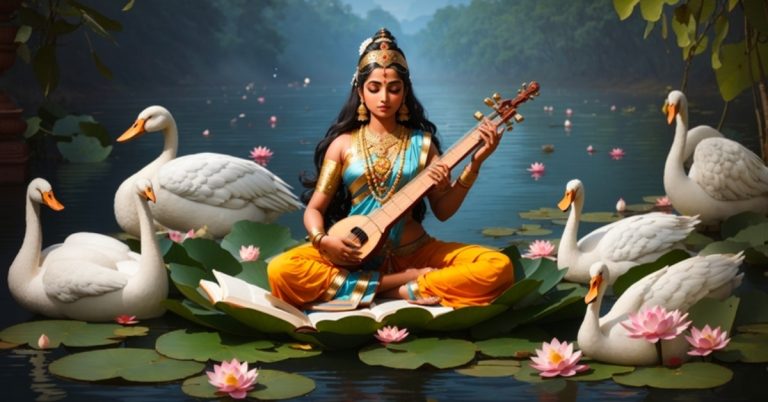
Radha: Hindu Goddess of Love and Devotion
A flute starts up somewhere in the dark forest, and every woman in the village sets down whatever she’s holding.
That’s the sound Radha answers. She’s the cowherd girl of Vrindavan who loved the god Krishna so completely that Hindu tradition came to rank her beside him, and in some temples above him. People in her home country still greet each other with her name, twice over: Radhe Radhe.
The god’s name comes second. This is the story of why.
Overview of Radha
Radha, also called Radhika and Radharani (“Queen Radha”), is the beloved of Krishna, the eighth avatar of Vishnu. Her home is Braj, the cattle country around Mathura in northern India, and one village above all: Barsana, where she was born, and where the Shriji temple still crowns the hill.
She’s the chief of the gopis, the cowherd women who fell in love with Krishna during his youth among the herds, and she rules the territory that love opens up: devotion, longing, the joy of union, and the ache of separation. In the Vaishnava traditions that grew up around her, the love between Radha and Krishna is the pattern of bhakti, the soul’s passionate attachment to God, and Radha is the soul who loves best.
Her name in Sanskrit means success, prosperity, and perfection, which set her on the road to being identified with Lakshmi, Vishnu’s consort, whose earthly form she’s said to be. The theologians went further. To the followers of Chaitanya she is Krishna’s hladini shakti, his own power of bliss, walking beside him as a separate person so that he can taste his own sweetness. Radha and Krishna together are one divine reality, and when the pair is named, hers goes first.
Her great festival is Radhashtami, her birthday, in late summer.
Titles
- Radharani (“Queen Radha”)
- Radhika
- Shriji, the name under which Barsana worships her
- Vrishabhanu-nandini (“daughter of Vrishabhanu”)
- Raseshvari (“queen of the rasa dance”)
- Kishori (“the young girl”)
- Madhavi, the feminine of Krishna’s title Madhava
Characteristics
How Radha tends to be shown in art:
- Golden-fair, set against Krishna’s dark blue
- Young, at the age when a cowherd girl would be dancing in the moonlight
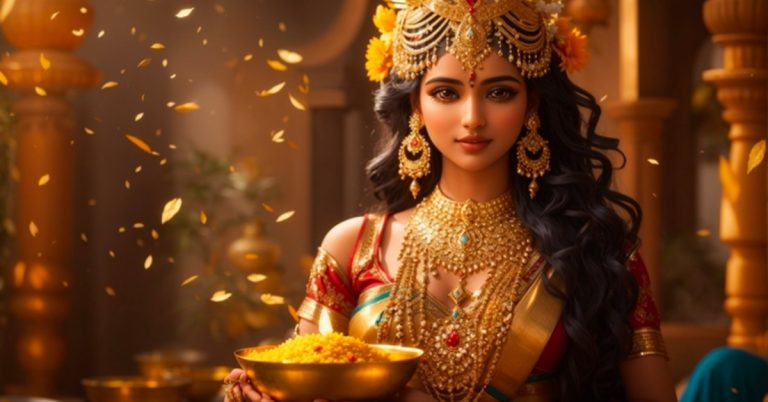
- Dressed in a bright sari, often red or blue, with a veil and heavy gold jewelry
- Standing at Krishna’s left in temple images, hands folded or holding a lotus
- Lotus-shaped eyes, the look behind the famous Bani Thani painting of Kishangarh
- Sometimes merged with Krishna into a single figure, half her, half him
Abilities
- Perfect devotion — the bhakti every other devotee measures themselves against
- Bliss — as hladini shakti, she is the power by which the god feels joy
- Intercession — devotees ask her to bring them to Krishna, since he refuses her nothing
- Mastery of the dance — queen of the rasa-lila
- Endurance in separation — her viraha, the longing that became a spiritual path
Symbols
- The lotus — purity, and the flower she was found in
- The flute — Krishna’s, but it calls her; in some paintings she holds it herself
- The peacock feather — Krishna’s crest, worn by her in devotion
- The full moon of autumn — the night of the great dance
- Radha Kund — the pond at Govardhan dug by her own hands
- Gold and blue — her color and his, the pairing that means “the two of them”
Traits
- Loves without reserve, and without thought of return
- Proud when slighted; her maan, her wounded and sulking pride, has its own name in the poetry
- Loyal past all reason, waiting a lifetime for someone who never comes back
- Generous to the other gopis who share her longing
- Free, choosing Krishna outside every social bond, and honored by the tradition for exactly that
Festivals and Rituals
The heart of Radha’s worship is Radhashtami, her appearance day, on the eighth day of the bright fortnight of the month Bhadrapada, which falls in August or September. Devotees fast until noon, then bathe the image of Radha in milk and honey and dress her in new clothes, and Barsana fills with pilgrims climbing the hill to the Shriji temple. The date lands fifteen days after Krishna’s own birthday, Janmashtami, so the two are kept as a pair.
Holi belongs to her too. The story goes that the boy Krishna complained to his mother that Radha was fair while he was dark. His mother, teasing, told him to smear color on Radha’s face until she matched. He did, and the Holi of Braj has been a color fight between Radha’s village and Krishna’s ever since. At Lathmar Holi the men of Nandgaon march on Barsana with colors, and the women of Barsana meet them with sticks and drive them out, exactly as Radha and her friends are said to have done.
Beyond the festivals, there’s the everyday practice. In Braj, “Radhe Radhe” is hello, goodbye, and thank you. Temples of the Radha-Krishna traditions dress and feed the divine couple through the day, and on Sharad Purnima, the full moon of autumn, they keep the night of the dance.
Legends associated with Radha
Radha’s stories come from many sources over many centuries, and they disagree with each other freely. But they circle the same center: a girl who loves a god, a god who leaves, and a love that turns out to be stronger than the leaving.
The girl in the lotus
In the oldest heaven, Goloka, before there was a Vrindavan, Krishna wished to know his own bliss. So says the Brahma Vaivarta Purana: Radha stepped out of his left side, whole and grown, his delight in the form of a woman. When he came down to earth as a cowherd, she came too.
The tradition of Braj tells it more tenderly. Vrishabhanu, the headman of a cattle village, went to bathe in the Yamuna one morning and found a baby girl lying in a lotus on the water, shining. He carried her home to his wife Kirtida, and they named her Radha. The child was perfect in every way but one. She kept her eyes shut.
Days went by. Then Nanda and Yashoda came visiting from the next village with their own new baby, a dark-skinned boy called Krishna, and set him down beside her. Radha’s eyes opened. She had been waiting, the story says, so that the first thing she ever saw would be him.
Her birthplace is given as Raval, across the river from Mathura, though Barsana claims her as its own, and the hilltop there is where the pilgrims go.
The dance under the autumn moon
She grew up, and so did he. On the night of the autumn full moon, when the forest of Vrindavan was white with light, Krishna went to the riverbank and played his flute.
The Bhagavata Purana tells what happened next. The gopis heard it. Every one of them stopped what she was doing, milking, cooking, nursing a child, serving a husband, and went, leaving the work half done. Krishna met them in the forest and told them to go home. They refused. And so he danced with them, the rasa-lila, the great circle dance, and by his power he multiplied himself so that between every two women there was a Krishna, and each one believed he danced with her alone.
Then a strange thing happened. Krishna vanished, and one gopi vanished with him. The others searched the forest, following two sets of footprints, and grieved that he had chosen one of them over all the rest. “Surely she has worshiped him best,” they said. The favorite, meanwhile, grew proud, and asked Krishna to carry her because she was tired. He disappeared, and left her weeping.
The Bhagavata never gives that gopi a name. Tradition has no doubt at all. She is Radha, and her pride, her maan, is the first appearance of the flaw that makes her a person. Krishna came back, in the end, to all of them. But the woman he took aside is the one the poets remembered.
The pond she dug with her bangles
One day a demon in the shape of a bull, Arishta, came charging through the pastures, and Krishna killed him. It should have been a triumph. Instead Radha turned away. Killing a bull, she said, was a sin, even for him, and he would have to bathe in every holy river on earth before she touched him again.
Krishna struck the ground with his heel and called every sacred river to a single pool, then bathed. Radha was unimpressed. If he could make a pond, she could make a better one. With her friends, using nothing but their bracelets, the gopis dug a second pool beside the first and filled it, the story says, with water the rivers themselves offered her.
Both ponds still exist at Govardhan. Shyama Kund is his. Radha Kund is hers, and for the followers of Chaitanya it is the holiest place on earth, the one spot where Radha’s love touches ground.
The night of the sulking
The story the tradition loves best is the one the poet Jayadeva told in the twelfth century, in the Gita Govinda.
It’s spring in the forest, and Krishna is playing with the other gopis. Radha sees him, and her heart breaks. She retreats to a bower by the Yamuna, and there her friend, her sakhi, finds her, sick with jealousy and desire, describing over and over what she saw. The friend goes to Krishna and tells him what Radha is suffering. Krishna, in his turn, is miserable, and sends the friend back begging Radha to come to him. She refuses. Her maan has her by the throat.
The night wears on. The friend carries messages back and forth. At last Krishna comes to Radha himself, and the god of the universe does something startling for a god. He begs. He tells her that her anger burns him worse than any poison. He asks her to place her foot on his head, to prove she has forgiven him.
There’s a legend about that line. Jayadeva wrote it, then lost his nerve. God asking a cowherd girl to step on his head was too much, and he went to bathe before deciding. When he came back the verse was already written into his manuscript, in his own hand. His wife told him he’d come home an hour ago and done it himself. It was Jagannath, the lord of Puri, who had walked in wearing the poet’s face to finish the poem. The Gita Govinda has been sung in the Jagannath temple every night since.
Radha relents. The lovers reunite. And Jayadeva ends his poem with Radha, in bed, playfully ordering Krishna to fix her hair and put her jewelry back on. She commands. He obeys.
The chariot to Mathura
This is the story that gives Radha her deepest meaning, and in it almost nothing happens.
Krishna’s uncle Kamsa, the king of Mathura, had sought his death since before he was born. Now he sent a chariot to bring the boy to the city, and Krishna, who had a kingdom to overthrow, got in. The gopis blocked the road, then followed the wheels as far as they could run. Then the dust settled, and he was gone.
He never came back. He killed Kamsa, freed his parents, took a throne, fought wars, married queens, and counseled Arjuna on the field of Kurukshetra. Vrindavan stayed behind him, and Radha stayed in it.
The Bhagavata says he sent his friend Uddhava with a message. Uddhava, a philosopher, arrived expecting to console the gopis with wisdom, and found instead women who spoke to bees because the bees had been near Krishna, who had forgotten to eat, and who asked him only whether Krishna still remembered the forest. Uddhava went home a changed man, praying to be reborn as a shrub in Vrindavan so that the dust from a gopi’s feet might fall on him.
Years later there was a meeting. During a solar eclipse the whole of India gathered at Kurukshetra, and Krishna, now a king among kings, saw the people of Braj in the crowd. The gopis, the Bhagavata says, embraced him with their eyes, and asked for nothing except that he stay in their hearts. Later poets gave that meeting to Radha, and made it the last time she saw him. He offered to bring her to his palace. She declined. The Krishna she loved carried a flute, and he’d left it in the forest.
This is viraha, love in separation, and the Bhakti traditions decided it was higher than union. The soul that has God is content. The soul that longs for him burns, and the burning is the love. Radha waiting in Vrindavan is the image of every devotee who has ever felt the absence of the divine and gone on loving anyway.
An older Radha?
Follow Radha back through the texts, and she gets fainter the earlier you go.
The Bhagavata Purana, the great scripture of Krishna’s life, tells the rasa-lila in full and never says her name. Neither does the Vishnu Purana, the Harivamsa, or the Mahabharata. The gopis are there, and one gopi is singled out, but she’s anonymous. Radha’s first sure appearance is somewhere else entirely, in a collection of Prakrit love poems called the Gaha Sattasai, attributed to the Satavahana king Hala and dated by scholars anywhere from the first to the fourth century CE. One verse addresses Krishna directly: as you blow the cow-dust from Radha’s face, it says, you take the glory from all the other milkmaids. That’s the whole reference. She’s a village girl in a village poem, and the dust on her face is real dust.
Over the next thousand years she surfaces here and there, always briefly: a line in Bhatta Narayana’s play Venisamhara around 800 CE, then a citation in Anandavardhana’s treatise on poetry a century later. The Prakrit and Apabhramsha poets knew her, and the Tamil saints of the south sang of a cowherd bride of Krishna called Nappinnai who looks a great deal like her. Then, in the twelfth century, Jayadeva put her at the center of the Gita Govinda and gave her a jealousy, a voice, and half the poem, and scholars from Barbara Stoler Miller on have called that the moment Radha became Radha. Within a few generations the theologian Nimbarka had made her Krishna’s eternal consort, the Brahma Vaivarta Purana had written her origin from Krishna’s own side, the Padma Purana had named her an incarnation of Lakshmi, and the Devi-Bhagavata had folded her into the supreme Devi. By the time Chaitanya walked Bengal in the sixteenth century, weeping for Krishna in Radha’s own voice, she was the center of a theology, and his followers came to believe that Chaitanya himself was Radha and Krishna in one body. A generation later the Radha Vallabh school of Vrindavan dropped Krishna from the top of the altar and worshiped her alone.
Devotees and historians read this record in opposite directions. To Gaudiya commentators, the Bhagavata‘s silence is deliberate: the sage who narrates it hid her name because her love was too intimate to speak aloud, and the unnamed gopi is proof of her, the way a closed door is proof of a room. To historians of religion, the trail runs the other way. A cowherd girl from the folk poetry of the Deccan and the Ganges plain was taken up by court poets, then by mystics, then by theologians, and by the end she had been raised from a milkmaid with dust on her cheek to the bliss-power of God. Both readings agree on one thing. However she started, the tradition looked at the love between a village girl and a god and decided it was the truest thing it knew.
Radha across cultures
The Hindu tradition already holds Radha up against other women, and the comparison is the point.
Sita, the wife of Rama, is the other great heroine of Vishnu’s avatars, and she loves inside marriage, through exile and fire and abandonment, the pattern of the faithful wife. Parvati won Shiva by sitting in austerity on a mountain until the god came to her. Radha did neither. She and Krishna are traditionally unmarried, and the Gaudiya school prizes that, calling it parakiya, love outside the social bond, and ranking it above the married love of Sita or of Krishna’s own queens. A wife’s love is owed. Radha’s is given, at a cost, with nothing to hold it in place but itself, and the theologians decided that made it the purest thing a soul could offer.
That decision has cousins everywhere. The Sufi poets of Persia sang of the soul as the lover and God as the beloved, and told the story of Majnun, who went mad in the desert for Layla and found in his madness a road to God. Jewish and Christian readers took the Song of Songs, a bride’s love poem to her absent lover, and read it for two thousand years as the soul calling after the divine. In every case the human love is passionate, unsanctioned, and unresolved, and in every case the longing itself is the ladder. Radha climbed it first in India. Wherever people have believed that God can be loved as well as obeyed, someone has stood in her place at the edge of the forest, listening for a flute.
Final thoughts
Krishna leaves. That’s the plot, and it’s the part that makes Radha a goddess.
Anyone can love in the moonlight with the god standing in front of them. Radha loved him for the rest of her life from a village he never revisited, and the tradition took one look at that and put her name ahead of his. She’s the patron of the part of us that keeps loving after the answer stops coming, and she says that part is the best thing in us, the piece that sits closest to the divine. So here’s the question she leaves at the edge of the forest: when the thing you love goes silent, what does your love become?
Bibliography
- “Radha”, “Radha Krishna”, and “Gaudiya Vaishnavism”. Wikipedia.
- “Gita Govinda” and “Gaha Sattasai”. Wikipedia.
- “Radhashtami” and “Lathmar Holi”. Wikipedia.
- “Radha” and “Jayadeva”. Encyclopaedia Britannica.
- Miller, Barbara Stoler, trans. Love Song of the Dark Lord: Jayadeva’s Gitagovinda. Columbia University Press.
- Hawley, John Stratton, and Donna Marie Wulff, eds. The Divine Consort: Radha and the Goddesses of India. Beacon Press.
- Schweig, Graham M. Dance of Divine Love: The Rasa Lila of Krishna from the Bhagavata Purana. Princeton University Press.
- Bhagavata Purana, Canto 10: chapters 29–33 (the rasa-lila), chapter 47 (Uddhava and the gopis), and chapter 82 (the meeting at Kurukshetra). Trans. via Vedabase.
- Babaji, Satyanarayana Dasa. “Why Radha Is Not Mentioned in Bhagavata Purana”. Jiva Institute.