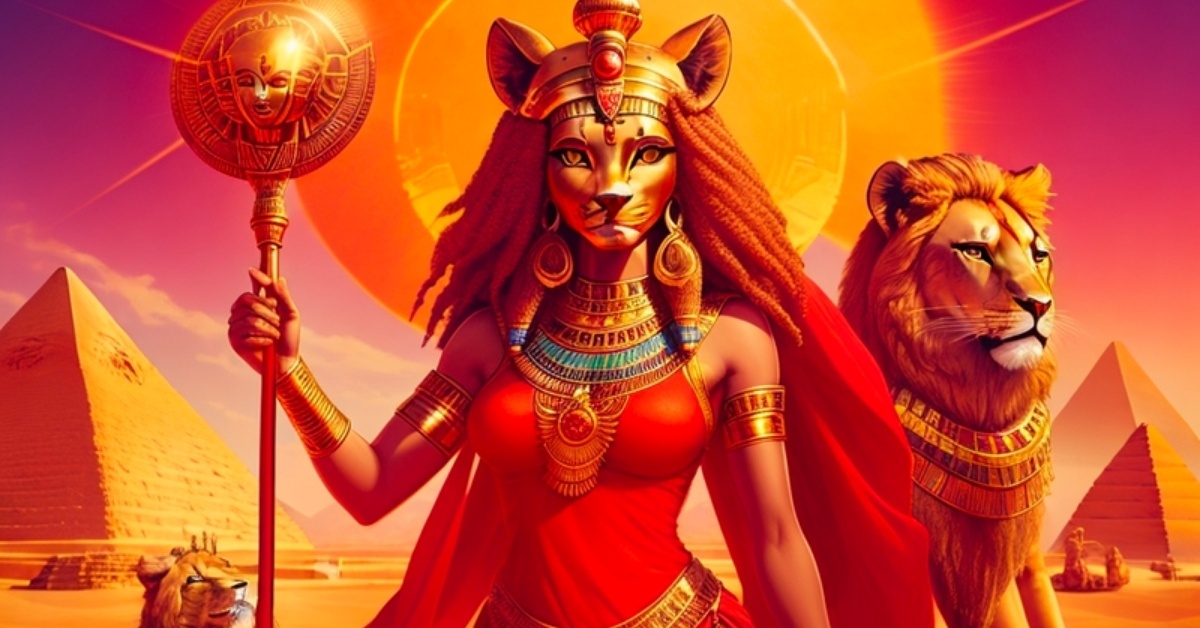
Sekhmet: Goddess of Destruction and Healing
Sekhmet shows that destruction and healing can live in the same body.
She is the lioness daughter of the sun, the burning desert wind given a face, and the force the Egyptians both feared and begged for mercy. Her name comes from sekhem, the word for power, and she spends every myth proving it. When her rage once nearly wiped out humankind, it took a flood of blood-red beer to stop her. And when she finally woke from it, the same power that had been killing turned to healing.
She is one of the oldest and most formidable deities in Egypt, worshipped for thousands of years, and still called on today by anyone learning to turn their anger into something that mends.
Overview of Sekhmet
In ancient Egyptian belief, Sekhmet is the daughter of Ra, the sun god, and one of his most powerful weapons. She is a war goddess and a plague goddess, the scorching heat of the midday sun, and, at the very same time, a goddess of healing.
She is usually shown as a woman with the head of a lioness, crowned with the sun disc that marks her as Ra’s daughter and his protector. The Egyptians called her the Eye of Ra, the part of the sun god that goes out to punish his enemies and defend what is his.
In the city of Memphis she was the wife of Ptah, the craftsman-god who shaped the world, and the mother of Nefertum, the young god of the lotus. The three of them together form the Memphite triad, one of the most important divine families in Egypt.
Her great celebration was the Festival of Drunkenness, held at the start of the year, when Egyptians drank, danced, and made music to soothe her wildness into calm.
Titles
- The Powerful One (from sekhem, “power” or “might”)
- Lady of Flame, She Who Breathes Fire
- The Eye of Ra
- Mistress of Dread, Lady of Terror
- Lady of Life, and Goddess of Healing
- She Who Loves Ma’at, the protector of law and order
- The Red Lady
Characteristics
How Sekhmet is pictured:
- The body of a woman and the head of a lioness
- Crowned with the sun disc and the uraeus, the rearing cobra of royalty
- Robed in red, the color of blood and of the desert at sundown
- Often holding an ankh, the sign of life, or a papyrus scepter
- Her hot breath imagined as the desert wind, her body as the burning sun
- Paired with the gentle, cat-headed Bastet, her calmer mirror image
Abilities
- Fire: her breath is flame, and the killing heat of the desert sun is hers
- Plague: she sends sickness, her arrows and messengers carrying disease
- Healing: the same hand that sends plague can lift it, and her priests were among Egypt’s first physicians
- War: she goes before the pharaoh into battle and burns his enemies
- Guardian of Ma’at: she enforces the order and law that hold the world together
Symbols
- The lioness: fierce, untamed power
- The sun disc and uraeus: her descent from Ra
- The color red: blood, and the desert sky at dusk
- The ankh: the life she can give or take
- Blood-red beer: the drink that ended her rampage, from her most famous myth
- The hot desert wind: how her plagues were said to travel
Traits
- Ferocious and fearless, almost impossible to command once roused
- Fiercely just, an enforcer of law and order
- Loyal and protective toward those who honored her
- Genuinely dangerous when disrespected or crossed
- A healer at her core, which is how she is most loved today
Festivals and Rituals
Sekhmet’s biggest festival grew straight out of her most famous myth. At the Festival of Drunkenness, held at the start of the year, Egyptians drank great quantities of beer and wine, danced, and played music, deliberately re-enacting the drunkenness that once calmed the goddess before she could destroy the world.
It was not a small affair. Tens of thousands took part, from priestesses to ordinary people to doctors. The archaeologist Betsy Bryan of Johns Hopkins University, excavating the Temple of Mut at Luxor, presented evidence of these rites in 2006, including a “Porch of Drunkenness” added to the temple by the pharaoh Hatshepsut. The festival mixed revelry and worship without apology. Getting drunk was how you met the goddess and asked her to stay gentle.
Legends associated with Sekhmet
Sekhmet’s stories circle one idea. Power without a limit will devour even the thing it set out to protect, and the way back is never more force.
The Destruction of Mankind
This is her defining myth, preserved in the ancient text known as the Book of the Heavenly Cow.
Ra, the sun god, had grown old, and humankind had grown disrespectful, plotting against him and abandoning the laws of Ma’at. So Ra sent out his Eye to punish them. He took the goddess Hathor and sent her to earth as a lioness, and in her fury she became Sekhmet, the Powerful One.
She fell on the world like fire. But rage, once it has tasted blood, forgets how to stop. The fields ran red, and Sekhmet kept killing. Even Ra, who had ordered the punishment, was horrified by how far it went and told her to stop. She could not hear him.
So the gods made a plan. They brewed seven thousand jars of beer and dyed it blood-red with ochre, then poured it across the fields in the night. When Sekhmet came at dawn, she saw a world that looked drowned in blood and drank deep, believing it was exactly that. She drank until she was too drunk to kill, and she slept. When she woke, the rage was gone. Humanity had been spared, and the destroyer had turned gentle.
The lotus and the Memphite triad
There is a softer side to Sekhmet that the war stories tend to bury.
In Memphis she was the wife of Ptah, the great craftsman-god who shaped the world on his potter’s wheel. Their son was Nefertum, the god of the blue lotus and of perfume, who was said to have risen out of the first waters at the very dawn of creation. Father, mother, and child together made the Memphite triad, one of Egypt’s holiest families.
It is a quiet, telling detail. The goddess of slaughter is also half of a family built around creation, and the mother of the god of the lotus and sweet scent. Some older texts give her another son as well, Maahes, a lion-headed god of war who clearly took after his mother. Destruction and tenderness were never separate in her. They were the same goddess.
The Mother of the Pharaohs
From the Pyramid Texts, Egypt’s oldest sacred writings, Sekhmet is bound to kingship. The pharaoh was said to be conceived by her and nursed on her milk, and to carry her fury with him into war. To be Sekhmet’s child was to inherit her power and her right to rule.
Because she loved Ma’at, the order and justice that kept the world from chaos, her bond to the throne was also a bond to justice. A king who claimed Sekhmet as his mother was claiming the duty to uphold the law, not only the strength to enforce it.
The goddess who guarded against plague
Here is where Sekhmet’s two faces meet. Because she could send disease, the Egyptians believed she could also take it away, and they built an entire healing practice around staying in her favor.
Her priests, the wab-priests of Sekhmet, were among the earliest physicians in Egypt, named in the medical handbook called the Ebers Papyrus right alongside the ordinary doctors. As far back as the Old Kingdom, they inspected the meat served at festivals to keep sickness from spreading, one of the first times anyone understood that disease could pass from animals to people.
When a wave of plague swept the region during his reign, the pharaoh Amenhotep III raised around six hundred granite statues of Sekhmet, a litany in stone begging her to lower her arrows and spare his people. Hundreds of them survive, and they are why so many museums today hold a seated, sun-crowned lioness staring calmly back.
The Eye of Ra and her many faces
The Destruction of Mankind is really one episode in a much older and wider story, the one usually called the Distant Goddess. In it, the fiery daughter of the sun, sometimes Sekhmet, sometimes Hathor, sometimes the lioness Tefnut, grows enraged and storms off into the deserts of Nubia, where she rampages as an untouchable lioness. The sun god cannot rule without her, so he sends Thoth, the god of wisdom, to coax her home with stories and flattery. Step by step she is soothed, and as she crosses back into Egypt her fury cools into blessing: the lioness softens into the gentle Hathor, the river rises, and the land turns green again. Read this way, Sekhmet’s calming by the blood-red beer is not a one-time trick but a single beat in a pattern the Egyptians told again and again, the dangerous power that has to be welcomed home before it can give life.
Some interpreters see an even older layer underneath her, a single lioness-and-sun goddess whose opposite moods were eventually given separate names. In this telling Sekhmet was born as the fierce face of Hathor, with the cat-headed Bastet standing as her gentle twin, the same power smiling instead of snarling. Over the centuries the faces kept merging and dividing. She took on the attributes of Mut, the mother goddess of Thebes, who could herself appear as a lioness, until the lines between Sekhmet, Bastet, Mut, and Hathor blurred into one another. It is a reminder that these may never have been quite separate goddesses so much as different weather over the same fierce, life-giving sun.
Sekhmet across the world
Sekhmet never really left.
Of all her titles, the one that outlived the rest is Goddess of Healing. Modern practitioners work with her precisely to move through rage and fear and come out calm on the other side, which is the exact arc of her own myth. Her hundreds of statues stand in museums around the world, from the Met in New York to the British Museum to the Egyptian Museum in Turin, still wearing the sun on their heads. She appears in novels, games, and films as the lioness of war.
For a goddess who began as almost pure destruction, it means something that the world chose to remember her, in the end, as the one who heals.
Final thoughts
Sekhmet lasts because she tells the truth about power.
The same force that can level a city can also defend it. The same fury that nearly ended the world became, after rest, the thing that healed it. She does not ask you to trade your fierceness for gentleness, or to pretend your anger away. She shows you that the fire in you is not the problem. Stopped, rested, and turned in the right direction, even your fiercest anger can be turned to healing.
Bibliography
- “Sekhmet”. World History Encyclopedia.
- “Sekhmet”. Encyclopaedia Britannica.
- “Statue of the Goddess Sakhmet”. The Metropolitan Museum of Art.
- “The Statues of Sekhmet: ‘Mistress of Dread'”. American Research Center in Egypt.
- “Johns Hopkins Expert Discusses Ritual Public Drunkenness in Ancient Egypt”. Johns Hopkins University.
- “From Shamans to Priests of Sekhmet: The Origins of Doctors in Ancient Egypt”. PMC.
- “Sekhmet”. Ancient Egypt Online.
- “Sekhmet”. Wikipedia.
- “The Eye of Ra”. Wikipedia.
- “Hathor”. Wikipedia.