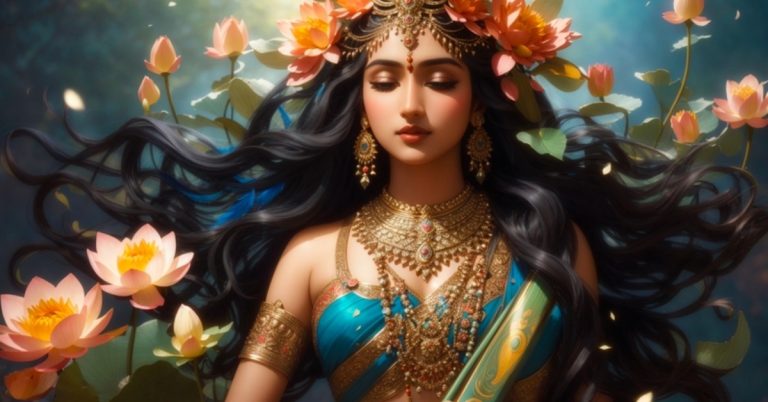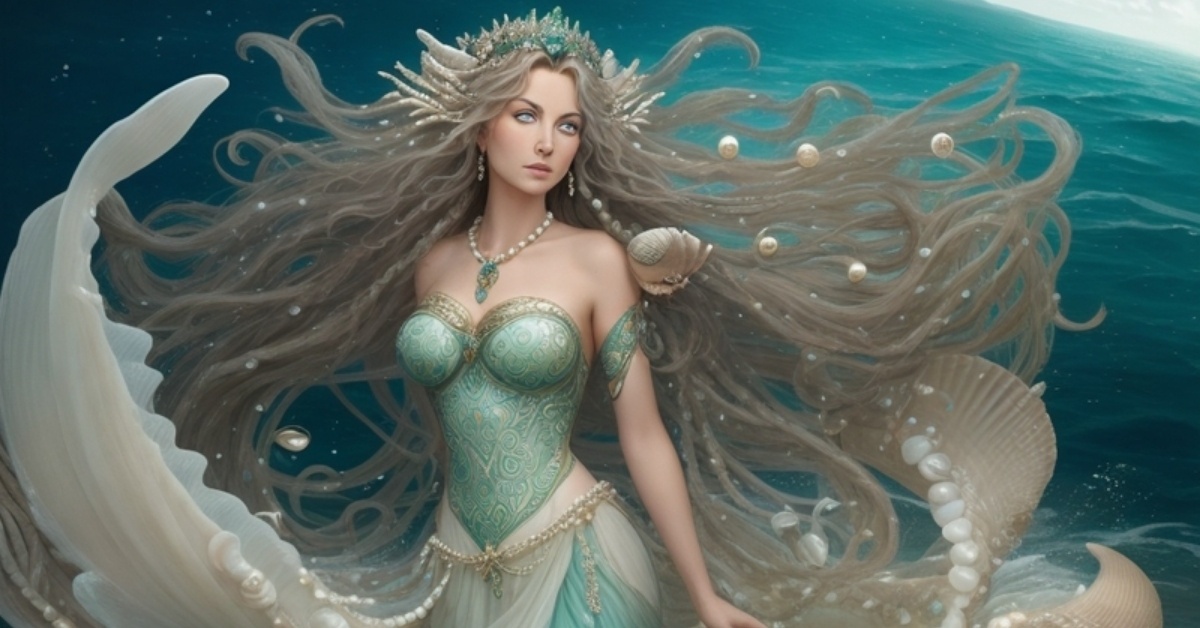
Cliodhna: Irish Goddess of Love, Beauty, and the Sea
The tide at Glandore has a woman’s name.
Twice a day it comes up the harbor in County Cork, and for the better part of a thousand years the people on that shore have called it Tonn Chlíodhna, Clíodhna’s Wave, after the goddess it took. She had left the otherworld for a man. He went hunting. She fell asleep on the sand, and the sea came for her.
That is one Clíodhna. There’s also the queen of the banshees of Munster, the fairy woman of the MacCarthys, and the voice that made the Blarney Stone worth kissing. They’re all the same woman, and how the first turned into the rest is the real story.
Overview of Cliodhna
Clíodhna (pronounced KLEE-uh-nuh, and spelled Clídna, Clíona, or Cleena depending on the century) is one of the Tuatha Dé Danann, the divine race of Irish myth who withdrew into the hills and became the people of the sídhe, the fairy mounds. The medieval texts make her the daughter of Gebann, chief druid to the sea god Manannán mac Lir, and give her a home in Tír Tairngire, the Land of Promise, one of the names for the Irish otherworld across the western sea.
She’s a goddess of love and beauty first. Every version of her agrees on that, from the twelfth-century poets who called her Clíodhna Cendfind, “fair-headed,” to the Cork storytellers who warned that a beautiful stranger on the shore might be her. Men fall for her. She falls for them. It rarely ends well for anyone.
Her country is South Munster, the old kingdom of Desmond, and above all County Cork. Her palace is Carrigcleena, “Clíodhna’s Rock,” a ring of rough stones on a green hill in the parish of Kilshannig a few miles southwest of Mallow. Her wave is at Glandore. Her families are the MacCarthys, the O’Keeffes, and a handful of other old houses of the south, who claimed her as their bean sí, the woman of the mounds who keens when one of them is about to die. That is where the title “queen of the banshees” comes from, and why the name of a love goddess ended up attached to a wail in the night.
Titles
- Clíodhna Cendfind (“fair-headed,” her epithet in the Dindshenchas)
- Queen of the Banshees
- Queen of the Fairies of South Munster
- Clíodhna of Carrigcleena
- Clíodhna of the Wave (Tonn Chlíodhna)
- Bean sí of the MacCarthys
Characteristics
How Clíodhna is described in the stories:
- A woman of striking beauty, fair or golden-haired
- Young, and dressed as a woman of the otherworld, which in Irish tales means finer than anything mortal
- Attended by three bright-colored birds whose song puts the sick to sleep
- In older Munster tradition, able to appear as a wren or a white hare
- In later folklore, a lone beautiful stranger met on the shore or near her rock, usually by a young man who is seen again rarely, if at all
Abilities
- Love and enchantment — she chooses her lovers, mortal or otherwise, and they rarely refuse
- Healing — her three birds eat apples from an otherworld tree, and their song cures sickness
- Shapeshifting — the wren and the white hare, both creatures with old ties to Irish magic
- Foretelling death — as banshee she keens for the great families before the blow falls
- Protection of the land — early tradition has her guarding crops and cattle from blight and the evil eye
- Eloquence — the gift she is said to have handed the MacCarthys, and through them the Blarney Stone
Symbols
- The wave — Tonn Chlíodhna at Glandore, one of the three great waves of Ireland
- Three bright birds — her companions from the Land of Promise
- Otherworld apples — the food that gives the birds their healing song
- The rock — Carrigcleena near Mallow, her fairy palace
- The Blarney Stone — the stone she pointed a MacCarthy toward, in the story the castle still tells
Traits
- Passionate, and willing to give up the otherworld for love
- Jealous when crossed, as her rival Aoibheall found out
- Fiercely loyal to her chosen families
- Dangerous to the men she wants, even when she means them no harm
- Tied to place: a goddess you meet at a specific rock, on a specific shore
Festivals and Rituals
Clíodhna’s worship lived in the landscape, which is how much of Irish religion survived once the old gods became the fairies. The record holds no calendar festival for her and no temple; it holds a rock, a wave, and a stone.
Carrigcleena was treated as a fairy fort, a place people left alone: unplowed, undug, and avoided after dark. The wave at Glandore was listened to. A loud Tonn Chlíodhna on a still night was read as a warning, and Munster tradition held that the three great waves of Ireland roared when a king was in danger. The MacCarthys and O’Keeffes had her keening as their family death-omen, which is a ritual of a kind, one nobody asked for.
Today her most-visited shrine is a slab of limestone set into the battlements of Blarney Castle, kissed by thousands of people a year, few of whom know her name. Modern pagans who honor her tend to do it at the sea, with the things she’s associated with: apples, birdsong, and salt water.
Legends associated with Cliodhna
Her stories come from two layers. The medieval texts, the Dindshenchas and the Acallam na Senórach, tell one tale about her: how she left the otherworld and how the wave got her name. Everything else, the banshee, the rock, the rivalry, the Blarney Stone, comes from the folklore of County Cork, collected over the last few hundred years. Both layers are hers, and they are different enough to be worth telling apart.
The three birds of the Land of Promise
Before she ever came to Ireland, Clíodhna lived in Tír Tairngire, the Land of Promise, where everyone stays young and the feasting goes on forever.
She had three birds there, and the storytellers never forgot them. They were brilliantly colored, one telling gives them plumage like a robin, a blue tit, and a goldfinch, and they fed on the apples of an otherworld tree. That fruit did something to their voices. When the birds sang, the sick fell asleep, and when they woke they were well.
The birds are a small detail with a long echo. Healing sleep brought on by otherworld music is the exact thing that will undo her. The same power that cures on her side of the sea becomes, on the Irish side, the sleep that holds her under.
Ciabhán of the Curling Locks
The Acallam na Senórach, the great medieval collection of Fianna tales, tells the love story in full.
Ciabhán was a prince of Ulster, a son of the king, and his trouble was that women loved him. The men of Ulster got tired of it and drove him out. He went to the Fianna, and the same thing happened there. So he took to the sea in a small boat, alone, and a storm caught him far from land.
Out of the storm came Manannán mac Lir, the sea god, riding the waves on horseback as if they were a plain. He took pity on the young man and carried him to Tír Tairngire, the Land of Promise, where a feast was in progress. Ciabhán won the hall with a feat of skill that outdid its own champion, and among the watching faces was Clíodhna, daughter of Manannán’s own chief druid, Gebann. She looked at the curling-haired stranger and decided.
They fled together. She left the Land of Promise in a boat with him, and they made landfall on the south coast of Ireland at Trá Théite, Teite’s Strand, the shore at Glandore. Ciabhán pulled the boat in, told her to wait, and went inland after deer.
He should have stayed.
Here the tellings split, and both are old. In the Acallam, the sea itself comes after her: a great wave rises over the strand, fills the boat, and drowns her where she lies. In the Dindshenchas, the medieval “lore of places,” a musician of the otherworld has a hand in it. Iuchna of the curling locks, one of Manannán’s people, finds her waiting in her boat of bronze and plays for her. The music is the healing sleep of her own country, and it takes her. She sleeps. Iuchna turns the boat. The wave comes.
The Dindshenchas poem says the wave had a name already, the Wave of Dún Téite, after an earlier woman drowned on that shore. From that day it took Clíodhna’s instead. The same wave, the poet adds, swallowed fifty ships of Manannán’s household, as if the sea god’s whole court had come to fetch her home and paid for it.
Whether Manannán sent the wave in anger, in grief, or simply because the otherworld keeps its daughters is something the texts leave open. The folk versions are less careful. In County Cork they’ll tell you plainly that it was Manannán’s music, and that he wanted her back.
The father’s curse
The second Dindshenchas poem gives the tragedy a different root.
In this version her father, called Genann, wants her kept. When Ciabhán comes for her and she steps into his boat, the old druid speaks a curse over the water: a wave will come, he says, “whose crest shall sparkle,” and it will find her wherever she lands. A storm drives the lovers ashore at Trá Théite, and the wave keeps its promise.
Same shore, same drowning, different meaning. In one telling the sea god’s court reclaims her. In the other, a father’s word does. Medieval Irish poets kept both on the page side by side and let them stand.
The wave that became her voice
Tonn Chlíodhna is one of the three great waves of Ireland. The other two are Tonn Rudraige at Dundrum Bay in County Down and Tonn Tuaige at the mouth of the Bann, and the triad turns up in Irish texts from the twelfth century on. When a true king was in danger, the story went, all three waves cried out at once.
That gives Glandore a strange double status. The wave is where the goddess died, and it is also her voice. Cork tradition holds that when the tide booms in the harbor on a calm night, it is Clíodhna, and that one day she will raise a wave big enough to swallow Munster. In the old poems she drowns. In the living folklore she goes under the water and comes back up at Carrigcleena as something else.
The queen at Carrigcleena
Seven miles southwest of Mallow, on a hillside in Kilshannig parish, there’s a ring of rough rocks around two acres of green ground. That is Carrigcleena, Clíodhna’s Rock, and for centuries it was the fairy palace of the queen of the Munster sídhe.
The stories that gather there are love stories with teeth. Clíodhna takes mortal lovers. A handsome young man walking near the rock meets a beautiful woman, and he vanishes, or comes home years later, changed. Several old families of Cork claimed descent from her, the O’Keeffes among them. One folktale has her marrying a chieftain of the O’Keeffes outright.
Her most famous romance is a rivalry. She and Aoibheall, the fairy queen of County Clare, fell in love with the same young man. Clíodhna, jealous to the bone, cast a spell on her rival and turned her into a white cat. Munster’s two great fairy queens, divided over a mortal boy, is exactly the sort of story the countryside told about the old goddesses once they had shrunk to fit in a hill.
The Blarney Stone
Cormac Láidir MacCarthy, “Cormac the Strong,” lord of Muskerry, built the present Blarney Castle in 1446. Somewhere in the following centuries a story attached itself to a stone in its parapet, and Clíodhna is at the center of it.
Cormac, the story goes, was tangled in a lawsuit that had him cornered. The night before he was due in court he appealed to Clíodhna, the fairy woman of his house, and she answered in a dream. Her instruction was simple and strange: on his way to court, kiss the first stone you find.
He did. He walked into the court and spoke with such easy, persuasive fluency that the case went his way, and everyone who heard him wondered where the words had come from. Convinced the stone was charmed, he had it set into the castle wall. That kind of talk, smooth and clever and never quite lying, eventually took its name from the castle: blarney.
There are other origin stories for the stone, some of them involving Scottish kings and the Stone of Scone. This one is the local one, and it is the only one where the gift of eloquence has a goddess behind it.
The keening woman
The last of her legends is a sound.
For the great families of South Munster, the MacCarthys above all, Clíodhna was the bean sí, the woman of the mound who cries in the night when one of the family is about to die. The cry is called keening, and it is the same wail the women of Ireland raised over their own dead for centuries. The banshee is the family’s grief arriving early.
It is a long way from the fair-headed girl in the bronze boat to a voice at the window. Cork folklore holds both at once. The woman who died in the wave and the woman who mourns the dying are one Clíodhna, and both belong to the house of MacCarthy.
An older Cliodhna?
Banshee is a small word for what she seems to have been. Bean sí means only “woman of the sídhe,” a woman of the fairy mounds, and in the folklore of the last few centuries it names a wailing omen. Read the older material, though, and a different figure comes into focus behind that wail.
The folklorist Patricia Lysaght, whose study of the banshee is the standard work, puts Clíodhna in the front rank of her evidence. The death-messenger of the great families, she argues, is in several cases “a former land goddess who is now a bean sí,” and she names Clíodhna directly as the “territorial goddess of south-Munster,” bound to the important families of the region precisely because she once stood for the region itself. In that reading the banshee’s tie to individual houses is a fossil of a sovereignty goddess: the woman who embodied a territory, who married its king and gave his line its right to rule, and who therefore had every reason to grieve when one of that line died. Jenny Butler of University College Cork makes the same point in plainer terms, describing Clíodhna as the sovereignty principle at work for the dynasties of the south. The fact that Cork families claimed descent from her, that she took their chieftains as lovers, and that she keened for them, all fits an old goddess of the land better than it fits a ghost.
The wave points the same way. In medieval tradition the three great waves of Ireland were powers, and they answered to kingship, roaring together when a rightful king was in danger. Naming one of them for Clíodhna puts her in a company of named waters that includes Boann, the goddess whose name the river Boyne still carries. In Ireland a goddess of the land is often a goddess of a specific water, and a specific water often keeps her name long after her worship is gone. The poets who wrote “Tonn Chlíodhna” in the twelfth century were explaining a name that was already old.
Her sisters in the pattern make the case stronger. Lysaght and others group Clíodhna with Áine and Aoibheall as a triad of Munster goddesses, each attached to a territory and a family, each remembered later as a fairy queen with a banshee’s voice. The washer at the ford, the form the Morrigan takes when she foretells a warrior’s death, and the crow-shaped Badb shrieking over the field, are older death-heralds from the same tradition, and scholars have long read the banshee as their folk descendant. Where Brigid survived by becoming a saint, Clíodhna survived by becoming a fairy. The goddess got smaller, and she stayed.
The question stays open. The land-goddess reading is the majority scholarly view, but the sources are late, and the connections are argued from pattern, since the texts that survive call her a fairy queen and leave the older title to be inferred. It is one perspective, held by serious people, and it explains more of the evidence than the alternatives do.
Cliodhna across cultures
A beautiful woman who belongs to the water, who loves mortal men, and whose love drowns them is one of the oldest stories people tell about the sea.
The German Lorelei sits on her rock above the Rhine and sings sailors onto the reefs. The Slavic rusalka rises from the river to pull young men under. Greek sirens sang ships to ruin long before either. What sets Clíodhna apart is that she’s the one who drowns. The music that undoes her is the healing song of her own home, and the man who leaves her on the shore does it by accident. Ireland took the sea-woman story and turned its danger inward.
Her other half, the death-herald, travels too. Wales has the Gwrach y Rhibyn and the Cyhyraeth, screaming or moaning before a death in the family. Scottish Gaelic tradition has the bean nighe, the washer-woman who scrubs the shrouds of those about to die. Brittany has the Ankou. Every one of them keeps the same rule Clíodhna keeps: the omen belongs to a family, to a place, to a people, and it comes from somewhere older than the household that fears it.
The love goddess who came out of the sea belongs to more than one people. The Greeks had Aphrodite rising from the foam. The Yoruba have Yemọja, the sea mother whose children are the fish. Clíodhna is Ireland’s version of that pairing, and she carries the extra weight that Irish goddesses tend to carry: she is also the land, and the land also grieves.
Final thoughts
Stand at Glandore at high water on a quiet night and the story finishes itself.
What comes up the harbor is a love goddess who gave up an immortal country for a man with good hair, a territorial power that once made kings and now keens for their descendants, and a wave with a woman’s name that has outlasted the woman, the kings, and the language the poets wrote it in. Ireland kept her by shrinking her, and she kept Ireland by refusing to leave a single shore of it.
When a goddess loses her worship and turns into a fairy queen, has she been diminished, or has she simply found the last place people were still willing to meet her?
Bibliography
- Gwynn, Edward, trans. “Tond Clidna I” and “Tond Clidna II”. The Metrical Dindshenchas, Part III. CELT: Corpus of Electronic Texts, University College Cork.
- Dooley, Ann, and Harry Roe, trans. Tales of the Elders of Ireland (Acallam na Senórach). Oxford World’s Classics, 1999.
- Butler, Jenny. “Clíodhna: the Cork goddess, banshee and queen of the fairies”. RTÉ Brainstorm, 26 January 2022.
- Lysaght, Patricia. The Banshee: The Irish Supernatural Death-Messenger. Glendale Press, 1986.
- Ó hÓgáin, Dáithí. The Lore of Ireland: An Encyclopaedia of Myth, Legend and Romance. Boydell Press, 2006.
- Daimler, Morgan. Pagan Portals: Fairy Queens, chapter 6, “Cliodhna.” Moon Books, 2019.
- “Tonn”. Oxford Reference (the three great waves of Ireland).
- “Clíodhna of the Banshees”. Ireland Information.
- “The Goddess Clíodhna, Queen of the Banshees”. Tales From the Wood.
- “Clíodhna” and “Blarney Stone”. Wikipedia.