Maat: Egyptian Goddess of Truth and Cosmic Order
Picture a scale. On one pan sits your heart, with everything you did in your life packed inside it. On the other pan sits one ostrich feather.
The feather belongs to Maat, and if your heart weighs more than it does, you are finished.
She is the Egyptian goddess of truth, justice, and the right order of the universe. She is also the plain Egyptian word for all of those things at once, which makes her the rare goddess who is a principle with a face. Pharaohs ruled by her, judges wore her, and every soul that ever died in Egypt came face to face with her feather.
Overview of Maat
Maat, also spelled Ma’at, is a daughter of the sun god Ra, and her name is the ordinary Egyptian word for truth, order, justice, and balance. The word covers a lot of ground. It means the Nile flooding on time and the sun coming up. It means the king ruling fairly, the scribe measuring honestly, and neighbors telling each other the truth. All of that is maat, the world running the way the gods set it up to run at creation.
The opposite word is isfet: chaos, violence, injustice, lies. Egyptian thought treated the two as a standing contest. Maat was the condition the gods established, isfet was what crept in when people and powers went wrong, and the job of everyone from the pharaoh to the farmer was to keep the first ahead of the second.
The goddess is that principle wearing a body. She has a father, a feather, and a place in her father’s boat. Beyond that she has almost no stories of her own. She was too busy being the rule everyone else had to follow. Kings called themselves “beloved of Maat,” and Hatshepsut took the throne name Maatkare, “Maat is the life force of Ra.” When Akhenaten tore up the old religion, one of the few phrases he kept was “living in maat.”
Her most important appearance is in the Book of the Dead, at the judgment of every soul. That scene is hers, and this post will spend some time in it.
Titles
- Daughter of Ra
- Lady of the Hall of Two Truths
- Maaty, “the Two Maats,” the doubled form that names the judgment hall
- The Feather of Truth
- “That which is straight,” the root sense of her name
Characteristics
How Maat tends to be shown in art:
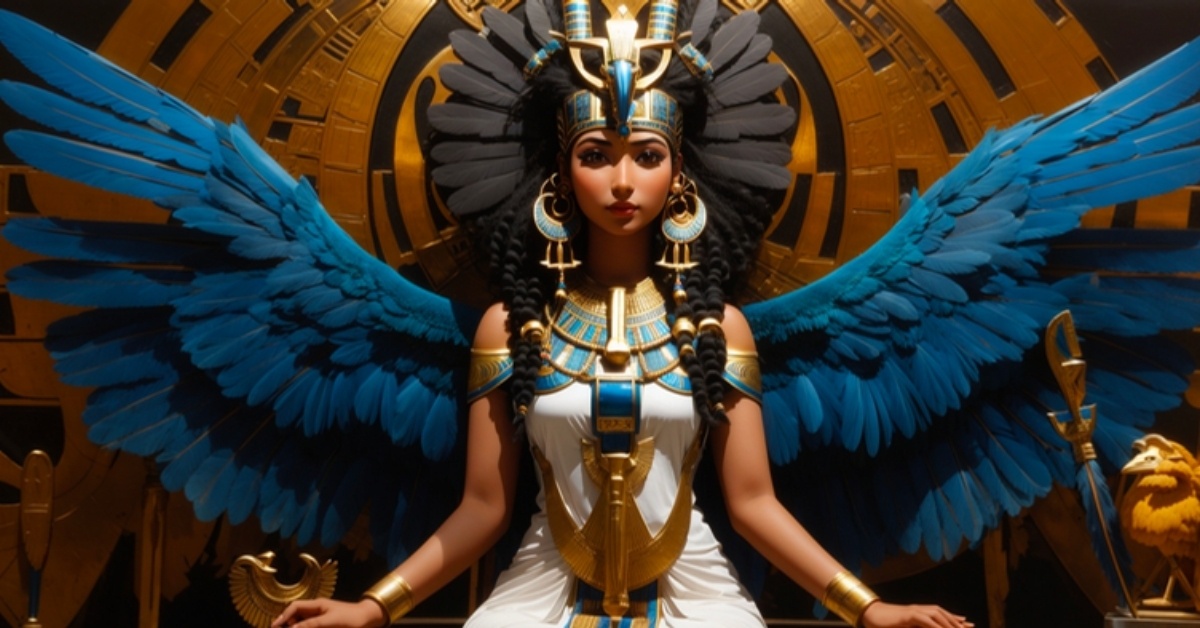
- A slender young woman, often seated
- A single ostrich feather standing upright in a headband
- Sometimes with wings spread along both arms
- Seated on, or standing beside, a low plinth, the hieroglyph that spells her name
- Holding the ankh and the was-scepter of the gods
- In the judgment scene she shrinks to a tiny figure sitting on the scale, or disappears into her feather
Abilities
- Cosmic order — the seasons, the stars, and the Nile keep time because of her
- Judgment — she is the standard every heart is measured against
- Legitimacy — a king who upheld her ruled by right, and one who failed her had no claim to the throne
- Guidance — she rides in Ra’s solar barque and keeps its course through the sky and the underworld
- Ethics — the Egyptian idea of a good life was simply a life lived in maat
Symbols
- The ostrich feather — the emblem of truth, light enough to weigh a heart against
- The scales — the instrument of the judgment
- The plinth — the flat base that supports thrones and statues, and the sign for her name
- The ankh — the sign of life she holds out to kings
- The solar barque — the boat where she stands beside her father
Traits
- Impartial to the point of silence; she rarely speaks in any text
- Exacting, since a single lie tips the scale
- Steady, the fixed point everything else is measured from
- Foundational, present at creation and required at every death
- Slight in form and absolute in effect
Festivals and Rituals
Bastet drew crowds to Bubastis every year. Maat’s worship happened in small chapels tucked inside other gods’ precincts, and in the daily practice of living straight; no great annual festival of hers is on record, and for most of Egyptian history she had no temple of her own.
The one ritual that belonged to her was the presentation of Maat. Carved on temple walls from Karnak to Abydos, it shows the pharaoh holding out a small seated figure of the goddess to the assembled gods. The gesture was a report card. The king was declaring that under his rule the world had stayed in balance. Every pharaoh performed it, and Seti I had it carved into his great temple at Abydos where visitors can still see it.
Her courts were her temples in another sense. From the Fifth Dynasty the vizier, the highest official under the king and the head of the justice system, carried the title “priest of Maat.” Later writers, Diodorus among them, say the chief judge wore a small image of her on a chain as a badge of office, a sign that the ruling would be balanced. Hatshepsut and Amenhotep III did eventually build her a modest temple at Karnak, inside the precinct of Montu, and under Ramesses IX that building was where the famous tomb-robbery trials were held. Textual evidence points to other shrines at Memphis and at the workers’ village of Deir el-Medina, where ordinary people left her offerings of food, wine, and incense.
Legends associated with Maat
Other goddesses come with a stack of adventures. Maat comes with a courtroom. Her stories are few, and nearly all of them circle the same idea: the world has a right order, and every heart gets measured against it.
Born with the sun
When Ra rose from the dark water of Nun at the start of time, Maat rose with him. Everything that existed was the sun and the order he carried with him. The kings who came after took their job description from a phrase that appears again and again on their monuments: to “put maat in the place of isfet.”
One of the Coffin Texts, written on Middle Kingdom coffins around 2000 BCE, puts the words in Ra’s own mouth. He lists the good things he did at creation. He made the four winds so every person could breathe. He made the flood so the poor would eat like the rich. He made every person like every other. Then comes the line that matters. In his words, he “did not command that they do wrong”; it is their own hearts that disobey him. Maat was the world as he made it, and isfet was what people chose.
From then on she rode with him. In the solar barque that carries the sun across the sky by day and through the underworld by night, Maat stands with her father, and the boat holds its course because she is aboard.
The Hall of Two Truths
This is the scene the ancient Egyptians painted on papyrus, carved into tombs, and wrapped inside their mummies. It comes from Spell 125 of the Book of the Dead, and it is the reason Maat matters.
You die. Anubis, the jackal-headed god, takes you by the hand and leads you into a long hall. At the far end sits Osiris, lord of the dead, with his sisters Isis and Nephthys standing behind his throne. Along the walls sit forty-two gods, the Assessors of Maat, one for every district of Egypt, and each of them answers for one sin.
Before anything is weighed, you have to speak. This is the Negative Confession, and it runs through all forty-two judges by name. “I have not stolen.” “I have not slain men and women.” “I have not uttered lies.” “I have not committed sin.” Forty-two times you say what you did not do, and forty-two gods listen for a false note.
Then the scale comes out. Your heart goes in one pan. The Egyptians left the heart in the body at embalming for exactly this reason, because it was the seat of memory and conscience, and it had one more job to do. In the other pan goes Maat, either as her feather or as a tiny seated figure of the goddess herself. Anubis steadies the plumb line. Thoth, the ibis-headed god of writing, stands with his palette ready to record the result.
And at the foot of the scale waits Ammit. She has a crocodile’s head, a lion’s forequarters, and a hippopotamus’s rear, the three animals most likely to eat an Egyptian, stitched into one creature. Her name means “Devourer of the Dead.” If your heart weighs more than the feather, she eats it, and that is the end of you. No underworld, no rebirth, no Field of Reeds. The Egyptians called this the second death, and they feared it more than the first.
If the pans balance, Thoth writes it down and declares you maa kheru, “true of voice.” Horus takes your hand and leads you to Osiris, and the fields of the blessed open in front of you.
Notice who does what in this scene. Anubis handles the scale, Thoth keeps the record, and Osiris gives the verdict. Maat sits in the pan and says nothing at all. The scale speaks for her. She is the measure itself.
The heart that could testify
The Egyptians took the weighing seriously enough to hedge their bets. Spell 30B of the Book of the Dead was carved onto a heart scarab, a stone beetle laid over the chest of the mummy, and it is a plea addressed to the heart itself.
The dead person asks their own heart to keep quiet. “Do not stand up against me as a witness,” the spell says, and “do not be hostile to me before the Keeper of the Balance.” A heart, after all, knows everything its owner did, and in the Hall of Two Truths it might be tempted to say so.
It is a strangely honest piece of magic. The whole scene depends on the heart telling the truth, and the scarab is an admission that the truth might weigh more than a feather.
The peasant who argued for nine days
Maat also worked outside the afterlife, and one Middle Kingdom story shows how. A farmer named Khun-Anup was driving his donkeys to market when a landowner’s man tricked him, seized the animals and his goods, and beat him for complaining.
Khun-Anup went to the high steward Rensi and asked for justice. His plea was so eloquent that Rensi reported it to the king, and the king gave a remarkable order: stall him. Make him keep talking, and write it all down. So the peasant came back and pleaded nine separate times, each speech a lecture on maat, on what a judge owes the weak, on how a crooked official rots the whole state. On the ninth day he insulted the steward and was beaten for it. Then Rensi read the speeches, gave him back his property, and handed him the property of the man who robbed him as well.
The Egyptians copied that story for centuries. It says a great deal about what they thought maat was: a standard that a farmer could hold a magistrate to, out loud, and win.
An older Maat?
The word did the work first.
By the time anyone carved a picture of the goddess, Egyptians had been using maat for generations as a plain description of how things ought to be. The Pyramid Texts of King Unas, cut into his burial chamber around 2350 BCE, already treat it as the principle that governs the sky and the state, and they are among the oldest religious writings that survive anywhere in the world. Images of Maat as a woman with a feather appear from the middle of the Old Kingdom, a little later, and the Fifth Dynasty title “priest of Maat” went to a vizier, a judge, rather than to anyone running a cult.
The German Egyptologist Jan Assmann, who wrote the standard study of the concept, defined maat as the idea of a meaningful order that runs through humans, objects, and nature alike: the meaning of creation, in the form the creator intended it. That is an idea before it is a person. The oldest wisdom text in Egypt, the maxims attributed to the vizier Ptahhotep, says as much: maat is great, its worth lasts, and it has not been disturbed since the day its creator made it. That is the language people use for a law of nature.
Her thinness as a character points the same direction. Compare her with Isis, who has a husband to mourn, a son to hide, and a hundred spells to cast. Maat has a father, a boat, and a feather. Egyptian mythology gave personalities to almost everything, from the sky to the inundation, and Maat is what that habit looks like when it is applied to an abstraction. She was personified because Egyptians personified things, and she stayed thin because the idea was doing all the lifting.
The same antiquity shows in the pairing of maat and isfet. The contest between order and chaos is built into Egyptian kingship from its earliest monuments. Every king was the guarantor who “put maat in the place of isfet,” a formula that outlived dynasties and was still being carved under Tutankhamun and the Ramessides. The goddess grew out of that duty, as the visible sign of the thing the king was supposed to protect.
She was a goddess all the same. Egyptians built her chapels, offered her incense, and made her the face of their most important ritual. Some scholars stress how far she developed into a real cult figure, with temples and priests; others, following Assmann, keep her mainly as an ethical and cosmic principle that took a body for convenience. Both are reading the same evidence. Maat is the case where the Egyptian instinct to give an idea a face left the idea in charge.
Maat across cultures
Cultures that run on a calendar and a harvest tend to arrive at an idea like maat, and several of them got there on their own.
In Vedic India the word was rta, the cosmic order that makes the seasons turn and the rituals work, guarded by the god Varuna. Across the border in Iran the same root became asha, the “truth” at the heart of Zoroastrian religion, and the Zoroastrians also imagined the soul’s deeds weighed on a balance after death. Scholars routinely set rta and asha beside maat as the same instinct in three languages: the universe has a right way to run, truth is part of its machinery, and a person’s life is measured against it. China’s Dao, the way things go when nothing is forcing them, belongs to the same family.
The Greeks split the job among several figures. Themis was divine law, Dike was justice in the courts, and both were shown with scales in later art. But the goddess who most resembles Maat in practice is Athena, the one who sits as judge at the first murder trial in Greek myth and casts the deciding vote for mercy. Athena judges with a mind. Maat judges with a feather. Egypt trusted the measure, and Greece trusted the wisdom of the one holding it.
The scale itself is Maat’s longest-traveling gift. The weighing of souls passed from Egyptian tomb paintings into Greek poetry, where Zeus weighs the fates of heroes, and on into Christian art, where the archangel Michael holds the balance at the Last Judgment. The blindfolded Lady Justice on courthouses today holds the same instrument. Her feather is the far end of that line, three thousand years back.
Final thoughts
An ostrich feather weighs almost nothing, and the Egyptians chose it on purpose.
Set against it, a heart carrying even one lie comes down heavy. That is a hard standard, and Egypt lived under it for three thousand years, from the pharaoh presenting a tiny figure of Maat to the gods down to a farmer arguing for his donkeys. She asks the same thing of all of them: live straight, tell the truth, keep the world in balance, and be ready to have it weighed.
Her name was a word before it was a woman, and the word survives every time a carpenter says a board runs true. Which leaves the question the Hall of Two Truths puts to everyone: when your heart goes on the scale, what would you choose to leave out of it?
Bibliography
- Assmann, Jan. Ma’at: Gerechtigkeit und Unsterblichkeit im Alten Ägypten. C.H. Beck.
- Faulkner, Raymond O., trans. The Ancient Egyptian Book of the Dead. British Museum Press.
- Karenga, Maulana. Maat, the Moral Ideal in Ancient Egypt. Routledge.
- Lichtheim, Miriam. Ancient Egyptian Literature, Volume I: The Old and Middle Kingdoms (Ptahhotep, the Eloquent Peasant, Coffin Text 1130). University of California Press.
- Mark, Joshua J. “Ma’at”. World History Encyclopedia, 2016.
- “Maat”. Encyclopaedia Britannica.
- Papyrus of Hunefer, judgment scene (EA 9901,3). The British Museum.
- “Maat”, “Assessors of Maat”, “Ammit”, and “Weighing of the heart”. Wikipedia.
- “The Maxims of Ptahhotep”, “The Eloquent Peasant”, and “Ṛta”. Wikipedia.