Nephthys: The Egyptian Goddess Who Stood at the Head of Every Coffin
On an Egyptian coffin, the goddess painted at your feet is Isis. The goddess painted at your head is her sister.
For three thousand years that was the arrangement. Two women with wings, one at each end of the dead, the pair the texts call the two kites. One of them became the most famous goddess of the ancient world. The other stayed where she was, at the head of the coffin, doing the work the hymns leave out.
Overview of Nephthys
Nephthys is the youngest child of the sky goddess Nut and the earth god Geb, which makes her the sister of Osiris, Isis, and Set, and the granddaughter of Shu and Tefnut. She is the last-born of the nine gods the priests of Heliopolis counted as the founding family of the world, and she is already there in the Pyramid Texts, the oldest religious writing that survives from anywhere, cut into the walls of royal tombs around 2300 BCE.
Her name is a job description. The Greeks heard Nebet-hut and wrote Nephthys, and the Egyptian words mean “Lady of the Mansion” or “Lady of the Enclosure.” The hut in her name is the word for a great walled building, a temple precinct or an estate, so she is the mistress of something large with walls around it. Which building is the question, and the section below on her name takes it up.
She is married to Set, the god of storms and disorder who murders their brother Osiris, and she sides with the brother. Across the whole funerary tradition Nephthys stands with Isis, mourns Osiris, and protects his son Horus, and the texts treat this as ordinary. She is the sister who stayed with her family when her husband turned against it.
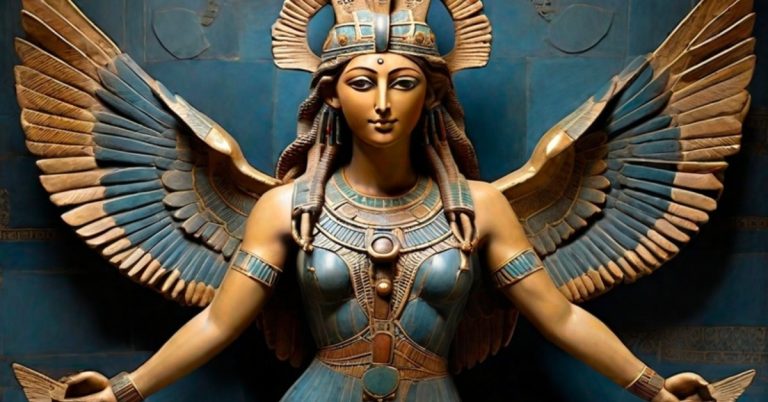
Egyptian art shows her as a woman wearing the hieroglyphs of her own name on her head, a basket sitting on top of a rectangular enclosure. Often she has the wings of a bird, spread wide across the end of a coffin or the shoulders of a mummy, because the kite, a hawk that cries in long shrill notes, was the form the two sisters took to grieve.
Titles
- Lady of the Mansion, the meaning of her Egyptian name
- Sister of Isis, Osiris, and Set, daughter of Geb and Nut
- One of the two kites, with Isis, the divine mourners of Osiris
- Friend of the Dead, an epithet from the funerary texts
- Nurse of the king, in the Pyramid Texts
- Guardian of the god Hapy and the lungs, among the four canopic jars
Characteristics
How the texts and the tombs describe her:
- Loyal to Osiris, Isis, and Horus though married to Set
- A mourner who protects while she weeps, wings spread over the body
- Almost always in a pair, mirroring Isis on the other side of the dead
- Fierce when the moment calls for it, a protector in the night as much as a griever
- Present at both ends of life, nursing the king and guarding the corpse
Symbols
- The kite — the hawk whose cry sounded like a woman keening
- The head of the coffin — her station, opposite Isis at the feet
- The basket on the enclosure — the hieroglyphs of her name, worn as a crown
- The canopic jar — hers holds the lungs, under the baboon-headed Hapy
- Mummy wrappings — the strips of cloth Egyptians associated with her, sometimes read as her hair
Legends associated with Nephthys
Egyptian myth comes down to us in pieces. The Osiris story survives in spells, hymns, and ritual scripts, and Nephthys appears throughout them as the sister who is always at Isis’s side. What follows draws on those Egyptian sources and then on the one Greek writer who set the whole story down in order.
The death of Osiris and the two kites
Set killed Osiris and, in the fuller versions, cut the body into pieces and scattered it through Egypt. Isis went searching, and Nephthys went with her. Egyptian texts describe the two of them as birds circling and crying over the body, and the Pyramid Texts already give them the name that stuck, the two kites. When they found their brother they wept, and their weeping had power in it. The lament of the two sisters was one of the forces that called Osiris back into life.
Every Egyptian funeral after that reenacted the scene. The dead person became Osiris, and two women took the sisters’ roles. A papyrus now in Berlin preserves the script, the Lamentations of Isis and Nephthys, along with stage directions: two women with clean bodies and no body hair, wigs on their heads, the names of Isis and Nephthys written on their shoulders, tambourines in their hands. Another Ptolemaic papyrus, the Bremner-Rhind, keeps a longer cycle called the Songs of Isis and Nephthys, sung over several days in the temple of Osiris. In both the sisters call to their brother to come home to his house, and in both Nephthys speaks in her own voice.
At the head of the coffin
Once the body was wrapped, the sisters kept watch. On coffins and sarcophagi from the Middle Kingdom onward Isis kneels at the foot and Nephthys at the head, wings out, and the texts written beside them are protective spells. The Egyptian dead lay with their heads to the north in a good many periods, and the north was the direction of the imperishable stars, the part of the sky that never set. Nephthys guarded that end.
She also had a share of the organs. When embalmers removed the viscera and stored them in four canopic jars, each jar came under one of the four sons of Horus, and each of those gods was paired with a goddess. Isis took Imsety and the liver, Neith took Duamutef and the stomach, Serket took Qebehsenuef and the intestines, and Nephthys took the baboon-headed Hapy and the lungs. Her name appears on those jars for two thousand years.
The nurse of the king
Her care for the dead was one half of her office. The other half was care for the living king. In the Pyramid Texts the dead pharaoh is nursed by the two sisters as he rises to join the gods, and Nephthys is named as his nurse in her own right. Ramesside kings kept the idea, and one text has Nephthys promising to protect the king as she protected Horus. The same goddess who received the body at the end had suckled it at the beginning.
The temple beside Set’s
For most of Egyptian history Nephthys had no cult of her own. She was honored wherever Osiris and Isis were honored, which was everywhere. The exception is a town called Sepermeru in Middle Egypt, where Set had a major temple. A land survey from the reign of Ramesses V, the Wilbour Papyrus, records a temple of Nephthys there, adjoining her husband’s, with its own estates and staff. It is one of the few places where the marriage the myths describe was also a fact on the ground, two temples sharing a wall.
Plutarch’s Nephthys, and the birth of Anubis
The story most retellings give Nephthys comes from a Greek. Around 100 CE the philosopher Plutarch wrote On Isis and Osiris, the only full narrative of the myth that survives, and Nephthys gets a subplot in it. Osiris, he says, slept with Nephthys by mistake, thinking she was Isis. Nephthys, afraid of her husband, exposed the child. Isis found out from a garland of clover Osiris had left behind, went looking, and with the help of dogs found the baby and raised him. He was Anubis, the jackal god of the embalmers.
Plutarch also gives Nephthys other Greek names. Some call her Teleute, he says, the End, and some call her Aphrodite or Nike. And he explains what he thinks the story means. Nephthys is the outer edge of the land, the desert margin where the flood barely reaches, and Osiris is the Nile. In a high year the water overflows its usual limit and touches her, and the affair is that. She is barren because the desert is barren.
That reading has stuck to her for two thousand years, and it deserves a closer look.
Whose house? The Nephthys behind the Greek version
Nearly everything a modern reader is told about Nephthys as a person, the infertility, the affair, the dark twin who shadows her radiant sister, runs through Plutarch, and Plutarch was a Greek Platonist writing about a foreign religion in the last centuries of its life. Egyptologists have spent a century sorting his Nephthys from the Egyptian one, and the two come apart in interesting places.
The name is the one thing everyone agrees is hers, and even there the meaning is contested. Nebet-hut is a title, “Lady of the Mansion,” and several scholars have pointed out that it is an epithet standing in for a personal name the record leaves out. The argument is over the mansion. One school reads it as the temple, so that Nephthys is the personification of the sacred enclosure itself. Another reads it as the sky, the house of her mother Nut. A third reads it as the tomb, the house of Osiris, which fits everything she does. Jessica Lévai, whose doctoral work is the fullest modern study of the goddess, lays out the range and declines to force a single answer. The honest position is that Egyptians probably heard more than one of these at once.
The Anubis story is a different matter. Egyptian texts name several mothers for Anubis, and Nephthys is rarely one of them. In the Coffin Texts he is the son of the cow goddess Hesat, or of Bastet; other traditions make him a son of Ra. The version where Osiris mistakes one sister for the other appears fully formed only in Plutarch, and while a few Ptolemaic-period Egyptian texts do connect Anubis with Nephthys, most Egyptologists treat the affair as a late strand, elaborated by a Greek author who liked a neat allegory. In the Egyptian record, from the Pyramid Texts through the funerary liturgies, Nephthys’s whole story is a murdered brother and a sister who needs her.
The barrenness comes through the same filter, though here Egypt gave Plutarch something to work with. One utterance in the Pyramid Texts, a spell that wards off gods who might approach the king’s tomb with ill intent, calls Nephthys by an insulting secret name, an imitation of a woman with no vulva. It is startling in isolation. In context the same spell hurls a rude name at every god in the list, Osiris and Isis included, because knowing a god’s hidden name was how you kept the god out. That one spell is the whole Egyptian evidence for her sterility, and the texts that call her a nurse and a mother of the king pull the other way. Plutarch’s desert-margin allegory turned one apotropaic insult into a biography.
The dark twin is the most modern layer of all. Popular retellings set the sisters against each other, light and shadow, life and death, day and night. Egyptian texts do the opposite. The sisters are a unit, so alike in art that only the hieroglyphs on their heads tell them apart, and their power comes from acting together. Nephthys is the one who stays loyal to Osiris and Horus even though Set is her husband, which makes her the least divided figure in the whole story. The scholarly consensus today reads her as Isis’s complement: the second mourner, the second wing, the other half of a pair Egyptians always drew together.
Nephthys across cultures
The sister who follows the searcher, the bird whose cry announces a death, the woman who keeps station at the head of the dead: each of these has cousins elsewhere.
In Greece, when Demeter went searching for her stolen daughter, Hecate went with her carrying torches, and the companion in the search became a goddess of thresholds and the dead in her own right. In Ireland the Morrígan takes the form of a crow and cries over the battlefield, a bird whose voice means somebody has died. In Norse tradition Hel receives the ordinary dead in a hall at the end of a long road, keeping what she is given and holding to her terms. Each of these traditions grew up on its own, and what they share with Nephthys is the intuition that death calls for a woman at the door, one who grieves and guards in the same gesture.
Egypt’s version is the earliest by a wide margin, and it is also the least lonely. Where other cultures gave the job to a single dark goddess, Egypt gave it to two sisters and put one at each end.
Final thoughts
The Greeks named her the End, and the Egyptians put her at the head of the bed. Both were describing the same woman from different sides.
Nephthys is the goddess of showing up. Her brother is murdered and she goes with her sister to find him. Her sister weeps and she weeps beside her. The body is wrapped and she takes her place at the head of it, wings out, for as long as it lies there. She does all of this while married to the murderer, and every Egyptian text treats that as ordinary. She belongs to the family that grieves, and that is where she stays.
Isis got the temples, the mysteries, and the two thousand years of fame. Nephthys got the other end of the coffin. When somebody you love has died, which of those two would you choose to have in the room?
Bibliography
- Faulkner, R. O. The Ancient Egyptian Pyramid Texts. Oxford University Press, 1969. The two kites, Nephthys as nurse of the king, and the apotropaic utterance that gives each god an insulting hidden name.
- Faulkner, R. O. “The Bremner-Rhind Papyrus: I. A. The Songs of Isis and Nephthys.” Journal of Egyptian Archaeology 22 (1936). The Ptolemaic liturgy sung in the temple of Osiris.
- Faulkner, R. O. “The Lamentations of Isis and Nephthys.” In Mélanges Maspero I, 1934. The Berlin papyrus (P. Berlin 3008) with its rubric for the two women who play the sisters.
- Faulkner, R. O. The Ancient Egyptian Coffin Texts. Aris & Phillips. Anubis as the son of Hesat or Bastet.
- Plutarch. Isis and Osiris. Moralia vol. V, trans. Frank Cole Babbitt, Loeb Classical Library, 1936. Chapters 12, 14, and 38 for Nephthys’s Greek names, the birth of Anubis, and the desert-margin allegory.
- Lévai, Jessica. Aspects of the Goddess Nephthys, Especially During the Graeco-Roman Period in Egypt. Doctoral dissertation, Brown University, 2007. The fullest modern study; the range of readings of “Lady of the Mansion.”
- Gardiner, Alan H. The Wilbour Papyrus. Oxford University Press, 1941–1952. The land survey recording the temple of Nephthys at Sepermeru beside Set’s.
- Wilkinson, Richard H. The Complete Gods and Goddesses of Ancient Egypt. Thames & Hudson, 2003. Iconography, the canopic pairings, and the coffin positions.
- Pinch, Geraldine. Handbook of Egyptian Mythology. ABC-CLIO, 2002. The Osiris cycle and the sisters’ role in it.
- Sjöö, Monica, and Barbara Mor. The Great Cosmic Mother. HarperOne, 1987. Isis material (the book does not name Nephthys); read for its lens on the Egyptian mother-and-mourner complex, one modern perspective among many.
- “Nephthys”. Wikipedia. Survey of the attestations, the name, and the Sepermeru temple.
- Mark, Joshua J. “Nephthys”. World History Encyclopedia.