Sita: Hindu Goddess of the Earth and Devotion
A king was plowing a field to open a sacrifice when the blade caught on something in the soil. He looked down, and lying in the furrow was a baby girl.
Sita begins in the ground, and she ends there too. Between those two moments sits the Ramayana, the epic that half of Asia has been telling and retelling for more than two thousand years.
She’s the princess who chose exile over a palace, the captive who outlasted a demon king, and the wife whose devotion is still held up as the measure of all others. She is also, at the very end, the woman who said no.
Overview of Sita
Sita, also called Janaki and Vaidehi, is the heroine of the Ramayana and the wife of Rama, the seventh avatar of the god Vishnu. Her first home is Mithila, the kingdom of King Janaka on what is now the border of Bihar and southern Nepal. Her second is Ayodhya, the capital of Rama’s line. Hindus honor her as an avatar of Lakshmi, goddess of fortune and Vishnu’s eternal consort, who came down to earth to stand beside him through his human life.
Her name means “furrow,” the line a plow cuts through a field, and that one word carries her whole story. She is the daughter of Bhumi, the Earth, born from the soil and taken back into it. Her territory is virtue, devotion, and endurance, and underneath all of those, the fertility of the land.
For some of her devotees she is a great deal more than Rama’s consort. The Sita Upanishad, a medieval text attached to the Atharva Veda, names her Prakriti, primal nature itself, and the source of will, action, and knowledge. In the Ramanandi order, the largest Vaishnava monastic tradition in India, she and Rama are worshiped together as a single divine pair, and the greeting Siya-Ram puts her name first.
Her birthday is Sita Navami in the spring. Her wedding is celebrated at Vivaha Panchami in early winter.
Titles
- Janaki (“daughter of Janaka”)
- Maithili (“princess of Mithila”)
- Vaidehi (“of Videha,” her father’s kingdom)
- Bhumija (“earth-born”)
- Ayonija (“born of no womb”)
- Siya, her everyday name in Hindi devotion, as in Siya-Ram
Characteristics
How Sita tends to be shown in art:
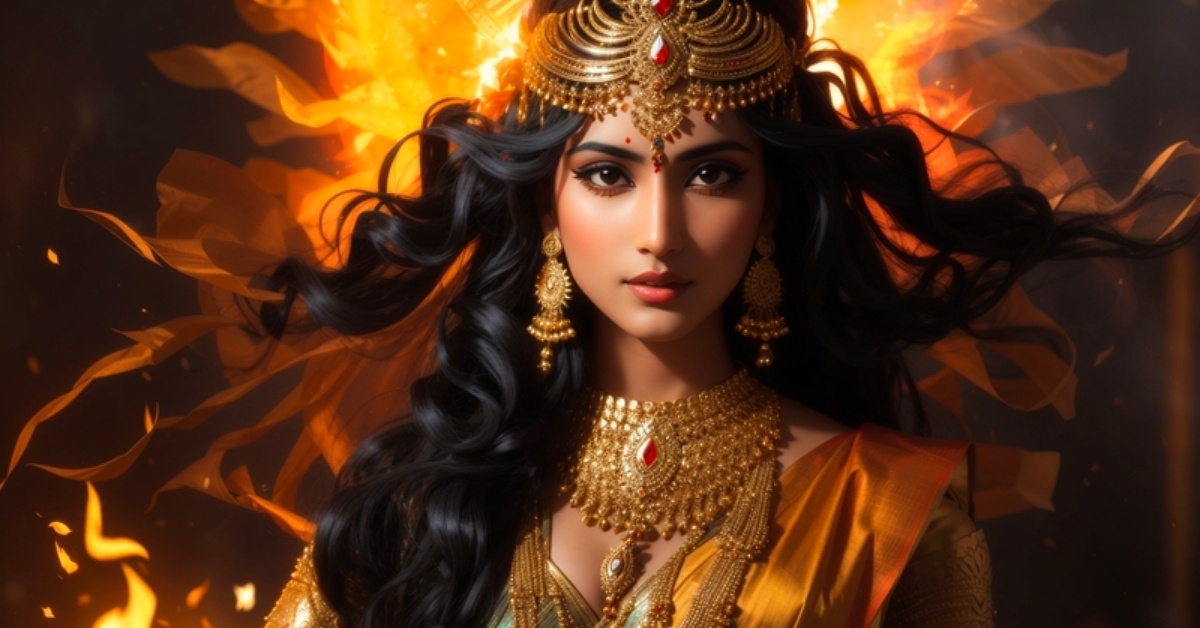
- A young woman of great beauty, with long dark hair and large, calm eyes
- Dressed in a sari, most often gold or red, and crowned and jeweled as a queen
- In scenes from the forest years, in plain bark cloth with her hair unbound
- Standing at Rama’s left, with Lakshmana and Hanuman completing the group
- Holding a lotus, the flower she shares with Lakshmi
- In the Madhubani painting of her home region, drawn with a bold black outline and filled with saturated color
Abilities
- An unbreakable will — a year in Ravana’s garden, under constant threat, and she held every day of it
- Purity as a force — in the tradition, her devotion is a literal power, strong enough to carry her through fire unburned
- Endurance — fourteen years of forest, a year of captivity, and a second exile spent raising two sons alone
- The Earth’s own daughter — when she calls on her mother, the ground answers
- Moral clarity — she argues with Rama when she judges him wrong, and the epic gives her the better of several of those arguments
Symbols
- The furrow and the plow — her birth and her name
- The earth — her mother, and her final refuge
- Fire — the ordeal she walked through, and the witness that vouched for her
- The ashoka tree — the grove where she was held; the name means “without sorrow”
- The lotus — Lakshmi’s flower, carried over to her avatar
- The chudamani — the hair jewel she sent across the sea to Rama as proof she was alive
Traits
- Devoted, to her husband and to dharma, and she treats the two as one
- Mild in manner and immovable in substance
- Outspoken when something is unjust, whatever the rank of the person she’s addressing
- Forgiving, to the point of sparing the demonesses who had tormented her for a year
- Dignified, and at the last, done with being tested
Festivals and Rituals
Sita’s birthday is Sita Navami, also called Janaki Navami, on the ninth day of the bright half of the month of Vaishakha, which falls in April or May. Married women fast that day for the long life of their husbands, and temples read the story of her birth from the earth.
Two towns claim that birth. Sitamarhi, in Bihar, holds a procession around the city that begins and ends at the Urvija Kund, the pond said to mark the furrow itself. Janakpur, just across the border in Nepal, is the old capital of Mithila and the site of the Janaki Mandir, a white marble temple with sixty rooms built for her in 1911 by a queen of Tikamgarh. Its walls are painted in the Madhubani style of the region.
Janakpur is also where her wedding is celebrated at Vivaha Panchami, the fifth day of the bright half of Margashirsha, in November or December. Tens of thousands of pilgrims come to watch the marriage of Rama and Sita reenacted with images of the couple, in the city where the tradition says it first happened.
Beyond her own days, she is present at every one of Rama’s. The nine nights of Navratri end in Dussehra, when effigies of Ravana burn across north India to mark his defeat and her rescue. Diwali, three weeks later, remembers the lamps Ayodhya lit to welcome the two of them home. And through the autumn, the open-air plays called Ramlila retell the whole epic, night after night, in towns and villages everywhere.
Legends associated with Sita
Sita’s story is the Ramayana, and the Ramayana is more than one book. Valmiki’s Sanskrit epic is the oldest and the one told here, but the Tamil poet Kamban, the Hindi poet Tulsidas, and hundreds of other tellers across India and Southeast Asia have shaped it since, and each of them made her a little different. Where the versions part ways, I’ll say so.
The child in the furrow
Janaka, king of Mithila, was a philosopher as much as a ruler, the sort of king sages came to argue with. One day he was plowing a field himself, turning the first furrow to consecrate the ground for a sacrifice, when the plow struck something and stopped.
In the furrow lay an infant girl. Some tellings say she was in a clay pot, and some say she lay in the open earth, but all of them agree on what Janaka did. He lifted her out, carried her home to his queen, Sunayana, and named her for the place he found her. Sita, the furrow.
She grew up as the princess of Videha, but everyone knew she was the Earth’s daughter, and the epic keeps reminding you of it. Her other names say the same thing: Bhumija, “born of the earth,” and Ayonija, “born of no womb.”
Later tellings give her stranger origins. In the Adbhuta Ramayana and the Thai Ramakien, she is the daughter of Ravana himself, cast adrift as a baby because of a prophecy that she would destroy him. Valmiki’s telling is older and plainer. She comes from the ground, and only the ground.
The bow that broke
Janaka’s court kept a treasure, an enormous bow that had belonged to the god Shiva. It had come to the royal house generations earlier, and it was so heavy that it took hundreds of men to move the iron chest it lay in. Janaka made a vow: whoever could lift and string the bow of Shiva would marry his daughter.
Princes came from every kingdom and failed. The bow stayed where it lay.
Then the sage Vishvamitra arrived from the forest with two young princes of Ayodhya in tow, Rama and his brother Lakshmana, whom he had been training to fight demons. Rama walked up to the bow, took it in one hand, lifted it, bent it, and drew the string. The bow snapped in two with a crack like a thunderbolt that knocked men to the ground.
Sita was watching. In Valmiki’s telling the bow did the choosing, and the wedding followed. The ceremony at Mithila was a double celebration, since her sister Urmila married Lakshmana the same day and two cousins married Rama’s other brothers. Every year at Vivaha Panchami, Janakpur stages it again.
Exile, chosen
Rama was to be crowned king of Ayodhya. On the eve of it, his stepmother Kaikeyi called in two old promises from his father: her own son Bharata would rule, and Rama would go into the forest for fourteen years. Rama, who held his father’s word above everything, agreed at once.
He went to Sita and told her to stay behind.
Her answer is one of the best scenes in the epic. She refused. She reminded him that a wife’s place is with her husband, in a palace or a forest, and that his exile was hers. When he kept arguing, she got sharp. Her father, she said, must have thought he was giving her to a man, and had instead handed her to a woman wearing a man’s body. Rama gave in. Sita put on bark cloth, and Lakshmana came too, leaving Urmila behind for fourteen years.
The forest years were, for a while, the happiest of the story. They lived at Chitrakuta, then deeper south in the Dandaka forest, and finally at Panchavati on the Godavari river. And the epic gives Sita a voice there. When Rama promised the forest sages he would kill the demons who troubled them, she took him aside and warned him against going hunting for enemies on another man’s behalf. A weapon carried too long, she told him, changes the hand that carries it.
The golden deer
Trouble came in the shape of a demoness. Shurpanakha, sister of the demon king Ravana, saw Rama and wanted him, then turned on Sita when he laughed her off. Lakshmana cut off her nose and ears. She fled to her brother in Lanka and told him about the woman she had seen, and Ravana decided he wanted Sita for himself.
He sent the shape-shifter Maricha to Panchavati in the form of a golden deer. Sita saw it grazing near the hut, a creature that shone like sunlight, and asked Rama to catch it for her. He went after it. Far off in the forest, as Rama’s arrow struck it, the deer cried out in Rama’s own voice, calling for help.
Sita heard and begged Lakshmana to go. He refused, certain it was a trick. She accused him of wanting his brother dead so that he could have her, words the epic makes clear she regretted, and he went. The famous protective line Lakshmana draws in the dirt belongs to later tellings. In Valmiki’s version there is only an empty clearing and a woman alone.
An ascetic came to the door asking for alms. Sita served him. He revealed himself as Ravana, ten-headed and twenty-armed, and when she refused him he seized her by the hair and carried her into the sky in his flying chariot. The old vulture Jatayu, a friend of Rama’s father, rose to fight him and was cut down. As they flew south, Sita tore off her jewels and dropped them to the earth so someone could follow the trail. A band of monkeys on a hilltop found them.
The ashoka grove
Ravana offered her his palace. Sita refused it and asked to be kept outdoors instead, so he put her in the Ashoka Vatika, a pleasure garden behind his palace, under a simsapa tree, ringed by demonesses with orders to break her.
He came in person to woo her. Each time, before she spoke, she laid a blade of grass on the ground between them, her sign that she was speaking to him across a barrier, and that he counted for about as much as the grass. She told him he was a jackal trying to carry off a lioness. He gave her one year to consent. After that, he said, his cooks would serve her for breakfast.
The epic explains what held him back. Years before, Ravana had assaulted the celestial dancer Rambha, and her husband Nalakubara had cursed him: if he ever again forced himself on a woman against her will, his head would burst into seven pieces. Sita’s refusal was the one thing keeping her alive.
The demonesses screamed at her day and night. One of them, Trijata, told the others of a dream she’d had in which Ravana fell from his chariot in rags and Rama came riding over the sea, and warned them to leave the prisoner alone. Sita, by then, was close to giving up. She had decided to hang herself by her own braid from the tree.
That was the night a monkey dropped a ring into her lap from the branches above.
Hanuman, son of the wind, had leapt the ocean to find her. He had watched from the tree, unsure how to approach without frightening her, and finally let fall Rama’s signet ring. Sita knew it at once. They spoke. She gave him her chudamani, the jewel from her hair, so Rama would know the message was hers, and then she told Hanuman the truth. She could hold on for one more month. After that she would be dead. Hanuman, before leaving, set fire to the city of Lanka with his own burning tail.
Some later tellings soften this whole passage with the idea of a shadow Sita. In the Adhyatma Ramayana and in Tulsidas, the real Sita is hidden in the keeping of the fire god Agni before the abduction, and it is an illusion that Ravana carries off. Valmiki’s telling is harder. His Sita spends the year in the garden herself.
The fire
Rama came with an army of monkeys and bears, built a bridge across the sea, and killed Ravana. Sita was bathed and dressed and brought before him in front of the whole host.
And Rama, in front of everyone, told her he had fought the war for his own honor and the honor of his house, and that a woman who had lived a year in another man’s home was lost to him. She was free, he said, to go where she liked.
Sita’s reply is short and it cuts. She asked why, if he thought so little of her, he had fought a war for her when a message by Hanuman would have done. She asked Lakshmana to build a pyre. Then she walked around it, called on Agni to witness that her heart had stayed with Rama through everything, and stepped into the fire.
Agni rose out of the flames carrying her, unburned, her garlands still fresh, and told Rama in front of the gods that she was without stain. Rama answered that he had always known it, and had needed the world to see. This is the agni pariksha, the trial by fire, and the tradition has argued about it ever since. The oldest tellers presented it as the vindication of a queen before her people. Many modern readers, and a long line of poets and playwrights before them, have heard the scene differently, as the moment the story turns against its hero. The epic itself leaves room for both.
They flew home on Ravana’s captured chariot. Ayodhya lit every lamp it owned to welcome them, and Rama was crowned with Sita beside him.
The second exile
The last book of the Ramayana, the Uttara Kanda, is one that many scholars believe was added later, and it is the one that has caused the most grief.
Rama’s spies brought him the gossip of the city. A washerman, quarreling with his wife, had said he was no Rama, to take back a woman who had lived in another man’s house. Rama decided that a king’s house had to stand above talk. He ordered Lakshmana to take Sita, who was pregnant, into the forest on the pretext of a visit to the hermitages, and to leave her there.
Lakshmana did as he was told and wept while doing it. Sita, abandoned on the bank of the Ganga, sent a message back to her husband: she would live, for the sake of his children.
The sage Valmiki took her in. In his hermitage she gave birth to twin sons, Lava and Kusha, and raised them there for years, and Valmiki taught them the great poem he was composing, the story of Rama. The poet of the Ramayana, in other words, raised Sita’s children on the Ramayana, and the two boys were the first people ever to sing it.
They sang it for Rama. He was holding a great horse sacrifice when two young bards wandered into the camp and began the epic from its opening lines. The king listened for days before he understood whose sons they were. He sent for Valmiki, and for Sita. And he asked her, one more time, to swear before the assembly that she was pure.
Valmiki swore for her, and staked all his ascetic merit on it. Then Sita spoke. As surely as she had held Rama alone in her heart, she said, let her mother the Earth receive her.
The ground opened. Bhumi rose on a throne carried by serpents, took her daughter into her lap, and the earth closed over them both. Rama begged the ground to give her back, and the ground stayed closed. He ruled for a long while afterward, and when his time came, he walked into the Sarayu river and ended his human life.
For most of the epic’s history that ending was read as tragedy. It also reads as a verdict. Asked to prove herself for the third time, Sita declined, and went home to the one parent who took her as she was. A growing number of retellings, from Chitra Banerjee Divakaruni’s The Forest of Enchantments to the feminist Telugu novelist Volga, have chosen that second reading, and they are in good company. Even Valmiki’s telling gives her the last word.
An older Sita?
Long before anyone wrote the Ramayana, farmers in the Ganges plain were already praying to Sita, and the Sita they prayed to was the furrow in the field.
The Rigveda, the oldest text in any Indian language, contains a short hymn to the Lord of the Field, and two of its verses turn to the furrow by name. “Auspicious Sita, come near,” the farmer sings, “we honor you, that you may bless us and bring us fruit in abundance.” Sita here is the plowed line in the soil itself, personified as a goddess and asked for a harvest. The later ritual manuals keep her. The Paraskara Grihya Sutra prescribes a furrow sacrifice at plowing time, and there she is called the wife of Indra, the rain-bringer. The Kausika Sutra makes her the wife of Parjanya, the rain cloud. She belongs, in these texts, to a whole family of field goddesses, alongside Urvara, the fertile soil, and Prithvi, the earth.
The consensus among scholars is that the heroine of the epic grew out of this goddess. The name, which meant “furrow” before it meant anyone, is the strongest clue. The birth story is the next. A king plowing a ritual furrow and finding a child in it makes sense as a myth of the furrow deity given a human life. And the ending, when the Earth opens and takes her daughter home, reads as the same goddess returning to what she always was.
All of this leaves the Sita of the Ramayana fully herself. The devotion, the exile, the year in the garden, and the fire are her story, and the tradition that honors her as Lakshmi’s avatar is a living one with its own truth. But the epic seems to have inherited a goddess who was already old, a spirit of the tilled field, and built a queen around her. The plow that found her is the plow that made her.
Sita across cultures
A goddess born from the soil and taken back into it has cousins in most places where people farm.
The Greeks had Gaia, the Earth herself, mother of the gods, and the Romans had Terra, whose name is still the Latin word for the ground. Sita is the one of the three who lived a human life, and the instinct behind all three is the same: the field that feeds you has a mother, and she can open her arms. Within Sita’s own tradition the closest figure is Radha, the beloved of Krishna, who like Sita is worshiped alongside a Vishnu avatar and, in some traditions, is honored above him. Where Radha stands for love that breaks every rule, Sita stands for love that keeps every one of them, and the two together map the whole range of Vaishnava devotion.
Her story also traveled farther than almost any other in Asia. In Thailand she is Nang Sida of the Ramakien, the national epic, painted on the walls of the Grand Palace in Bangkok. In Cambodia she is Neang Seda of the Reamker. In Java and Bali she is Dewi Sinta, danced every night in the shadow of the Prambanan temples. The Jains tell her story too, with Sita as Janaka’s natural daughter who ends her life as a nun, and a Buddhist version, the Dasaratha Jataka, makes her Rama’s sister before she becomes his wife. Each culture kept the woman and changed the story around her, which is about the surest sign there is that the woman came first.
Final thoughts
She walked through fire and came out with her garlands fresh. She outlasted the gossip of a whole city. And when she was asked to prove herself a third time, in front of the king and the court and the sages, she chose the earth over the argument.
That’s the Sita worth knowing. She is the model of devotion that a billion people still invoke at weddings, and she is also the wife who told her husband, in effect, that a love which has to be proven forever is a love he has already lost. Both of those women are in the epic. The tradition has spent two thousand years deciding which one to look at.
What do you make of her ending? Was the Earth taking her daughter home a rescue, a refusal, or something the story meant to leave open?
Bibliography
- Valmiki. The Ramayana, Sundara Kanda (Hanuman meets Sita). Trans. Desiraju Hanumanta Rao and K. M. K. Murthy. valmikiramayan.net.
- Valmiki. “Nalakuvara Curses Ravana” (Uttara Kanda, ch. 26). Trans. Hari Prasad Shastri. Wisdom Library.
- Rig Veda 4.57.6. Trans. H. H. Wilson. Wisdom Library.
- “Sita in the Vedas”. Hindu Blog.
- “All About Devi Sita”. Hindu American Foundation.
- “Sita”. New World Encyclopedia.
- Richman, Paula, ed. Many Ramayanas: The Diversity of a Narrative Tradition in South Asia. University of California Press.
- Divakaruni, Chitra Banerjee. The Forest of Enchantments. HarperCollins India.
- “Sita”, “Sita Navami”, “Vivaha Panchami”, and “Janaki Mandir”. Wikipedia.
- “Sita Upanishad”, “Lakshmana rekha”, and “Ashoka Vatika”. Wikipedia.