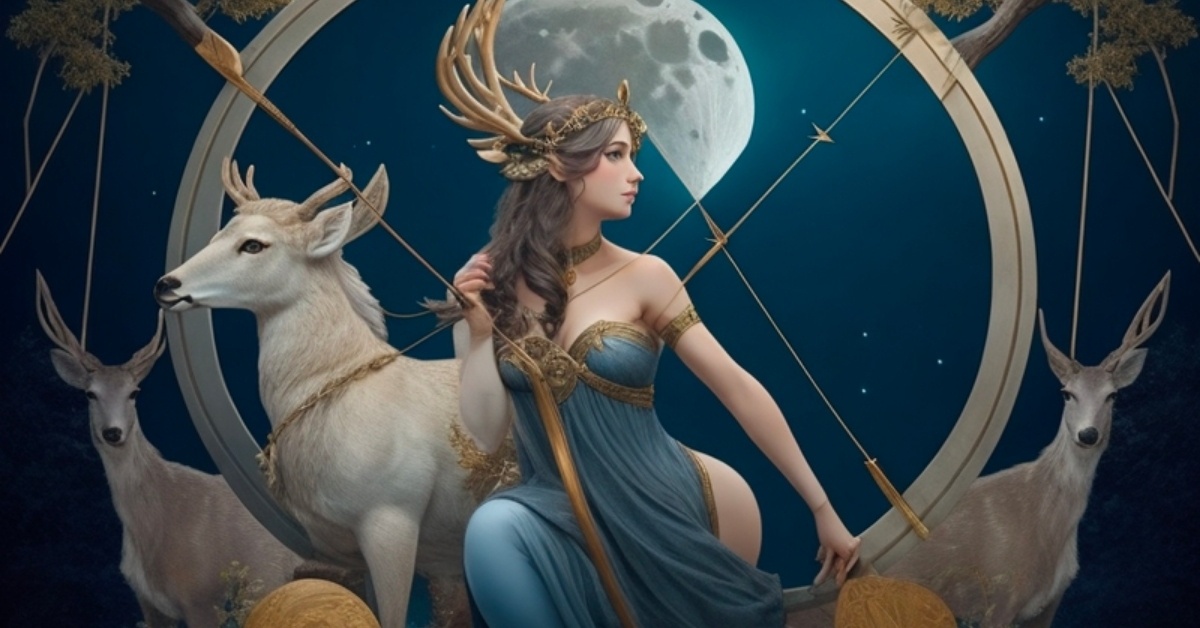
Artemis: Greek Goddess of the Hunt and the Moon
A hunter comes over the ridge and finds a goddess bathing in a mountain pool. He gets one look. By the time he understands what he’s seen, antlers are pushing through his skull and his own dogs are turning toward him.
That’s Artemis. She’s the wild one among the Olympians, the twin who was born first, the archer whose arrows arrive without warning. The Greeks prayed to her at the edges of things: the treeline, the birthing bed, the last summer a girl was still a child. The silver bow is hers, and so, in time, is the moon.
Overview of Artemis
Artemis is one of the twelve Olympians, daughter of Zeus and the Titaness Leto, and twin sister of Apollo. She rules the hunt and the wild animals, the mountains and forests beyond the city walls, and the dangerous passages of women’s lives: childbirth, girlhood, and the crossing between them. Her link to the moon came later, once the Greeks began folding the moon goddess Selene into her.
Her name is older than the Greek alphabet. It appears on Bronze Age Linear B tablets from Pylos, written a-te-mi-to and a-ti-mi-te, and its meaning is still an open question. The ancient Greeks guessed artemes, “safe” or “unharmed.” Modern scholars have proposed arktos, “bear,” and a pre-Greek origin backed by the Lydian form Artimus.
She was worshipped almost everywhere Greeks lived, with great sanctuaries at Ephesus, Brauron, Sparta, and Delos. The Romans knew her as Diana.
Titles
- Potnia Theron (“Mistress of Animals,” her title in Homer)
- Agrotera (“of the wild,” the huntress)
- Phosphoros (“light-bringer,” the torch-bearer)
- Locheia (“of childbirth”)
- Kourotrophos (“nurse of the young”)
- Delia and Cynthia (for Delos and its Mount Cynthus)
- Artemis Ephesia, the Lady of Ephesus
Characteristics
How Artemis tends to be shown in art:
- Young, tall, and long-limbed, often mid-stride
- Wearing a short tunic hitched to the knee for running
- A quiver on her back and a bow in her hand
- Hair tied back, hunting boots laced high
- A deer or a hound at her side
- In later art, a torch in her hand or a crescent moon in her hair
Abilities
- Archery — her arrows bring sudden, painless death, and in Homer a woman who dies without warning has been struck by Artemis
- Mastery of the hunt — every wild creature answers to her, prey and predator alike
- Midwifery — the goddess called on in labor, and by one account a midwife at her own brother’s birth
- Transformation — she turns Actaeon into a stag and Callisto into a bear
- Guardianship of the young — of children, girls, and young animals
Symbols
- The bow and arrows — forged for her by the Cyclopes, in Callimachus’s telling
- The deer — her sacred animal, including the golden-horned hinds that drew her chariot
- Hunting dogs — a gift from the god Pan
- The bear — the animal of her girls’ rite at Brauron
- The torch — for her role as light-bringer
- The crescent moon — her later lunar emblem
Traits
- Fiercely independent, sworn to remain unmarried
- Swift to punish anyone who crosses her or insults her mother
- Protective of women, children, and the young of every species
- Loyal to the companions she chooses
- At home in the wild, restless inside walls
Festivals and Rituals
The strangest and most telling of her rites belonged to Brauron, on the east coast of Attica. There, Athenian girls approaching marriageable age were consecrated to Artemis as arktoi, “she-bears.” Dressed in saffron-colored robes, they danced, raced, and “played the bear” for the goddess before returning to the city to be married. Every four years the Brauronia procession walked the fifteen miles from Athens to the sanctuary. Women who died in childbirth had their garments dedicated there.
At Sparta, Artemis Orthia received harsher offerings. Boys were flogged at her altar while they tried to snatch cheeses piled on it, a rite Pausanias describes and Roman-era crowds filled an amphitheater to watch.
Her greatest house stood at Ephesus in Asia Minor. The temple the Lydian king Croesus helped fund around 550 BC was one of the Seven Wonders, nearly twice the size of the Parthenon, burned by an arsonist in 356 BC, and rebuilt grander. Six centuries later, the crowd that shouted down the apostle Paul was still chanting “Great is Artemis of the Ephesians.”
Legends associated with Artemis
Artemis’s myths keep circling the same ground: what she protects, what she punishes, and how thin the line between the two can be. They also show a goddess who takes her mother’s side every time. Ask Niobe, who boasted of her fourteen children within Leto’s hearing and lost all of them to the twins’ arrows before she wept herself to stone.
The birth on Delos
Artemis’s story begins with a pregnant Titaness and a queen of heaven who wanted her to suffer.
Leto was carrying Zeus’s twins, and Hera forbade every land under the sun to give her shelter. Leto wandered from shore to shore and was turned away everywhere. Only Delos, a barren floating rock that belonged to neither land nor sea, took her in.
The Homeric Hymn to Apollo says she labored nine days and nine nights while Hera kept the goddess of childbirth away. According to Apollodorus, Artemis came first, and then helped deliver her own twin. The goddess of childbirth started the job the day she was born.
Callimachus adds the scene that defines her. Still a small girl on her father’s knee, Artemis asks Zeus for her gifts: to keep her maidenhood forever, a bow and arrows, a tunic to the knee, a choir of sixty ocean nymphs, all the mountains, and the title Bringer of Light. Zeus laughs and gives her all of it.
Actaeon and the hounds
Actaeon was a Theban prince and, by every account, good at his work. That was his problem.
In Ovid’s version he wandered off from his hunting party on Mount Cithaeron and came upon Artemis bathing with her nymphs. She had no bow at hand, so she flung water in his face and told him to go tell people what he had seen, if he could. Antlers sprouted. His skin turned to hide. His own hounds, fifty of them, ran him down and tore him apart while his companions shouted for Actaeon to come see the kill.
Older tellings give a different offense. Euripides has him boast he was the better hunter. Apollodorus and the Hesiodic Catalogue of Women say he courted Semele, whom Zeus wanted. The punishment never changes. The hunter becomes the hunted.
Orion and the constellation
Orion was a giant and a hunter, and for a while he hunted beside Artemis herself. It ended badly, and the Greeks told the ending three different ways.
In one version Orion boasted he would kill every beast on earth. Gaia, the earth, sent a scorpion, which stung him dead. Artemis set him in the stars, and the scorpion after him, so that Orion still sets as Scorpius rises. In Homer, Orion took the dawn goddess Eos as a lover, and Artemis shot him on Ortygia for it.
The version Istrus tells is the cruelest. Artemis loved Orion and meant to marry him. Apollo, set against the match, dared his sister to hit a dark shape bobbing far out at sea. She hit it, as she hit everything. The shape was Orion, swimming. She placed him among the stars in her grief.
Callisto and the bear
Callisto was one of Artemis’s companions, sworn like her mistress to stay unmarried. Zeus wanted her, so he took the shape of Artemis herself to get close.
When the pregnancy showed, the goddess turned Callisto into a bear, in Hesiod’s telling, and drove her from the company. Hyginus preserves versions where Hera does the transforming instead, or where Artemis shoots the bear at Hera’s request. Callisto gave birth in bear form to a son, Arcas. Years later, out hunting, Arcas nearly killed the bear that was his mother, and Zeus lifted them both into the sky as the Great Bear and the Bear-Keeper.
The Athenians had a bear rite for their daughters, and their goddess had a companion who became one. Some scholars think the two facts are connected.
An older Artemis?
Under the huntress in the short tunic there seems to be someone much older, and her trail starts with the oldest Greek writing we have.
Her name is already on the Linear B tablets from Pylos, centuries before Homer. And when Homer names her, he reaches for a title: potnia theron, “Mistress of Animals.” That title matches one of the oldest images in the ancient world, a goddess standing between two beasts, one in each hand. The motif reaches back to a seated clay figure flanked by lionesses at Çatalhöyük in Anatolia, around 6000 BC, and runs through Minoan Crete and the Near East before it ever appears on a Greek vase. Many scholars read the Olympian Artemis as the Greek name laid over that far older figure.
Ephesus is where the older layer shows plainest. The cult statue of Artemis Ephesia belongs to another world from the marble huntress. Her body is a tapering pillar. She wears a mural crown, the emblem of the Anatolian mother goddess Cybele. Animals climb her skirt in rows. And across her chest hang rows of oval objects that tradition has long called breasts, a sign of nourishment and fertility. Scholars have argued since. Robert Fleischer proposed in 1973 that they represent the testicles of sacrificed bulls hung on the statue. Anton Bammer’s excavations in 1987 and 1988 turned up gourd-shaped amber pendants, drilled for hanging, at the spot where an early wooden image once stood, and some now think the “breasts” began as a necklace. Whatever they were, the goddess wearing them belongs to Asia Minor first. Her priestesses were called melissai, bees, her chief priest the “king bee,” and the bee was the emblem on Ephesian coins from about 600 BC.
One tradition, developed at length by Monica Sjöö and Barbara Mor, reads the Ephesian goddess as a survival of that older animal-mother, with the slim virgin huntress of the poets as one late fragment of a much larger whole. That is one reading among several. But even the cautious view leaves an Artemis who was a Bronze Age name, a Mistress of Animals, and a Lady of Ephesus before she was ever Apollo’s twin.
Artemis across cultures
The goddess who guards the wild and the young keeps turning up under other names.
Her Roman twin is Diana. Diana had an independent Italian origin before Greek contact, with her great shrine at Lake Nemi, where the priest held his office until a challenger killed him. There she was worshipped as Diana triformis: huntress, moon, and underworld, sharing the second face with Luna and the third with Hecate. The Greeks built the same triangle. By the classical period Artemis was routinely identified with Selene, and with Hecate whenever she carried her torches, so that one goddess held the hunt, the moon, and the crossroads at once.
The Mistress of Animals type she inherited is older and wider than Greece. Near Eastern and Anatolian art shows the same figure gripping lions, stags, or birds for thousands of years before Homer. Artemis is the name the Greeks gave to an idea that predates them: the wild has a keeper, and she is female.
Final thoughts
Artemis holds the thresholds every life has to cross.
Birth, the first hunt, the end of childhood, the sudden death: she stands at every one of them, bow in hand. She rewards the ones who respect her boundaries and destroys the ones who cross them. She has been doing it since before the Greeks could write her name. The huntress on the marble is the young face. The Lady of Ephesus, pillar-bodied and hung with animals, is the old one. Both are her.
Bibliography
- Atsma, Aaron J. “Artemis”. Theoi Greek Mythology.
- Callimachus. Hymn 3 to Artemis. Trans. A. W. Mair, via Theoi.
- Cartwright, Mark. “Artemis”. World History Encyclopedia.
- Kapach, Avi. “Artemis”. Mythopedia.
- Sjöö, Monica, and Barbara Mor. The Great Cosmic Mother. HarperOne.
- Australian Centre for Ancient Numismatic Studies. “The Bee and the Deer”. The Coinage of Ephesus, Macquarie University.
- “Artemis”, “Temple of Artemis”, and “Potnia Theron”. Wikipedia.
- “Brauron”, “Artemis Orthia”, and “Actaeon”. Wikipedia.
- “Leto” and “Diana (mythology)”. Wikipedia.