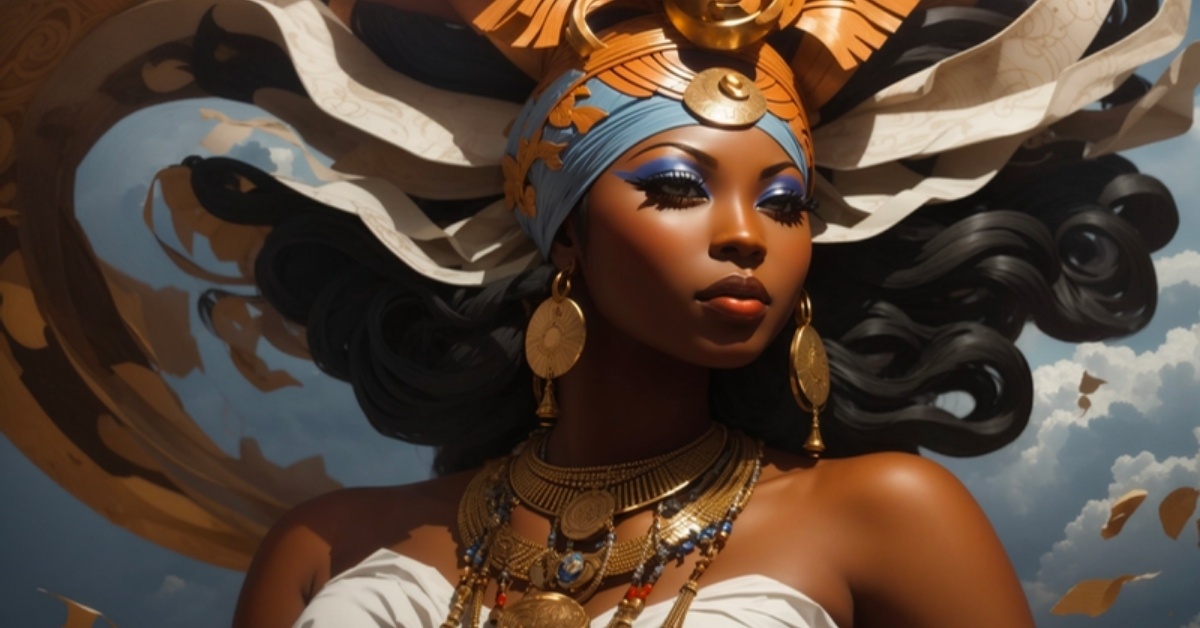
Ayao: Orisha of the Air and the Whirlwind
Stand at the center of a tornado and the wind stops. The funnel roars in a ring around you, and the column inside it is still air, a room of calm with the storm for walls.
In Cuban Lucumí tradition, that room has a tenant.
She is Ayao, orisha of the air and the whirlwind, younger sister of the storm herself. She is also one of the least public figures in the whole orisha family, kept by a small number of priests and spoken of with care, which is why so little about her ever reaches print.
Overview of Ayao
Ayao, written Ayaó in Spanish and sometimes Ayaó or Ayao in English, belongs to the Yoruba-descended family of orishas. Her home, as far as the written record goes, is Cuba. She is honored in Lucumí, the Cuban branch of orisha religion better known to outsiders as Santería, and in the Lucumí communities that have spread from there to Miami, New York, Puerto Rico, Venezuela, and beyond.
Her territory is the moving air. Wind, whirlwind, the small spiral of dust on a dirt road, and the vast one that pulls roofs off. Practitioners place her in two homes at once: the eye of the tornado, where the wind falls silent, and the forest, where she lives high in the crown of the ceiba or iroko tree and down among its roots.
She is a virgin warrior. Her closest bond is with Oya, the great orisha of storms and the cemetery gate, who is called her older sister. She works beside Osain, lord of the forest and its herbs, and her crossbow puts her in the company of the forest hunters, Ochosi above all. Practitioners describe her as a keeper of esoteric knowledge, a sorceress in the old sense of the word, someone who knows the plants and the secrets of the great tree.
She is honored alongside Oya, on Oya’s days, and most of what surrounds her belongs to initiates.
Titles
- Orisha of the Air
- Orisha of the Whirlwind
- Orisha of the Clouds
- Oya’s younger sister
- The chaste orisha, protector of girls and maidens
Characteristics
Ayao’s iconography is thin. Practitioners describe how she is kept and how she moves:
- Small, small enough to live among the roots of the ceiba
- Kept above the ground: her vessel hangs from the ceiling on chains or sits on a table
- Traveling as a whirlwind or a spiral of wind
- Young, serious, and chaste
- Dressed in brown and green in some houses, in dark red, yellow, and pink in others
Abilities
- Command of the wind — she raises the whirlwind and stills it
- Calming Oya — she is the steady center to her sister’s storm, and Oya’s children receive her to balance that energy
- Herbal knowledge — learned from Osain, and shared with those who petition her
- Esoteric knowledge — she holds the secrets of the ceiba and its ceremonies
- Guardianship — a fierce protector of girls and young women
Symbols
- The whirlwind — her form and her vehicle
- The crossbow with a serpent — her chief implement, a hunter’s weapon wound with the snake
- The quill — a pen, in some houses made of copper
- Nine stones — nine is her number, shared with Oya
- The ceiba and the iroko — the sacred tree that is her house, from crown to roots
- Brown and green — bark and leaf, in the lineages that dress her in forest colors
Traits
- Fierce, with a warrior’s readiness
- Chaste and pure, and protective of that purity in others
- Steadying, the calm inside her sister’s chaos
- Secretive, revealing little even to the people who keep her
- Loyal to Oya above all
Festivals and Rituals
Ayao rides with Oya. When Oya is celebrated, Ayao is there beside her, and that shared day is the whole of her public calendar.
Her worship works differently from that of the major orishas. Ayao is received: given to a priest as an addition to the orishas they already keep. She comes without a kariocha, the crowning ceremony that seats a major orisha on an initiate’s head. The people who receive her are usually the children of Oya, for whom she is described as foundational, a steadying presence. Others may receive her when divination calls for it. Practitioners name one household that stays outside her: the children of Yemaya.
What public sources agree on is the shape of her care. She eats what Oya eats, chickens and guinea fowl, and always at a height. She is set at a dressed table with flowers, fruit, and drink, and she is greeted at the foot of the ceiba. Her ceremonies are held up off the floor because she stays above the earth.
That is as far as the public record goes, and it is as far as this post will go. Everything else about her care is held inside initiate tradition, and it stays there.
Legends associated with Ayao
What the public record holds for Ayao is images: fragments of her nature that practitioners repeat, where the major orishas have whole biographies in patakis, the teaching stories of the tradition. Here are the ones that hold together.
The still center of the storm
Oya is the tearing wind. Her Yoruba name comes from ọ ya, “she tore,” and she travels as the tornado, the lightning, and the flood of the Niger River, which the Yoruba call by her name.
Ayao is what sits inside that. Practitioners place her in the eye of the tornado, the one calm place a storm has, and in the small whirlpool of air that spins up on a dry road. Where Oya rages, Ayao steadies. The saying in Cuban houses is that she always calms Oya, and that is why Oya’s children receive her: they carry their mother’s temperament, and Ayao is the counterweight.
It makes the sisters a matched pair. One is the storm. The other is the silence in the middle of it.
The one who stays above the ground
Ayao lives in the ceiba, the towering silk-cotton tree that Cubans of every faith treat as sacred, and which Lucumí practice identifies with the iroko of West Africa. She is said to live in its highest branches and, being tiny, among its roots as well.
From this comes the rule that shapes everything about her: she stays above the earth. Her vessel is hung from the ceiling on chains or kept on a table, she eats at a set table, and she is greeted at the foot of the tree. The image is of something airborne and elevated, a creature of the crown of the forest that has agreed to stay near the ground only on her own terms.
Osain’s pupil
The forest in orisha religion belongs to Osain, the one-legged, one-armed lord of the herbs, who knows every leaf and what it does. Ayao works with him, and in some houses with a female form of Osain called Oronikuin.
What she learns from him is the craft of plants and the secrets of the forest, the knowledge that Lucumí calls aché, the working power in leaves and roots. Her whirlwind is part of that. In West African thinking, the spinning wind that comes out of the bush is the forest’s own messenger, and a person carried off by it comes back changed. Ayao holds that door.
An older Ayao?
The written trail for Ayao is short, and nearly all of it is Cuban.
She appears in Lucumí treatises, in the practitioner literature, and in the oral teaching of Cuban houses. Nigerian sources are a different matter. The great documented figure of the Yoruba wind is Oya, whose cult began in the town of Ira in what is now Kwara State and spread through the Oyo Empire before the Atlantic slave trade carried her to Cuba and Brazil. Judith Gleason’s full-length study of Oya, drawn from both Nigeria and the Caribbean, treats the storm goddess in depth without a Nigerian Ayao standing beside her. Ayao, on the present evidence, is a figure the tradition articulated most fully in the diaspora, as a companion and counterweight within Oya’s own wind complex.
There is one Nigerian figure whose shape matches hers closely. Yoruba tradition knows an orisha called Àjìjà, or Aja, the orisha of the whirlwind, the forest, the animals in it, and the herbalists. Àjìjà carries people off in a whirlwind into the bush, keeps them lost there for weeks or months, teaches them the healing plants, and guides them back out as healers. Whirlwind, forest, and herbal secrets in one small deity: that is Ayao’s portfolio almost line for line. Whether Ayao descends from Àjìjà, or the two grew from the same West African idea of the spinning wind as the forest’s messenger, nobody has shown. The names differ, and no source traces a lineage. The resemblance stands on its own; a family tree would be a guess.
The other reason her record is thin is structural. Ayao is an orisha who is received, and only by a minority of priests. Her cult was at one point thought to be nearly lost in Cuba, and it has been recovering as more olorishas take her in. A deity kept by few people, in a tradition that guards its secrets, leaves a faint mark in public writing on purpose. What can be known about Ayao is limited, and much of the limit is by design.
Ayao across cultures
The idea that a spinning column of wind is a person, or carries one, turns up wherever whirlwinds do.
To the Navajo, the dust devil is a chindi, a spirit of the dead, and the direction of its spin tells you whether to worry. The Arikara and Arapaho of the Northern Plains speak of Whirlwind Woman, a dangerous storm spirit who, like Ayao, is a woman. In Australian Aboriginal tradition the willy-willy is a spirit that can take a misbehaving child away, an echo of the West African whirlwind that carries people into the bush. The Greeks gave each direction of wind its own god, the four Anemoi, and set Aeolus over them as keeper of the winds in a bag, while Japan’s Fūjin carries the winds in a sack on his shoulders and travels with his thunder-god twin Raijin, a storm pair much like Oya and her sister.
Closer to home, Ayao sits inside a family of powerful women. Oya shares Shango with two other river goddesses, Oshun of the Osun River and Oba of the Oba River, and Yoruba tradition gives each her own river and her own temper. Ayao is the one among them whose element is air alone, which may be part of why she stayed so hard to see.
Final thoughts
The loudest thing in the sky keeps a still room at its center, and the Lucumí put a sister in it.
Ayao is the reminder that power has an inside as well as an outside. Oya tears; Ayao holds. The tradition that keeps her has chosen to keep her mostly out of view, and the honest thing a writer can do is respect that choice, describe what is shared openly, and leave the rest with the people whose orisha she is.
When you picture the eye of a storm, do you imagine emptiness there, or someone waiting?
Bibliography
- “Ayao”. Wikipedia.
- “Ayaó”. EcuRed.
- “Ayao: La hermana menor de Oya”. Osha e Ifá.
- “Ayao”. Cuba Yoruba (blog).
- “Ayao”. Occult World.
- “Ọya”. Wikipedia.
- “Oya”. Santeria Church of the Orishas.
- Gleason, Judith. Oya: In Praise of an African Goddess. HarperOne.
- “Aja (orisha)”. Wikipedia.
- “Santería”. Wikipedia.
- “Storm Spirits and the Undead: Native American Tornado Myths”. Ancient Origins.
- “Dust Devils: Texas’ Ghostly Little Twisters”. Texas Parks & Wildlife Magazine.
- “Anemoi” and “Fūjin”. Wikipedia.