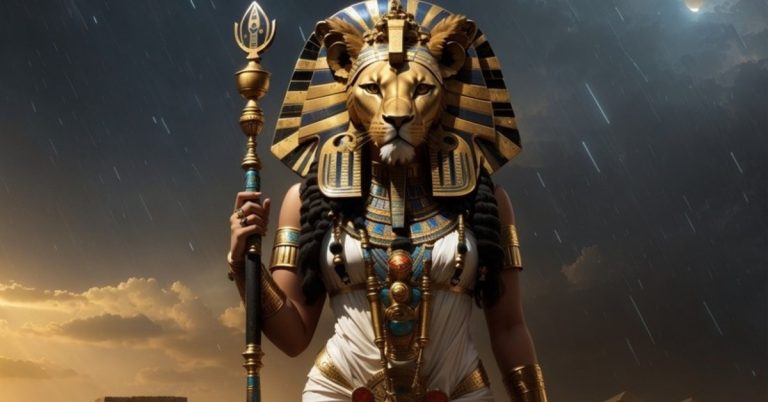
Oba: Yoruba Orisha of the River and Marriage
She cut off her own ear and stirred it into her husband’s dinner.
Oba did it for love, on the advice of a rival who wanted her gone. That one meal cost her the marriage, the house, and her place beside the king of thunder. Where the river that carries her name meets the river of her rival, the water still churns.
That confluence is where you find her now. Oba, orisha of the Oba River, first wife of Shango, and the patron of every wife who gave more than she was asked to.
Overview of Oba
One thing to settle first. In Yoruba, ọba is the ordinary word for king, the title carried by the Oba of Benin and dozens of other rulers across Nigeria. The goddess is Ọbà, a different word with different tones and a story of her own. This post is about her.
Ọbà is the orisha of the Oba River, which rises about fifteen kilometers north of Ogbomoso in Oyo State and runs south to join the Osun. Her worship began near the river’s source at Igbon, and during the wars of the nineteenth century her devotees carried her to the safer walls of Ogbomoso, where she is still honored today. The people of Iwo are called the children of the River Oba.
In the Yoruba homeland she is a daughter of Yemaja, the great mother of waters, and the senior wife of Shango, the third king of Oyo who became the orisha of thunder and lightning. That marriage is the center of her story. Oba is the orisha of the home and the marriage bed, of fidelity, of the long patience of a wife, and of what happens when that patience is spent.
She is a living presence. Yoruba practitioners in Nigeria, Cuba, Brazil, Trinidad, and across the Americas keep her shrines, sing her praises, and tell her story as something that is still true.
Titles
- Ọbà, orisha of the Oba River
- Senior wife of Shango
- “Oba, who owns parrot tail feathers and fights on the left” (her praise name at Ogbomoso)
- Obba, Obba Nani (Cuba)
- Obá (Brazil)
Characteristics
How Oba tends to be shown in art and in the dance of her devotees:
- A regal woman in the dress of a queen, often crowned
- One hand raised to cover an ear, or a wrap or headtie arranged to hide it
- Holding a sword or machete and a shield
- Dressed in pink in Nigeria and much of Cuba; red, white, and yellow in Brazil
- Carrying a horsetail flywhisk, the mark of royalty
Abilities
- Command of the river — she is the Oba River, its floods and its rapids
- Guardian of marriage — the orisha a wife petitions for a faithful, lasting home
- Warfare — in the diaspora she is a warrior who fights alongside Oya and has beaten every orisha but Ogun
- Endurance — the strength of the one who stays, and the strength of the one who finally leaves
- Keeper of the dead — in Cuba she watches over cemeteries with her sisters Oya and Yewa
Symbols
- The ear — the sacrifice that defines her, shown covered or as a sacred object on her altar
- The sword and shield — her warrior’s gear
- The river — the Oba itself, and the rapids where it meets the Osun
- The wheel — borrowed from Saint Catherine of Alexandria, one of the saints she is paired with in Cuba
- Copper — her metal in Santería, with pink and lilac beads on her necklace
Traits
- Devoted past the point of reason
- Proud, and slow to show a wound
- Fierce when her loyalty has been spent
- A strategist, in Brazil the general of the women’s societies
- Protective of wives, of women who have been deceived, and of anyone who has loved without being loved back
Festivals and Rituals
Oba’s oldest center is the town of Odo-Oba near Ogbomoso, where her festival is still held on the river that bears her name. Offerings go into the water. Her praise names are sung, the ones that call her the warrior who fights on the left, the partner of Ajagun, the fighter.
In the diaspora her worship travels with the Catholic calendar. Cuban houses pair her with Saint Catherine of Siena, and some keep her day on May 22, the feast of Saint Rita of Cascia, the patron of difficult marriages. Devotees offer her yams, honey, and coconut, and they ask her for what her own story withheld from her: a faithful partner, peace at home, and love that lasts.
Her taboo is the ear. Her priests and her initiates avoid drawing attention to it, and in some houses her sacred objects include an ornament made to hide the wound.
Legends associated with Oba
Oba has one great story, and it is told from Nigeria to Havana to Bahia with the same bones and different flesh. Around it gather the tales of her warrior years and the rivers she and her rival became.
The three wives of Shango
Shango ruled Oyo as its third king before he became the orisha of thunder, and he ruled his household the way he ruled everything: loudly, hungrily, and with a great deal of fire.
He had three wives. Oba came first, the legitimate wife, the one whose sons would inherit. She kept his house and his counsel. Then came Oshun, the river goddess of sweetness, beauty, and cunning, and Shango loved her cooking above every other pleasure in his life. And there was Oya, the storm, the wind that runs ahead of his thunder, who fought at his side and was raised to be his queen.
Three rivers in one compound. It was never going to be calm.
Oba watched Shango’s eyes follow Oshun to the kitchen and back. She was his first wife and his most faithful, and she was losing him one meal at a time.
The ear in the soup
So Oba went to Oshun and asked her the question a proud woman hates to ask. What is your secret? How do you keep him?
Oshun saw her chance. She wrapped her head so that one ear was hidden, and she told Oba the truth as she wanted Oba to hear it. Years ago, she said, she had cut off a piece of her own ear, dried it, and ground it to powder. She stirred it into Shango’s food, and from that day he could refuse her nothing. Oba stared at the headtie and believed every word.
That evening Oba cooked Shango’s favorite dish, amala with a rich soup, the way he liked it best. Then she took a knife, cut off her own ear, and dropped it into the pot.
Shango sat down to eat. He was several mouthfuls in when something pale floated up through the soup, and he lifted it out and saw what it was.
He roared. Poison, he shouted, witchcraft, his own wife trying to kill him at his own table. Thunder broke over the compound. The women ran. Oba fled from the house with her hand pressed to the side of her head, weeping, and as she ran she fell to the earth and became a river.
Where the rivers meet
The story does not end with Oba’s fall, because Shango was a king, and a king finds out who lied to him.
When he learned what Oshun had done, he called her out into the rain and the storm, and she too dissolved into water. She became the Osun River, the one that runs through the sacred grove at Osogbo. Oba became the river that flows south from Ogbomoso.
The two rivers meet near a village called Odo-Oba, at the northern end of what is now the Asejire Reservoir, and they meet in a stretch of rapids. The water there is rough and loud, two calm rivers colliding instead of merging. The Yoruba say that this is the two co-wives, still fighting. Oshun and Oba never made peace, and the river shows it.
The ear that worked
One telling ends in triumph. In the verses of Ifá, the Yoruba divination corpus, the story turns.
In that version, Oba goes to the diviners, and Ifá tells her to lend Shango her ear. She does exactly that. She listens. She is the one wife who pays attention to his ideas, and it binds him to her more surely than any charm, because none of the others would hear him out. The ear that ruins her in one telling is the ear that wins him in the other.
Cuban tellings add their own turns. In some, the trickster who deceives Oba is Oya rather than Oshun. In one, the rivalry drops out entirely: a famine has emptied the compound, and Oba feeds her husband the only meat she has left, which is her own. The story keeps changing hands.
The warrior of the rivers
Across the Atlantic, Oba grew a second life.
In Brazil’s Candomblé she is Obá, the guerreira, the warrior of the waters. The itans say she fought her way through the orixás one by one. She beat Eshu, the trickster. She beat Oshumare, the rainbow serpent. She beat Omolu, the lord of disease, and even Orunmila, the master of divination. The gods feared her. Only Ogun, the orisha of iron and war, ever brought her down, and in some houses he became her husband afterward. She leads the Elekô society and the Gelede, the women’s societies that no man may enter.
In Cuban Santería she is Obba Nani, daughter of Obatala, sister to Oya, Oshun, and Yewa. She guards the cemetery gate with her sisters. She is the orisha of the wife who gave everything, and her people call her brave and misunderstood, strong and tolerant, and jealous when she has cause.
The severed ear traveled with her. On her altars in Havana and Salvador it is there, as an object or as a covered wound, the mark of the story that made her.
An older Oba?
Oba’s story is unusual among goddess myths in one way: you can go and stand in it. Drive out from Ogbomoso to Odo-Oba, and the rapids where two rivers quarrel are right there in the water. The Yoruba have long read the landscape as sacred biography, and the confluence of the Oba and the Osun is a clear case. The rough water came first. The story of two wives who never made peace is the way generations have explained what the river was already doing. In that sense the myth is a map, and Oba is the name the land gave to its own turbulence.
The scholar William Bascom, who worked among the Yoruba and then in Cuba and Brazil, traced this myth across the ocean in a 1976 study called “Oba’s Ear.” He collected versions in Nigeria, in Havana, and in Bahia, and found the same core traveling intact: a wife, a rival’s lie, an ear in the food, a husband’s fury, a river. What changed was the frame around it. Nigerian tellings keep the river and the landscape. Cuban and Brazilian tellings, cut loose from the Oba River itself, grew the warrior and the cemetery guardian instead, and they attached Oba to Catholic saints who had suffered in marriage, Catherine of Siena and Rita of Cascia. The myth held. The goddess adapted to hold it.
The Ifá reading points to something older still. In the diviners’ verses, Oba’s ear is a virtue. She listens, and listening wins. Set beside the popular tale, the two versions look like a single theme argued from both sides: how much should a wife give? The popular story answers with a warning, the diviners answer with a blessing, and the Yoruba tradition keeps both. Whatever Oba was before the ear story reached her, and the sources fall silent there, she has been for a long time the orisha who carries that question in her body.
Oba across cultures
The pattern of the first wife displaced by a favored rival runs through mythology on every continent. Hera, queen of the Greek gods, spends her legends punishing the women Zeus prefers, and her fury has the same source as Oba’s grief, a marriage in which the husband’s attention is the only currency. Where Hera turns on the rivals, Oba turns on herself. That is the difference in the two stories, and it is why one goddess reads as a tyrant and the other as a wound.
The woman who becomes a river is nearly as old. Ovid’s Byblis weeps until she dissolves into a spring. Greek river nymphs and Indian river goddesses like Ganga carry the same idea: a woman’s sorrow or devotion pours out of her and never stops flowing. Oba belongs to that family, with one distinction. Her river has a second river to argue with.
In the Americas the Church supplied its own echo. Catherine of Siena, the mystic who called herself the bride of Christ, and Rita of Cascia, who endured an abusive husband and was later named the patron of impossible causes, were both drafted to stand for Oba behind a Catholic mask. The match is closer than most syncretisms. Both saints loved beyond what love returned to them, and both were rewarded for it in the end. That is the ending Oba’s devotees ask her for, and the one her own story never gave her.
Final thoughts
Read one way, Oba is a warning, the wife who gave too much and lost everything. Her devotees read her the other way.
The Oba they honor is the one who is still there in the rapids, still fighting, who crossed an ocean and became a general, who guards the cemetery gate beside the sister who was once her rival. She kept the wound and made it hers. The ear on her altar is the place where devotion and self-destruction meet, and she asks the people who come to her to know the difference.
Where is that line for you? What does love ask of you, and when does giving it become giving yourself away?
Bibliography
- Bascom, William. “Ọba’s Ear: A Yoruba Myth in Cuba and Brazil”. Research in African Literatures, Vol. 7, No. 2 (Autumn 1976), pp. 149–165.
- Brown, David H. Santería Enthroned: Art, Ritual, and Innovation in an Afro-Cuban Religion. University of Chicago Press, 2003.
- González-Wippler, Migene. Santería: The Religion. Llewellyn, 1994.
- Ogunsunlade, Imisioluwa. “Sàngó and His Wives”. Oriire, 2023.
- “Obba Nani: Orisha of Fidelity and Devotion in Santeria”. Osha e Ifá.
- “Orixá Obá: A Guerreira das Águas”. Candomblé Desmistificado.
- “Ọba (orisha)”, “Oba River”, and “Obá (orixá)”. Wikipedia.
- “Nigeria’s Ọ̀ṣun Òṣogbo festival celebrates the power of a Yoruba goddess”. The Conversation.