Juksahkka: The Sami Bow-Woman and Protector of Boys
In the old Sámi reckoning, every child in the womb began as a girl.
Whether that child was born a boy depended on one goddess, and on whether the family had left her enough. She lived at the back of the tent, where the drum and the hunting weapons were kept, and her name means bow-woman.
Of the three áhkká sisters, Juoksáhkká is the one people talk about least. She is also the one who decided who would grow up to carry the bow.
Overview of Juksahkka
Juoksáhkká, written Juksáhkká or Juksakka in the older records, is one of the three daughters of Máttaráhkká, the ancestral mother of pre-Christian Sámi religion. Her home is Sápmi, the Sámi homeland that runs across the north of Norway, Sweden, Finland, and Russia’s Kola Peninsula. The record places her in the Scandinavian part of it. Eastern Sámi communities, including those in what is now Finland, seem to have had no daughters of Máttaráhkká at all.
Her name is her whole description. Juoksa is the Sámi word for bow, and áhkká is the word for an old woman, a wife, or a goddess. The bow is her place in the tent, her offering, her gift to the child, and the reason she exists.
The four home goddesses lived in the ground under the goahti, the Sámi tent, and each had her own square of it. Sáráhkká lived under the hearth, Uksáhkká under the door, and Juoksáhkká at the back, in the sacred space behind the fire called the boaššu, where the drum and the hunting gear were stored and where, by custom, women stayed out.
Making a child was a chain of hands. The high god sent the soul to Máttaráhkká, who built a body around it and passed it to Sáráhkká, who placed it in the mother’s womb. At that point the child was a girl, because in this belief every child started that way. Then Juoksáhkká’s part came. A family that wanted a son made offerings to her, and she turned the girl into a boy before the birth.
Titles
- Juoksáhkká, the Bow-Woman (juoksa, “bow,” and áhkká, “woman”)
- Juksáhkká, Juksakka, Juks-akka (spellings in the 17th- and 18th-century records)
- Joeksaahka (South Sámi)
- Stäukedne, “bow mother,” and Jiukom-áhkká, recorded as local names in a few districts
Characteristics
All the record gives her is a place on the drum:
- A small figure on the drum skin, drawn beside her sisters beneath the sun
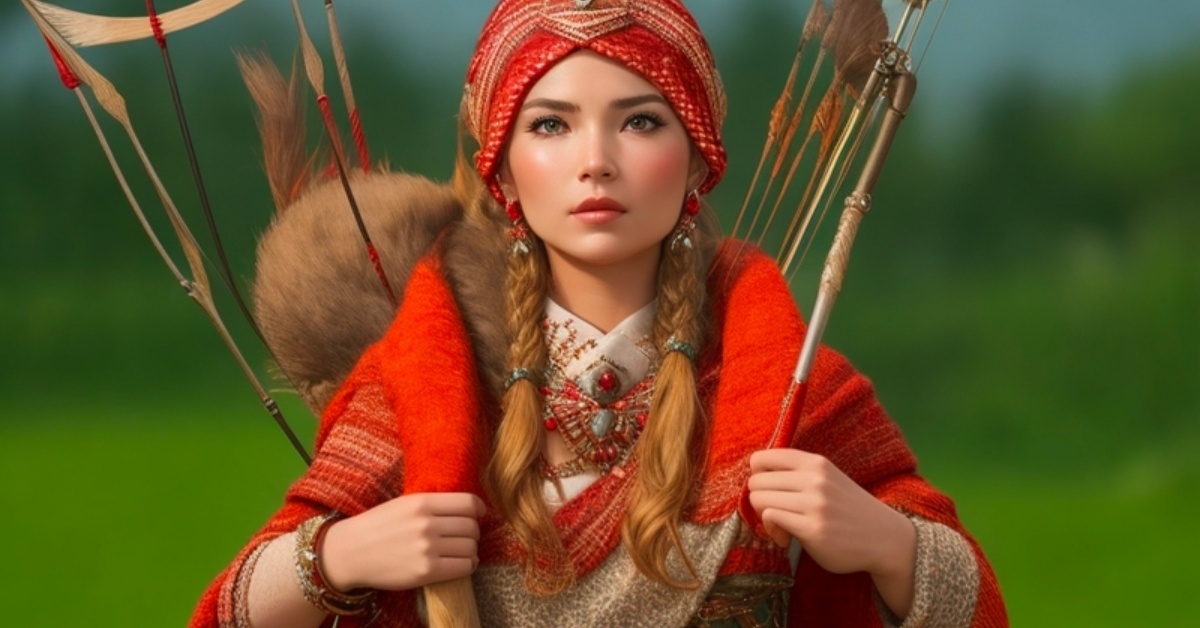
- Sometimes holding a bow, the one thing that marks her apart from Sáráhkká and Uksáhkká
- Reached by offerings poured or laid into the ground at the back of the tent
Abilities
- Deciding the child’s sex — she turns a girl into a boy in the womb, when the offerings are enough
- Guarding boys — from conception through boyhood; Christfried Ganander, writing in 1789, adds that she kept children safe from shots and falls
- Helping women — Ganander also names her as a helper during menstruation
- Making a hunter — the boy she shapes grows up under her bow, and the family asks her for his skill with it
Symbols
- The bow and arrow — her name, her drum figure, and the small bow hung beside a son’s cradle
- The back of the tent — the boaššu, the men’s sacred space behind the hearth
- The drum — kept in her part of the tent, with her figure painted on it
Traits
- Decisive: she is the one sister whose act changes what the child will be
- Tied to the male sphere while remaining a goddess, seated in the space kept for men
- Transactional in the sources: the sex of the child follows the size of the offering
Festivals and Rituals
No calendar festival for Juoksáhkká survives. Her worship was household worship, done at the back of the tent, and it centered on one wish: a son.
The plainest ritual was the offering itself. Drink and food went into the ground where she lived, in the same way Sáráhkká was fed at the hearth and Uksáhkká at the door. Families who wanted a boy gave more.
After a birth, the mother ate a porridge in Sáráhkká’s honor, and the porridge carried an omen. In one account, three small pieces of a bow and arrow were dropped into the porridge for a son, and the way the mother’s spoon met them told the boy’s future.
Then came the bow by the cradle. A miniature bow and arrow were hung beside a baby boy so that he would grow into a skilled archer, and so that the bow-woman would keep him. It was a toy, a prayer, and a job description in one.
Legends associated with Juksahkka
Juoksáhkká has no story in the sense that a Greek goddess has stories. No missionary wrote down a myth about her, and the Sámi who knew one were the people the missionaries were trying to silence. What survives are practices, and in each of them she is the one who acts. Read together, they are her legend.
The girl who became a boy
The center of Juoksáhkká’s cult is a piece of reproductive cosmology recorded across the Scandinavian Sámi areas: every child begins in the womb as a girl.
This runs against most of the ancient world. Aristotle, writing in the fourth century BCE, treated the female as a male who fell short in the making. The Sámi picture starts from the opposite end. The girl is the default. A boy is a change, and the change takes a goddess.
The change also takes a gift. The sources agree that Juoksáhkká acted when she had been given enough, and the Sámi Parliament’s own summary of the tradition puts it in one line: people made offerings to Juoksáhkká when they wanted a son, since they believed all fetuses began as girls. Sons were wanted in a hunting and herding economy, so her offerings were plentiful. The Ájtte museum in Jokkmokk records a slightly different telling, where one of the daughters decides the sex, Sáráhkká if a girl and Juoksáhkká if a boy, which makes the sisters a pair of gates.
The goddess in the men’s space
Her address is the strangest thing about her. The boaššu at the back of the tent held the drum and the hunting weapons, and by custom women kept away from it. The hunting bow itself was a man’s tool, kept out of women’s hands. Yet the goddess who lived there, and who carried a bow on the drum, was female.
The contradiction has a logic once you follow the child. She is the sister who makes boys, so she keeps the boys’ things, and she keeps them in the place where a boy will someday be allowed to go and his sister will not. The whole geography of the tent, hearth to door to back wall, is the life of a child laid out on the floor: conceived at Sáráhkká’s fire, carried out through Uksáhkká’s door, and raised toward Juoksáhkká’s bow.
Which sister?
Even the missionaries who preserved her lost track of her. Christfried Ganander, in his 1789 Mythologia Fennica, credits Uksáhkká, the door-woman, with turning daughters into sons, a power the older Scandinavian sources give to Juoksáhkká. Hans Skanke’s 1731 inventory of a South Sámi drum lists Sarakka and Jugsakka among the figures and folds Uksakka into her sister, then adds their mother Maderakka to keep the count at three. The accounts that place her at all put her at the back of the tent; the rest give her no fixed spot.
That swapping is the closest thing she has to a legend: a goddess whose name held steady while the men writing her down kept trading her powers back and forth with her sisters.
An older Juksahkka?
A Finnish scholar named Uno Harva put his finger on the problem a century ago. Harva, who published as Uno Holmberg, spent his career on the religions of the Finno-Ugric peoples, and Juoksáhkká bothered him. A goddess holding a bow, in a culture where women were barred from touching one, looked to him like a foreign import.
Take that seriously, and it changes what the sources can tell you. Everything we have on Juoksáhkká was written between the 1670s and the 1840s by Lutheran clergy and crown officials whose job was to end her worship. Samuel Rheen described the Lule Sámi in 1671; Nicolai Lundius and others sent similar reports, and Johannes Schefferus compiled them into Lapponia in 1673. In Norway, Johan Randulf’s Nærøy manuscript of 1723 and Hans Skanke’s account of 1728–1731 grew out of Thomas von Westen’s mission, which confiscated drums by the dozen. In Sweden, a Sámi man named Lars Nilsson was burned at Arjeplog in 1693, together with his drum, for using it to try to bring back a drowned grandson. Lars Levi Læstadius, a pastor of Sámi descent, tried in the 1840s to correct the earlier accounts in his Fragments of Lappish Mythology, and even he was working at a century’s remove from a religion already driven indoors.
So the record of the bow-woman is a confession record. It comes from people who were being questioned, translated by people who disapproved, and copied by people who had never seen a drum. It is also regional. The written material clusters in the South Sámi area, the daughters of Máttaráhkká were unknown in the east, and Juoksáhkká’s name, place, and powers shift from district to district. Harva’s reading, that she came in from outside, is one way to explain the shifting. Another is that a goddess who governs the sex of the child sat on the seam between the women’s world and the men’s, and the missionaries, who noticed neither world clearly, kept mislabeling her.
Either way, what she preserves is real. The belief that every child begins female, and that a goddess makes some of them male, is a rare window into how Sámi people once thought about sex and how it was decided. Bow, tent, drum, and cradle all point at the same place. And the tradition has a present tense. Sámi women organized under the name Sáráhkká in 1988, the drum is back in Sámi art and music, and the goddesses of the tent belong to a living people who are still deciding, for themselves, what to do with what the missionaries left behind.
Juksahkka across cultures
A goddess who decides whether a baby will be a boy has few exact counterparts, but the pieces of her turn up everywhere.
The nearest is the bow at the cradle. Across Siberia and Central Asia, families hung a small bow and arrows over a boy’s cradle so he would grow up a hunter and a warrior, and among Turkic peoples the child-goddess Umay watched over the cradle the way the áhkká sisters did. The Sámi practice belongs to that same northern world.
Rome had the habit of splitting a single event among many small gods. A Roman birth called on one deity for the first cry, another for the cradle, and another for the child’s first steps out of the house. The three sisters divide the child’s early life in the same spirit, with one difference: the Roman helpers were a crowd, while the Sámi ones were a family with a floor plan.
And on the drum itself, she sits beneath Beiwe, the sun, who was painted at the center and who protected the reindeer calf as the sisters protected the child. A sun mother above, a bow-woman at the rear of the tent, and a girl in the womb waiting to be told what she will be. It is a small cosmology, drawn on a single piece of reindeer skin.
Final thoughts
The bow-woman comes down to us as a few paragraphs written by men who wanted her gone.
What those paragraphs preserve is a people’s answer to a question every culture has asked, which is where a boy comes from. The Sámi answer was that he comes from a girl, and that the change is the work of a goddess who keeps the hunting gear and takes her payment in advance. The recorders found it strange enough to write down and dangerous enough to suppress, and they managed, between them, to do both.
She is the least visible of the three sisters, and the one whose decision mattered most to the family waiting by the fire. If you could ask the women who fed her at the back of the tent one question about her, what would it be?
Bibliography
- Samiskt informationscentrum (Sametinget). “Gudavärlden”. Samer.se.
- Ájtte, Svenskt Fjäll- och Samemuseum. “Sami goddesses”. Ájtte.
- Bäckman, Louise, and Juha Pentikäinen. “Sami Religion”. Encyclopedia of Religion, via Encyclopedia.com.
- Læstadius, Lars Levi. Fragments of Lappish Mythology. Ed. Juha Pentikäinen, trans. Börje Vähämäki. Aspasia Books.
- Rydving, Håkan. The End of Drum-Time: Religious Change among the Lule Saami, 1670s–1740s. Acta Universitatis Upsaliensis.
- Skanke, Hans. “A lost South Sámi drum, described by Hans Skanke in 1731”. Old.no.
- Ganander, Christfried. Mythologia Fennica. Turku, 1789.
- Holmberg (Harva), Uno. Lappalaisten uskonto. WSOY, 1915.
- Aristotle. On the Generation of Animals. Trans. Arthur Platt, via MIT Classics.
- “Juoksáhkká”, “Máttaráhkká”, “Sáráhkká”, and “Uksáhkká”. Wikipedia.
- “Samuel Rheen” and “Nærøy manuscript”. Wikipedia.