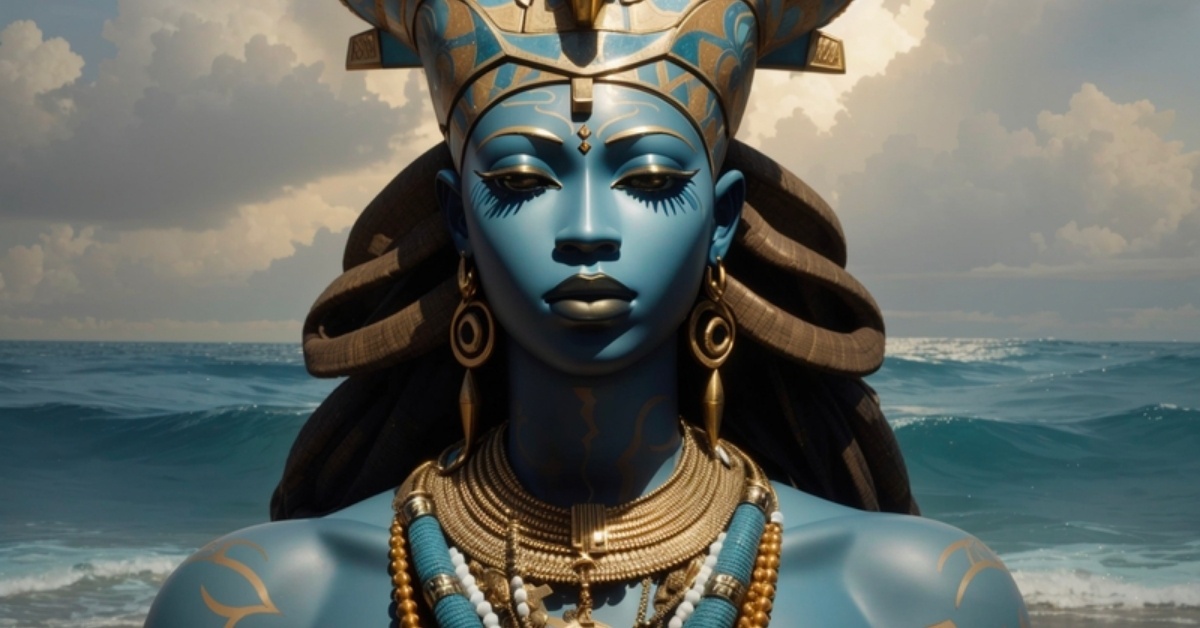
Olokun: Orisha of the Deep Sea
Somewhere below the last of the light, the water goes still.
That is where Olokun lives: the floor of the sea, the one part of the world no living person has looked at. The Yoruba call the deity the owner of the ocean, and everything the ocean keeps belongs to Olokun too. Sunken ships. Coral and pearls. The drowned.
Wealth past counting, secrets past telling, and a temper that once tried to take the whole world back under water.
Overview of Olokun
Olokun’s name says the job plainly. In Yoruba and in Edo, olo means owner and okun means sea: Olokun, the owner of the sea. The deity belongs to the Yoruba of southwestern Nigeria and, with equal force, to the Edo people of the old Kingdom of Benin next door, and traveled with both across the Atlantic into Cuba, Brazil, Trinidad, and beyond.
Ask who Olokun is and the answer changes with the shoreline. Along the coast, worshipers usually speak of Olokun as male, a king under the waters; inland, Olokun is more often a goddess; in Cuban Lucumí (Santería) the orisha is androgynous, one face received through Ifá and another through Ocha. The Edo of Benin, whose sea deity has drawn women’s congregations for centuries, speak of Olokun as both the great mother of wealth and children and the “king of the waters” mirrored by their own Oba. This site files Olokun among the goddesses, and that is one true reading of a deity whose gender was always allowed to move like the tide.
What holds steady underneath is the territory. Olokun rules the deep ocean, the abyss beneath the waves that Yemoja governs at the surface. From that dark comes wealth, in cowries and coral and everything ships have ever carried. From it comes health, fertility, and the kind of knowledge that arrives in dreams. And in it rest the dead the sea has taken, which in the Americas came to mean something very specific.
Titles
- Olokun, “Owner of the Sea”
- Owner of the Deep
- Ruler of the Great Waters
- King of the Waters (the Edo title, paired with the Oba as “king of dry land”)
- Mother of Wealth and Children (in Benin’s women’s congregations)
- Guardian of the Middle Passage (in the diaspora)
Characteristics
How Olokun tends to be shown:
- Rising from dark water, sometimes with the tail of a fish, as merman or mermaid depending on the telling
- Robed in deep blue, black, or white, the colors of the abyss and of ritual purity
- Wearing a mask, or half hidden, a face that stays partly unseen
- Heavy with coral beads and strings of cowries
- Often bound with chains, a reminder of the flood
- In Benin, present in the mud figures and wavy white chalk lines of household shrines
Abilities
- Wealth — every fortune that comes by sea is Olokun’s to give, from cowrie money to coral to trade goods
- Fertility and children — in Benin, Olokun is the deity women ask for a child
- Health and stability — in Lucumí, initiates receive Olokun for these blessings by name
- Prophecy and dreams — the deep is where the unknown lives, and Olokun sends word up from it
- Command of the ocean — floods, storms, calm passage, and safe return all lie in Olokun’s hands
- Keeping of the dead — souls who die at sea rest in Olokun’s house until released to the ancestors
Symbols
- The ocean floor — Olokun’s true image in nature
- Cowrie shells — money, divination tools, and Olokun’s own currency
- Coral — the red beads of Benin royalty, said to come from Olokun’s palace
- Chains — the seven links that hold the sea in its bed
- The sealed vessel — in Lucumí, Olokun lives in a covered pot or tureen whose contents stay private
- White chalk — orhue in Edo, drawn in wave patterns on shrines and worn on the faces of devotees
- Colors and number — deep blue and white, sometimes green, and the number seven
Traits
- Unfathomable: the deity of what has never been seen
- Generous without limit to those who give proper respect
- Proud, and quick to answer a slight with a flood
- Ancient, older than the land itself in the creation stories
- Private, preferring a covered vessel and a closed shrine to public show
- Steady at the bottom of everything, the way the sea floor is
Festivals and Rituals
Olokun’s worship has always happened at the water’s edge. Offerings go into the sea itself: fruit, cooked yams, molasses, grains, and in the old way, ducks and other fowl. Devotees dress in white and coat their faces with white chalk, then drum and dance on the beach.
In Benin, Olokun is the most widely venerated deity of all, with shrines in homes, family compounds, and village quarters. Priestesses called ekhaemwen-Olokun, most of them women who have passed through seven years of initiation, keep the shrines and lead the prayers. The great state shrine stands at Urhonigbe, founded by tradition under Oba Ohen in the fourteenth century, where an annual festival draws the villages of the “Olokun triangle.” The Oba’s own year-end Igue rites, held between Christmas and New Year, keep the bond between the king of the land and the king of the waters.
In Lagos, Olokun walks the streets. The white-robed masquerades of the Eyo festival include an Eyo Olokun group, and in Ile-Ife the Olokun grove hosts the deity’s own annual celebration. Across the ocean, Trinidad’s Ase Odun Olokun gathers devotees at river mouths and mangroves, and Brazilian Candomblé honors Olokun on the feast of Yemanjá.
Legends associated with Olokun
Olokun’s stories share a single shape: the sea was here first, the sea is richer than anything on land, and the sea has to be persuaded, tricked, or chained into leaving the rest of us alone.
The sea before the land
In the beginning there was only water, and the water was Olokun’s.
The orishas lived in the sky with Olodumare, the supreme god, and looked down on an endless gray ocean. Obatala, the sculptor of the orishas, found it a waste. He asked permission to make land, gathered a snail shell of sand and a five-toed hen, and climbed down a golden chain to the surface of the water. He poured out the sand. The hen scratched it in every direction, and wherever it scattered, dry ground appeared. Obatala named the place Ile-Ife, molded people from clay, and went back up to heaven to rest.
He had asked Olodumare’s permission. He had never asked Olokun’s.
Olokun looked at the mud and the villages spreading across what had been open water and felt the insult land. Nobody had consulted the owner of the sea about giving away the sea. So Olokun called the waters up. The tide climbed the fields, then the houses, then the hills. People drowned by the hundreds while the orishas in heaven argued about what to do.
Eshu carried the people’s prayers upward. Obatala consulted Orunmila, the god of divination, who told the orishas what they were dealing with: a force older than any of them, and a fair grievance. Force alone would fail. So they went to Ogun, the smith, and asked him for the longest chain he could forge. Obatala took it down to the water and, as the Ifá verses tell it, bound Olokun with seven chains and fixed the deity to the floor of the ocean.
The waters fell back to their bed. They are still there, and so are the chains. When the sea heaves and the storm surge comes ashore, the old people say Olokun is testing the links.
The contest of cloths
Olokun ruled everything under the water, and in time that stopped feeling like enough.
The sea had made Olokun rich beyond any orisha. Dyed cloth was the great wealth of the Yoruba world, and Olokun’s stores of it were bottomless: indigo and crimson, cloth shot with gold, cloth patterned like fish scales and foam. Who in heaven could match it? Olokun decided to find out, and sent word to Olodumare: a contest, the finest robes against the finest robes, and let everyone see who owned the most.
Olodumare agreed, and then did something the sea deity never expected. He stayed home. In his place he sent his messenger Agemo, the chameleon, to stand in for him.
Olokun came out in a first robe, a blue so deep it drank the light. Agemo’s skin turned the same blue. Olokun changed into a second robe, green shot with silver. Agemo matched it. A robe of crimson; a robe striped like the tide line; a robe woven in every color the sea has ever held. Each time, the little chameleon wore the same thing, thread for thread, and stood there looking politely bored.
Olokun stopped. If a mere messenger could do this with his skin, what could the master do? The deity bowed, took off the last robe, and went back down into the water, and never again claimed to be Olodumare’s equal. The sea keeps its wealth to this day. It also knows who is in charge.
The jealous wife and the Atlantic
In another telling, Olokun is a woman, and the ocean is what her anger made.
Oduduwa, the first king of Ile-Ife and ancestor of the Yoruba, took Olokun as his senior wife. He took other wives too, and one of them stood too high in his favor for Olokun’s liking. The rivalry ran hot and then ran over. In her fury Olokun struck the earth, and the water that poured out spread west without end. That water is the Atlantic. The Yoruba coast looks out on the ocean a queen’s jealousy made, and the sea has been temperamental ever since.
The king who stole the coral
The Edo of Benin tell a story about how the red coral beads of their kings came into the world, and it starts at Olokun’s palace.
Oba Ewuare, who ruled Benin in the middle of the fifteenth century, traveled to the house of Olokun under the waters. There he saw the deity robed in coral, strings of it, whole garments of it, glowing red in the dark. He stole it. He carried the coral back to Benin and put it on, and from that day the Oba of Benin has worn Olokun’s coral as the mark of his rank. Only the Oba grants the right to wear it.
Historians hear something specific under the legend. Ewuare’s reign is the moment Portuguese ships first appeared off the coast, bringing coral, brass, and cowries in trade. To the Edo, the strangers had come out of Olokun’s own domain, so their goods were Olokun’s wealth arriving at last. The king who stole the coral is the king who opened the sea.
The ones the sea keeps
The last story is the newest, and in the Americas it is the one that matters most.
Olokun has always kept the drowned. In Yoruba belief, souls who die at sea stay in Olokun’s house until the deity chooses to release them to the ancestors. Then came the centuries of the slave trade, and the Atlantic filled with the dead: the Africans who died in the holds, who were thrown overboard, who went over the side by choice rather than arrive. Their descendants in Cuba and Brazil looked at the ocean between themselves and home and understood who held it.
So in Lucumí, Olokun became the guardian of the Middle Passage. The deity who owns the floor of the sea owns the place where those ancestors lie, and keeps them. When initiates receive Olokun in a sealed vessel and set it in a private place in the home, they are receiving, among other things, the memory of everyone the crossing took. The orisha of unfathomable depth turned out to be the one who could hold an unfathomable grief.
An older Olokun?
The brass head that Leo Frobenius dug out of the Olokun grove at Ile-Ife in 1910 is the hardest evidence we have for how long people have been bringing offerings to this deity. Frobenius, a German explorer with a weakness for grand theories, decided the head was Greek work and the grove a relic of lost Atlantis, with Olokun as a local Poseidon. He was wrong about all of that. Scientific reexamination in 2010 confirmed the head as a genuine lost-wax casting of the Ife school, made somewhere between the thirteenth and fifteenth centuries, and the sculpture now called Ori Olokun stands as the best-known image ever associated with the deity.
Benin’s record runs almost as deep. Edo tradition credits Oba Ohen, in the fourteenth century, with founding the state shrine at Urhonigbe, and the Igue rites that honor the Oba’s bond with Olokun are said to go back to Ewuare’s reign a century later. Anthropologists who documented the cult in the twentieth century, among them Paula Ben-Amos and Norma Rosen, who was herself initiated in Benin City, found a religion built around women: congregations praying for children, priestesses with seven years of training, mud sculptures and wave-patterned chalk on every shrine, and a deity understood as the source of every fortune that arrives by sea. In the court’s own cosmology, Olokun is “king of the waters” and the Oba is king of dry land, with the great rivers as Olokun’s wives. Popular Edo devotion just as readily calls Olokun the goddess of the sea. Both are old.
That doubleness seems to be the point. Where the sea is a working neighbor, along the coast, Olokun is a king; where it is a distant giver of children and wealth, inland, Olokun is a mother; where it is a grave, in the diaspora, Olokun is both at once and receives the dead. Different peoples gendered the water according to what they asked of it, and the deity let them. What stayed fixed through all of it is the depth: for as far back as the record reaches, Olokun has been the owner of the part of the world that stays unseen.
Olokun across cultures
Olokun belongs to a crowded coastline of water spirits, and the family resemblances are strong.
Nearest are the other Yoruba waters. Yemoja, the river mother who became the ocean’s surface in the Americas, is Olokun’s sister, wife, mother, or daughter depending on who tells it, and some Cuban lineages honor the two together as one power seen from above and below. Oshun holds the sweet rivers, the fresh water that runs down into Olokun’s salt. Westward, among the Fon of Benin Republic, the creator Mawu and the primordial grandmother Nana Buluku rule from a similar kind of depth, older than the gods who do the daily work, and the Fon tend to speak of Olokun as female too.
Further out, the pattern repeats. Haitian Vodou has Agwe, admiral of the sea, whose offerings are floated out on rafts to sink into his domain. All along the West African coast Mami Wata appears, the mermaid spirit of wealth and danger whom Olokun’s fish-tailed images often resemble. And Frobenius, for all his Atlantis nonsense, was reaching for a real likeness when he thought of Poseidon: a sea god with a grudge, who floods a coast when a rival wins the land. The sea is the same everywhere. So, it turns out, is the way people have imagined its owner.
Final thoughts
Olokun is the one deity defined by a place no one living has ever seen.
That is a strange thing to worship and a very honest one. The sea gives cowries, coral, fish, and safe passage. It takes ships and whole generations, and it explains none of it. Olokun holds all of that without apology: the wealth, the flood, the drowned, the chains. Devotees in Benin, Lagos, Havana, and Salvador are still bringing white cloth and cooked yams to the shoreline, and still keeping a covered vessel in a private room, because some things are better honored than understood.
Which is the harder thing to carry, the sea’s riches or its dead?
Bibliography
- “Olokun”. Wikipedia.
- Ben-Amos, Paula, and Flora Edouwaye S. Kaplan. “Edo Religion”. Encyclopedia of Religion, via Encyclopedia.com.
- Rosen, Norma. “Chalk Iconography in Olokun Worship”. African Arts 22, no. 3 (1989).
- Mackay, Danielle. “Olokun”. Mythopedia.
- Paneque, Cosette. “Olokun, great mysteries at the bottom of the ocean”. CosettePaneque.com.
- “The Olokun head reconsidered”. Afrique: Archéologie & Arts.
- “Oba Ewuare and the Portuguese”. Art Institute of Chicago, Benin: Kings and Rituals.
- “Pendant: Oba Flanked by Attendants (Edo peoples)”. The Metropolitan Museum of Art.
- “Olokun: Why the goddess of the sea is accorded respect”. Nigerian Tribune.
- “Olokun Deity and Its Various Olokun Festivals”. Trip Down Memory Lane.
- “Igue festival” and “Eyo festival”. Wikipedia.
- “Yoruba – Flood Folklore”. Curious Taxonomy.
- “Olokun”. Godchecker.