Trivia: Roman Goddess of the Crossroads
Walk out to the place where three roads meet. Do it after dark, on the night the moon goes black. Set a plate of food down in the dirt, turn around, and keep your eyes on the road home.
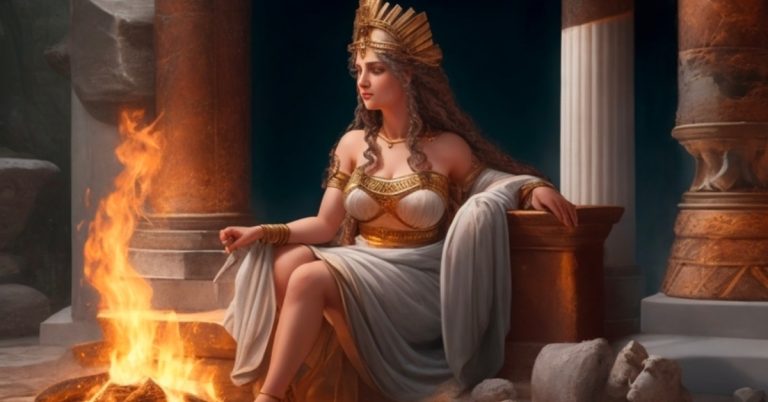
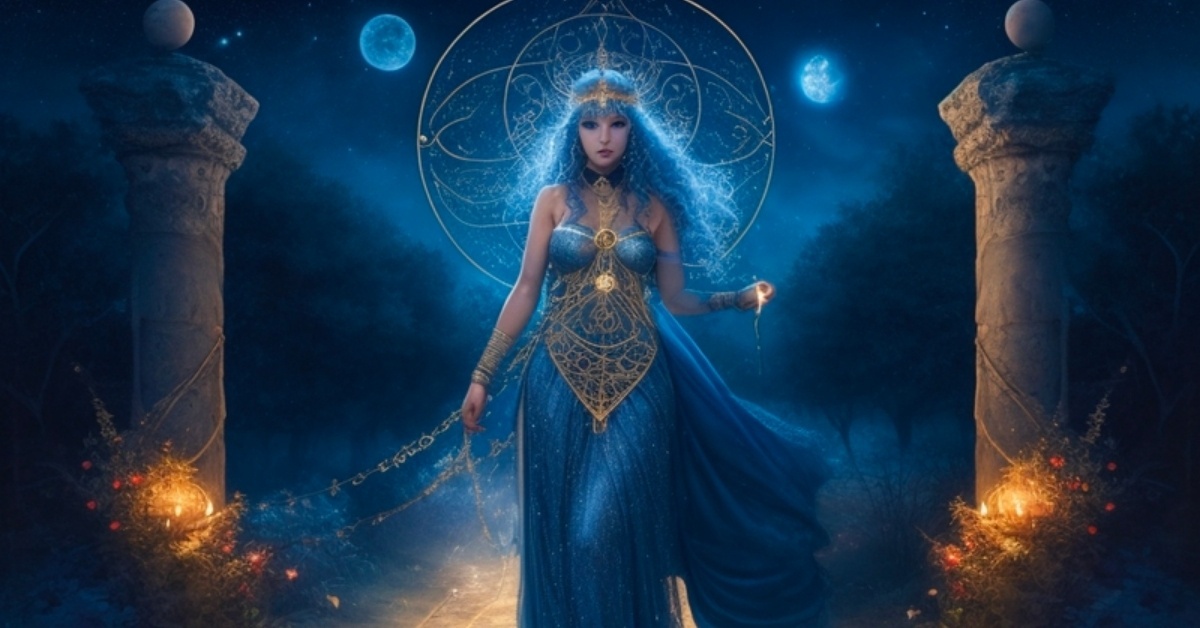
That was how a Roman reached her. Her name was the place itself. Trivia means “the three ways,” and she was the goddess who stood at the fork with a torch in each hand, dogs at her heels, and three faces looking down three roads at once, so that nothing could come up behind her.
Rome’s poets gave the name to Diana. Rome’s witches gave it to Hecate. The farmers around a volcanic lake south of the city gave it to the lady of their grove. One word, three goddesses, and a story about how they became each other.
Overview of Trivia
Trivia is a Roman goddess whose story starts with her name, because “Trivia” began as a title. It’s Latin for “of the three roads,” a straight translation of the Greek trioditis, the crossroads epithet of Hecate. When Greek Hecate came to Italy, she came with her address, and the Romans hung that address on a goddess they already had.
That goddess was Diana. The oldest surviving Latin use of the name is in the poet Ennius, around 200 BC, who called her “Titanis Trivia,” Trivia of the Titan line, meaning Diana, whose mother Leto was a Titan’s daughter. Two centuries later Catullus sang to Diana that she was “called mighty Trivia” and, by her borrowed light, Luna. Virgil used Trivia for Diana over and over in the Aeneid. When Roman writers said Trivia, they usually meant Diana in her night aspect: the moon in the sky, the huntress on the earth, and the queen of ghosts underneath.
The scholar Varro offered two explanations for the name. Either the Greeks set her image up wherever three roads met in their towns, or she was the Moon, which moves through the sky “by three ways”: up, across, and onward. Both fit. Trivia was the goddess of the fork in the road and the goddess of the moon over it, and Romans held both at once.
In the city she lived at street level. Her images stood at road-forks, three-bodied and back-to-back, the way Greek hekataia did. Her real home lay sixteen miles south of Rome at Aricia, on the crater lake of Nemi, in a grove so old the Latin cities had once shared it as common ground. Virgil calls the water there “the lake of Trivia.” The Romans called it speculum Dianae, Diana’s mirror, because it held the moon.
Her great festival came on the Ides of August, when the grove at Nemi filled with torches.
Titles
- Trivia (“of the three ways”)
- Diana Trivia
- Hecate Trivia
- Titanis Trivia (“Trivia of the Titan line,” her oldest Latin epithet, from Ennius)
- Diva triformis (“three-formed goddess,” from Horace)
- Hecate triceps (“three-headed Hecate,” from Ovid)
- Diana Nemorensis (“Diana of the Grove,” her face at Nemi)
Characteristics
How Trivia tends to be shown in art:
- Three women in one, standing back to back, or one body with three faces
- A burning torch in each hand, sometimes a torch in every hand of all three
- Keys at her belt, for the gates she keeps
- Dogs at her feet, often a black bitch, her animal and her sacrifice
- In the Greek-style crossroads statues, also serpents, daggers, and whips
- On the Nemi coin of 43 BC: three figures joined by a bar, one holding a bow, one a poppy, a row of cypress trees behind them
Abilities
- Guardian of the roads — she keeps watch at forks and gates, where travelers pick a road in the dark
- Mistress of magic — the power that witches call on by name: Dido’s priestess, Medea, Erictho
- Keeper of the door below — she opens the way to the underworld and commands the ghosts who wander out of it
- Light in the dark — her torches and her moon are the only light on the night road
- Protector of women in childbirth — the reason Roman women walked to Nemi with torches in their hands
Symbols
- The crossroads — her altar and her name
- The torch — one in each hand, lighting the way and the way down
- The key — to the gates of the underworld
- The dog — her companion, her herald, and her offering
- The moon — her light, “borrowed,” as Catullus put it
- The grove and the lake — Nemi, Diana’s mirror
Traits
- Watchful, with faces on every side and nothing behind her
- Dangerous to the careless and steady to the faithful
- Hard to hold to one shape, since one name covers three goddesses
- At home on the edges: the gate, the fork, the shoreline, the hour after sunset
- A friend to the people Rome ranked lowest, women in labor and runaway slaves
Festivals and Rituals
Trivia’s worship had two faces, one bright and one dark, and the Romans kept both.
The bright one was the Ides of August, the thirteenth of the month, at Nemi. Ovid describes the scene in the Fasti: a woman whose prayer had been answered would walk from Rome with a burning torch, her hair wreathed in flowers, and at the grove she’d find the hedges hung with votive threads and the trees covered in tablets thanking the goddess. The poet Statius says that on that night the “Arician grove of Trivia” glittered with torches, that hunting stopped, that Diana herself garlanded the hounds. Plutarch adds that it was a holiday for slaves. Archaeologists have pulled clay wombs and swaddled babies out of the sanctuary in numbers. Women came to Nemi to conceive, and to survive what came after.
The dark face belonged to the crossroads. The Greek custom of leaving Hecate a supper at the fork on the moonless night, then walking away with eyes forward, traveled to Italy with her name. Poets describe the sacrifice she preferred: black animals, offered at night. In the Aeneid, the Sibyl slaughters four black bullocks for Hecate on the shore of Avernus before Aeneas goes down among the dead, and as the goddess arrives, the ground bellows and dogs howl in the dark.
Legends associated with Trivia
Trivia’s legends are the moments when Roman poets called her by that name, and those moments share a pattern. She is summoned when someone is about to cross a line: into the underworld, into a curse, into magic, or back from death.
The priestess of Phoebus and Trivia
The most famous crossing in Roman literature begins in her grove.
When Aeneas lands at Cumae, Virgil sends him first into “the groves of Trivia” beside the temple of Apollo. The Sibyl who meets him there is priestess of both gods, “of Phoebus and of Trivia.” He asks her to lead him down to the dead to see his father. The Sibyl warns him that going down is the easy part.
Before they go, Aeneas vows a temple of solid marble to Phoebus and Trivia. Then, at the mouth of Avernus, the black bullocks are killed and the Sibyl calls on Hecate, “powerful in heaven and hell.” The goddess comes at dawn. The earth roars, the trees on the ridge shake, and dogs are heard howling as she passes. Only then does the priestess plunge into the cave, with Aeneas following.
Hecate, the Sibyl says, put her in charge of these groves. Trivia is the doorkeeper of the whole descent. Aeneas passes through her, and the Roman future passes through with him.
Dido’s curse and the three faces of Diana
Trivia is the goddess you call when you have decided to do something terrible.
In Book Four of the Aeneid, Dido, abandoned, builds a pyre in the courtyard of her palace. She tells her sister it’s a magic rite to cure her of love. A priestess from the far edge of Africa is brought in to work it, and Virgil describes her invocation: three hundred gods, Erebus, Chaos, and “threefold Hecate, the three faces of the virgin Diana.” Dido, barefoot with her dress unbound, scatters water she pretends comes from the lake of Avernus, and then calls the gods to witness as she dies.
The ancient commentator Servius paused over that line to explain what every Roman already understood. The three faces of Diana are one goddess in three places: Luna when she’s above the earth, Diana when she’s on it, and Proserpina when she’s beneath it. Trivia is the name for all three at once, which is why she’s the one to call when your intent reaches from the living world into the dead one.
Medea and the three-headed goddess
The great witch of Roman poetry is Greek, and the goddess she prays to is the goddess of the crossroads.
Ovid’s Metamorphoses gives Medea a night scene that Roman readers kept returning to. Under a full moon she walks out barefoot, hair loose, and prays to Night, to the stars, and to “three-headed Hecate, who knows all my undertakings and strengthens the arts of magic.” A chariot drawn by dragons comes down out of the sky. For nine days she gathers herbs across Thessaly, and then she cuts the throat of her husband’s aged father, drains him, and refills him with her brew. Aeson wakes forty years younger. Earlier in the same book, Jason swears his marriage oath by “the triple goddess,” and Medea holds him to it.
A generation later, Lucan gave Rome its most frightening witch, Erictho, who raises a corpse on the eve of Pharsalus. In her spell she calls Persephone “the third and lowest face of our Hecate.” Roman magic always ends up at the same fork in the road, and Trivia is standing there.
Hippolytus comes back as Virbius
One legend plants Trivia in Italian soil, and it explains a rule the priests at Nemi kept for centuries.
Hippolytus, the son of Theseus, refused his stepmother’s advances. She lied to his father; his father cursed him; his horses bolted at the sight of a sea-monster and dragged him to death along the shore. Virgil takes the story from there. Diana, moved by his innocence, had the healer Asclepius bring him back to life, then hid him: “Trivia conceals him in her secret places,” sending him to the nymph Egeria and her grove at Aricia, where he lived out an ordinary life under a new name, Virbius.
That, Virgil says, is why horses were banned from the goddess’s temple and grove at Nemi. Ovid tells the same story in the Fasti: “here Hippolytus hides, who was torn to pieces by his horses, and so no horse may enter the grove.” The man who died on the road came back and lived at Trivia’s sanctuary. She opens the door down, and once in a while she lets someone back through it.
An older Trivia?
Ask how old this goddess is and you get two different answers, depending on which of her faces you’re looking at.
Hecate is old, but she’s an import. Hesiod praised her in Greece around 700 BC, and she seems to have come to the Greeks from Caria in Anatolia, where her greatest temple stood at Lagina. She reached Italy with the rest of the Greek pantheon and brought her crossroads, her dogs, and her suppers with her. That is the goddess the witches of Roman poetry mean when they say Trivia.
The lake at Nemi is older than her arrival. The sanctuary there belonged to the Latin peoples before Rome ruled them. Cato preserved the dedication: a Latin leader named Egerius Baebius of Tusculum consecrated the grove on behalf of a league of Latin towns, at a time when Rome was one member among several. Vitruvius, describing the temple, calls its plan archaic, the old Etruscan-Italic type. The goddess of that grove was Diana Nemorensis, “Diana of the Grove,” whose name grows from the same Italic root as dius, “bright” or “of the sky.” She was a light goddess of the wild, of animals and birth, before anyone in Italy had heard of the underworld Hecate.
Her priest is the strangest thing about her. Strabo, Pausanias, Suetonius, and Servius all describe him. The priest of Diana at Nemi was a runaway slave who had won the job by killing the previous priest, and who kept it only as long as he could kill each challenger who came for him. Servius adds the detail that made the story famous: a challenger had first to break a branch from a certain tree in the grove. Suetonius says the emperor Caligula, thinking one priest had held office too long, hired a stronger man to finish him. The Romans called this figure the rex Nemorensis, “the King of the Wood,” and a Victorian scholar, James Frazer, built a book that grew to twelve volumes, The Golden Bough, around the question of why anyone would have invented such a rite. Frazer’s answer, a dying god-king renewed by his killer, is now mostly set aside, and some historians doubt the combat ever happened as described. But the accounts are ancient and consistent, and the lake is still there.
The coin from 43 BC shows what happened next. Publius Accoleius Lariscolus, a man from Aricia, struck a denarius with the cult statue of Nemi on the back: three goddesses joined by a bar, one with a bow, one with a poppy, cypresses behind. By the last century of the Republic, the grove goddess had been fitted out as a triad, huntress and moon and underworld, with Greek Hecate as her third face. C. M. C. Green, whose study of the Arician cult is the standard one, reads the three as one Diana all along, seen in her three places. Either way, “Trivia” is the seam where they met. It’s a Greek epithet, translated into Latin, worn by an Italic goddess whose lake reflected the moon long before the moon was hers.
Trivia across cultures
Trivia’s whole identity is a set of cross-references, and the goddesses she’s closest to each have their own page here.
Her Greek original is Hecate, whose torches, dogs, and moonless suppers she inherited whole. Her sky-face is the moon, Luna at Rome and Selene in Greece, the “borrowed light” of Catullus’s hymn. Her face below is Proserpina, the queen of the dead whom Servius names as the third of the three and whom Erictho called “the lowest of our Hecate.” And when Medea opens her great spell, the first power she addresses is Nyx, Night herself, “most faithful keeper of secrets,” before she turns to the three-headed goddess. Trivia stands where those four meet, which is what her name says.
The crossroads itself is a shared idea. The Greeks set stone herms of Hermes at their forks. In West Africa and across its diaspora, Eshu, with his cousins Elegua in Cuba and Papa Legba in Haiti, is the keeper of the crossroads and the gate, the one who must be greeted first because he decides what gets through. Japan set dōsojin, guardian stones, at village boundaries and road-forks to keep evil from walking in. Each of these grew up on its own. Nearly everyone who has ever traveled at night seems to have decided that the fork in the road has a god, and that it’s wise to leave something on the ground there.
Final thoughts
A word that started as a street address ended up carrying three goddesses.
That’s Trivia’s real story. Rome met a Greek goddess of the crossroads, translated her name, and found that the name already fit a goddess of its own, the lady of the lake at Nemi whose torches lit the shore every August. The crossroads, the moon, and the underworld turned out to be one place seen from three sides, and Trivia was the word for standing at the center of it.
She was a goddess you met outside, at the edge, at the hour when the road went gray, and you left your offering and walked on. What would you leave at the fork, and which of her three faces would you choose to meet?
Bibliography
- Virgil. Aeneid, Book IV, Book VI, and Book VII. Trans. A. S. Kline, Poetry in Translation.
- Servius. Commentary on the Aeneid, 4.511. Perseus Digital Library.
- Catullus. Poem 34, Hymn to Diana. Wikisource.
- Horace. Odes III.22, To Diana. Trans. A. S. Kline, Poetry in Translation.
- Ovid. Metamorphoses, Book VII (Medea) and Fasti, Book III (the grove at Aricia). Trans. A. S. Kline, Poetry in Translation.
- Lucan. Pharsalia, Book VI (Erictho). Trans. A. S. Kline, Poetry in Translation.
- Varro. On the Latin Language, Book VII.16 (Ennius and the name Trivia). ToposText.
- “Rex Nemorensis: The King of the Wood” (Strabo, Pausanias, Suetonius, Servius, Ovid cited). Encyclopaedia Romana.
- Frazer, James George. The Golden Bough (1890), Chapter 1. Wikisource.
- Green, C. M. C. Roman Religion and the Cult of Diana at Aricia. Cambridge University Press, 2007; reviewed in Bryn Mawr Classical Review.
- “Denarius of P. Accoleius Lariscolus, Rome”. Harvard Art Museums.
- Atsma, Aaron J. “Hekate”. Theoi Greek Mythology.
- “Trivia (mythology)”, “Diana (mythology)”, “Diana Nemorensis”, “Rex Nemorensis”, “Nemoralia”, and “Hecate”. Wikipedia.