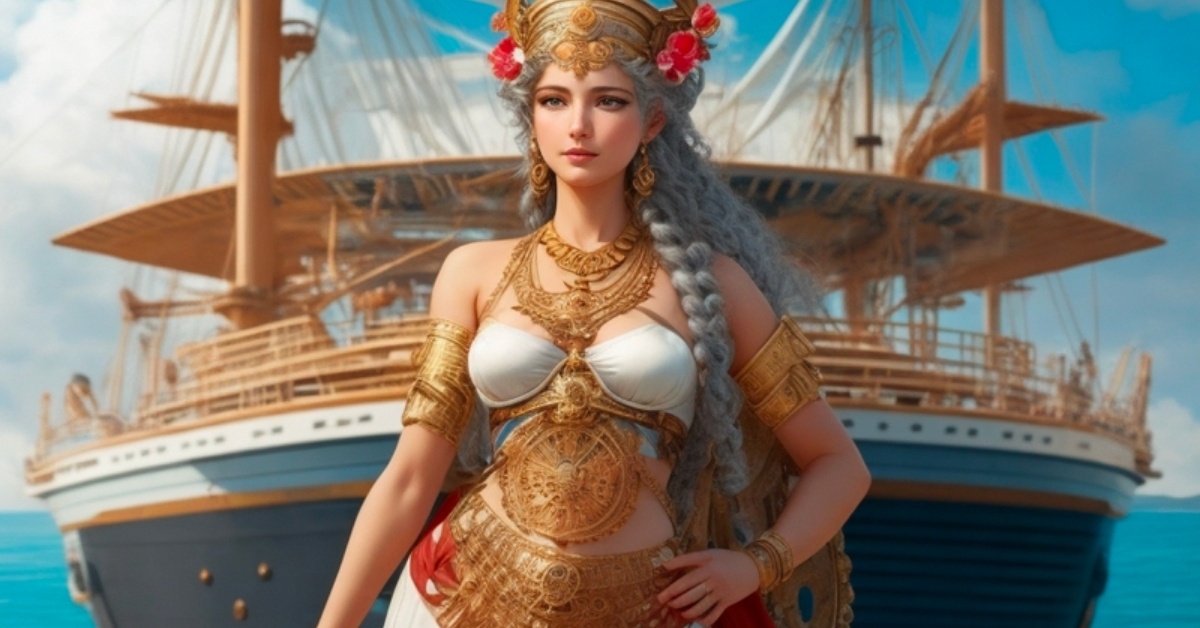
Fortuna: Roman Goddess of Fortune and Fate
In a temple beside Rome’s cattle market stood a wooden statue with its face wrapped in togas, hidden longer than anyone could remember.
The Romans said it was a king, the son of a slave woman, and that the goddess who owned the temple had loved him. She climbed through his window at night. She put him on the throne. Then she let his own daughter drive a chariot over his body.
That is Fortuna. The hand that lifts you is the hand that lets go.
Overview of Fortuna
Fortuna is the Roman goddess of luck, chance, and fate, the force that decides what a day brings. Her name comes from fors, “what is brought,” from the verb ferre, to carry. Fortune is whatever arrives at the door. The Romans posted her everywhere: at the birth of a firstborn, on the road home, over the grain fleet, in the drawing of lots, and on the morning of a battle.
She is older than the Greek luck goddess Tyche, whose rudder and cornucopia she later borrowed, and far more Roman than the borrowed props suggest. Her oldest homes are the Latin towns around Rome, Praeneste and Antium above all, where she spoke through oracles and was already ancient when the city was young. Pliny the Elder, writing in the first century AD, said that in every place and every hour, by every voice in the world, Fortuna alone is invoked, accused, blamed, and praised.
She has more cult than myth. Rome and its neighbors built her dozens of temples and gave her dozens of surnames, each one a job. What follows is the goddess as the Romans lived with her.
Titles
- Fortuna Primigenia (“the Firstborn,” the great goddess of Praeneste)
- Fors Fortuna (the old Fortuna of the Tiber bank, with the midsummer holiday)
- Fortuna Virilis (“Men’s Fortune,” a woman’s luck with men)
- Fortuna Muliebris (“Women’s Fortune,” the temple the matrons won)
- Fortuna Redux (“Fortune Who Brings You Home”)
- Fortuna Huiusce Diei (“the Fortune of This Day”)
- Fortuna Publica Populi Romani (“the Public Fortune of the Roman People”)
- Fortuna Annonaria (keeper of the grain supply)
- Fortuna Obsequens and Fortuna Respiciens (“Gracious” and “Watchful,” two of the king’s foundations)
Characteristics
How Fortuna tends to be shown in art:
- A grown woman in a long tunic and mantle, standing or enthroned
- A ship’s rudder in her right hand, its blade resting on a globe
- A cornucopia in the crook of her left arm
- At Praeneste, seated with two infants in her lap
- A veil or a tall crown on her head, and on imperial coins a wheel beside her feet
- Blindfolded only later, in the Middle Ages, when the wheel became her whole story
Abilities
- Steering the outcome — with her hand on the rudder, every enterprise ends where she steers it
- Bringing you home — as Fortuna Redux she guarded the return from war, sea, and exile
- Guarding the firstborn — mothers carried newborns up the terraces of Praeneste to put them in her care
- Speaking through the lots — her oracles at Praeneste and Antium answered in wooden tablets drawn by a child
- Ruling a single day — as Fortuna Huiusce Diei she held the fate of one date, and a general could win it or lose it
- Raising the low-born — she made a slave’s son king of Rome, and the poor kept her feast
Symbols
- The rudder — the tiller of every voyage, venture, and war is in her hand
- The cornucopia — the horn that pours out grain, fruit, and coin
- The globe — the round, rolling footing under everything she gives
- The lots — oak tablets in an olive-wood chest, her voice at Praeneste
- The wheel — the rota Fortunae, a Roman image already in Cicero’s day and the emblem the Middle Ages made of her
- The veil — the covered face, first on the statue of her beloved king and in the end on herself
Traits
- Blind to rank, and partial to the low-born
- Restless, arriving through windows and leaving without notice
- Unbribed and unargued with; her lots answered the same whether a consul or a farmhand asked
- Maternal at Praeneste, a nurse with infants at her breast
- Plural at Antium, where the oracle kept two Fortunae, and either sister might answer
Festivals and Rituals
Fortuna’s worship was spread across the whole Roman year, one feast per surname.
On April 1 women washed the statue of Venus, then went to the baths and burned a pinch of incense to Fortuna Virilis, asking her to hide their blemishes from men’s eyes. Ovid adds the drink for the day: poppy crushed in milk and honey, the cup Venus drank on her wedding night.
On April 10 and 11 the stone calendar of Praeneste records that “the oracle is open.” The town’s two chief magistrates sacrificed a calf, and the lots came out of their chest.
On June 11, the Matralia, the mothers of Rome honored Mater Matuta, and her twin temple next door in the Forum Boarium belonged to Fortuna, with the veiled king inside.
On June 24, midsummer, the city emptied onto the Tiber for Fors Fortuna. Crowds went downstream on foot and by boat to her two temples on the far bank, garlanded and drinking. Ovid says rowing home tipsy was part of the rite. It was the holiday of the plebs and of slaves, who had few of their own, and they kept it because the man who founded the shrine had been one of them.
On July 30, the anniversary of Vercellae, the city sacrificed to Fortuna Huiusce Diei in her round temple in the Campus Martius.
On October 12, the Augustalia, the pontiffs and the Vestal Virgins sacrificed at the altar of Fortuna Redux by the Porta Capena, on the anniversary of the day Augustus came home.
Legends associated with Fortuna
Fortuna has few myths and a great many stories, because the Romans told her through history: kings, generals, and matrons who met her and came away changed. Every telling below is anchored to a temple you could once walk into, and in two cases still can.
The king Fortuna loved
Servius Tullius was the sixth king of Rome, and his mother was a slave.
Her name was Ocrisia, a captive from the Latin town of Corniculum, and she served in the palace of King Tarquin the Elder and Queen Tanaquil. The stories about how she conceived are strange even by Roman standards. A phallus of fire rose from the hearth, and the household god, or Vulcan himself, was the father. While the boy slept one afternoon, flames played around his head without burning a hair, and Tanaquil, who understood omens, told her husband to raise the child as their own. He grew up in the palace, married the king’s daughter, and took the throne.
The Romans explained his rise the way they explained everything else that baffled them. Fortuna loved him. Plutarch says the goddess came to him at night through a window, and the gate in that wall was called the Fenestella, “the little window,” ever after. Ovid puts it more bluntly: she burned for the king, and he was the one man she saw clearly.
Servius paid her back in temples. Plutarch lists them: Fortuna Primigenia on the Capitol, Fortuna Obsequens, Private Fortune on the Palatine, Virgin Fortune, Watchful Fortune on the Esquiline, Fortune of Good Hope, and the Fortune of the Fowler, the one whose bird-lime catches you and holds. A slave’s son turned the whole city into her shrine.
Then she let go. His daughter Tullia and her husband, Tarquin the Proud, had him murdered in the street, and Tullia, driving home, ordered her coachman over her father’s body. Rome named the road Vicus Sceleratus, “Crime Street,” and the name stuck.
In Fortuna’s temple beside the cattle market stood a wooden statue of Servius wrapped in togas. Ovid, writing under Augustus, offers three reasons for the cloth: grief; shame, because a goddess had loved a mortal; or the goddess’s own voice, heard once inside the temple, saying cover my face, so I never have to look at my wicked daughter. When the temple burned in 213 BC, Ovid says, the fire took everything but the statue. Vulcan spared his son.
The lots of Praeneste
Praeneste, the modern Palestrina, sits on a hillside twenty-two miles east of Rome, and the whole hillside was her temple.
Cicero tells the founding story in order to doubt it. A nobleman named Numerius Suffustius was haunted by dreams, and the dreams turned threatening, ordering him to split open a rock at a certain spot. His neighbors laughed. He took a hammer to the flint anyway, and out of the split stone fell lots of oak, carved with letters in an alphabet older than anyone could read. At the same time honey ran from an olive tree on the spot where the temple now stands. The soothsayers ordered a chest made from the olive wood, and the lots were kept in it from then on.
The procedure was simple. A boy shook the chest and drew a tablet, and the tablet held your answer. Fortuna guided the child’s hand. Cicero, a skeptic and a senator, notes that in his day the crowds kept coming to the lots of Praeneste while the magistrates and men of standing stayed away. He quotes the philosopher Carneades, who said he had seen Fortune more fortunate at Praeneste than anywhere on earth.
The site backed the joke. In the last decades of the second century BC the town rebuilt the sanctuary as a stack of six terraces climbing the hill, joined by ramps and staircases, lined with colonnades, crowned by a round temple at the summit. It was among the largest religious buildings in Italy. When the dictator Sulla sacked Praeneste in 82 BC he punished the town and spared the goddess. Pliny credits him with laying her a mosaic floor, the great Nile scene that fills a room in the Palestrina museum today. The emperor Tiberius, who disliked oracles near the capital, had the chest sealed and carried to Rome. Suetonius says it arrived empty, and the lots reappeared only when the chest went home.
The oracle answered questions for another three centuries, until the Christian emperors closed the temples. The terraces are still there. A Renaissance palace sits on the top one.
Boats on the Tiber
Downstream from the city, on the far bank of the Tiber, stood two old temples of Fors Fortuna. The Romans credited the first to Servius. The second was built in 293 BC by the consul Spurius Carvilius out of the spoils of an Etruscan and Samnite war, and Livy says he placed it beside the king’s.
Ovid describes the holiday in a string of instructions: honor Fors with joy, Quirites, walk or take a fast boat, wear garlands, drink, and come home unsteady. The poet gives the reason the plebs loved her: the founder of her shrine was one of them, a man who rose from nothing to a crown. In a religion run by senators and priests, June 24 belonged to the rowers, the laborers, and the enslaved, and the goddess of the unearned was theirs for the day. Tiberius, who tried to move her lots, rebuilt one of her river temples in AD 17.
The women who stopped an army
In 488 BC Gaius Marcius Coriolanus, a Roman patrician driven into exile, came back at the head of a Volscian army and camped four miles from the walls. The Senate sent envoys. He refused them. The priests went out in their robes. He refused them too.
Then the women went. A matron named Valeria gathered the mothers of Rome and took them to the Volscian camp with his mother Veturia, his wife Volumnia, and his children. Veturia asked him whether she had raised a son or an enemy. He broke and led the army away. By most accounts the Volscians killed him for it.
The Senate asked the women what they wanted. They asked for a temple. Fortuna Muliebris, Women’s Fortune, was dedicated in 486 BC at the fourth milestone of the Via Latina, on the ground where the matrons had met the army, and the women paid for a second cult statue out of their own purses. When it was set in place it spoke, twice, and the words were recorded: by the holy law of Rome, women, you have dedicated me. Only a woman married once, to a living husband, was allowed to touch or garland it.
The fortune of this day
On July 30, 101 BC, two Roman armies met the Cimbri at Vercellae, in the north of Italy, and the war that had been terrorizing Rome for a decade ended in an afternoon. One of the generals, Quintus Lutatius Catulus, vowed a temple during the fighting. He dedicated it to the Fortune of This Day.
That is a precise theology. Every date, the Romans thought, had its own luck, and the luck of July 30 had been on Rome’s side once and might be asked for again. Catulus built his round temple in the Campus Martius, a ring of eighteen columns around a cult statue nearly twenty-six feet tall, marble at the head, arms, and feet, with drapery of bronze that was stripped off after the empire turned Christian. The head was dug up in 1929 and sits in a Roman museum. The temple is Temple B in the Largo di Torre Argentina, the sunken square where tourists now photograph the cats, a few steps from the hall where Caesar was stabbed on the Ides of March. The Fortune of This Day watched that one from next door.
Bringing the emperor home
In 19 BC Augustus returned from the East, and the Senate voted an altar to Fortuna Redux, Fortune Who Brings Home, beside the Porta Capena on the road he came in by. Augustus recorded it himself in the account of his reign, along with the order that the pontiffs and the Vestals sacrifice there every year. The day, October 12, became the Augustalia.
Fortuna Redux was a goddess of the return, and the emperors adopted her as the patron of their own homecomings. She appears on coin after coin with the rudder, the globe, and the cornucopia, marking the safe arrival of Domitian from Germany, and of Caracalla and Geta from Britain in AD 211. Domitian built her a temple in AD 93. Horace had already written the prayer for her. His ode to the Fortuna of Antium asks her to keep Caesar safe on his way to Britain and the East, and reminds her that Necessity walks ahead of her with nails and wedges in a bronze hand.
An older Fortuna?
A bronze plaque from Praeneste, cast in the first half of the third century BC and dug up in 1882, records a gift. A woman named Orcevia, wife of Numerius, gave it to Fortuna Primigenia, daughter of Jupiter, in thanks for a birth.
That is the oldest surviving mention of the Firstborn Fortune, and it calls her Jupiter’s daughter. Two centuries later Cicero described the statue that stood in her sanctuary: the infant Jupiter, seated with Juno in Fortuna’s lap and reaching for her breast, an image he says was held in the deepest reverence by mothers. So the same goddess is Jupiter’s firstborn child and the nurse who suckles him. Later dedications at the site read Fortunae Iovis puero Primigeniae, which can be translated “to Fortuna Primigenia, child of Jupiter,” or, with equal grammar, “to Fortuna Primigenia, for the boy Jupiter.” The ambiguity is in the stone.
Scholars read this two ways. Jacqueline Champeaux, whose two-volume study of the cult remains the standard account, argues that the contradiction records successive phases. The oldest Praenestine Fortuna was a great goddess of birth, motherhood, and destiny, a mother of the gods; a wave of Greek influence later recast her as Jupiter’s daughter, on the model of Tyche as the child of Zeus. Georges Dumézil read the nursing statue the same way, and Annalisa Franchi de Bellis takes the epithet Primigenia to mean primordial, the one who is born first and the one who gives birth. Daniele Miano, in a 2018 study of Fortuna in early Italy, cautions that the Orcevia plaque is the earliest evidence and it says daughter, so the mother-goddess reading rests on Cicero’s statue and on inference from the cult, and stays a hypothesis.
What is beyond argument is that she was there first. The lot oracle was an Italic institution, practiced at Antium, Caere, and Falerii as well as Praeneste, long before the Hellenistic world made Tyche fashionable. Rome’s own Fortuna was credited to Servius Tullius, a king of the sixth century BC, and under the church of Sant’Omobono in the Forum Boarium archaeologists have found archaic twin temples of that same age, the pair the Romans knew as Fortuna’s and Mater Matuta’s. The rudder, the globe, and the cornucopia arrived in the second century BC with the Greek-style rebuild of the sanctuary. The mothers who carried their firstborn up the hill predate all of it.
The Fortuna of the poets, the restless lady with the wheel, keeps her place. The stones set a second figure beside her: a Latin mother of destinies who hands out each life at birth and takes the child, and the god, to her breast. Orcevia thanked that one.
Fortuna across cultures
The Romans drew her from their neighbors and lent her to everyone after.
Her closest kin is Tyche, the Greek goddess of chance, whose attributes she took over so thoroughly that a Roman statue and a Greek one are often told apart only by the label. Next door in Etruria stood Nortia, the fate goddess of Volsinii, in whose temple a nail was driven into the wall every year to fix the year’s destiny in place. Rome kept the same rite on the Capitol. Where Nortia nailed the year down, Fortuna kept it rolling.
When Rome absorbed Egypt the meeting produced Isis-Fortuna, the Egyptian Isis with Fortuna’s rudder and cornucopia, the household goddess of Pompeian shrines and the patron of sailors from Alexandria to Ostia. Isis’s hymns claim outright that she has overcome Fate, which is the promise the rudder makes in bronze. At Praeneste the infant on Fortuna’s knee beside Jupiter was Juno, the queen of the Roman gods nursed by the goddess of birth. And the horn of plenty she carries is the same plenty Ceres grows in the field. As Fortuna Annonaria she guarded the grain ships that fed the city, the luck Rome depended on most.
And she outlived the gods. Around AD 524 the philosopher Boethius, waiting in prison for execution, wrote The Consolation of Philosophy and put Fortuna’s wheel at the center of it, and the Middle Ages took the image as the plain truth about power. Kings rise on one side, fall on the other, and the goddess turns the crank. The medieval songs collected as the Carmina Burana open by calling her name. Machiavelli, writing in 1513, gave her a chapter of The Prince, comparing her to a river in flood that only good embankments can hold, and advising that Fortune favors the bold. She has a magazine named for her, and the five hundred largest companies in America line up each year under her title.
Final thoughts
Rome ran on planning. It surveyed roads in straight lines, drafted its armies by census, and wrote its laws on bronze. Then it gave its loudest holiday to the goddess of whatever nobody planned.
That is the honest part. The Romans understood that luck is impartial, so they built her temples for every kind of person: a shrine for the slave-born king, a boat party for the poor, a temple the matrons earned, an altar for the emperor’s return, and a hillside for mothers with a newborn. The same goddess covers all of them. She lifts whom she likes and lets go when she likes. The Romans took the deal, because the alternative was pretending the deal was theirs.
When the year has gone your way, which do you thank first: the plan, or whatever came in through the window?
Bibliography
- Cicero. De Divinatione, Book II, 85-87 (the lots of Praeneste). Trans. W. A. Falconer, Loeb, via LacusCurtius.
- Plutarch. On the Fortune of the Romans (Servius Tullius, Fortuna Muliebris, the Fortuna cults of Rome). Trans. F. C. Babbitt, Loeb, via LacusCurtius.
- Ovid. Fasti, Book IV (April 1, Fortuna Virilis) and Book VI (June 11 and June 24, Servius Tullius and Fors Fortuna). Trans. A. S. Kline, Poetry in Translation.
- Horace. Odes 1.35, to Fortuna of Antium. Trans. John Conington, Perseus Digital Library.
- “Cult of Fortuna Primigenia at Praeneste” (the Orcevia inscription, Cicero’s statue, Champeaux, Franchi de Bellis, Miano). Key to Umbria.
- Champeaux, Jacqueline. Fortuna: Recherches sur le culte de la Fortune à Rome et dans le monde romain des origines à la mort de César. École française de Rome, 1982-1987.
- Miano, Daniele. Fortuna: Deity and Concept in Archaic and Republican Italy. Oxford University Press, 2018.
- Matthews, Lydia. Roman Constructions of Fortuna. D.Phil. thesis, University of Oxford.
- “Fortuna”. Encyclopedia of Religion, via Encyclopedia.com.
- “Fortuna”. World History Encyclopedia.
- “Fortuna Huiusce Diei, Aedes”. Digital Augustan Rome.
- “Cats, a Temple, Statue Fragments and the Goddess Fortuna (Largo Argentina, Rome)”. University of Kent, Lucius’ Romans.
- “Fortuna”, “Fors Fortuna”, “Sanctuary of Fortuna Primigenia”, “Fortuna Redux”, “Fortuna Huiusce Diei”, “Temple of Fortuna Muliebris”, “Servius Tullius”, and “Veneralia”. Wikipedia.