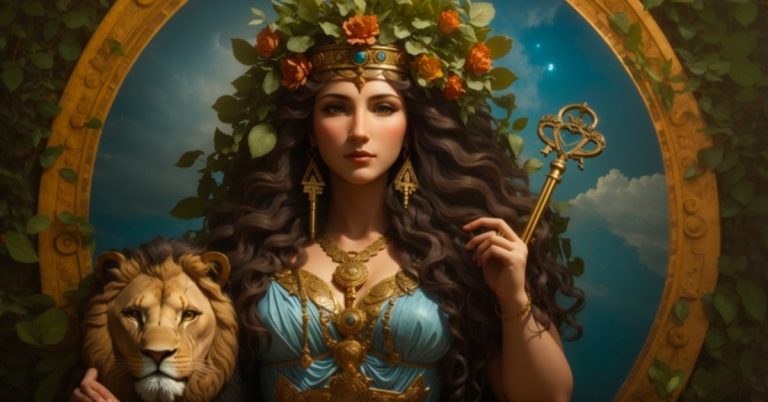
Bellona: Roman Goddess of War
A priest stands beside a squat stone pillar at the edge of Rome, a spear in his hand. Somewhere across the sea sits a king the Senate has decided to fight. The priest hurls the spear over the pillar into a patch of bought ground, and with that one throw, Rome is at war.
The pillar belongs to Bellona. So does the temple behind it, the generals camped outside the city waiting for permission to come home, and, centuries later, the priests who opened their own arms on her floor. Rome kept its goddess of war just outside the walls, on purpose. This is her story, told mostly in stone and ritual, because that is where Rome wrote it.
Overview of Bellona
Bellona is the Roman goddess of war. Her name says so outright: it comes from bellum, the Latin word for war, and in the oldest form of the language it was Duellona, from duellum, the same root that gives English its word “duel.” She is war itself with a face on it: the clash, the blood, the noise, and the ending.
Rome gave her a family late and loosely. Later writers made her a daughter of Jupiter and Juno, and depending on who is telling it, she is the sister, wife, daughter, charioteer, or nurse of Mars. The Greeks matched her with Enyo, the “sacker of cities” who rode beside Ares, and once the two were paired, the stories of one flowed into the other.
What Rome gave her in abundance was real estate. Her temple stood on the Campus Martius, the Field of Mars, outside the pomerium, the sacred boundary that marked where the city ended and where armies had to stop. That placement made her house one of the most useful buildings in Rome. Later, her name absorbed a goddess from the mountains of Cappadocia with a different character altogether, and her worship took on a sound and a smell it never had before.
Her festivals fell on June 3, the anniversary of her temple, and March 24, the “day of blood.”
Titles
- Duellona (her archaic Italic name, from duellum, “war”)
- Ma-Bellona (the fused Roman and Anatolian goddess of the later cult)
- Enyo (her Greek equivalent, the “sacker of cities”)
- “The fire-eyed maid of smoky war” (Shakespeare’s name for her, in Henry IV, Part 1)
Characteristics
How Bellona tends to be shown in art:
- A grown woman in a crested military helmet, her face set hard
- Armored, with a sword or spear in one hand and often a shield in the other
- Carrying a lit torch, the fire she brings to cities
- Brandishing a whip or a bloodied scourge
- Driving a four-horse chariot into the fight, sometimes with Mars beside her
- In later paintings, wild-haired and wide-eyed, the picture of battle frenzy
Abilities
- War-making — the formal declaration of war happened at her door, over her column
- Victory — Ovid calls her the goddess “who always brings Rome success”
- Battle frenzy — she drives soldiers into the fury that wins fights and, in her later cult, drove her own priests to cut themselves
- Guarding the threshold — she holds the line between the armed world outside Rome and the civil world inside it
- Prophecy — the priests of her Cappadocian cult fell into trances and spoke oracles, and she appeared to Sulla in a dream
Symbols
- The spear — thrown over her column to open a war
- The columna bellica — the “war column” beside her temple, a symbol of the boundary and the beginning
- The torch — the burning of cities
- The scourge — the whip she carries, sometimes shown dripping blood
- The helmet and shield — her warrior’s gear
- The chariot — war in motion
Traits
- Stern and unsmiling, all edge where Venus has charm and Minerva has patience
- Fierce to the point of frenzy
- A boundary-keeper, at home on the edge of things
- Loyal to Rome above any single Roman
- Hungry for blood in her later form, and honest about it
Festivals and Rituals
Bellona’s oldest feast was June 3, the day her temple on the Campus Martius was dedicated. Ovid marks it in his poem on the Roman calendar and points out the little column standing in front of the temple, from which the spear was thrown “when it’s been decided to take up arms against kings and nations.”
The second date came later and from farther away. March 24 was the dies sanguinis, the “day of blood,” which Rome also kept in the spring festival of Cybele and Attis. On that day the priests of Ma-Bellona, the Bellonarii, marched through the city in black, blowing trumpets and beating drums, and in the temple they gashed their own arms and thighs and poured out the blood as an offering. The Roman poet Tibullus describes a priestess in the goddess’s frenzy slashing her arms and sprinkling the blood on the crowd. Lucan, a century later, still knew the type: “the worshippers who gash their arms, inspired by fierce Bellona.”
The word Rome used for these priests was fanatici, “the temple-possessed,” from fanum, “shrine.” That is where English got the word “fanatic.” Bellona’s priests gave the language its term for people who take things too far.
Legends associated with Bellona
Bellona left Rome a thin file of stories and a thick file of practice. Her legends are the things Romans did in her name: a vow in the middle of a battle, a column at the edge of the city, a dictator’s dream. They add up to a portrait all the same.
The vow of Appius Claudius
Bellona’s temple began as a bargain struck in the middle of a fight.
In 296 BCE, during the Third Samnite War, the consul Appius Claudius Caecus was leading a Roman army against a combined force of Etruscans and Samnites. Livy tells the story. The battle was going badly, Appius was no soldier’s general, and at the worst of it he was seen in the front line with his hands raised to the sky, praying out loud: “Bellona, if today you grant us the victory, then I vow you a temple.”
The Romans won. Appius kept his word, and the temple went up on the Campus Martius, near the Circus Flaminius, on the far side of the sacred boundary. Appius Claudius Caecus is the same man who built Rome’s first aqueduct and its first great road, the Appian Way, and he went blind in old age, which is what Caecus means. Ovid enjoyed the irony: the man who vowed Bellona’s temple “saw clearly with his mind, though deprived of sight.”
The Claudii looked after her from then on. More than two centuries later, another Appius Claudius, consul in 79 BCE, hung the painted shield-portraits of his ancestors inside the temple to advertise that his family had built it.
The temple outside the walls
The placement of Bellona’s temple was the whole point of it.
Rome had a sacred boundary called the pomerium, a ritual line around the city that was older than the walls. Inside it was civil space. Armed men stayed outside it, and a general leading troops lost his military command the moment he crossed. That created a problem. A commander returning from a campaign and hoping for a triumph, the great victory parade through the city, had to wait outside until the Senate voted to grant it. Ambassadors from states outside Rome’s alliances waited beyond the boundary too.
Bellona’s temple solved both problems. The Senate met there, outside the line, to hear a general make his case for a triumph, and it met there to receive foreign envoys. The goddess of war hosted the meetings that decided whether a war was over and whether the next one would start. Her house was Rome’s front door for anyone who came armed or came from an enemy.
The spear over the column
The strangest ritual in Roman religion took place at her doorstep.
The old way of declaring war was simple. A priest called a fetial walked to the enemy’s border, recited the grievance, and hurled a spear into their territory. That worked when Rome’s enemies were a day’s walk away. In 280 BCE, Rome decided to fight King Pyrrhus of Epirus, across the Adriatic, and nobody was going to walk a spear to Greece.
So Rome improvised. A captured soldier of Pyrrhus was made to buy a small plot of land beside Bellona’s temple, and from then on that patch of ground counted, legally and religiously, as enemy soil. A short column, the columna bellica, was set up on it. When Rome declared war on a distant people, the fetial priest threw the spear over the column into the plot, and the war was open.
The trick lasted for centuries. Augustus is said to have performed the rite as a fetial when Rome declared war on Cleopatra, and Cassius Dio records that Marcus Aurelius hurled the bloodied spear from Bellona’s temple in the late 170s CE, on his way to fight the tribes across the Danube. A patch of dirt the size of a garden stood in for the entire enemy world, and Bellona watched over it.
Bellona and Mars
Rome left open what Bellona was to Mars, and it seemed content that way.
The ancient writers call her his sister, his wife, his daughter, and, in a few, his nurse. In art she is often his charioteer, holding the reins while he fights, which is the role the Greek Enyo played for Ares. The painters of the Renaissance and after loved that arrangement. Louis Lagrenée painted her handing Mars the reins of his horses; Rembrandt painted her alone, armored, her shield bearing the head of Medusa; Rubens dressed the queen of France, Marie de’ Medici, as Bellona to say something about power.
The looseness makes sense once you see what she is. Mars is the god of war as an institution: the army, the campaign season, the field where Romans trained. Bellona is the war itself, the moment the lines close. Every relationship the Romans tried on her, sister or wife or driver, is a way of saying the two are never far apart.
Sulla’s dream
The bloodiest chapter of Bellona’s story starts with a Roman general asleep.
In the 90s BCE, Lucius Cornelius Sulla served as a governor in the East and came into contact with the great sanctuary of Comana in Cappadocia, where thousands of temple servants worshipped a war goddess the locals called Ma. Roman soldiers took one look at her and called her Bellona. Some years later, Plutarch tells us, Sulla was marching on Rome to seize it by force, and the night before, he dreamed of that same goddess, “whom the Romans learned to worship from the Cappadocians.” She stood beside him, put a thunderbolt in his hand, named his enemies one by one, and told him to strike them. He did.
Sulla’s legionaries carried Ma’s cult home with them, and it fused with the older Roman goddess into Ma-Bellona. She got a new temple and a new priesthood, the Bellonarii, and her rites changed character. The old Bellona had received vows and hosted the Senate. The new one received blood, poured out by priests in black who cut themselves in a trance and prophesied. Educated Romans found it foreign and a little disgusting, and they kept coming to watch.
An older Bellona?
Strip the Cappadocian frenzy away and the Greek stories borrowed from Enyo, and something plainer and older is left underneath.
The first clue is in her name. Before Latin had bellum it had duellum, and before Rome had Bellona it had Duellona. That older spelling is preserved in the ancient grammarians and points to a goddess who belonged to the earliest layer of Italic religion, when the language itself was still forming. The Roman festival calendar backs this up. Her temple day, June 3, is an old, home-grown Roman date, and it stood on the calendar long before the eastern “day of blood” was added beside it.
The second clue is a name that sits next to Mars in the oldest Roman prayers. The scholar Aulus Gellius, writing in the second century CE, quotes an archaic formula that invokes “Moles of Mars, and Nerio of Mars,” and explains that Nerio “is Sabine and signifies valor and courage.” The comic playwright Plautus has a character joke that Mars, “coming home, greets his wife Nerio.” An old annalist, Gnaeus Gellius, told a story in which the Sabine woman Hersilia prayed for peace to “Neria of Mars.” Nerio, in other words, was the war-power beside Mars in the Sabine and early Latin tradition, personified valor, and understood by some as his wife. Enemy spoils were dedicated to her.
Several scholars have read Bellona as Nerio under a Latin name, and there is a neat coincidence to support it: the Claudii, the family that built Bellona’s temple and championed her cult, were of Sabine origin and used Nero as a family name, a word from the same root as Nerio. The 1911 Encyclopaedia Britannica lays out that argument, and the modern reference works still note the identification while treating it as an open question. The plainer reading is enough on its own: an Italic goddess of battle-valor, paired with Mars, who was later given the Latin name for war and, later still, a Greek biography.
On that old base, two overlays were laid. The Greek one gave her a parentage and a place beside Ares in the Trojan stories, through Enyo. The eastern one, Ma of Comana, gave her the trance, the black robes, and the blood, and it is that version most Roman poets describe, which is why she reads as so much wilder than her temple suggests. The Italic goddess stands under both. Knowing all three lets you tell which Bellona you are looking at.
Bellona across cultures
Every people that fought wars personified the fighting, and the figure they came up with is often a woman.
Egypt’s version is Sekhmet, the lioness whose breath was the desert wind and who had to be tricked with red-dyed beer to stop slaughtering humankind. Sekhmet is Bellona’s closest cousin: a goddess who is the violence itself, dangerous to her own side, and honored precisely because she is. Greece had Enyo, “sacker of cities,” and beside her the war-spirits Phobos and Deimos, Fear and Terror. Anatolia had Ma, the mother-warrior of Comana, whose ecstatic priesthood so resembled the Galli of Cybele that Romans lumped the two eastern cults together in their disapproval.
The contrast inside Rome is the most telling. Minerva is a war goddess too, and Rome honored her far more. She is the strategist, the one who wins through planning, and she could be brought inside the walls without a second thought. Bellona is the other half of the same thing, the part that has to stay outside. A culture that keeps both goddesses, and keeps them apart, is telling you what it thinks war is: a skill worth cultivating and a force worth fearing, in the same breath.
Final thoughts
For all the wars it fought, Rome would not let its goddess of war inside the city. It built her a house on the far side of the sacred line and kept her there.
That decision says more than any myth could. Rome wanted victory, so it prayed to her. It wanted its generals to come home safely, so it made them stop at her door and ask. It wanted a clean way to start wars against people it could never reach, so it bought a patch of ground and let her stand guard over it. And when a stranger goddess arrived from the East with drums and knives, Rome gave her Bellona’s name and let her bleed, outside the walls, where that kind of thing belonged.
Bellona is the goddess who kept war in its place. Rome depended on her, and it kept her at the gate. What do you make of a city that leaned on its war goddess that hard and still kept her outside the walls?
Bibliography
- “Bellona (goddess)”, “Temple of Bellona, Rome”, “Nerio”, and “Enyo”. Wikipedia.
- “Bellona”. Encyclopaedia Britannica, 11th ed. (1911), via Wikisource.
- Gellius, Aulus. Attic Nights, Book XIII, ch. 23 (Nerio of Mars). Loeb trans., via LacusCurtius.
- Livy. History of Rome, Book X, ch. 19 (the vow of Appius Claudius). Trans. via Perseus Digital Library.
- Ovid. Fasti, Book VI (June 3, the temple and the column). Trans. A. S. Kline, Poetry in Translation.
- Plutarch. Life of Sulla, ch. 9 (the dream of the Cappadocian goddess). Loeb trans., via LacusCurtius.
- Platner, Samuel Ball, and Thomas Ashby. “Aedes Bellonae”. A Topographical Dictionary of Ancient Rome (1929), via LacusCurtius.
- Smith, William, ed. “Fanum”. A Dictionary of Greek and Roman Antiquities (1890), via Perseus.
- “The Business of Butchery: Bellona and War, Society and Religion from Republic to Empire”. Academia.edu.
- “Bellona”. Imperium Romanum.