Kichijoten: Japanese Goddess of Fortune and Beauty
For three days each January, a temple in Nara brings out a painting it keeps hidden the rest of the year.
It is roughly twelve hundred years old, painted on hemp cloth, and it shows a round-cheeked woman in Chinese court silks with a jewel resting in her open left hand. People line up to bow to her and ask for a good year, the same request the emperors of Nara were making in front of images like this one before the paint was dry.
Her name is Kichijoten. She is the Buddhist goddess of fortune, beauty, and merit. She reached Japan by way of India and China, and the jewel in her hand grants wishes.
Overview of Kichijoten
Kichijoten, also written Kisshoten or in full Kisshotennyo, “the heavenly woman of good omen,” is a goddess of Japanese Buddhism. She belongs to the class of beings called ten, the devas: gods and goddesses adopted from India who stand guard over the Buddhist teaching. Her home in Japan is the old capital of Nara, where the great temples still keep her images, and her home before that is the Golden Light Sutra, the scripture that carried her across Asia.
Her territory is fortune in the widest sense. Wealth and a good harvest. Beauty and happiness. Fertility. And merit, the store of spiritual credit a person builds through good acts. That last one matters, because it shapes how she is approached. Kichijoten is the goddess you go to for a good year ahead, and in Japan the way you go to her is by first confessing the year you just had.
Her great observance is the Kissho Keka, the New Year rite of repentance before Kichijoten, still performed at Yakushi-ji in Nara.
Titles
- Kisshoten / Kisshotennyo (“heavenly woman of good omen”), the standard readings of her name
- Kudokuten (“goddess of merit”), her name in the Golden Light Sutra
- Hozotennyo (“heavenly maiden of the treasure store”)
- Sri-mahadevi (“the great goddess Sri”), her Sanskrit title, and a name of Lakshmi
- Gongdetian and Jixiangtian, the Chinese names the sutra translators gave her
Characteristics
How Kichijoten tends to be shown in art:
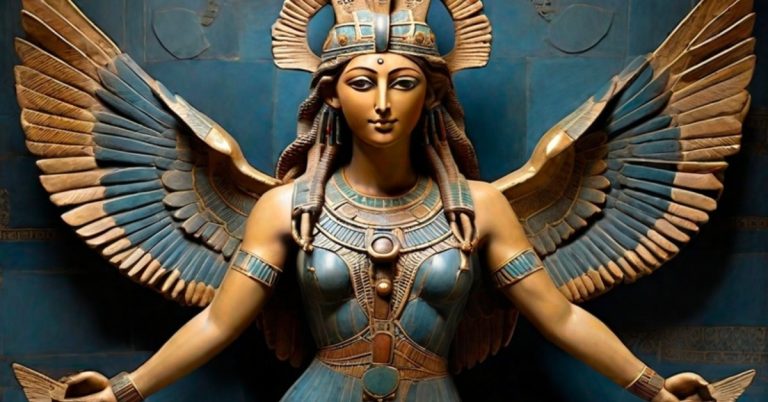
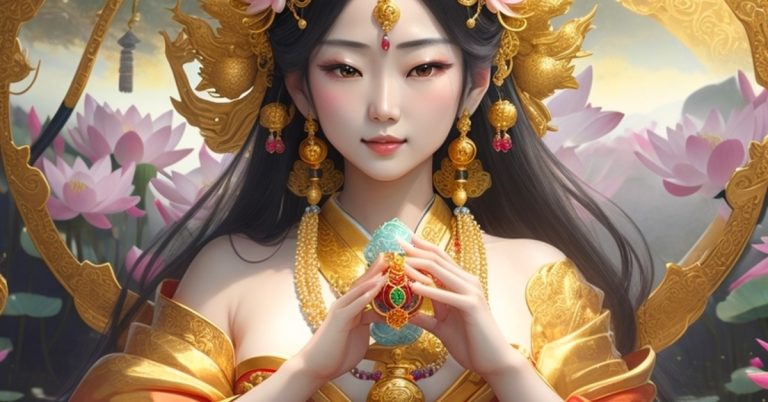
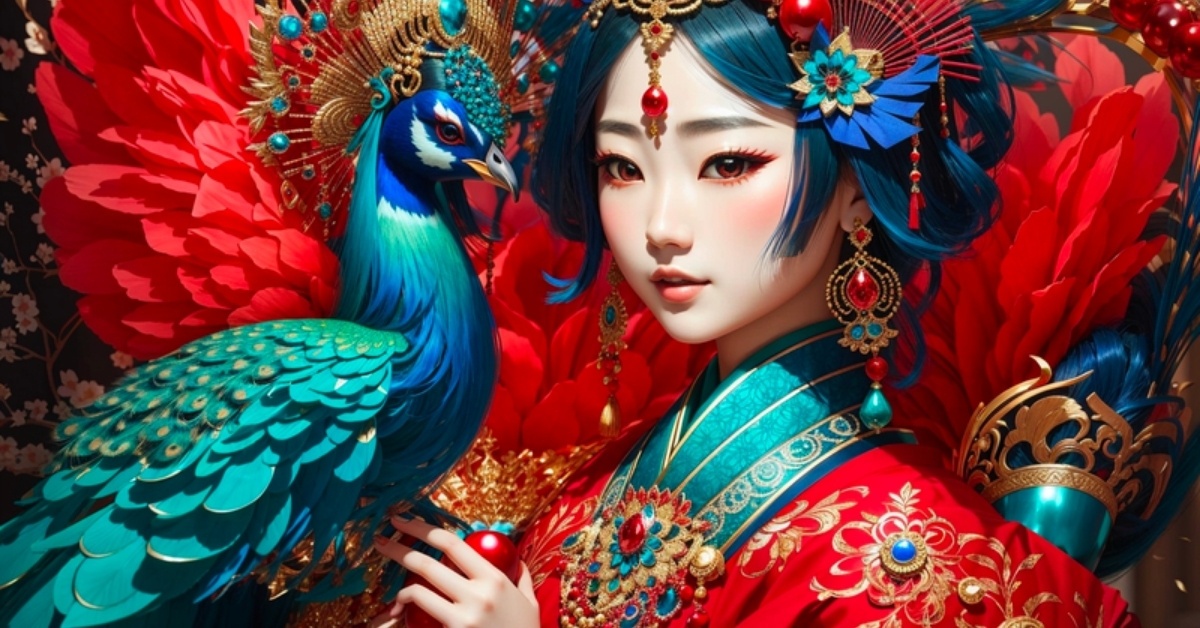
- A court beauty of Tang-dynasty China: full cheeks, crescent brows, a small composed mouth
- Dressed in layered, embroidered silks in the fashion of the eighth-century Chinese court
- An elaborate jeweled headdress, sometimes topped with a phoenix
- The wish-granting jewel, the nyoi-hoju, held in her left hand
- Her right hand open and lowered in the gesture of giving, or holding a lotus
- Standing, most often, with her robes painted as if caught mid-sway
Abilities
- Fortune and wealth — the core of her worship from India onward
- A good harvest — the request at the heart of her New Year rite
- Beauty and happiness — in Japan she becomes the pattern of feminine beauty itself
- Fertility — prayed to for children, an inheritance from Lakshmi
- Merit and pardon — the goddess before whom the year’s faults are confessed and cleared
- Protection — in the Golden Light Sutra she vows to guard anyone who upholds the teaching
Symbols
- The nyoi-hoju — the wish-fulfilling jewel, the cintamani of Sanskrit texts, the one object that identifies her
- The lotus — carried over from Lakshmi, who is born from one
- Tang court dress — her silks and headdress are as much her signature as the jewel
- The phoenix — the auspicious hoo bird, occasionally set in her crown
- The treasure ship — the takarabune of the Seven Lucky Gods, in the years she sails on it
Traits
- Serene and courtly, the calmest figure in any hall she stands in
- Generous, with the open giving hand to prove it
- Protective of those who keep faith with the teaching
- Bound to her opposite: Buddhist tradition gives her a sister named Kokuanten, goddess of darkness and misfortune, and insists the two travel as a pair
- Beautiful in a way that, according to the oldest Japanese stories, could unsettle a devotee
Festivals and Rituals
Kichijoten’s worship in Japan begins with the state. In the eighth century the court of Nara adopted the Golden Light Sutra as a charm for the protection of the state, and her rite came with it.
The rite is the Kissho Keka, the “repentance before Kichijoten.” Keka is confession: a congregation gathers before an image, recites, and repents the year’s faults, seen and unseen, and then asks for what it needs. In front of Kichijoten, what it needs is a peaceful country, a full harvest, and good luck. The court chronicle Shoku Nihongi records the rite fifteen times between 749 and 770, and once the empress herself performed it inside the palace. In 767 the court extended keka to the provincial temples, and from then on the rite was part of the machinery of the Japanese New Year. Temples in Nara were commissioning images of her for it by the 740s: Todai-ji, Horyu-ji, and, around 771, Yakushi-ji.
Yakushi-ji still keeps the rite. Its Shusho-e runs from January 1 to January 15, and the Kissho Keka is performed inside it, with the eighth-century painting of Kichijoten, a National Treasure, hung as the principal image for the first three days. Worshippers reflect on the year, pray for peace and a good harvest, and ask her for luck. The old painting then goes back into storage, and a modern one takes its place for the remaining days.
The other great image of her, the 1212 statue at Joruri-ji south of Nara, is a hibutsu, a hidden Buddha. It comes out for the first half of January, for two months in spring, and for two months in autumn, and the rest of the year it stays in the dark. That schedule is why, eight hundred years on, the paint on her silks is still bright.
Legends associated with Kichijoten
Kichijoten’s stories are about what happens to the people who stand in front of her. That is the way of a sutra goddess. She appears, she makes a vow, and the tales grow from the vow.
The vow in the Golden Light Sutra
Kichijoten enters Buddhism in a scripture, and the scripture gives her a speaking part.
The Golden Light Sutra is a Mahayana text that promises protection to any ruler who honors it. In its middle chapters a series of great beings step forward before the Buddha and pledge themselves to the sutra’s defenders: the Four Heavenly Kings, then the goddess Sarasvati, then Sri-mahadevi, then the earth goddess Prithivi. Sri-mahadevi, who is Kichijoten, gives her mantra and vows to guard any monk who upholds and teaches the text, and to see that he is provided for.
That vow is the whole foundation of her worship in Japan. A sutra that protects the nation, a goddess inside it who protects the sutra’s keepers, and a court that welcomed the protection. The Nara emperors read the text as a charm for the country; in 741 Emperor Shomu founded a monastery in every province and named them for it. Kichijoten came into Japan as part of the state’s insurance policy, and her New Year rite is that policy renewed each January.
Two sisters at the door
The best-known story about Kichijoten is a parable, and it comes from a different scripture, the Nirvana Sutra.
A rich man is at home when a beautiful woman arrives at his gate. He asks who she is, and she says she is the goddess of merit, Kudokuten, and that wherever she goes she brings gold, silver, and every good thing. Delighted, he burns incense and welcomes her in.
A second woman follows her to the door. This one is ugly, ragged, and pale, and when he asks her name she says she is Kokuanten, the goddess of darkness, and that wherever she goes she brings loss. He grabs a knife and tells her to leave or die.
The beautiful woman stops him. The ragged one is her sister, she says. They go everywhere together. Whoever loves her must take in the other, because they have been together from the start.
In the sutra the rich man throws them both out, and the Buddha explains that this is what the wise do with life and death: refuse the pair. Japanese tradition kept the sisters and drew its own moral. Fortune and misfortune come as a set, and Kokuanten, “black darkness,” became the ancestor of the binbogami, Japan’s god of poverty. Kichijoten’s beauty, in this reading, always has a shadow at its heel.
The man who fell in love with her statue
Japan’s oldest collection of Buddhist tales, the Nihon Ryoiki, was compiled by a monk of Yakushi-ji between 787 and 824, and it contains two stories about Kichijoten. The first is one of the strangest things in early Japanese literature.
In the province of Izumi there was a mountain temple with a clay image of Kichijoten. A layman who came to live there looked at it a little too long. He fell in love with the statue, and he prayed to it in earnest: give me a woman as beautiful as you.
One night he dreamed he lay with the goddess. The next morning he went to the hall, and the skirt of the clay image was stained.
He was ashamed of himself and confessed it, which is how the story reached the compiler. The tale is told with a straight face and a moral about the power of faith, since the goddess had, after a fashion, answered him. What it also records is how a Nara-period devotee could look at these Tang-style beauties. She was a goddess. She was also, unmistakably, a woman in a painting or a statue, and the old stories admit it.
A feast from nowhere
The second Nihon Ryoiki story is kinder, and closer to what people asked her for.
A woman of good family in the capital has fallen into poverty. Her wealthy relatives are coming, custom says she must feed them, and she has nothing. She goes to an image of Kichijoten in one of the city’s halls and prays. The feast arrives, in the versions of the tale, either through a mysterious visitor or as provisions that simply appear, and her guests go home impressed. That is what most prayers to Kichijoten looked like: faith before her image, and the household’s luck turns.
Wife of the guardian of the north
Kichijoten has a family, and in Japan the family is a warrior’s.
Bishamonten is the guardian king of the north, the armored god who carries a spear in one hand and a small pagoda, the treasure house, in the other. He is one of the Four Heavenly Kings who protect the Buddhist world, and in Japan he is also a god of war and, eventually, one of the Seven Lucky Gods.
The Japanese tradition makes Kichijoten his wife and gives them a son, the boy-attendant Zennishi Doji. At Kurama-dera, the mountain temple north of Kyoto, and in the mandalas painted of that mountain, she stands at Bishamonten’s side with the boy between them. The Chinese tradition that came before is less romantic and calls her his sister. Both versions leave her the same job: the beauty and wealth in the household of the god who guards the treasure. Some texts go further and make her the daughter of Kishimojin, the demoness who became a protector of children, which places Kichijoten in a whole family of converted powers.
The seat she lost on the treasure ship
The Seven Lucky Gods, the Shichifukujin, sail into Japanese harbors on their treasure ship in the first days of every New Year. Whether Kichijoten is on board depends on which picture you are looking at.
The seven first appear as a group in 1420, in Fushimi near Kyoto, where a procession of them was staged to mimic the parades of the great lords. Under the Tokugawa shoguns the roster was fixed: the priest Tenkai, consulting with the shogun Iemitsu, chose gods to embody longevity, fortune, popularity, sincerity, kindness, dignity, and magnanimity, and the painter Kano Yasunobu drew them. The standard seven are Ebisu, Daikokuten, Bishamonten, Benzaiten, Jurojin, Hotei, and Fukurokuju.
Kichijoten’s place in that list stayed open to revision. She appears in some rosters and drops out of others, most often standing in for Fukurokuju or Jurojin, whose gifts overlap with hers. The 1783 edition of the Butsuzozui, an illustrated handbook of Buddhist images, puts her in Fukurokuju’s seat. When she is in, and when Daikokuten is drawn in his feminine form, the ship carries all three goddesses of the Hindu Tridevi at once, which is a strange thing for a Japanese New Year card to be doing.
The goddess who took her role was Benzaiten, the lute-playing goddess of music and eloquence. From the medieval period onward Benzaiten was increasingly identified with Kichijoten, and Kichijoten’s function as the goddess of good fortune passed to her in popular belief. The only woman on the standard ship is Benzaiten, and part of what she is holding is Kichijoten’s portfolio.
An older Kichijoten?
The painting at Yakushi-ji is Japanese, the silks are Chinese, and the goddess inside them is Indian.
Kichijoten’s Sanskrit title is Sri-mahadevi, “the great goddess Sri,” and Sri is the oldest name of Lakshmi, the Hindu goddess of fortune, wealth, and beauty. Lakshmi’s roots reach into the Vedas. The Sri Sukta, a hymn attached to the Rigveda, calls on her as golden-hued, adorned in gold and silver, seated on a chariot, the giver of wealth, fame, food, and well-being. In the later Hindu picture she is born from the churning of the cosmic ocean, seated on a lotus, flanked by elephants pouring water, and married to Vishnu, the preserver. Everything Kichijoten grants, Lakshmi granted first, and the lotus in Kichijoten’s hand is Lakshmi’s lotus.
Buddhism took Lakshmi in as a protector. Mahayana texts kept several Hindu gods and goddesses in that role, powers who bowed to the Buddha and pledged to defend his teaching, and Sri-mahadevi is one of them. Her chapter in the Golden Light Sutra sits beside a chapter for Sarasvati, the Hindu goddess of learning. The sutra was translated into Chinese by Dharmaksema in the fifth century, and again by the pilgrim Yijing around 703 in the thirty-one-chapter version that became standard across East Asia. In Chinese she became Gongdetian, “the goddess of merit,” and Jixiangtian, “the goddess of good omen.” Read those two names in Japanese and you get Kudokuten and Kichijoten. The Tang court dress she wears in every image is the dress of the China she passed through; it was what a great lady looked like at the moment her image was fixed.
She arrived in Japan with the sutra. It was read at court around 660, and by the eighth century it was the scripture of state protection, which is why Kichijoten’s rite was a state rite and why the earliest Japanese images of her are the work of the great Nara temples. For a while she was the goddess of fortune in Japan.
Then her own traveling companion moved in. Sarasvati came through the same sutra and became Benzaiten, and where Kichijoten stayed a courtly figure of the old temples, Benzaiten was adopted everywhere: by musicians, by merchants, by island shrines, and by the cult of the dragon kings. From the medieval period the two goddesses were confused, then merged, and Kichijoten’s role as the bringer of luck settled on Benzaiten. When the Seven Lucky Gods were fixed in the Edo period, Benzaiten held the seat, and Kichijoten survived as the alternate, occasionally drawn in place of Fukurokuju.
So under the Japanese goddess of fortune lie two older ones. The first is Lakshmi, whose gifts she still carries and whose lotus she still holds. The second is her rival and sister in the same sutra, Saraswati, who in her Japanese form inherited the job. Kichijoten holds both of them, and together they explain why a woman in Tang silks stands in a Nara temple hall each January, holding an Indian jewel, and why the Japanese still climb the temple steps to see her.
Kichijoten across cultures
The thing Kichijoten stands for, fortune, keeps a woman’s face in most places it appears.
Her own ancestor, Lakshmi, is still worshiped across India, and on the night of Diwali households light lamps to draw her in, the same gesture of welcome the rich man made in the parable. In the Greek and Roman worlds the goddess of luck, Tyche or Fortuna, held a rudder and a horn of plenty, and the horn is close cousin to Kichijoten’s jewel: an object that gives without limit. Fortuna, too, was known for turning her wheel, which is Kokuanten’s lesson from the other side. Luck that arrives can leave.
Japan keeps a second prosperity deity, and the contrast is instructive. Inari, the kami of rice, sake, and commerce, is homegrown, Shinto, and everywhere: tens of thousands of shrines, red gates, fox messengers. Kichijoten is the imported, Buddhist, courtly answer to the same wish, and the two have shared the country for more than a thousand years without either replacing the other. A Japanese family can pray to Inari for the business and bow to Kichijoten at the New Year without any sense of contradiction. The wish is the same. The route to it is different, and Japan has long been comfortable keeping more than one route open.
Final thoughts
On the fourth of January the painting at Yakushi-ji goes back into the dark, and a newer one takes its place for the rest of the rite.
What stays is the order of the asking. A goddess of luck who hears your faults before she hears your wishes. A goddess of beauty whose oldest stories admit exactly how beautiful she is. A goddess of fortune who arrives, in the parable, with her ragged sister a step behind, and who tells you plainly that they come as a pair. Lakshmi crossed two countries and changed her clothes twice to become her, and the jewel in her hand stayed the same the whole way.
If Kichijoten stood at your gate with her sister behind her, would you let them both in?
Bibliography
- “Śrīmahādevī”. Wikipedia.
- “Kichijōten 吉祥天”. JAANUS: Japanese Architecture and Art Net Users System.
- “Golden Light Sutra”. Wikipedia.
- “Seven Lucky Gods”. Wikipedia.
- “Benzaiten”. Wikipedia.
- “Lakshmi”. Wikipedia.
- “Kichijo Tennyo Painting” and “Annual Events”. Yakushiji Temple.
- Cartwright, Mark. “Kichijoten, Yakushiji”. World History Encyclopedia.
- “Standing Statue of Kichijōten”. Wikipedia.
- “悔過 (Keka)” and “吉祥天 (Kichijōten)”. Wikipedia (Japanese).
- Nakamura, Kyoko Motomochi, trans. Miraculous Stories from the Japanese Buddhist Tradition: The Nihon Ryōiki of the Monk Kyōkai. Routledge.
- Bender, Ross, et al. “Question about repentance rituals in Japan”. PMJS: Premodern Japanese Studies discussion list.
- “Bishamonten”. Wikipedia.