Ceridwen: Welsh Goddess of the Cauldron and Inspiration
A boy is stirring a cauldron that has been boiling for a year, and three drops splash onto his thumb.
He sucks it, the way anyone would. In that instant he knows everything, including that the woman who owns the cauldron is about to kill him for it.
That’s how the Welsh tell the making of their greatest poet, and Ceridwen, the enchantress at the center of it, is one of the strangest and most argued-over figures in Celtic myth. Keeper of the cauldron of inspiration, hunter of a thief across land, water, and air, and mother to a genius she never meant to bear.
Overview of Ceridwen
Ceridwen, also spelled Cerridwen or Kerridwen, belongs to the Welsh corner of Celtic myth. Her home is Llyn Tegid, Bala Lake, the largest natural lake in Wales, where she lives with her husband Tegid Foel, whose name the lake still carries. They have two children: a daughter, Creirwy, so lovely the poets counted her among the three fairest maidens of Britain, and a son, Morfran, so ugly he’s also called Afagddu, “utter darkness.”
She rules a narrow territory, and rules it completely: Awen, the Welsh word for poetic inspiration, the flash that turns a rhymer into a bard. Medieval Welsh poets called her the keeper of the cauldron of Awen, and the greatest of them, Taliesin, claimed her as the mother who bore him a second time.
Like Rhiannon and the rest of the Welsh pantheon, she reaches us only through medieval manuscripts, and her name is as uncertain as her origins. The scholar Ifor Williams derived it from cwrr, “bent,” and read it as “crooked woman,” a witch’s name. Others hear cerdd, “song” or “craft,” in the first half and -wen, “fair” or “blessed,” in the second, which gives modern devotees “blessed song.” No reading has won.
Her festivals are all modern, and they are described below.
Titles
- Keeper of the Cauldron of Awen (the medieval poets’ title for her)
- Cerridwen, Kerridwen, Kyrridven (manuscript spellings)
- Mother of Taliesin
- The Crone (Robert Graves’s reading, taken up by modern Pagans)
- The White Sow and the Grain Mother (modern devotional titles)
Characteristics
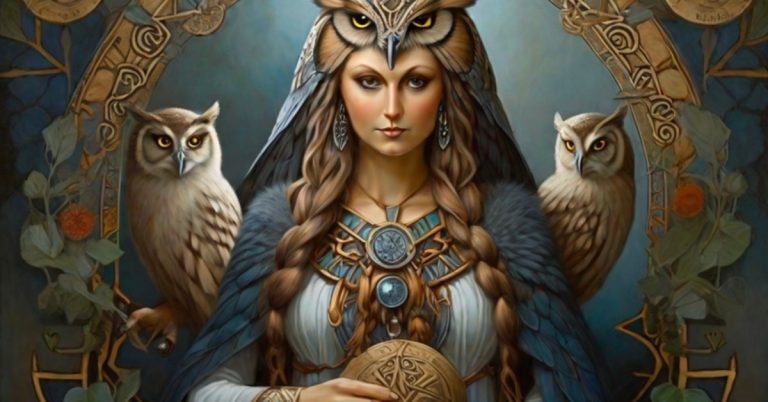
How Ceridwen tends to be shown in art:
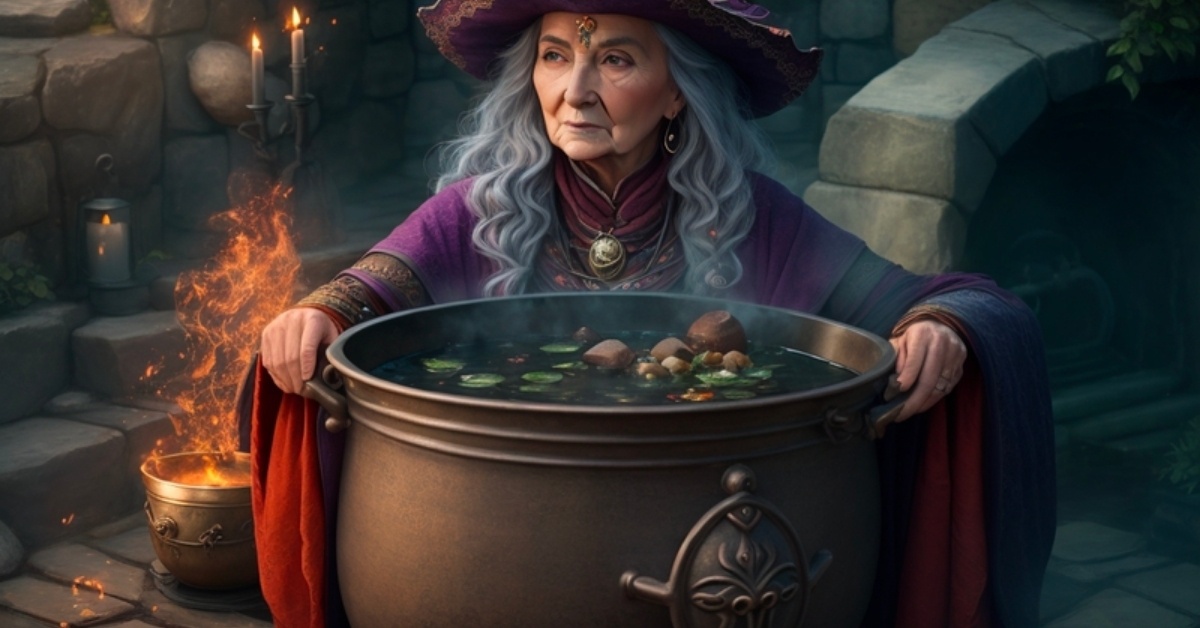
- A hooded woman bent over a great iron cauldron
- Older, sharp-eyed, and dark-cloaked in modern art; the medieval texts leave her face undescribed
- Caught mid-change, as greyhound, otter, hawk, or black hen
- Surrounded by the herbs she gathered for the brew
- The three-rayed Awen sign (/|) placed near her in modern imagery
Abilities
- Brewing — a potion that distills a year and a day of simmering into three drops
- Shapeshifting — greyhound, otter, hawk, and hen, each chosen to hunt the shape her quarry has taken
- Book-magic — she works from “the books of the Fferyllt,” gathering herbs by the planetary hours
- Rebirth — she swallows a grain of wheat and bears a poet nine months later
- Granting Awen — the gift of prophecy and song, hers to give and hers to lose
Symbols
- The cauldron — the vessel of inspiration and, later, of rebirth
- The three drops — everything the brew was for, in a splash
- The black hen and the grain of wheat — the end of the chase
- The hare, greyhound, otter, and hawk — the chase itself, on land, in water, and in the air
- The leather bag on the sea — how the poet reached the world
- The Awen sign (/|) — three rays of light, a modern emblem of her gift
Traits
- A devoted mother, fierce enough to tend a fire for a year for an unloved son
- Relentless when wronged
- Merciful at the last moment, when the beautiful infant stops her hand
- Learned, working her magic out of books and planetary tables
- Sovereign in her own house, with a husband who barely appears in the tale
Festivals and Rituals
The ancient and medieval record is silent on any festival of Ceridwen. The one thing that did survive is the Awen itself.
In the 1790s a Welsh stonemason named Edward Williams, better known by his bardic name Iolo Morganwg, invented an “ancient” bardic tradition almost from whole cloth, including the three-rayed sign /|\ and the Gorsedd of Bards that still opens the National Eisteddfod of Wales every August. Ceridwen’s cauldron sits behind that whole revival, and the sign he drew is now the badge of Welsh poetry.
Modern Pagans and Druids honor her at the dark moon and at Samhain, the Welsh Calan Gaeaf on October 31, when the old year ends. A cauldron on the altar, an offering of grain, and something the practitioner is ready to let go of, named out loud. Her story lends itself to that: whatever goes into the cauldron comes out changed.
Legends associated with Ceridwen
Ceridwen has one great story, and it gets told in full below, with two smaller threads that hang off it. The story comes to us as the opening of the Hanes Taliesin, the “Tale of Taliesin,” and it is one of the finest chases in world myth.
A cauldron for an unloved son
Ceridwen looked at her son Morfran and saw the life ahead of him. Every noble court would turn away a boy that ugly, however wellborn. So she decided to give him the one thing that outweighs a face: wisdom. Handsome was beyond her power. Wise was within it. He would be the wisest and most inspired man alive, and the courts would open for him anyway.
She took up the books of the Fferyllt, the old Welsh name for alchemists and sages, and set about brewing a cauldron of inspiration and knowledge. This was slow magic. The herbs had to be gathered on the right days and in the right planetary hours, and the brew had to boil without stopping for a year and a day. At the end of that time, three drops would leap from it, and those three drops would hold every gift the cauldron had to give. All that remained after would be poison.
She had a year of herbs to gather, so she found two helpers: a blind man named Morda to feed the flames, and a boy called Gwion Bach, “little Gwion,” to stir. She gave them strict orders that the pot must never stop boiling, and went out gathering herbs by the hours the books prescribed.
Three drops on a thumb
The year turned. On the last day, with Ceridwen away and the brew at its height, three drops of scalding liquid leapt from the cauldron and landed on Gwion’s thumb.
He did the only thing anyone does with a burned thumb. He put it in his mouth.
Everything Ceridwen had brewed for her son passed into the boy instead: all knowledge, all inspiration, the whole year and a day in a single taste. And the first thing that knowledge showed him was what Ceridwen would do when she found out. The cauldron, its work done, cracked in two and spilled its poison across the ground. Gwion ran.
Ceridwen came home to a broken pot, a year wasted, and a blind man who could tell her nothing. She struck poor Morda with a log, and he cried out that it was none of his doing. She knew that already. She could see, as clearly as Gwion could, who had her gift. She went after him.
The chase
This is the part of the story every Welsh child once knew.
Gwion saw her coming and turned himself into a hare. Ceridwen became a greyhound and ran him down toward a river. He leapt in as a fish. She followed as an otter and pressed him so hard he flung himself out of the water as a bird. She rose after him as a hawk and gave him no rest in the sky.
Exhausted, the boy spied a heap of winnowed wheat on the floor of a barn. He dropped into it and became one grain among thousands.
Ceridwen landed. She became a black hen, high-crested, scratching through the pile, and she found him, and she ate him.
Every form he chose, she answered with the one thing that hunts it. Earth, water, and air, and then the barn floor, where the hunt finally ends by the humblest means of all: a hen pecking at grain.
The child in the leather bag
By rights that was the end of Gwion Bach. Instead, Ceridwen found she was pregnant, and she knew exactly who she carried. She resolved to kill the child the moment it was born.
Nine months later she gave birth to a boy so beautiful that her resolve failed her. Keeping him was as impossible as killing him. So she sewed him into a leather bag and gave him to the sea.
The bag drifted. In Guest’s telling it washed up in the salmon weir of Gwyddno Garanhir, a lord whose weir was said to yield a hundred pounds’ worth of fish every May Eve. That year Gwyddno gave the catch to his son Elffin, the unluckiest young man in Wales, hoping it would change his fortune. What Elffin hauled from the weir was a leather bag with a baby in it, and when he opened it and saw the child’s forehead, he said, “tal iesin,” “radiant brow.” The child spoke back to him in verse.
That baby grew into Taliesin, the greatest poet of Wales, who went on to humble the bards of King Maelgwn Gwynedd and free Elffin from the king’s prison. And ever after he called himself twice-born, once of a mother he never names and once of Ceridwen.
What became of Morfran
The son the cauldron was brewed for missed his three drops, and the tradition remembered him anyway. Morfran, “sea crow,” turns up in Culhwch and Olwen among Arthur’s warriors, with a story of his own: he walked away from the battle of Camlan, the fight that ended Arthur’s reign, because every man refused to strike him. They took one look at the hair on his face, like a stag’s, and assumed he was a devil sent to help their side.
So Ceridwen’s ugly boy survived the battle that killed the king. Ugliness, it turns out, was its own kind of armor.
The drowned court
A last thread comes from the man who wrote the tale down. Elis Gruffydd, a Welsh soldier and chronicler stationed at Calais in the 1540s, added that Tegid Foel’s court had drowned beneath the lake in a single night, and that on moonlit evenings people claimed to see its lights shining under the water. Bala Lake still has that reputation, and locals still tell of a drowned town beneath it.
An older Ceridwen?
Start with a date. The fullest telling of Ceridwen’s story, the one everything above is drawn from, was written down around 1550 by that same Elis Gruffydd. That is more than a thousand years after the Romans left Britain, and it makes Ceridwen a real problem for anyone who wants to call her an ancient goddess.
She is older than that manuscript. Twelfth-century court poets like Cuhelyn Fardd and Cynddelw Brydydd Mawr already knew her as the keeper of the cauldron of Awen, and the Book of Taliesin, copied around 1325 from older material, names her repeatedly; one poem is titled “The Chair of Ceridwen.” The poets are her earliest witnesses; every altar, inscription, and Roman-era writer is silent about her.
That gap is where the argument lives. The historian Ronald Hutton reads the Tale of Taliesin as language from around the ninth century, and in it Ceridwen is a sorceress, a wealthy woman skilled in books, and nobody in the tale worships her. He argues that the twelfth-century poets promoted her: they were building a mythology of poetic inspiration for their own guild, and a sorceress with a cauldron became its goddess. On that view the “goddess” is a medieval literary creation, and a fine one. Later hands built higher. John Rhys in 1878 made her a dawn goddess. Iolo Morganwg’s invented bardic lore gave her the Awen sign. Robert Graves, in The White Goddess (1948), made her the destroying Crone of his Triple Goddess, and from Graves she passed straight into Wicca, where she is now among the most invoked goddesses in the modern movement.
Other readers, including many who write for that movement, hold that the sorceress is what was left of a goddess after Christian scribes had finished with her, and that the poets were remembering something older. The evidence leaves it open.
What is genuinely old is her cauldron. The Welsh had a whole family of magic cauldrons long before anyone wrote down the tale of Gwion Bach, and they share her vessel’s two powers, inspiration and rebirth. In Preiddeu Annwfn, an Arthurian poem in the Book of Taliesin that may date to around 900, Arthur raids the Otherworld for the cauldron of the Head of Annwn, “kindled by the breath of nine maidens,” which refuses to boil a coward’s food. In the Second Branch of the Mabinogi, the Pair Dadeni, the “cauldron of rebirth,” raises dead warriors the morning after they fall, whole but mute, until Bran’s half-brother Efnysien climbs in among the corpses and bursts it from inside. Across the sea, the Dagda’s cauldron, the Undry, was one of the Four Treasures of the Tuatha Dé Danann, and everyone who came to it left full.
Ceridwen’s brew does both things at once. It gives Awen, like the Otherworld cauldron. It swallows a boy and gives him back reborn, like the Pair Dadeni. Whatever the truth about her worship, the vessel she stirs belongs to the oldest layer of Celtic imagination, and she is its last and most personal keeper.
Ceridwen across cultures
The Welsh had a neighbor across the Irish Sea telling almost the same story about a thumb.
The Irish hero Fionn mac Cumhaill, as a boy, was set to cook the Salmon of Knowledge for his master, the poet Finn Eces, who had waited seven years to catch it. Fionn burned his thumb on the fish, sucked it, and received the wisdom meant for someone else. Two Celtic traditions, two boys, two burned thumbs, and two masters who watched a lifetime’s work go into the wrong mouth. Scholars have long noted the match, and it points to a shared Celtic idea: inspiration is a liquid, it is dangerous to handle, and it goes to the one who tastes it first.
Ireland gives her other kin as well. Brigid, goddess of poets, smiths, and healers, holds Awen’s Irish cousin, the fire of inspiration, and she is far better attested as a deity than Ceridwen is. And The Morrigan, who shifts from woman to crow to eel to heifer across the Irish epics, is the great shapeshifter of the Celtic world; Ceridwen’s chase reads like a Welsh answer to her.
Farther north, the Norse told of Odin and the mead of poetry: a drink that turned anyone who tasted it into a poet, stolen from the giant Suttungr, carried home by a god who fled in the shape of an eagle while the giant pursued as an eagle behind him. A liquid that grants poetry, a theft, a chase through changed shapes. The Norse put the god on the thief’s side; the Welsh put the goddess on the hunter’s. The bones of the story are the same.
Final thoughts
The strangest thing about Ceridwen is that she loses.
She spends a year and a day on a gift, and it goes to the wrong boy. She hunts him through four shapes and catches him, and he comes out of her more gifted than before. Every step she takes to destroy him makes him. By the end of the tale, the greatest poet in Wales is calling her mother, and the inspiration she meant to hoard for one child belongs to everyone who has ever been moved by a poem.
That may be why poets and modern Pagans keep returning to her. Her cauldron says that what goes in comes out changed, and that the change picks its own target. You tend the fire for a year. The drops choose the thumb.
Which reading do you take: was there ever a goddess at Bala Lake, or did the poets of Wales make one because they needed her?
Bibliography
- Guest, Lady Charlotte, trans. “Taliesin,” in The Mabinogion (1877). Project Gutenberg.
- Ford, Patrick K., ed. Ystoria Taliesin. University of Wales Press, 1992.
- Haycock, Marged, ed. Legendary Poems from the Book of Taliesin. CMCS Publications, 2007.
- Hutton, Ronald. “Finding Lost Gods in Wales”. Gresham College lecture transcript, April 26, 2023.
- Graves, Robert. The White Goddess. Faber & Faber, 1948.
- “Ceridwen”, “Hanes Taliesin”, and “Morfran”. Wikipedia.
- “Pair Dadeni”, “Preiddeu Annwfn”, and “Four Treasures of the Tuatha Dé Danann”. Wikipedia.
- “Ceridwen”. Mythopedia.
- “Ceridwen: The Celtic Goddess of Inspiration”. History Cooperative.