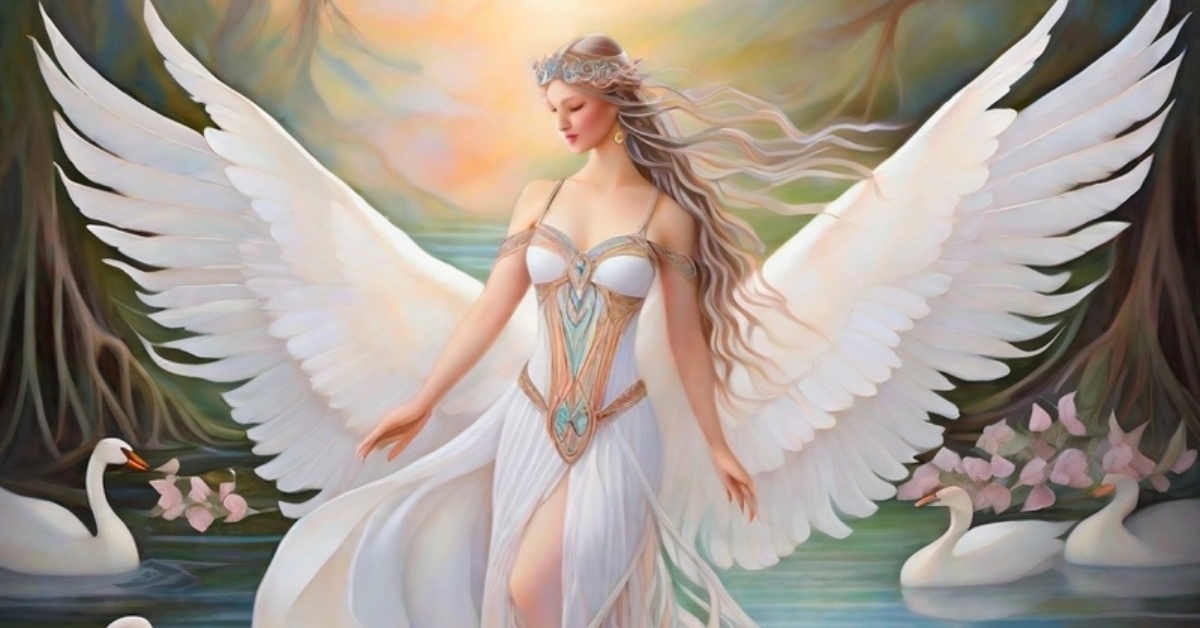
Caer Ibormeith: The Irish Swan Maiden
A god fell in love with a woman he had only ever seen asleep.
For a year he ate nothing. His mother searched all of Ireland for her, then his father, then a king. When they finally found her she was a swan on a lake in Munster, one white bird among a hundred and fifty, and she would be a woman again only at Samhain.
Her name was Caer Ibormeith. Ireland kept exactly one story about her, and it’s a good one.
Overview of Caer
Caer Ibormeith is a woman of the sídhe, the mound-dwelling people of Irish myth, who are the Tuatha Dé Danann under another name, the children of Danu. Her father is Ethal Anbuail, lord of Síd Uamain in Connacht, in the west of Ireland. Her story survives in a single Old Irish tale, Aislinge Óenguso, “The Dream of Óengus,” probably composed in the eighth century and copied into the manuscript we have around 1516.
That’s a narrow footing for a goddess, so let’s be straight about it. Caer has no temple, no festival on the old calendar, and no cult anyone has found. What she has is one tale, told with real beauty, in which she is the prize, the puzzle, and finally the equal of the god who wants her. Everything modern writers say about her as a goddess of dreams and prophecy grows out of that one story.
Her second name, Ibormeith, is usually glossed as “yew berry.” The yew is Ireland’s tree of graveyards and long life, and its red berries carry a poisonous seed. Make of that what you like. The tale leaves the name unexplained.
Titles
- Caer Ibormeith, “Yew Berry”
- Daughter of Ethal Anbuail
- The Swan of Loch Bél Dracon
- The girl of the dream (the tale’s title word, aislinge, means a dream or vision)
- Bride of the Mac Óc, “the Young Son,” which is Aengus’s own title
“Caer Aisling,” which you’ll see online, is a modern coinage. The medieval text knows her only as Caer Ibormeith.
Characteristics
How the tale, and the artists who came after it, show her:
- The most beautiful woman in Ireland, according to the man who dreamed her
- A head taller than the hundred and fifty maidens around her
- A silver necklace at her throat and a chain of burnished gold
- In her other year, a white swan among white swans
- Carrying a timpán, a small stringed instrument, and playing a god to sleep with it
Abilities
- Shape-shifting — a woman one year, a swan the next, turning at Samhain
- Dream-walking — she reaches Aengus in his sleep every night for a year
- Music that overpowers — her song with Aengus puts all of Ireland to sleep for three days and nights
- A power her own father admits is greater than his — which is why a siege changes nothing
Symbols
- The swan — her other body
- The silver chain — the link that joins her companions in pairs
- The gold chain — hers alone, the mark Aengus knows her by
- The yew and its berry — her name
- Loch Bél Dracon — “the Lake of the Dragon’s Mouth,” where the change happens
- Samhain — the night of the turning
Traits
- Self-possessed: she sets a condition before she goes to anyone
- Elusive: a year of visits that vanish at a touch
- Loyal once she’s chosen: “the girl remained with him after that”
- Beyond her father’s authority, and she knows it
Festivals and Rituals
The only festival Caer has is the one the tale gives her. Everything hangs on Samhain, the night of October 31 into November 1, when the old Irish year turned from its bright half to its dark half and the sídhe mounds stood open. That is when she changes shape, and that is when Aengus comes for her.
Modern pagans who work with her keep to that hinge. They honor her at Samhain with swan feathers, water, and dream work, and treat her as a guide for what surfaces in sleep. Those practices are recent and built from the story, which is how a one-tale figure stays alive.
Legends associated with Caer
Caer has one story, so here it is in full. It’s a love story that starts as a medical case, turns into a manhunt across four provinces, and ends with two swans singing an entire island to sleep.
The girl at the head of the bed
Aengus was asleep one night when he saw someone coming toward the head of his bed: a young woman, the most beautiful in Ireland. He reached to draw her to him and she was gone. Nothing was left of her but the missing of her.
He ate nothing the next day. The night after, she came again, and this time she brought a timpán, a small harp-like instrument, and played for him until he slept. Then she was gone again.
This went on for a year. Every night she came, and every morning he woke alone, and Aengus, the golden youth of the Tuatha Dé, the god of Brú na Bóinne whose kisses turned into birds, wasted away. He told no one the cause.
At the end of the year the physicians of Ireland were sent for. One of them, Fíngen, looked at the patient and read the case at once: love in absence, for a woman without a name. His bag held nothing for that. Fíngen sent for Aengus’s mother.
A year of searching
Boann, goddess of the river Boyne, searched Ireland for a full year and found no girl who matched the one in the dream.
So Fíngen sent for the Dagda, Aengus’s father, and the Dagda asked what use he could possibly be. “I know no more than you do.” Fíngen pointed out that he was king of the sídhe of Ireland, and that Bodb Derg, king of the sídhe of Munster, had knowledge that ran the length of the island. Bodb took the job and asked for a year to do it.
He needed most of it. At the end he sent word: the girl was found, at Loch Bél Dracon, the Lake of the Dragon’s Mouth, in the hills of Crotta Cliach in Munster.
Aengus was too weak to walk by then. They carried him to Bodb’s mound in a chariot and feasted him for three days and three nights, and then Bodb took him down to the lake to see whether he would know her.
The lake of the dragon’s mouth
He knew her.
At the water’s edge stood a hundred and fifty young women, in pairs, each pair joined by a chain of silver. One of them stood a head above the rest, with a silver necklace at her throat and a chain of burnished gold. That one, Aengus said.
Bodb told him the seeing was all he had to offer. Her name was Caer Ibormeith, daughter of Ethal Anbuail of Síd Uamain in Connacht, and Bodb had no power over her. So Aengus went home to the Boyne as sick as before, and now with a name to be sick over.
The siege of Síd Uamain
The Dagda and Boann went to Connacht, to Crúachu, where Ailill and Medb held court, the same king and queen who would one day launch the great cattle raid on Ulster. The Dagda’s people were feasted for a week, and then the Dagda asked for the girl.
Ailill and Medb said she was Ethal’s to give, and sent to Ethal. Ethal refused.
So Ailill’s warriors and the Dagda’s marched on Síd Uamain together, overran the mound, took sixty heads, and dragged Ethal Anbuail back to Crúachu in chains. And still he refused, and now, at last, he explained why. Giving her was beyond him, because her power was greater than his own.
Then he gave up the only thing he had that was worth anything. Caer spent one year in the shape of a bird and the next in the shape of a woman. The coming Samhain she would be at Loch Bél Dracon as a swan, with a hundred and fifty swans about her. That secret bought Ethal his life and a treaty between three powers, and Aengus, told where and when, went to wait.
Samhain, and two swans
He came to the lake at Samhain and found the birds on the water, a hundred and fifty white swans with silver chains.
He stood at the edge in his own shape and called out to her by name. A swan answered, asking who was calling. Aengus told her. She said she would come to him if he swore on his honor that she could return to the lake, and he swore it.
She came to him. He put his arms around her, and they fell asleep together in the form of two swans. Then they rose, circled the lake three times so that his oath was kept, and flew away as two white birds to Brú na Bóinne, singing together as they went. The music was so sweet that everyone who heard it slept for three days and three nights.
“The girl remained with him after that.”
A prelude to the war
The tale ends on a line that sounds like an afterthought and explains why anyone wrote it down. Because of the friendship made that day, Aengus brought three hundred warriors to fight for Ailill and Medb in the Táin Bó Cúailnge, the cattle raid of Cooley. The Dream of Óengus is a remscél, a fore-tale to Ireland’s great epic, filed away to account for one alliance.
That’s the bureaucratic reason it survived. The other reason is that some scribe loved it as much as you’re about to.
An older Caer?
Folklorists have a filing number for Caer’s story.
The swan maiden is tale type 400 in the Aarne–Thompson–Uther index and motif D361.1 in Stith Thompson’s catalog, and it is one of the most widespread stories humans tell. A man finds a woman who is also a bird. He must win her, and he must know her for what she is. The oldest written version is Chinese, from the fourth century. The Norse Völundarkviða opens with three brothers who marry three swan-wives, valkyries in feather-skins, who live with them seven winters and then fly away, and the smith Völund, Wayland in English, is left forging rings and waiting. Versions run from Scandinavia across the Slavic lands to Japan, where the celestial maiden’s stolen feather robe is a whole genre. The folklorist A. T. Hatto argued the tale followed the migration routes of the swans themselves, north into the breeding grounds of Eurasia and back, and that it may go back to a time before the Indo-European languages split.
Ireland’s telling belongs to the gentler branch. In most swan-maiden stories the man steals her feather cloak while she bathes and holds her by keeping it. Aengus’s test is recognition: pick the one girl out of a hundred and fifty who are chained alike, then pick her again as a swan among swans. Ireland liked that version so much it told it twice; in The Wooing of Étaín, King Eochaid must find Étaín among fifty women who look exactly like her, and loses. The Irish tales turn a story about capture into a story about knowing someone.
Samhain is the other old thing in the room. Irish tradition held that the mounds of the sídhe stood open on that night, when the year turned from its bright half to its dark half and the otherworld and this one overlapped. The Boyhood Deeds of Fionn says it flatly: the sídhe were always open at Samhain. Caer’s change of shape on that night reads as the seasonal door itself, the moment the otherworld’s own rhythm shows through. She is a swan for a year and a woman for a year, and the only night either world can reach her is the night the two are one.
What the evidence supports is smaller and stranger than a lost cult. Caer is what scholars call an otherworld woman, one of many sídhe daughters in early Irish literature who carry the otherworld’s power into a story about a mortal or a god. Some of those women, Étaín among them, have been read as faded sovereignty goddesses, the land itself in the shape of a bride. Others, like Brigid, kept a living cult into Christian Ireland. Caer left no such trail. What she left is the motif in its Irish form, a bird-woman of the mounds like the Morrigan with her crow shape, drawn by an eighth-century writer who knew exactly how old and how strange the story in his hands was. Whether there was ever a Caer before the tale is a question the evidence leaves open. The swan is older than any of us.
Caer across cultures
Put Caer beside the swan-women of other countries and the family resemblance is immediate. Völund’s valkyrie wife in the Norse poem, the tennyo of Japan with her feather robe hidden by a fisherman, the swan-brides of Russian and German folktales who marry, bear children, and fly the moment their wings are given back. The shape is constant. What changes is whether the woman is caught or chosen, and whether she stays.
Ireland kept coming back to swans on its own account. Étaín and Midir escape a king’s hall as two swans. The children of Lir spend nine hundred years on cold water in swan form. In each case the swan is the shape of someone who belongs to the otherworld and is passing through ours, and a chain, silver or gold, marks the passage. Caer’s gold chain sits in a long Irish tradition of birds that are more than birds.
She reached the modern world through a poet. W. B. Yeats took the Dream of Óengus and turned it inside out in “The Song of Wandering Aengus” in 1899: his Aengus glimpses the glimmering girl once, loses her, and grows old searching. In the old tale, the god finds her. Yeats kept the longing and threw away the ending, and a good many people now know the longing better than the story.
Final thoughts
Aengus had to know her to have her. That’s the whole test, and it’s a surprisingly modern one.
Everyone in the story with power, his father, a king, a queen, an army, gets him a name, a place, and a date. The girl herself is beyond all of them. She belongs to herself before she belongs to her father, and the sixty heads on the wall at Síd Uamain prove it. She comes to a man standing at the edge of a lake in his own shape, calling her by name, and giving his word she can leave. She comes, and then she stays.
Caer’s story is a swan-maiden tale in which the maiden negotiates. The only condition she asks for is the freedom to go back to the water, and Aengus flies three times around the lake to honor it before he takes her home. When you read the tale again, is that circuit an act of devotion or the price of admission? And is the difference the reason she stayed?
Bibliography
- Gantz, Jeffrey, trans. “The Dream of Óengus,” in Early Irish Myths and Sagas. Penguin, 1981.
- Shaw, Francis, ed. The Dream of Óengus: Aislinge Óenguso. Brown & Nolan, 1934; text and English translation (Kevin Murray) at Irish Sagas Online, University College Cork.
- Aislinge Óenguso, full text with translation. Irish Sagas Online, University College Cork.
- O’Brien, Lora. “Aislinge Óenguso.” Lora O’Brien: Irish Author & Guide.
- Hatto, A. T. “The Swan Maiden: A Folk-Tale of North Eurasian Origin?” Bulletin of the School of Oriental and African Studies 24, no. 2 (1961).
- Thompson, Stith. Motif-Index of Folk-Literature, motif D361.1 (Swan Maiden). Indiana University Press.
- Smith, Hillary. “Samhain.” World History Encyclopedia, 2020.
- Shaw, Judith. “Caer Ibormeith, Celtic Goddess of Dreams and Prophecy.” Feminism and Religion, 2015.
- Bellows, Henry Adams, trans. “Völundarkvitha.” The Poetic Edda, 1936.
- Yeats, W. B. “The Song of Wandering Aengus.” The Wind Among the Reeds, 1899.
- “Caer Ibormeith”, “Aengus”, “Swan maiden”, “Tochmarc Étaíne”, and “Children of Lir”. Wikipedia.