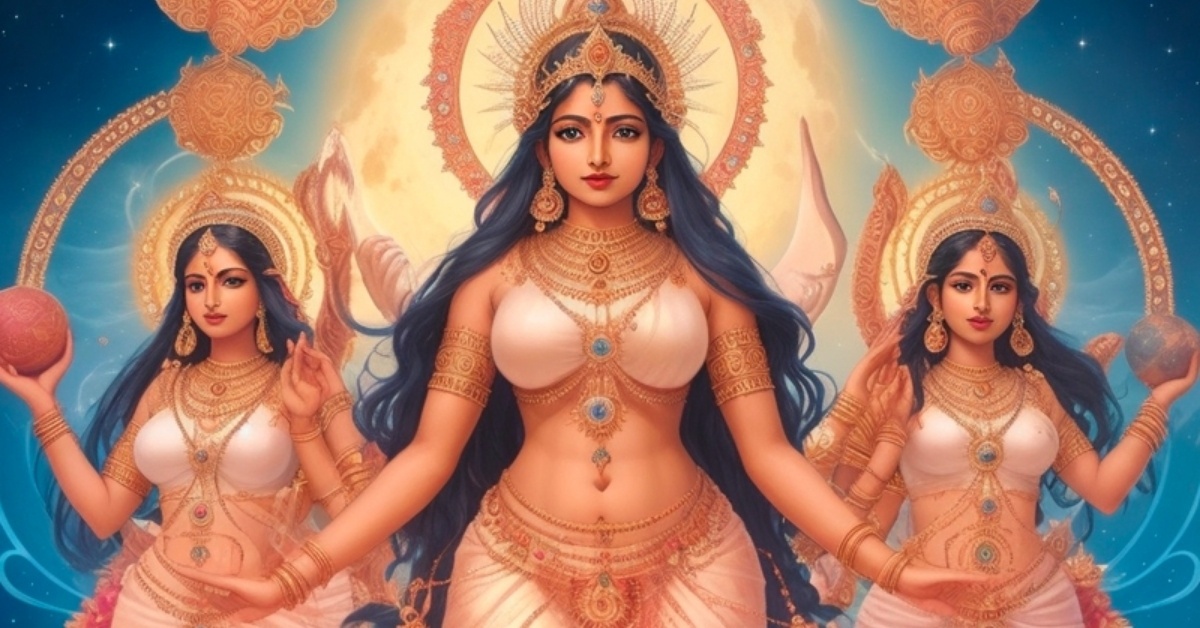
Shakti: The Divine Feminine Power of Hinduism
Every great god in Hinduism has a goddess beside him, and the theology is blunt about why she is there. She is his power. Without her he does nothing at all.
That idea has a name, Shakti, and it runs under the whole Hindu pantheon like groundwater. The word means power, ability, energy. In the traditions that carry it furthest, that energy is the universe itself, and it is female.
Overview of Shakti
Shakti is a Sanskrit word before it is a goddess. It comes from the verb root śak-, “to be able,” and in ordinary speech it means what that suggests: capacity, strength, the power to get something done. A king has shakti. So does a medicine, an army, and a spell. Sanskrit grammarians used the same word for a word’s power to carry meaning. It is a plain noun, and Hindu thought turned it into one of the largest ideas it owns.
The turn works like this. A god is a kind of consciousness, and consciousness by itself sits still. Whatever a god does, the creating, the protecting, the destroying, is his shakti, his power to act. And that power is imagined as a person, feminine, standing beside him: his consort. Brahma the creator has Saraswati, the flow of knowledge and speech that lets him make anything. Vishnu the preserver has Lakshmi, the fortune and sovereignty that let him keep the world in order. Shiva the destroyer has Parvati, who in her fiercer moods is Durga and Kali. In each pair the god is the one who is, and the goddess is the one who does.
The oldest philosophy behind this is the Samkhya school, which divides reality into two principles. Purusha, a masculine noun, is spirit: conscious, still, a witness. Prakriti, a feminine noun, is nature: everything that moves, grows, changes, and becomes. Only Prakriti acts. Purusha watches. The Shakta and Tantric traditions took that split and put a face on it, and the face was the Goddess.
Those traditions are the ones this post follows. Shaktism, the worship of Shakti as the supreme reality, is one of the major branches of Hinduism, alongside the worship of Vishnu and of Shiva. Its followers hold that the many goddesses of India, gentle and terrible alike, are forms of one power, and that this power is where the gods themselves come from. That supreme goddess as a person, Devi or Mahadevi, is a story of her own. This one is about the power itself.
Titles
- Adi Shakti, Adi Parashakti (“the primordial supreme power”)
- Mahashakti (“great power”)
- Parashakti (“the highest power”)
- Prakriti (“nature,” the active principle of the cosmos)
- Maya (the power that makes the one appear as many)
- Kundalini (“the coiled one,” Shakti asleep in the human body)
- Jagadamba, Jaganmata (“Mother of the World”)
- Chit-shakti (“the power of consciousness”)
Characteristics
Shakti is a concept first, so the tradition shows her in more than one way:
- As the consort at a god’s side, the way Parvati sits beside Shiva
- As one half of a single body: the god Ardhanarishvara, split down the middle, Shiva on the right and the Goddess on the left
- As a serpent coiled three and a half times at the base of the spine
- As a geometric diagram, the Sri Chakra, nine interlocking triangles with the Goddess as the point at the center
- As a stone in the earth: at Kamakhya in Assam the object of worship is a cleft in the rock, fed by a spring
- As the ten-armed Durga, which is what power looks like when it has been handed every weapon the gods own
Abilities
- Creation, preservation, and destruction — the three functions of the cosmos, and in Shakta thought the Goddess performs all three
- Maya — the power to veil reality, so that one thing appears as a world of separate things
- Grace — the power to lift that veil again, which the tradition treats as the same power turning the other way
- Kundalini — the power to rise through the human body and reunite with consciousness at the crown
- Speech and mantra — the Goddess as Vak, the power of the word, which is why mantras are said to work
Symbols
- The downward-pointing triangle — the yoni, the womb of the world, and the Shakti half of every yantra
- The Sri Chakra — four upward triangles for Shiva, five downward for Shakti, locked together
- The coiled serpent — kundalini, energy at rest
- Red — the color of Shakti: the vermilion in a married woman’s hair parting, the red hibiscus at Kali’s shrine, the red cloth from Kamakhya
- The lotus — creation opening out of the water
- The lion or tiger — untamed power, ridden and directed
Traits
- Active, where Shiva is still
- Immanent: inside every living thing, where Shiva stands outside it
- Free: the Tantric word is svatantrya, self-dependence, power that answers to nothing
- Both faces at once: the mother who feeds and the warrior who kills, with no contradiction between them
- Playful: creation as lila, the Goddess’s game
Festivals and Rituals
The great festival of Shakti is Navaratri, “nine nights,” held in autumn and again in spring. In much of India the nine nights fall into three sets of three, given to Durga, then Lakshmi, then Saraswati: power as strength, power as abundance, power as knowledge. In Bengal the autumn festival becomes Durga Puja, the largest event of the year. On the eighth or ninth night many families perform kanya puja, in which young girls are seated, their feet washed, and fed as living forms of the Goddess.
The strangest and most literal festival belongs to Kamakhya, the temple on Nilachal Hill above the Brahmaputra. At the summer solstice, during the Ambubachi Mela, the temple closes for three days because the Goddess is menstruating. The spring in the sanctum runs red, the doors stay shut, plowing stops in the surrounding fields, and on the fourth day pilgrims receive pieces of red cloth as blessing. Hundreds of thousands of people come. It is the generative power of the earth, treated as a woman’s body, and honored without embarrassment.
Beyond the calendar, Shakti worship runs through daily life. Devotees recite the Lalita Sahasranama, the thousand names of the Goddess. Sri Vidya practitioners worship the Sri Chakra with flowers, chant, and gesture. Pilgrims travel to the Shakti Pithas, the seats of power scattered across the subcontinent. And Tantric practitioners work with kundalini directly, through breath, posture, and mantra, to wake the coiled power inside their own bodies.
Legends associated with Shakti
Shakti’s stories are demonstrations more than biographies. Each one takes the idea, power is a goddess and the gods have none of it on their own, and shows it happening.
Shiva without Shakti
The formula every Shakta learns first is a pun. Take the letter i out of Shiva and you have shava, the Sanskrit for corpse. The god of consciousness, the great ascetic on his mountain, is a body on the ground until she moves him.
The Saundarya Lahari, “The Wave of Beauty,” a hymn to the Goddess that tradition credits to the philosopher Shankara, opens on exactly this claim. Joined to Shakti, it says, Shiva has the power to create the world. Apart from her, he lacks the power even to stir. A hundred verses of praise follow, and they begin from the statement that the supreme god is helpless alone.
Art makes the same argument. The image of Kali standing on Shiva’s chest, which so many people meet as a scene of horror, is read by her devotees as a diagram: the still god below, the moving Goddess above, and the world happening where her foot touches him. The god Ardhanarishvara makes the point in one body. In a Puranic telling, Brahma’s first creatures were all male and creation stalled, and it began to breed and grow only when Shiva showed himself as half woman and released the Goddess from his own body. Consciousness had to become energy before anything could be born.
The gods pour out their power
The Devi Mahatmya, the fifth- or sixth-century “Glory of the Goddess,” is the text where Shakti walks onto the stage in person, and its central scene is a lesson in where power lives.
The buffalo demon Mahishasura has beaten the gods and taken heaven, protected by a boon that no man or male god can kill him. Indra, Brahma, Vishnu, and Shiva stand in council, furious, and their fury leaves their bodies as light. The light pours out of each of them, gathers into a single blaze, and takes the shape of a woman. Shiva gives her his trident, Vishnu his discus, Indra his thunderbolt, and the mountain god gives her a lion. Ten arms, ten weapons, and she rides out alone.
The Durga who kills Mahishasura has her own post. What matters here is the mechanism. The gods stand aside. Their power leaves them, becomes a goddess, and then it fights. When the shakti goes out of a god, the tradition says, this is what it looks like. The Devi Mahatmya says so outright in the hymn the gods sing afterward, still recited today: they praise her as the power that dwells in every being, and they are strong through her alone.
The goddess who taught Indra
An older story makes the point on a smaller scale, and it comes from the Kena Upanishad, centuries before the Devi Mahatmya.
The gods have won a war against the demons, and they are pleased with themselves. As they celebrate, a strange spirit appears before them, and they send Agni, the god of fire, to find out what it is. The spirit sets a blade of grass on the ground and asks Agni to burn it. He, who burns whole worlds, cannot so much as scorch it. Vayu, the god of wind, is sent next, and he who carries everything cannot lift a single blade of grass. Then Indra, king of the gods, goes himself, and the spirit vanishes.
In its place stands a woman, radiant, whom the text calls Uma Haimavati, the daughter of the Himalaya. She tells Indra what he saw: it was Brahman, the ground of everything, and the gods won their war through its power alone. They had been congratulating themselves on strength that had been lent to them.
The Upanishad is about Brahman, and the woman is its messenger. But for Shakta readers the image is the whole doctrine in a single scene. The gods’ power was on loan, and when that is explained to them, the one who explains it is a goddess.
The fall of Sati and the seats of power
The most physical of Shakti’s legends is the one that mapped her onto the land.
Sati, the first wife of Shiva, was the daughter of Daksha, a lord of creation who despised his ascetic son-in-law. When Daksha held a great sacrifice and invited every god except Shiva, Sati went anyway, was insulted, and in her grief and rage gave up her body, in most tellings by fire. Shiva arrived, wrecked the sacrifice, and then did something the gods had never seen. He lifted his wife’s corpse onto his shoulder and began to wander, mad with grief, and where he walked the world began to come apart.
Vishnu ended it. He followed and, with his discus, cut Sati’s body into pieces as Shiva carried it, so that the pieces fell across the subcontinent. Wherever a part of her touched the earth, that ground became a Shakti Pitha, a seat of power, and each one holds a form of the Goddess with a form of Shiva as her guardian. The count varies by text; the Tantrachudamani lists fifty-one, one for each letter of the Sanskrit alphabet, and the Devi Bhagavata Purana gives a hundred and eight. Her toes fell at Kalighat in Kolkata. Her tongue fell at Jwalamukhi, where flames burn out of the rock. Her yoni fell at Kamakhya.
The story explains why Shakti, unlike most gods, is worshiped in the ground. Her body is the map. And at every seat, the pairing holds: a piece of the Goddess and a Bhairava standing watch, power and consciousness, still together.
The serpent at the base of the spine
The last legend is the one you can enter yourself, because it takes place inside a human body.
Tantric physiology holds that Shakti lives in every person as kundalini, “the coiled one,” a serpent wound three and a half times around itself at the base of the spine, asleep. Above her runs a channel through six centers of energy, the chakras, and at the crown of the head sits Shiva, as the thousand-petaled lotus. The whole cosmos, with its still god above and its sleeping power below, is repeated in you.
The work of kundalini yoga is to wake her. Through posture, breath, mantra, and concentration, the practitioner rouses the serpent, and she rises, center by center, until she reaches the crown and joins Shiva there. The texts describe that meeting as a flood of nectar and a dissolution of the separate self. Then she descends again, and the practitioner returns to the world.
The system reached its classic form in the sixteenth century, in the Shat-chakra-nirupana of Purnananda, and the Hatha Yoga Pradipika a century earlier already treats kundalini as the goal of yoga. In 1919 an English judge in Calcutta, John Woodroffe, translated the texts as The Serpent Power under the name Arthur Avalon, and the coiled goddess has been rising through Western yoga studios ever since.
An older Shakti?
The theology is medieval. The word is three thousand years old, and the intuition under it may be older than either.
In the Rigveda, śakti is still a common noun, ability or help, and its cousin śacī names the might of Indra, the storm god; his wife carries the same name, Śacī, as if his strength had already begun to take on a face. And one hymn of the Rigveda, 10.125, is spoken by a goddess in her own voice. Tradition credits it to a woman seer, Vak Ambhrini, and in it the goddess Vak, speech, declares that she moves with the gods, that whoever eats or breathes does so through her, and that she stretches over heaven and earth. Shakta tradition treats the hymn, the Devi Sukta, as a founding text, and it is still chanted at Durga Puja. Some scholars read it as an early statement of the Goddess as cosmic power; others treat it as a hymn to speech that later tradition adopted. Either way, the idea of a feminine power running through the gods is on the page a thousand years before Christ.
The philosophical step came in the Upanishads. The Shvetashvatara Upanishad, in its opening verses, says that sages in meditation saw devātma-śakti, “the power of the divine self,” hidden by its own qualities and ruling over every cause. That is the first time the word is used for the power of God as such, and it reads Samkhya’s active Prakriti as belonging to the divine rather than standing apart from it. The Kena Upanishad’s Uma, above, belongs to the same layer. By the time the Devi Mahatmya was composed, in the fifth or sixth century, the pieces were on the table, and that text put them together: the Goddess as Mahamaya, the great power, who holds even Vishnu in his cosmic sleep and releases him when the world needs him.
Then came the Tantras. From the middle of the first millennium onward, the Shakta and Shaiva Tantras and Agamas built a complete theology on Shakti, and the philosophers of Kashmir gave it its sharpest form. Somananda, in the ninth century, argued that Shiva and Shakti differ no more than fire and its heat. Abhinavagupta, around the year 1000, described reality as light, prakasha, and the light’s awareness of itself, vimarsha, and called the awareness Shakti. In that system she has outgrown the role of the god’s wife: she is the pulse of consciousness itself, and every person, in knowing anything, is doing what she does.
Under all of it lies something harder to date. The Indus Valley cities left thousands of terracotta female figurines, and some scholars read them as a mother goddess, though others caution that the evidence is too thin to say. The village goddesses of rural India, the gramadevatas, are worshiped in their millions without any consort at all, as the raw power of one place. And across the world, the oldest human images of the divine are overwhelmingly female. Historians of religion have long suggested that the Sanskrit theology of Shakti gave a philosopher’s vocabulary to a conviction that farming and village India already held: that the power that makes things grow is a woman. That is one reading among several, and the tradition’s own account, that the Goddess revealed herself, stands beside it. What the record shows for certain is a word that began as “ability,” was claimed by philosophers, and ended as the name of everything that moves.
Shakti across cultures
The claim that the active energy of the universe is female has relatives, and the differences are as telling as the likenesses.
Buddhist Tantra, which grew up alongside Hindu Tantra, also imagines enlightenment as a male and female principle in union, the yab-yum figures of Tibetan art. But it assigns the roles the other way around: the female is prajna, wisdom, the still and empty ground, and the male is upaya, skillful means, the active side. Chinese thought pairs yin and yang, with yin as the feminine, and yin is the receptive, yielding, dark half. Shakti stands out against both. In the Hindu account the feminine is the one that moves.
Jewish mysticism came to a picture closer to hers. In rabbinic Judaism the Shekhinah is the dwelling presence of God in the world, and in the Kabbalah she became explicitly feminine, the last of the divine emanations, the one that lives in exile among us and whose reunion with the higher aspects of God is the goal of all sacred work. A divine feminine presence, immanent in the world, separated from a transcendent masculine and longing for union: the shape of the idea is the same, and the two traditions arrived at it independently. The intuition reaches well beyond India.
Final thoughts
Power, in this theology, has a gender, and the gender is female.
That is a strange thing for a religion to say, and Hinduism says it plainly and has said it for thousands of years. The god sits still and the goddess acts. The gods lose a war until their power walks out of them as a woman. The universe is her body, cut into pieces and scattered as holy ground, and inside your own spine she lies coiled and waiting. Modern India still reaches for the word: “nari shakti,” woman power, is a slogan and a national award, and when the country tested its nuclear weapons in 1998 the codename was Operation Shakti.
The idea has outlived every empire that ruled the subcontinent, and it asks a question the West has mostly answered the other way. When you picture the force that makes everything happen, which face do you give it?
Bibliography
- Coburn, Thomas B. Devī-Māhātmya: The Crystallization of the Goddess Tradition. Motilal Banarsidass.
- Kinsley, David. Hindu Goddesses: Visions of the Divine Feminine in the Hindu Religious Tradition. University of California Press.
- Flood, Gavin. An Introduction to Hinduism. Cambridge University Press.
- Woodroffe, John (Arthur Avalon). The Serpent Power: The Secrets of Tantric and Shaktic Yoga. Dover.
- Johnson, Jean. “Shakti: The Power of the Feminine”. Asia Society.
- “Saundaryalahari, Verse 1”. Sri Kamakoti Mandali.
- Kena Upanishad, Parts 3-4 (Uma Haimavati). Sanskrit Documents.
- Shvetashvatara Upanishad 1.3. Sanskrit Documents.
- “Shakti”, “Shaktism”, “Prakriti”, and “Kashmiri Shaivism”. Encyclopaedia Britannica.
- “Kashmiri Shaiva Philosophy”. Internet Encyclopedia of Philosophy.
- “Shakti”, “Shaktism”, “History of Shaktism”, and “Devīsūkta”. Wikipedia.
- “Shakta pithas”, “Kamakhya Temple”, “Ambubachi Mela”, and “Kundalini”. Wikipedia.
- “Ardhanarishvara”, “Devi Mahatmya”, “Yab-Yum”, and “Shekhinah”. Wikipedia.
- “Shakti” and “Shaktism”. New World Encyclopedia.