Parvati: Hindu Goddess of Love, Marriage, and Motherhood
She stood between four fires in the summer heat and in freezing water through the winter rains. She gave up food, then gave up even the fallen leaves, and waited on a Himalayan peak for a god who had sworn off love.
That’s the courtship of Parvati, and it tells you what kind of goddess she is. The gentlest figure in the Hindu pantheon won her husband by out-lasting the greatest ascetic who ever lived.
She’s the daughter of the mountains, the wife of Shiva, the mother of Ganesha, and the tender face of the Great Goddess who also wears the faces of Durga and Kali. This is her story, told the long way.
Overview of Parvati
Parvati, also called Uma and Gauri, is one of the three great goddesses of Hinduism. With Lakshmi and Saraswati she forms the Tridevi, the feminine counterpart to the trinity of Brahma, Vishnu, and Shiva. Her home is the Himalayas, her father is the mountain range itself, and her husband is Shiva, the god of destruction and of yoga, who lives on the peak of Mount Kailash.
Her name says where she comes from. Parvata is Sanskrit for “mountain,” and Parvati means “she of the mountain,” the daughter of Himavat. She rules the warm half of life. Love, marriage, fertility, and motherhood are hers, and so is devotion itself, since her own devotion is the engine of nearly every story told about her.
She is also Shakti, the power that moves the universe. In the Shaiva and Shakta traditions, Shiva without Parvati is pure stillness, and Parvati is the energy by which anything at all happens. Every goddess, in that view, is a form of her, and she holds the fierce ones inside her the way a mountain holds fire.
Millions of Hindus worship her today, above all women praying for a good marriage and a healthy family. Her great festivals are Teej, Gangaur, and the nine nights of Navratri.
Titles
- Uma (the oldest of her names, already in use in the Upanishads)
- Gauri (“the fair one” or “the golden one”)
- Haimavati, Girija, and Shailaputri (all meaning “daughter of the mountain”)
- Ambika (“Mother”)
- Aparna (“she who lived without even a leaf,” from her great fast)
- Shakti (“Power”) and Mahadevi (“Great Goddess”)
- Jagadamba (“Mother of the World”)
- Annapurna (“full of food,” the form that feeds the world)
Characteristics
How Parvati tends to be shown in art:
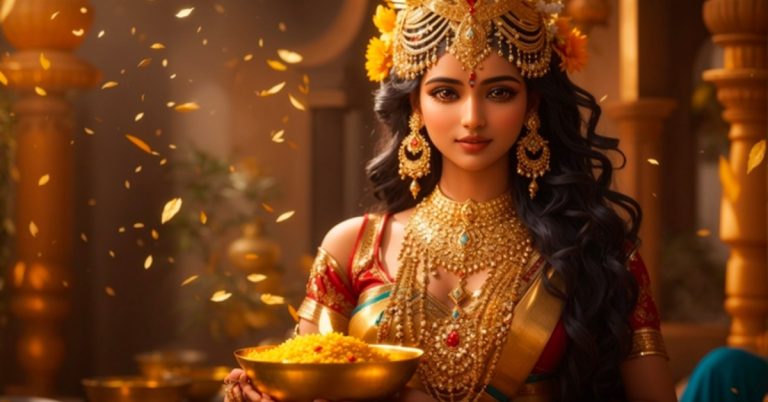
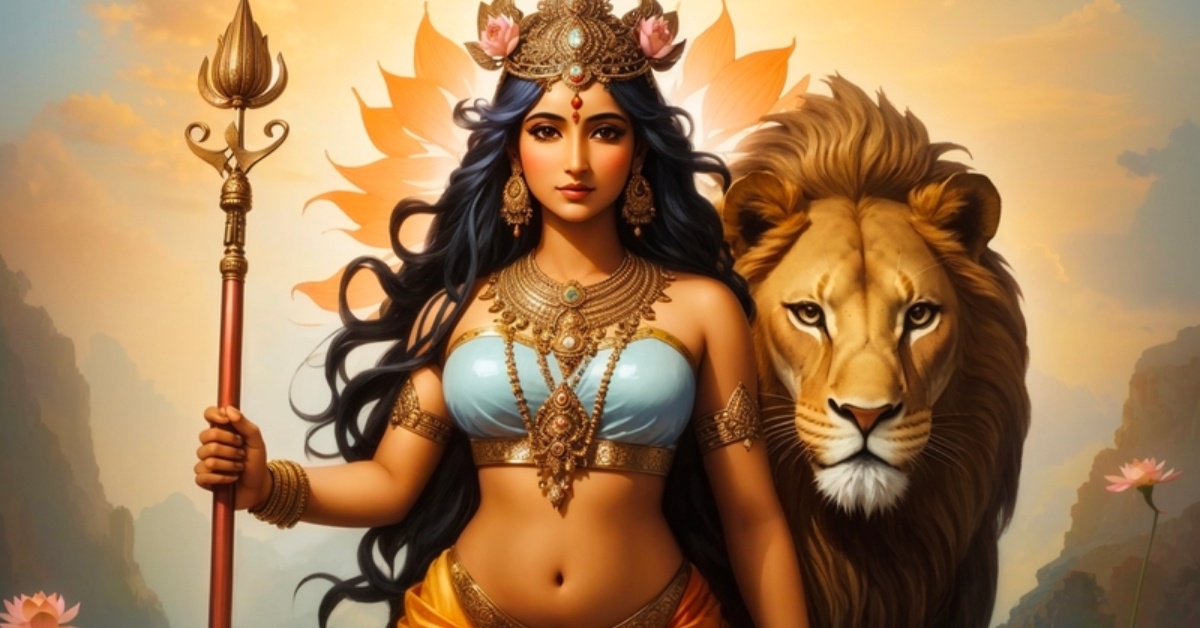
- Golden-skinned or fair, with a serene, half-smiling face
- Dressed in red, the color of marriage, with gold at her wrists, throat, and ears
- Two-armed when she stands or sits beside Shiva, four-armed when she appears alone
- Holding a lotus, or a mirror, a bell, or a trident borrowed from her husband
- One hand raised in the gesture that means “fear nothing”
- Riding a lion or a tiger
- Often with her family around her: Shiva, Ganesha, and Kartikeya
Abilities
- Shakti — she is the power by which Shiva, and the cosmos, act at all
- Tapas — asceticism so intense it bends the will of gods
- Creation from her own body — she made Ganesha with no help from anyone
- Transformation — she becomes Durga to fight and Kali to destroy, then folds back into herself
- Blessing marriage and children — the gift her worshippers ask for most
- Teaching and asking — the Tantras are written as her conversations with Shiva, and she asks the questions that draw the knowledge out of him
Symbols
- The lotus — purity and beauty rising out of mud
- The lion (or tiger) — the strength beneath her gentleness
- The mountain — her father, her birthplace, and her husband’s home
- The color red — the bride’s color, worn by her and by the women who fast for her
- The mirror — held in many of her images, a sign of beauty and self-knowledge
- The trident — shared with Shiva, a sign of their union
Traits
- Steadfast to the point of stubbornness, once she has chosen
- Tender and protective as a mother, and ferocious when her children are threatened
- Playful with her husband, teasing and arguing with him across many stories
- Quick to burn when insulted, whether by her father or by her husband’s followers
- Whole in herself. Shiva needs her far more than she needs to be told so
Festivals and Rituals
Parvati’s worship belongs to women more than to priests, and it fills the monsoon calendar.
Teej comes in three parts between July and September. Married women and unmarried girls fast, some without even water, and pray for a good husband or a long life for the one they have. Hariyali Teej greets the monsoon with swings hung from the trees; Hartalika Teej recalls the day Parvati’s friend carried her off into the forest so she could do her tapas in secret.
Gangaur in Rajasthan and Gowri Habba in Karnataka honor her as Gauri, the golden bride. In Maharashtra she arrives as a guest during Ganesh Chaturthi, the birthday of her son, and is welcomed into the house alongside him.
Navratri, the nine nights of the goddess, opens with Shailaputri, “daughter of the mountain,” the first of the nine forms of Durga and Parvati by another name. And Maha Shivaratri, Shiva’s great night, is remembered in many traditions as the night of their wedding.
Legends associated with Parvati
Parvati’s myths are a love story told over two lifetimes, and they keep returning to one idea: devotion is a force, and the goddess is the one who wields it. Her fierce forms have their own stories. These are hers.
Sati and the fire
Before she was Parvati, she was Sati, and her first life ended in flames.
Sati was the youngest daughter of Daksha, one of the lords of creation, and the one he loved best. She loved Shiva, the wild god of the cremation grounds, and she won him through austerities of her own. Daksha never forgave either of them. He saw a matted-haired beggar smeared in ash, wearing snakes, who had married his favorite child without his blessing.
So when Daksha held a great fire sacrifice and invited every god in heaven, he left Shiva and Sati off the list.
Sati went anyway. She told herself she needed no invitation to her father’s house. Daksha met her in front of the assembled gods, mocked her, and insulted her husband to her face. Sati answered him with the only thing that could shame him. In the older tellings she withdrew into herself and burned her body with the fire of her own yoga; in later ones she threw herself into the sacrificial flames. Either way, she left her father holding a corpse.
Shiva’s grief was catastrophic. He tore through the sacrifice, then lifted Sati’s body onto his shoulder and began to dance, and the dance shook the worlds. To stop him, Vishnu sent his discus after the body and cut it into pieces as Shiva carried it. Wherever a piece fell, the ground became holy. Those places are the Shakti Pithas, fifty-one of them by the most common count, and pilgrims still visit them across India, Nepal, Bangladesh, and Pakistan today.
Her name has a darker afterlife. The practice of a widow burning on her husband’s pyre, outlawed in India since 1829, took its name from her. The story itself says something different: Sati chose the fire in defiance of her father, over a living husband she refused to hear insulted.
Daughter of the mountain
Sati had made a promise before she died. She would be born again, and she would marry Shiva again.
Shiva, meanwhile, went into mourning and stayed there. He withdrew to the high Himalayas and sank into meditation so deep that centuries went by and the world forgot what his voice sounded like.
Sati was reborn to the mountain. Her father in this life was Himavat, the god who is the Himalayas, and her mother was Mena, and the sage Narada visited soon after her birth to read her fate. The child, he said, would marry Shiva.
The girl set her heart on it early. When her mother saw how hard she pushed her austerities and cried “u, ma” (“oh, don’t”), the words stuck and became her name, Uma. When she gave up even the fallen leaves she had been living on, the sages who watched named her Aparna, “leafless.” Everyone could see what she was doing. Nobody could talk her out of it.
The god of love turns to ash
The gods had their own reasons to want the marriage.
A demon named Taraka had won a boon from Brahma: nothing could kill him except a son of Shiva. Since Shiva had buried himself in grief and had no son, Taraka ran the three worlds unopposed. The gods needed Shiva to fall in love, and quickly.
So Indra sent Kama, the god of love, with his bow of sugarcane and his arrows of flowers. Kama crept up on the meditating Shiva as spring broke out around him, took aim, and shot. Shiva’s eyes opened. Then the third eye in his forehead opened too, and a jet of fire burned Kama to a heap of ash where he stood.
Parvati, who had come to Shiva’s hermitage with an offering, watched it happen. She understood then that beauty alone would win her nothing, and she went home and asked her parents’ leave to do tapas.
This is the fast that opens this post. Kalidasa, the greatest of Sanskrit poets, tells it in his Kumarasambhava, “The Birth of the War God.” Parvati sat between four fires with the sun for a fifth. She stood in the winter rivers. She ate less and less, then nothing at all. Her body thinned until the sages said she had out-done every ascetic alive, including the god she was doing it for.
The stranger at the hermitage
One day a young brahmin came to her hermitage and asked her, politely, what a girl like her thought she was doing.
He knew who she was, he said, and he knew who she was doing this for, and he could only assume she had lost her mind. Shiva? The man lived in cremation grounds. He wore snakes for jewelry and ash for clothes, when he wore anything. His family was unknown. He rode a bull. He had a habit of dancing with ghosts. A princess of the Himalayas, wasting away over that?
Parvati heard him out, and then she answered him. Whatever Shiva was, she said, she had chosen him, and a person who loves has stopped weighing merits and faults. She told her friend to send the young man away, since he was insulting the god she loved. When he kept talking, she turned her back to leave.
The brahmin caught her hand. It was Shiva, of course. He had come to test her, and she had passed. “Because of your tapas,” he said, “I am your servant from this moment on.”
She refused to elope with him. She insisted on a proper wedding, with her father’s consent and priests and fire, and Shiva, the god who answers to no one, went and asked.
The wedding on the mountain
The wedding procession that arrived at Himavat’s palace is one of the great comic set pieces of Hindu myth.
Shiva came as he was: smeared in ash, snakes for a necklace, a garland of skulls, the crescent moon in his tangled hair, riding a bull, with his retinue of ghosts and goblins and misshapen ganas howling and dancing behind him. Mena, the bride’s mother, took one look at the groom and fainted, or in some tellings flatly refused to go through with it.
Parvati begged Shiva to spare her mother, and he shed the terrible form and appeared as a beautiful young god, radiant, jeweled, and calm. Mena recovered. The wedding went ahead, Brahma serving as priest, Vishnu standing as the bride’s guardian, and every god in heaven in attendance. Kalidasa spends his seventh canto on it.
Many Hindus mark this wedding every year. Maha Shivaratri, the Great Night of Shiva, is kept by some traditions as the anniversary of the night the mountain’s daughter married the god of the cremation ground.
Ganesha at the door
Years later, on Kailash, Parvati wanted a bath and some privacy. Shiva’s attendants answered to Shiva, and a wife in Shiva’s house had nobody of her own to guard a door.
So she made someone. In the Shiva Purana she takes the unguent from her own skin, in popular tellings the turmeric paste she has rubbed on for her bath, shapes it into a boy, and breathes life into him. She names him her son, hands him a staff, and sets him at the door with one instruction: let no one in.
Shiva came home. The boy stopped him. Shiva, who had no idea who this child was, told him to move. The boy refused. Shiva sent his ganas to shift him, and the boy beat them all. Then the god lost his temper, and in a stroke he cut the boy’s head from his shoulders.
Parvati came out and saw what he had done to her son.
Her rage in that moment is the closest her gentle form comes to Kali. She swore to unmake creation. The goddesses of the worlds rose out of her as her own shaktis, and the gods fell at her feet to beg. She named her price: her son alive, and first among the gods in every rite.
Shiva sent his servants north to bring back the head of the first creature they found. It was an elephant. They set its head on the boy’s shoulders, Shiva breathed life back into him, and the child rose as Ganesha, the elephant-headed god. He is the first god called on at the start of every Hindu ceremony, in front of Shiva himself, because his mother demanded it.
The six-headed son
Taraka still ruled the worlds, and the gods still needed Shiva’s son.
The birth of that son is a strange, roundabout story. Shiva’s seed, in the Mahabharata and the Skanda Purana, was too hot for anything to hold. Agni, the fire god, carried it and could not bear it. He dropped it into the Ganges, and the river carried it to a bed of reeds, where it became six infant boys. The six stars we call the Pleiades, the Krittikas, found them there and nursed them.
Parvati went to the reeds and gathered up the six babies. She embraced them so tightly they fused into one child with six heads and twelve arms. That is Kartikeya, also called Skanda, Murugan, and Subrahmanya, the god of war.
He grew up fast. Riding a peacock and carrying the spear his mother gave him, he led the gods’ army against Taraka and killed him. The demon who could only die at the hands of Shiva’s son died at the hands of Parvati’s.
Half of Shiva
Of all the images of Parvati, the one that says the most about her is the one where she is only half there.
Ardhanarishvara, “the Lord who is half woman,” is Shiva and Parvati as a single body, split down the middle. The right side is Shiva, with matted hair, the crescent moon, and a chest smeared in ash. The left side is Parvati, with a jeweled crown, a full breast, and a red silk skirt. The figure has been carved this way since at least the first century CE, when the Kushan sculptors of Mathura made the earliest examples we have.
The stories that explain it vary. In one, a sage named Bhringi worships Shiva alone and refuses to bow to Parvati, so the goddess fuses herself to her husband, leaving Bhringi no way to circle one without circling the other. In another, Brahma asks Shiva for help in creating the world, and Shiva splits himself, and the female half that steps out of him is the goddess.
The meaning under all of them is the same. Shiva is purusha, consciousness, and Parvati is prakriti, nature and energy, and neither one exists without the other. It is the most direct statement in Hindu art that the goddess and the god are one.
The golden one and the dark one
One last story explains her name Gauri, and it points toward her other selves.
Shiva, teasing his wife, once called her Kali, “the dark one,” and Parvati took it badly. She went away to do tapas again, this time to shed her dark complexion, and when she rose from it she was golden, Gauri. The dark sheath she cast off took on a life of its own as the goddess Kaushiki, one of the forms of Durga.
Devotees read the story two ways at once. Gauri is the bride, the golden, gentle wife who is worshiped at Teej and Gangaur. And the dark one is never far off. Durga is what Parvati becomes when there’s a demon to kill; Kali is what leaps from her brow when Durga’s fury boils over. The gentle goddess and the terrible goddess are one goddess, and she chooses her face.
An older Parvati?
Somewhere in the middle of the first millennium BCE, in a short prose parable in the Kena Upanishad, the god Indra meets a shining woman on a mountain. He has come looking for a mysterious spirit that has just humbled the gods. She tells him what it was: Brahman, the absolute, the source of the gods’ own strength. The text names her Uma Haimavati, “Uma, the daughter of the Himalaya.” No Shiva, no Sati, no wedding, no Ganesha. Just a goddess of the mountain who knows more than the king of the gods.
That is the earliest Parvati we can point to, and she arrives with a set of names older than she is. Ambika appears in Vedic ritual texts as the sister, and then the wife, of Rudra, the storm god who became Shiva. The Taittiriya Aranyaka invokes “the husband of Ambika, the husband of Uma.” Gauri turns up in early prayers. Haimavati, “of the Himalaya,” is in the Upanishad. By the time the epics and Puranas tell Parvati’s full story, all of these names have gathered onto one goddess, and the word Parvati itself is the newest of them.
Scholars read that pattern as a trace of assimilation. David Kinsley, in Hindu Goddesses, suggests that “Parvati’s early history and origin may lie with a goddess who dwelled in the mountainous regions and was associated with non-Aryan tribal peoples,” and adds that such a goddess “would be an appropriate mate for Shiva, himself a deity who dwells in mountainous regions and on the fringes of society.” Some linguists have proposed a Dravidian root for Uma, in amma, “mother.” Rudra himself stood at the edge of the Vedic pantheon, a god of the wild places kept at a distance in the sacrifice, and his rise to Shiva, the Great God, is often read as the Vedic tradition absorbing a god from outside it.
Put those together and a picture forms, though it stays a hypothesis. Before the Sanskrit poets gave her a father and a wedding, the Himalayas may already have had a mother goddess of their own, worshiped by the peoples who lived in them, whom the growing Brahmanical tradition drew in as the bride of its wild mountain god. Her myths keep the seam visible: she is born from the mountain, and she wins her husband by leaving the palace for the wilderness. The evidence is thin, and the Upanishad’s Uma may or may not be the same figure the Puranas later married to Shiva. What survives for certain is the mountain. She has never once been separated from it.
Parvati across cultures
Mountains make mothers all over the world. Sumer’s Ninhursag, whose name means “Lady of the Sacred Mountain,” was the great birth goddess of Mesopotamia four thousand years ago. Phrygia’s Cybele was worshiped as the Mother of Mount Ida and was carried to Rome as the Great Mother of the Gods. Parvati sits in that company as the mountain daughter who became the mother of the world.
Her marriage has traveled too. In the Buddhist texts of Tibet and East Asia, Shiva and Parvati appear as Maheshvara and Uma, worldly gods bowed to the Buddha, and Japanese temple art paints Uma-hi seated beside Daijizaiten, the Japanese name for Shiva. Across Southeast Asia, from Java to the old kingdom of Champa in Vietnam, carvings of Uma stood in Shiva’s temples for a thousand years, and in Bali she is worshiped today as Dewi Uma, who in the island’s own stories becomes its fierce Durga.
One story from the far side of the world reads like hers turned inside out. When the Egyptian god Osiris was killed and cut into pieces scattered across the land, his wife Isis went searching, gathered every piece, and put him back together. Sati’s body is the one cut into pieces and scattered, and her husband is the one left grieving. The same grief, the same scattered body, the same holy ground wherever a piece came to rest, and the roles reversed. Both cultures seem to have arrived at the same thought: a love that outlives the body leaves marks on the land.
Final thoughts
Parvati stands in every temple to Shiva, and in most Hindu homes she is on the shelf beside her elephant-headed son.
She is the goddess of a specific kind of strength, the kind that stays. She chose a husband nobody approved of, twice, and burned or fasted rather than give him up. She built a son out of her own skin when no one would guard her door. She is the half of Shiva that moves, and the mother who folds six children into one and hands him a spear. The fierce goddesses get the battles. Parvati gets the marriage, the household, and the mountain, and she holds all three of them together with a patience that once out-waited a god.
Which brings up the question her whole story asks. Devotion, in Parvati’s myths, is the most powerful force there is, stronger than Shiva’s third eye and Daksha’s contempt. What would it look like to treat your own devotion, to a person or a calling, as that kind of power?
Bibliography
- Butcher, Michael. “Parvati”. Mythopedia.
- Kinsley, David. Hindu Goddesses: Visions of the Divine Feminine in the Hindu Religious Tradition. University of California Press.
- Doniger O’Flaherty, Wendy. Hindu Myths: A Sourcebook Translated from the Sanskrit. Penguin Classics.
- Kalidasa. Kumarasambhava (“The Birth of the War God”). Summary and dating via Wikipedia.
- “Later Vedic goddesses (3): Parvati and Uma”. Wisdom Library (Devi Tantra, Mantra, and Yantra study).
- “Parvati”. Encyclopaedia Britannica.
- “Parvati”, “Sati (Hindu goddess)”, and “Shakta pithas”. Wikipedia.
- “Ganesha”, “Kartikeya”, and “Ardhanarishvara”. Wikipedia.
- “Kena Upanishad” and “Teej”. Wikipedia.
- “Ninhursag” and “Isis”. Wikipedia.