Saraswati: Hindu Goddess of Knowledge and Music
A child sits in a parent’s lap with a plate of raw rice in front of them. An older hand closes over the small one and guides a fingertip through the grains until a single letter appears.
That is how a great many Indian children write for the first time: on a festival morning, in front of a goddess. Saraswati is the Hindu goddess of knowledge, music, speech, and the arts, and every student, singer, and scholar in the tradition has asked her for something at least once. She holds a lute, a book, and a string of prayer beads, and she has been keeping India literate for about three thousand years.
Overview of Saraswati
Saraswati is one of the great goddesses of Hinduism and the consort of Brahma, the creator. With Lakshmi, goddess of wealth, and Parvati, goddess of power, she forms the Tridevi, the three goddesses who match the three great gods. Vishnu has Lakshmi, Shiva has Parvati, and Brahma has Saraswati.
Her territory is everything that happens in the mind and comes out through the mouth or the hands. Learning and memory. Speech and eloquence. Music, poetry, and every art that needs practice. She is the patron of students, teachers, musicians, writers, and anyone who has ever sat down to master a difficult thing.
Her name is Sanskrit and older than her books. It joins saras, pooling or flowing water, with vati, “she who has,” and in the oldest hymns it named a river before it named a goddess. Hindus in Bengal also know her as a daughter of Durga, and she stands beside Lakshmi in the great Durga Puja tableau every autumn.
Her great festival is Vasant Panchami, the first day of spring, when the whole country puts on yellow.
Titles
- Sharada (her name in Kashmir, where the shrine of Sharada Peeth was once a great seat of learning)
- Vagdevi and Vac (“goddess of speech”)
- Bharati (“goddess of eloquence”)
- Brahmi (“consort of Brahma,” also “goddess of the sciences”)
- Vani (“melodious speech”)
- Vidyadatri (“bestower of knowledge”)
- Vedamata (“mother of the Vedas”)
Characteristics
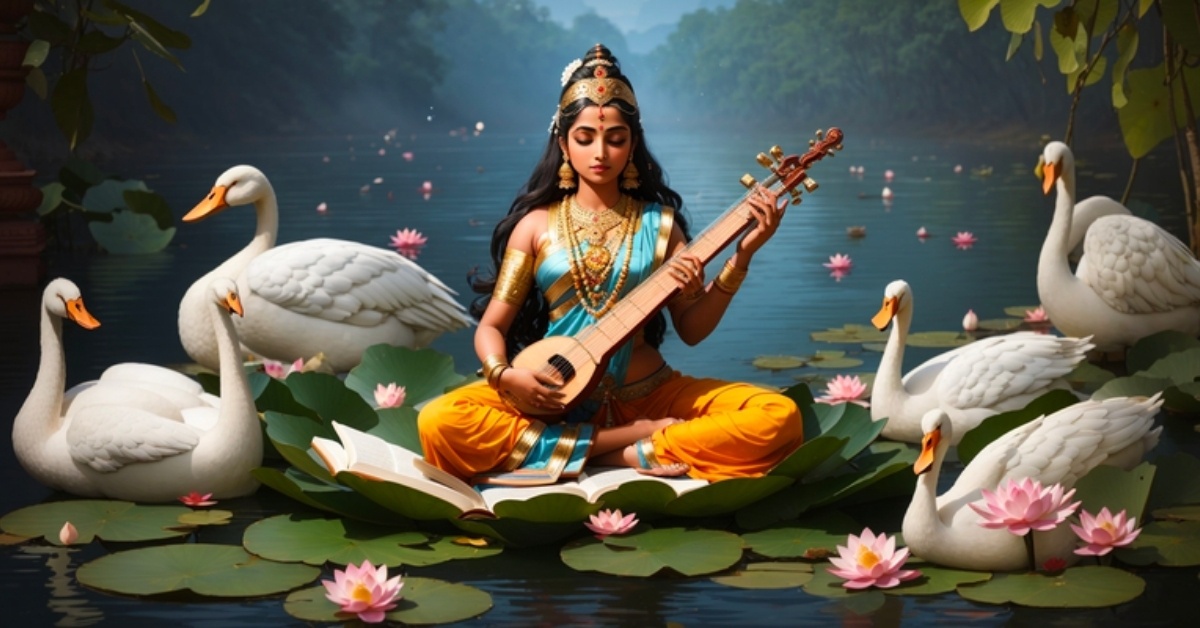
How Saraswati is shown in temples and on festival altars:
- Young, luminous, calm, and unarmed, where her sister goddesses carry weapons
- Dressed in white, sometimes with a blue or gold border, the color of purity and unclouded thought
- Seated on a white lotus, often at the edge of a river
- Four arms: two hands playing the vina, one holding a book, one holding a rosary
- A swan (hamsa) beside her, and in some regions a peacock
- Wearing far less jewelry than Lakshmi, a detail Hindus point to on purpose
Abilities
- Knowledge and learning — she gives memory, understanding, and the discipline to earn both
- Speech — every word spoken well is hers, from a child’s first letter to a poet’s last line
- Music — the vina in her hands makes her patron of every musician in the tradition
- The arts and creative inspiration — painters, dancers, and writers pray to her before beginning
- Discernment — her swan is said to separate milk from water, and she gives that same power to tell true from false
- Purification — the water pot she carries links her to her old life as a river
Symbols
- The vina — the long-necked lute, standing for the arts and for a mind tuned in harmony
- The book — the Vedas, and all knowledge that can be written down
- The mala — the rosary of beads, standing for meditation and the inner side of learning
- The kamandalu — the water pot, for purification and the river she once was
- The white lotus — truth rising clean out of muddy water
- The swan — discernment, and a bird that lives on the water
- The peacock — beauty and the vanity that comes with it, kept at her side and under her eye
- The color yellow — the mustard fields of early spring and the clothes worn at her festival
Traits
- Serene and self-possessed, the calmest figure in any group of deities
- Discerning, with a swan’s instinct for what is true
- Independent, and a reluctant consort in more than one telling
- Quick to anger when slighted, and capable of cursing a god
- Generous to the diligent, indifferent to the merely rich
Festivals and Rituals
Saraswati’s great day is Vasant Panchami, the fifth day of the bright half of the month of Magha, which falls in late January or early February. It marks the first day of spring, and it is also called Saraswati Puja.
Devotees wear yellow, the color of the mustard blossom that fills the fields of north India at that time of year. Her images are dressed in yellow silk and set on altars in homes, schools, and universities. Then the tools come out. Books, notebooks, pens, musical instruments, paintbrushes, and in modern households laptops and tablets are laid at her feet to be blessed, and in many families the books stay closed that day, because they belong to the goddess until morning.
This is also the day of the first letter. In Bengal the ceremony is called Hathe Khori, and in much of the south it is Vidyarambham, “the beginning of learning.” A small child sits in the lap of a parent, teacher, or priest, who guides the child’s finger to trace the first letters of the alphabet in a tray of rice or sand, and then on a slate. In Kerala the rite happens instead on Vijayadashami, the last day of Navaratri, and in the south the final three days of Navaratri belong to Saraswati as a whole, when workers place the tools of their trade before her in the rite called Ayudha Puja.
In Bengal the festival ends at the water. After the worship, the clay image of the goddess is carried to the nearest river or pond and immersed, so that she goes back to the water.
Legends associated with Saraswati
Saraswati’s stories are fewer than Lakshmi’s or Parvati’s, and they are strange ones. The Puranas are frank about the discomfort of her origin, and the folklore is frank about her temper.
Born of the creator
At the beginning of creation Brahma needed knowledge to do the work, and so, the Matsya Purana says, she came out of him. Some tellings have her emerge from his mouth as speech itself; others from his left side or from his mind. Her name in this story is often Shatarupa, “she of a hundred forms,” and some texts treat Shatarupa and Saraswati as one goddess.
Then the story turns. Brahma looked at what he had made and kept looking. She moved to his right to escape his gaze, and a face appeared on that side of his head. She moved behind him, and to his left, and each time a new face followed her, until he had four heads looking in four directions. When she rose upward to get away, a fifth head grew on top.
The tradition holds Brahma to account. In the Shiva Purana Saraswati curses him for it, and in several tellings Shiva, offended by the creator’s lust for his own creation, removes the fifth head. This is one of the reasons Hindus give for why Brahma, alone among the three great gods, has almost no temples.
Despite the beginning, she becomes his consort, and from their union comes Svayambhuva Manu, the first man. Hindu commentators read the whole story as a lesson about the mind: knowledge is born from the creator, and the creator must learn to see her clearly instead of hungrily.
The three wives of Vishnu
The Devi Bhagavata Purana gives Saraswati a different first husband and a sharper temperament.
In this telling Vishnu has three wives: Lakshmi, Ganga, and Saraswati. One day Saraswati catches Ganga exchanging a look with Vishnu that she dislikes, and she says so. Ganga answers in kind. Lakshmi steps in to make peace and is ignored by both, and then cursed for her trouble. The argument gets out of hand, and the two goddesses curse each other to become rivers on earth, condemned to wash away the sins of everyone who bathes in them.
Vishnu, surveying the wreckage of his household, decides that one wife is enough. He keeps Lakshmi, gives Ganga to Shiva, and sends Saraswati to Brahma. In a single afternoon the goddess of eloquence talks herself out of one marriage and into another, and both she and Ganga end up as rivers anyway.
The curse at Pushkar
Brahma’s consort has a temper in the Padma Purana too, where she goes by the name Savitri and is usually identified with Saraswati.
Brahma decided to perform a great fire sacrifice at Pushkar, in what is now Rajasthan, on the spot where a lotus he had thrown at a demon fell to earth. A yajna needs the sacrificer’s wife seated beside him, and the auspicious moment was passing. Savitri was late. Rather than let the hour go, Brahma had the priests marry him on the spot to a local girl named Gayatri, and the rite went ahead.
Savitri arrived to find another woman in her seat. Her curse was precise: Brahma would be worshiped at Pushkar and nowhere else on earth.
The tradition takes the curse seriously. Pushkar’s temple of Brahma is one of a bare handful in the world, and on the two hills above the town stand two smaller temples, the higher one to Savitri and the lower one to Gayatri, still looking at each other across the lake.
Wealth and wisdom cannot share a house
The best-known Saraswati story is folklore, told in every Indian language and written down in none of the scriptures, and it is about her and Lakshmi.
The two goddesses, the saying goes, cannot stay in the same house. Where Lakshmi settles, Saraswati leaves, and the reverse. The rich forget their books, and the learned stay poor. A folk proverb adds that in good times Lakshmi walks toward you and Saraswati walks away, and in hard times Saraswati comes back.
The moral of the tale is argued about as much as the tale is told. Some hear it as a warning that money and learning pull in opposite directions. Others point out that Saraswati is the one you need in both seasons, since she teaches you how to keep wealth when you have it and how to rebuild when you have lost it. Either way, it says something that the folklore imagines these two as sisters who love each other and still cannot share a roof.
An older Saraswati?
The oldest hymns to Saraswati are about water.
The Rigveda, composed somewhere around the middle of the second millennium BCE, gives her three whole hymns of her own, and in all of them she is a river, and a specific one. The poets place her between the Yamuna and the Sutlej, in the plain that runs southwest from the Himalaya toward the desert, and they describe her with the awe of people who have stood on her bank. She comes down from the mountains “pure in her course from the mountains to the sea,” one hymn says. Another says she has “burst with her strong waves the ridges of the hills.” She roars, she runs where she likes, she feeds the cattle and the crops, and in a verse that later Hindus never stopped quoting she is ambitame, naditame, devitame: “best of mothers, best of rivers, best of goddesses.”
Then, within the same book, she starts to shrink. Scholars who read the Rigveda in the order its parts were composed notice that the later hymns describe a smaller river, one that has lost water to its neighbors. By the time of the Brahmanas, the ritual commentaries that follow the Vedas, the Saraswati is said to disappear into the sand at a place called Vinasana, “the vanishing,” and to run on underground. Later Hindu tradition holds that she surfaces once more, unseen, to join the Ganges and the Yamuna at the confluence at Prayagraj, which is why the meeting of the two visible rivers is called the Triveni Sangam, the meeting of three.
Most scholars think the Rigvedic river was real, and that it survives today as the dry bed of the Ghaggar-Hakra, a seasonal stream and a long, buried paleochannel running from the Shivalik hills across Haryana, Rajasthan, and into the Pakistani desert. More than fifteen hundred sites of the Harappan civilization have been found along that bed, including the great cities of Kalibangan and Rakhigarhi, which is a lot of people to settle beside a dry river. The argument is about timing. Some scholars, among them Michel Danino, hold that the Ghaggar-Hakra was still a major river when the Harappans built on it and that the Rigveda remembers its decline. Others, following Michael Witzel, argue that it had already dwindled before the hymns were composed, so the poets were either exaggerating or describing a river farther west. Geologists have complicated both views: a 2017 study found that the paleochannel once carried the Sutlej, which shifted to its present course thousands of years before the Harappans arrived, though a smaller river seems to have kept flowing in the old bed for a long time after. What everyone agrees on is that the water went away.
When it did, the goddess moved. She left the riverbed for the mouth.
The Rigveda already had a goddess of the sacred word, Vac, “Speech,” who declares in one famous hymn that she moves with all the gods and makes a seer of anyone she loves. In the Brahmanas the two goddesses run together. Saraswati is named Vagdevi, goddess of speech, and the Shatapatha Brahmana explains why with an image drawn straight from her old life: as all waters meet in the ocean, it says, so all knowledge meets in speech. The river that had carried the Vedic people’s cattle and crops now carried their hymns, and by the time the Puranas were written she was sitting on a lotus with a book in her hand.
She kept the water anyway. The pot in her fourth hand, the lotus rising from a pool, the swan that is a waterbird before it is a symbol, the images immersed in a river when her festival ends, and the invisible current at Prayagraj are all the same river, still running under the goddess of learning. This is one reading among several, and the tradition itself would put it differently: the river is still flowing, and what it carries has changed.
Saraswati across cultures
Wisdom goddesses turn up in a lot of pantheons, and Saraswati has close cousins she never met and a few descendants she sent abroad herself.
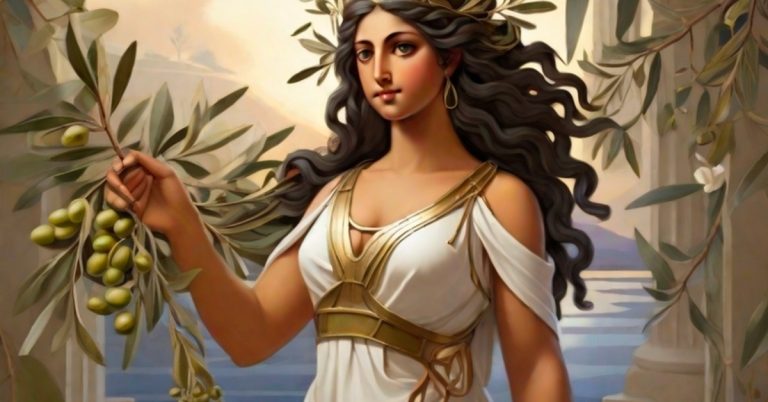
The Greek Athena is the obvious match, a goddess of wisdom and craft born without a mother from the body of the chief god, with a bird at her side. The parallel has limits. Athena is armored and Saraswati is unarmed; Athena guards a city and Saraswati guards a syllable. Set the two side by side and you get a fair picture of what Greece and India each meant by “wisdom”: for one, the strategy that wins; for the other, the word that is spoken correctly.
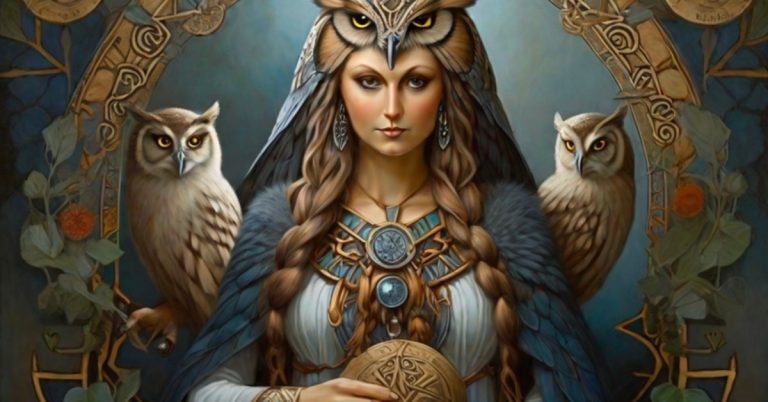
The Celtic Brigid is closer in spirit. She is the patron of poets and the goddess of inspiration, with sacred wells and springs all over Ireland, and her feast of Imbolc falls at the start of February, within days of Vasant Panchami. Two cultures at opposite ends of Eurasia both put their goddess of the inspired word at the first breath of spring, beside the water.
Saraswati’s own travels are better documented. Buddhism carried her across Asia, and in the Sutra of Golden Light she appears as a protector of the teaching and of anyone who upholds it. In Japan she became Benzaiten, one of the Seven Lucky Gods, playing a biwa instead of a vina, and her shrines sit on islands and beside lakes and the sea, at Enoshima, Itsukushima, and Chikubushima. The river in the Punjab was an ocean and a thousand years away, and Japan built her temples beside the water anyway. Tibet knows her as Yangchenma, patron of music and poetry, and in Bali, where Hinduism survived the conversion of the rest of Indonesia, Hari Saraswati comes around every 210 days on the Balinese calendar, and books are laid out and blessed just as they are in India.
The oldest image of her anywhere is Jain. It is a statue from Kankali Tila at Mathura, dated by its inscription to 132 CE, showing her seated with a book and a rosary. Jains honor her as Shrutadevi, the goddess of the recorded teachings of the Tirthankaras, and a great many of the finest medieval Saraswati sculptures in India come from Jain temples. The goddess of knowledge, fittingly, refused to belong to a single school.
Final thoughts
Every year a hand closes over a smaller hand and traces the first letter, and the goddess who watches has been watching for three thousand years.
She has changed almost everything about herself in that time. She was a torrent that broke mountains; she is a woman in white with a lute across her lap. The job stayed the same. Saraswati carries what people most need and can least hold in their hands, once as water, now as words, and India still lays its books at her feet every spring to make sure she keeps carrying it.
Bibliography
- Cartwright, Mark. “Sarasvati”. World History Encyclopedia.
- Kinsley, David. Hindu Goddesses: Visions of the Divine Feminine in the Hindu Religious Tradition. University of California Press, 1988.
- Danino, Michel. The Lost River: On the Trail of the Sarasvati. Penguin India, 2010.
- Wilson, H. H., trans. Rig Veda 2.41.16 (“best of mothers, best of rivers, best of goddesses”). Wisdom Library.
- Griffith, Ralph T. H., trans. The Hymns of the Rigveda, Book 6, Hymn 61 (to Sarasvati). Wikisource.
- Swami Vijnanananda, trans. Devi Bhagavata Purana, Book IX, Chapter 6 (“On the coming in this world of Lakṣmī, Gaṅgā and Sarasvatī”). Wisdom Library.
- Pattanaik, Devdutt. “Battle of Lakshmi and Saraswati” and “Jain Saraswati on Goose or Peacock”. devdutt.com.
- “Kankali Tila: Mathura’s Jain Connection”. Live History India.
- “Saraswati”, “Sarasvati River”, and “Ghaggar-Hakra River”. Wikipedia.
- “Vasant Panchami”, “Brahma Temple, Pushkar”, and “Benzaiten”. Wikipedia.