Lakshmi: Goddess of Wealth and Prosperity
Every Diwali, Hindu households across the world do something oddly precise: they leave the door open, light a trail of lamps toward it, and clean the house from top to bottom, all to make sure one goddess can find her way in and feels welcome enough to stay. Ask where her story starts, and most people will tell you the same version: born from a churning ocean of milk, holding a lotus, choosing Vishnu the moment she saw him. That story is real, and it’s the one carved into most modern retellings. It’s also, by a few thousand years, younger than the goddess herself.
Long before anyone wrote down the churning myth, hymn-singers were already praising a goddess by nearly this name, tied to gold, cattle, grain, and good fortune, with no ocean, no churning, and no husband anywhere in the verses. Lakshmi is one of Hinduism’s most beloved deities. She may also be one of its oldest continuously worshiped ones, older than half the story most people know her by.
She’s Lakshmi, or Sri, a name history seems to have used interchangeably with hers for centuries. The Sanskrit roots behind “Lakshmi,” lakṣ, “to perceive, observe, know,” and lakṣa, “a goal, a mark, an aim,” point at something more specific than money: understanding your own aim, and pursuing it (Wikipedia Contributors). As the consort of Vishnu, the preserver of the universe in Hindu cosmology, she doesn’t stay in one place or one body. Wherever Vishnu descends to earth as an avatar, tradition holds that Lakshmi comes with him, under whatever name that life requires.
Overview of Lakshmi
She’s rarely called only “Lakshmi.” India’s temples, home altars, and festival calendars know her under a whole cluster of names, each pointing at a different facet of the same figure.
Titles
- Sri or Shri, the older name, still used today as India’s own honorific of respect, roughly “the venerable,” derived from her
- Mahalakshmi, “Great Lakshmi,” her form as a supreme goddess in her own right rather than only as Vishnu’s consort
- Padma or Kamala, “lotus,” for the flower she’s rarely shown without
- Ksheerabdhitanaya, “daughter of the ocean of milk,” from her best-known origin story
Abilities
Lakshmi is traditionally called the source of eight kinds of wealth, the Ashta Lakshmi, discussed below, and the list says a great deal about what “wealth” meant to the people who first prayed to her: money and grain, yes, but also courage, knowledge, victory, and children. That last one ties her to fertility and continuity, a family line carrying on, a thread that reaches back to her oldest Vedic form as Sri. Later Vaishnava theology folds her into something even larger still: she is Vishnu’s Maya, the creative power that lets him manifest the material universe at all (Cartwright; “Lakshmi – New World Encyclopedia”).
Symbols
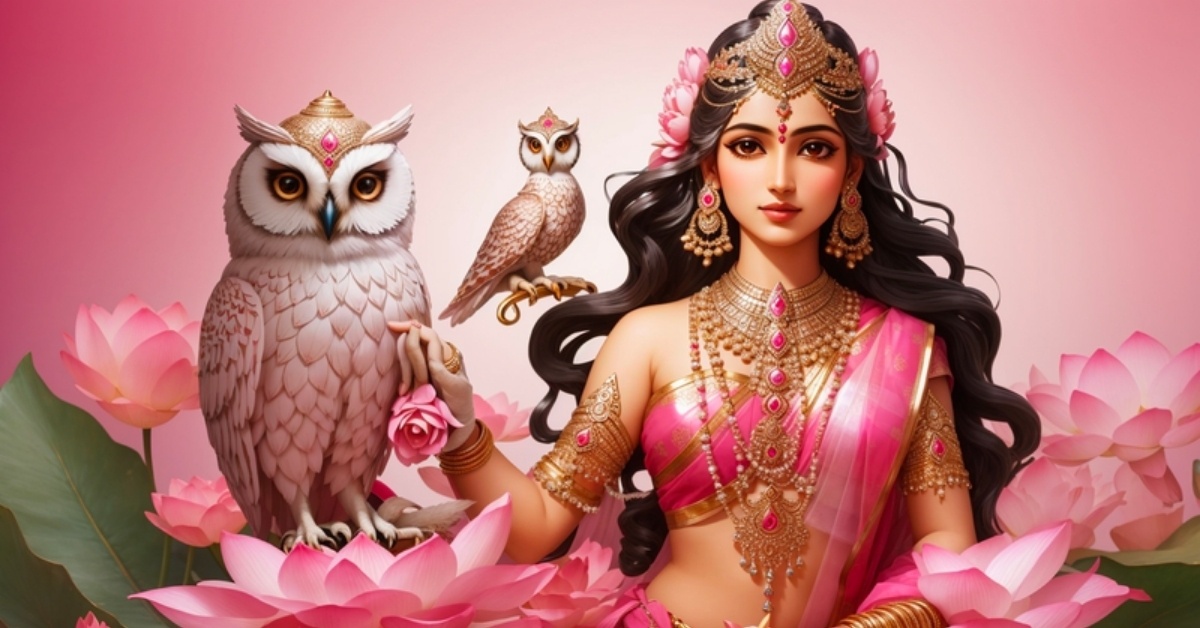
Her lotus is the symbol most people know, a flower that grows up through mud into a clean, undisturbed bloom, read across Hindu art as purity and spiritual unfolding. She’s shown seated or standing on one, usually holding a second in her hand, gold coins spilling from her palms toward her devotees. Two less obvious symbols round her out. Elephants, especially in the Gajalakshmi imagery of two elephants bathing her with their trunks, mark abundance and royal favor. And an owl, her lesser-known vehicle, carries a warning inside the blessing: a creature that sees clearly in the dark but is blinded by daylight, read as a reminder not to let wealth blind you once you have it (Wikipedia Contributors; The Editors of Encyclopaedia Britannica).
Traits
Compassion sits at the center of how devotees describe her. She’s approached less as a goddess to be feared into generosity and more as one already inclined toward it. That reputation shapes the festivals built around her, covered below: they lean toward invitation and welcome rather than appeasement, on the theory that a goddess this generous mostly needs to be asked in.
Legends associated with Lakshmi
Her stories don’t all agree on where she began, which is unusual for a goddess this central, and worth taking seriously rather than smoothing over.
Born from the churning sea
The version most people know comes from the Ramayana and later Puranic retellings: the gods and demons, desperate for the nectar of immortality, churn the cosmic ocean of milk together, using Mount Mandara as a churning rod and the serpent Vasuki as the rope, with Vishnu steadying the whole operation in his tortoise form, Kurma. All sorts of things surface before the nectar does: poison that Shiva swallows to save creation, a wish-granting cow, the divine physician Dhanvantari carrying the nectar itself. Before the story ends, Lakshmi rises from the foam holding a lotus, radiant, adorned in white. She looks over the assembled gods and demons and chooses Vishnu, without hesitation (Cartwright; Wikipedia Contributors). That single image, an entire ocean churned open and the goddess of fortune choosing for herself who gets to keep her, is the one most Lakshmi art still returns to.
The sister no one invites in
Where there’s a goddess of fortune, Hindu tradition also makes room for her opposite, and the pairing goes back further than most people expect. The Sri Sukta itself, the same ancient hymn that first names her, already calls on Sri to drive off a rival named Alakshmi, the goddess of misfortune, hunger, and poverty (Wikipedia Contributors). The Atharvaveda pushes the idea further, describing a hundred “Lakshmis” born alongside every person at birth, some virtuous and lucky, others wicked and unlucky, good fortune and bad bundled into the same life rather than sent by two separate goddesses at war. Later folk custom keeps the two sisters distinct and gives Alakshmi her own small ritual: many Lakshmi Puja traditions include a symbolic sweeping-out, driving the unwanted sister from the house before inviting the wanted one in.
Married again, under another name
Not every Lakshmi legend keeps her married to the Vishnu of the churning story. In a well-loved South Indian tradition centered on Tirupati, Lakshmi leaves her husband after a quarrel and goes to live, under the name Padmavati, in the royal household of King Akasa Raja. Vishnu, in the guise of Srinivasa, searches for her; the two fall in love without either quite realizing who the other really is, and they marry a second time in a wedding still reenacted at Tirupati today (Cartwright). It’s an unusual thing for a myth to do, remarry its own central couple under new names, and it points at how regional a goddess this supposedly universal figure actually is: Tirupati’s Lakshmi carries her own local history, distinct from the ocean-born goddess worshiped everywhere else.
One goddess, every lifetime
Vaishnava tradition ties Lakshmi to Vishnu even more tightly than marriage: wherever he descends to earth as an avatar, she’s said to come with him, under whatever name that incarnation calls for. As Rama’s queen she is Sita; as Krishna’s, she appears as Rukmini or Radha (Wikipedia Contributors). In this theology, “Lakshmi” names a role that reappears across every era of the story, always at the god’s side, always wealth and steadiness incarnate, whatever name she happens to be wearing that lifetime.
Before the ocean was churned
Here is the detail most modern retellings skip entirely: the ocean-churning story, as famous as it is, is not the oldest thing written about this goddess.
Centuries before the Puranas were composed, a fifteen-verse hymn called the Sri Sukta, tucked into an appendix of the Rigveda and likely composed in the later Vedic period, possibly earlier than Buddhism itself, praises a goddess named Sri in her own right: golden, lotus-colored, glowing, the giver of cattle, food, and fame. The hymn carries no birth story. No ocean gets churned in it, and no husband is chosen. Some scholars go further and argue Sri and Lakshmi began as two separate goddesses, worshiped under different names, who merged into a single figure over the centuries that followed; an early Vedic text, the Vajasaneyi Samhita, still lists “Sri and Lakshmi” side by side as if they were two distinct wives of Vishnu, before later tradition folded them into one (Wikipedia Contributors).
That leaves two ways to hold this goddess, and both are worth having in view at once. One is the familiar, cosmic-drama version: Lakshmi born from a churned ocean, chosen by and for Vishnu, defined against her shadow-sister Alakshmi. The other, older layer has no ocean and no husband at all: a self-standing goddess of shine, grain, and fortune that a much later mythology eventually married off. Some readers of Hindu goddess traditions go a step further still, reading Lakshmi, alongside Kali, Durga, and Parvati, as regional faces of one underlying Shakti, the single divine feminine power that Tantric tradition holds runs beneath every one of her named forms. That reading belongs to a specific strand of scholarship on Indian goddess traditions rather than to mainstream Vaishnava theology, and it isn’t the only way to understand her. But it’s a real thread in how she’s been read, and it places the churned-ocean Lakshmi most people know in much older, wider company than the story lets on.
Lakshmi today
No deity in the Hindu calendar gets a bigger single night than Lakshmi gets at Diwali. Homes are cleaned top to bottom in the days before, doorways are lined with rows of oil lamps, the diyas that give the Festival of Lights its name, and elaborate rangoli patterns are drawn on thresholds, all meant as an open invitation for the goddess to step inside and stay. Businessmen traditionally open fresh account books that night and place them before her image for a blessing; farmers make their own offerings for a fertile year ahead. Clay images of Lakshmi and Ganesha are worshiped side by side across northern India through the festival, fortune and good beginnings asked for in the same breath (“Lakshmi – New World Encyclopedia”).
She isn’t only a once-a-year goddess. Across much of South India, particularly Tamil Nadu and Karnataka, married women observe Varalakshmi Vratam on the Friday before the August full moon, a day built around a decorated ritual pot representing Varalakshmi, the boon-granting form of the goddess, with prayers for the health and long life of husbands and family. And the eightfold Ashta Lakshmi tradition, splitting her wealth into eight distinct forms, from Dhana Lakshmi’s money and Dhanya Lakshmi’s grain to Vidya Lakshmi’s learning and Veera Lakshmi’s courage, keeps her from ever collapsing into a goddess of cash alone. It’s a working theology of abundance broad enough to cover a harvest, a hard exam, and a hard year all at once.
Her reach runs well past Hinduism, too. Buddhist tradition has its own goddess of abundance, Vasudhara, generally read by scholars as shaped by Lakshmi’s long-standing popularity across the same regions; Jain communities separately venerate Padmavati, a wealth-and-fertility goddess whose iconography closely echoes Lakshmi’s own. Across faiths and centuries, the throughline holds: whatever else changes about how people picture abundance, it keeps arriving in her shape.
Final thoughts
Lakshmi resists being pinned to one story, which suits a goddess whose whole domain is abundance in every form it takes. The Puranas give her a dramatic birth from a churning ocean and a chosen marriage to the preserver of the universe. The older Vedic hymns suggest she, or a goddess very like her, needed no ocean and no husband to be worth praising in the first place. Folk tradition gives her an unwanted sister to sweep out the door each year, and Vaishnava theology gives her a new name and a new face in every one of Vishnu’s incarnations.
What holds steady across every layer of that history is what people actually go to her for: not just money, but the fuller kind of wealth, knowledge, courage, family, a harvest that comes in. Millions of doorways get swept and lit for her every autumn on the strength of that promise, a tradition old enough that no single myth ever quite manages to contain the whole of it.
Bibliography
- “Lakshmi”. Wikipedia.
- “Śrī Sūkta”. Wikipedia.
- “Samudra Manthan”. Wikipedia.
- “Varalakshmi Vratam”. Wikipedia.
- Cartwright, Mark. “Lakshmi.” World History Encyclopedia, 14 Aug. 2015.
- The Editors of Encyclopaedia Britannica. “Lakshmi | Hindu Deity.” Encyclopædia Britannica.
- “Lakshmi.” New World Encyclopedia.
- Kinsley, David. Hindu Goddesses: Visions of the Divine Feminine in the Hindu Religious Tradition. University of California Press.
- Rhodes, Constantina. Invoking Lakshmi: The Goddess of Wealth in Song and Ceremony. SUNY Press.
- Sjöö, Monica, and Barbara Mor. The Great Cosmic Mother. HarperOne.