Kali: Hindu Goddess of Time, Death, and Liberation
She wears a necklace of severed heads and a skirt of severed arms, and she stands on the chest of a god.
Millions of people call her Ma. Mother.
That gap, between the most frightening image in Hindu art and the tenderness of the people who love her, is the whole story of Kali. Her name means both time and black, and she is the one power in the universe that nothing outlasts.
Overview of Kali
Kali, also called Kalika and Mahakali, is the fierce dark goddess of the Hindu tradition, the embodiment of time, death, and the destruction that clears the way for liberation. Her name comes from the Sanskrit kāla, which means both “time” and “black,” so she is at once the Black One and She Who Is Time. She is the wrath of Durga given a body, the dark side of Parvati, and, in the tradition that loves her most, the Divine Mother herself.
She is worshiped across India and Nepal, but her heartland is the east: Bengal, Assam, and Odisha, with Kolkata as her city. In Tantra she heads the Mahavidyas, the ten wisdom goddesses, and her worship there reaches into places most religion avoids, the cremation ground above all. She is Shakti, the active power of the universe, shown at full strength.
Her great festival is Kali Puja, held on the new-moon night of Kartik, the same night much of India celebrates Diwali.
Titles
- Mahakali (“Great Kali”)
- Kalika
- Shyama (“the Dark One”)
- Chamunda (“slayer of Chanda and Munda”)
- Dakshina Kali (the benevolent Kali of Bengal’s household shrines)
- Bhavatarini (“she who carries across the ocean of existence”)
- Ma Kali, Kali Ma (“Mother Kali”)
Characteristics
How Kali tends to be shown in art:
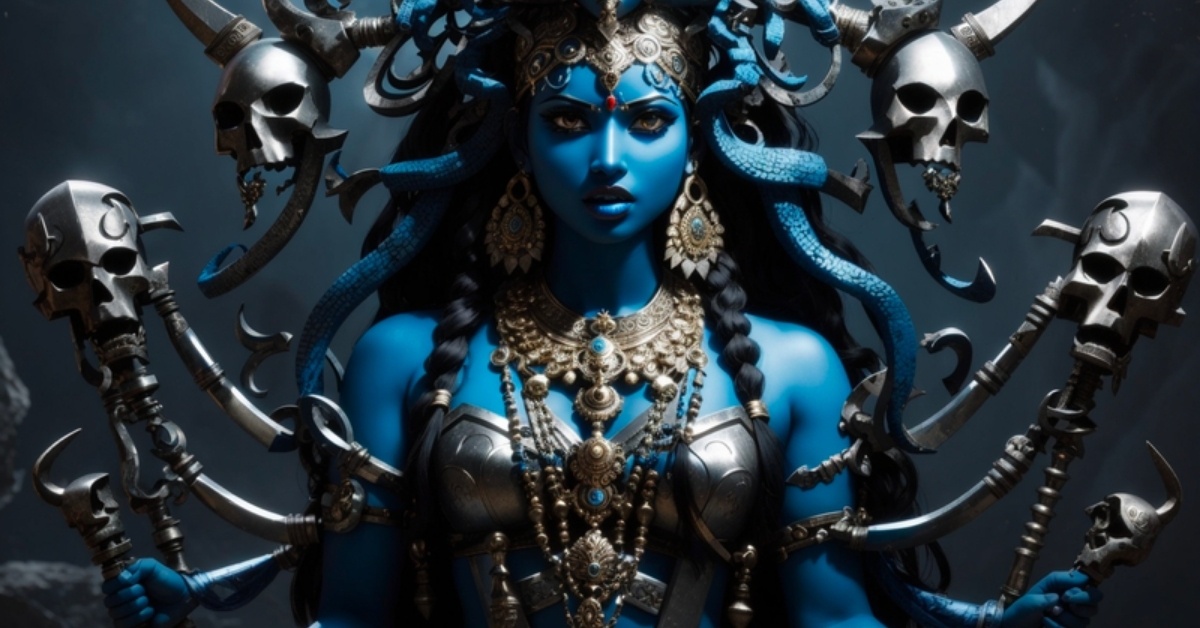
- Black or deep blue skin, the color of the night sky and of the void before creation
- Naked, or wearing a tiger skin, her hair loose and wild
- Three eyes, and a red tongue lolling from her mouth
- Four arms: a bloodied sword and a severed head in her left hands, gestures of blessing and fearlessness in her right
- A garland of severed heads and a skirt of severed arms
- One foot planted on the prone body of Shiva
Abilities
- Destruction of demons — the one warrior the gods send when nothing else works
- Dominion over time — everything born passes through her, and she is there at the end of it
- Liberation — she cuts away the ego and the fear of death, freeing her devotees
- Protection — fierce to enemies, a shelter to those who call on her
- Transformation — the death she brings is the death of whatever you are ready to release
Symbols
- The sword — divine knowledge, cutting through ignorance
- The severed head — the ego she frees you from
- The garland of heads — fifty or fifty-one of them, read as the letters of the Sanskrit alphabet: all speech, all mantras, are hers
- The skirt of arms — the karma of her devotees, which she takes on herself
- The lolling tongue — read as the flush of shame, or as the appetite that swallowed a demon’s blood
- The cremation ground — where she is at home, and where attachment burns away
- The red hibiscus — her flower, offered at every shrine
Traits
- Ferocious in battle, past the point of stopping
- Free: naked, unbound, outside every social rule
- Tender toward her devotees, who approach her as children
- Blunt and unsentimental about death, and unafraid of it
- Compassionate in a way that hurts before it heals
Festivals and Rituals
Kali’s great night is Kali Puja, on the new moon of the month of Kartik in October or November. It falls on the same night as Diwali, so while much of India lights lamps for Lakshmi, Bengal, Assam, and Odisha keep the night for Kali. Clay images go up in neighborhood pandals, the midnight worship begins around twelve, and devotees offer red hibiscus, sweets, rice, and lentils, some keeping vigil until dawn. At Kolkata’s Kalighat temple she is honored as Lakshmi herself that night. The festival grew to its present scale in eighteenth-century Bengal under Raja Krishnachandra of Nadia, and it grew again in the nineteenth, when Ramakrishna made her name a household word.
Her two great homes are both in Kolkata. Kalighat is one of the fifty-one Shakti Pithas, the places where pieces of the goddess Sati fell to earth; the toes of her right foot fell here, and the present temple dates to 1809. Dakshineswar, the riverside temple built by Rani Rashmoni and consecrated in 1855, is where Ramakrishna served as priest and spoke to Kali as a living mother. In many Bengali households she is worshiped daily, and in Tantric practice her worship goes to the cremation ground itself, where a practitioner sits among the fires and faces what she embodies.
Legends associated with Kali
Kali’s myths come back to the same three beats again and again: a battle no one else can win, a fury that will not stop, and the one thing that finally stops it. Together they explain both the terror and the tenderness.
Born from the brow of Durga
Kali’s first great appearance is in the Devi Mahatmya, the sixth-century “Glory of the Goddess,” and she arrives the way a storm does.
Two demon kings, Shumbha and Nishumbha, have driven the gods out of heaven, and the gods appeal to the Goddess. She takes the field as Durga, also called Ambika and Chandika. Shumbha sends his generals Chanda and Munda against her with an army, and as they close in, the goddess’s face darkens with rage. From the frown on her brow, out steps Kali.
The text lingers on her. She is gaunt, black, and terrible, with sunken red eyes, her mouth gaping and her tongue hanging out, dressed in a tiger skin and a garland of human heads, carrying a sword, a noose, and a skull-topped staff. She falls on the demon army and eats it, horses, elephants, chariots, and all. Then she seizes Chanda by the hair and cuts off his head, does the same to Munda, and lays both heads at Durga’s feet. Durga gives her a new name for it: Chamunda, slayer of Chanda and Munda.
She is, from her first breath, the goddess’s anger made flesh. Everything Durga cannot afford to become, Kali is.
Raktabija and the blood that would not land
Shumbha’s next champion is Raktabija, and he carries a gift from Shiva that makes him close to unkillable.
His name means “blood-seed.” Every drop of his blood that touches the ground springs up as another Raktabija, full-grown and armed. Durga wounds him, the drops fall, and a second demon rises. The Matrikas, the seven mother goddesses fighting beside her, wound him too, and with every stroke the battlefield fills. Soon the gods face an army of one demon, multiplied past counting, and every blow they land makes it worse.
Durga turns to Kali. Open your mouth, she tells her, and drink his blood as fast as it runs.
So Kali does. She spreads her tongue across the battlefield and catches every drop before it lands. Durga strikes Raktabija with her sword, with her spear, with her arrows. The blood streams out and never reaches the earth. The clones already standing are gulped down whole. Drained white, the demon staggers and falls, and Durga takes his head.
The image people know, Kali’s red tongue out, comes partly from this moment. Some read it as hunger, some as the mouth of time itself, which swallows everything that bleeds. Either way, the lesson is plain. Some evils grow every time you strike them. Kali’s answer is to take the whole thing into herself.
The dance that stopped on Shiva’s chest
The Devi Mahatmya ends its battle with the demons dead. Later tellings, especially in Bengal, ask what happened next, and their answer gives Kali her most famous pose.
The war is won, but Kali cannot stop. Drunk on the blood of demons, she begins to dance, and the dance is destruction. The earth shakes under her feet. Whatever she touches breaks. The gods, who summoned her, realize she will go on until there is nothing left, and none of them can stand in her way.
One can. Her consort Shiva walks onto the battlefield and lies down among the corpses in her path, still and unresisting, one more body on the ground.
Kali dances on. She steps on him. And in the moment her foot lands on his chest, she looks down and sees who she is standing on.
She stops. Her tongue comes out between her teeth.
What that gesture means depends on who you ask, and the tradition has never settled it. Across Bengal and Odisha the usual reading is lajja, the sudden bodily embarrassment of a wife who has stepped on her husband, a gesture Bengalis still make. Others read it as the shock of recognition, the instant her awareness returns and the fury drains away. Tantric readings go further and turn the scene into a teaching: Shiva is pure consciousness, inert without energy, and Kali is Shakti, the power that acts. Without her he is a corpse. Without him she has nothing to stand on. A Bengali pun makes the point in one word: Shiva without the i is shava, a corpse.
The dark goddess of Bengal’s household shrines, Dakshina Kali, is this Kali, right foot forward on Shiva’s chest, mid-stop, forever caught at the moment she chose to come back.
The dark skin of Parvati
Another origin story, from the Vamana Purana, ties Kali to the gentlest goddess in the pantheon.
Parvati, Shiva’s wife, is dark-skinned, and one day Shiva teases her for it. Stung, she goes into the mountains to practice austerities until the gods grant her a golden complexion. She sheds her dark outer skin like a sheath, and from that cast-off darkness a goddess takes shape: Kali. The bright Parvati becomes Gauri, “the fair one,” while the darkness she set aside walks off with a life of its own.
The story says something the battle myths leave out. Kali and Parvati are one goddess. The tenderness and the terror share a body, and the terror is the part the world shamed her for.
Ma Kali and the poet who scolded her
The last great Kali legend has no demons in it. Its setting is eighteenth- and nineteenth-century Bengal, and it is the story of how a goddess of the cremation ground became a mother.
In the 1700s a poet named Ramprasad Sen, a clerk by trade, began writing songs to Kali in Bengali rather than Sanskrit, and he wrote to her the way a child speaks to its mother. He complains to her. He argues. He accuses her of neglect, then asks for her lap. The songs, called Shyama Sangeet, are still sung in Bengal, and the stories that gathered around Ramprasad say she answered him, appearing as a little girl to help him mend a fence while he sang.
A century later, at the Dakshineswar temple on the Ganges, a young priest named Ramakrishna took this further than anyone. He demanded more than a stone image. He wept before Kali for a vision, and when it came he described her as an ocean of living light. From then on he spoke to her daily, fed her, joked with her, and called her simply Ma. His disciple Vivekananda carried her to the West and wrote a poem to “Kali the Mother” in which the terror is the point: only the one who can love death itself, he says, meets the Mother face to face.
This is the Kali most of her worshipers know. The heads and the sword are still there. What the devotee sees behind them is a mother who is honest about death, and who will take the karma off your shoulders and wear it as a skirt.
An older Kali?
The Devi Mahatmya introduces her in the sixth century, but the trail runs further back, and it runs to the edges of the map.
The Mahabharata gives her a walk-on part, and it is a chilling one. On the last night of the great war, when Ashvatthaman creeps into the sleeping Pandava camp to slaughter it, the doomed soldiers dream of a dark woman with a bloody mouth and a noose in her hand, singing as she leads them away. The epic calls her Kalaratri, “the black night,” and she is death itself, with no temple and no consort. Older still, the Mundaka Upanishad names kālī as one of the seven tongues of the fire god Agni, the black tongue that consumes the offering. The goddess who later spreads her tongue across a battlefield begins, in the texts, as a tongue.
Where she was worshiped is the more telling clue. The Kathasaritsagara, the eleventh-century “Ocean of Story,” fills its tales with shrines of the fierce goddess in the Vindhya hills, tended by forest peoples the text names as Savaras, Bhillas, and Pulindas, with a sword hung in the sanctum and human heads on the walls; kings and bandits alike come to her for boons and pay in flesh. Bhavabhuti’s eighth-century play Malatimadhava sets a scene at a temple of Chamunda beside a cremation ground, where a devotee tries to sacrifice the heroine. The Matsya Purana places Kali’s origin at Mount Kalanjara in north-central India, a tribal stronghold. Many scholars read all this as one picture: Kali began as a goddess of the margins, of hill peoples, battlefields, thieves, and burning grounds, outside the Vedic order and its priesthood, and the great Sanskrit texts absorbed her by making her Durga’s rage and Parvati’s shadow. Her identification with Chamunda, herself understood as a tribal goddess of the Vindhyas, points the same way.
What carried her from the edge to the center was Tantra, and then Bengal. Tantric traditions made the cremation-ground goddess their supreme deity, first among the Mahavidyas, and taught that the road to liberation runs through the things she embodies rather than around them. In seventeenth-century Bengal the scholar Krishnananda Agamavagisha gave her the Dakshina Kali form now in every household shrine, and a century later Ramprasad taught the whole region to call her Mother. That is one reading, and the tradition itself holds several. On any of them the outsider is still visible. She is naked because she owns no rules. She lives among the dead because that is where she always lived. The center came to her.
Kali across cultures
Kali’s pairing of a mother who is also death with a rage that only love can stop has relatives.
Egypt’s Sekhmet is the closest. The lion-headed goddess is sent by the sun god Ra to punish humanity, and like Kali she cannot stop once she has begun; the gods save the world by flooding a field with beer dyed red, which she drinks for blood until she sleeps. Two goddesses, two rampages, two endings in which the killing is halted by giving the goddess what she wants instead of fighting her. In Mexico, the Aztec earth mother Coatlicue wears a skirt of woven serpents and a necklace of human hands and hearts with a skull at its center, a mother of gods who is also the grave that takes everything back; scholars of comparative religion have set her beside Kali for a century. Closer to home, the Buddhist goddess Tara shares Kali’s dark, fierce form in her Tantric aspect, and Hindu Tantra lists her second among the Mahavidyas, right behind Kali herself.
Each of these goddesses is her own. But the same idea keeps surfacing wherever people think hard about death: the power that ends everything is also the power that gave birth to it, and the only way past the fear is to look straight at her.
Final thoughts
Fifty heads, a skirt of arms, and a name that means time.
Kali is the goddess who refuses to make death pretty, and her devotees love her for exactly that. She drinks the blood of the demon who multiplies with every wound. She dances until a god lies down in her path. She takes the karma off your back and wears it. Everything else the pantheon offers, prosperity, beauty, wisdom, order, sits inside a span of time that she owns, and she is the one goddess who says so out loud.
Bengal looked at her and called her Mother. What do you see when you look?
Bibliography
- Cartwright, Mark. “Kali”. World History Encyclopedia.
- Coburn, Thomas B. Encountering the Goddess: A Translation of the Devi-Mahatmya and a Study of Its Interpretation. SUNY Press.
- Devi Mahatmya, Chapter 7 (Chanda and Munda) and Chapter 8 (Raktabija). devimahatmya.com.
- Kinsley, David. Hindu Goddesses: Visions of the Divine Feminine in the Hindu Religious Tradition. University of California Press.
- McDermott, Rachel Fell. Mother of My Heart, Daughter of My Dreams: Kali and Uma in the Devotional Poetry of Bengal. Oxford University Press.
- Natesan, Sivagami. “Ma Kali”. Hindu American Foundation.
- “Description of Goddesses in the Kathasaritsagara”. Wisdom Library.
- “Kali”. Encyclopaedia Britannica.
- “Kali”. New World Encyclopedia.
- “Kali”, “Chamunda”, “Raktabīja”, and “Kali Puja”. Wikipedia.
- “Ramprasad Sen”, “Dakshineswar Kali Temple”, and “Kalighat Temple”. Wikipedia.
- “Sauptika Parva”. Wikipedia.
- Mundaka Upanishad 1.2.4. Trans. F. Max Müller, Sacred Books of the East vol. 15.
- Mark, Joshua J. “Sekhmet” and “Coatlicue”. World History Encyclopedia.