Durga: Hindu Warrior Goddess and Slayer of the Buffalo Demon
The gods had been beaten, thrown out of heaven, and sent home. So they got angry, all of them at once, and the anger came out of their bodies as fire.
The fire pooled in the air and became a woman. Every god handed her his own weapon. She laughed once, loud enough to shake the worlds, and rode out on a lion to finish what none of them could.
That is Durga. She still rides out every autumn, when hundreds of millions of people build her a body out of river clay, paint in her eyes, and then carry her back to the water.
Overview of Durga
Durga is the great warrior goddess of Hinduism, and one of the most widely worshiped deities in the world today. Her name comes from the Sanskrit durga, a fort or a place hard to reach, so she is “the Inaccessible One,” the stronghold you shelter behind and the one thing an enemy can never take.
She belongs to no single pantheon of gods, because in the tradition that loves her most, Shaktism, she is the whole pantheon. Every god’s power is a spark of her. Most Hindus meet her as the fighting form of Parvati, Shiva’s wife, the gentle mountain goddess who takes up ten weapons when the world needs it. Her scripture is the Devi Mahatmya, “The Glory of the Goddess,” a 700-verse hymn folded into the Markandeya Purana around the fifth or sixth century CE and still chanted aloud during her festival.
Her worship runs hottest in eastern India, Bangladesh, and Nepal, where her autumn festival stops whole cities for a week.
Titles
- Mahishasuramardini (“slayer of the buffalo demon”)
- Chandika, or Chandi (“the fierce one”)
- Ambika (“the mother”)
- Bhavani (“giver of life”)
- Katyayani (the warrior form worshiped on the sixth night of Navaratri)
- Vindhyavasini (“she who dwells in the Vindhya mountains”)
Characteristics
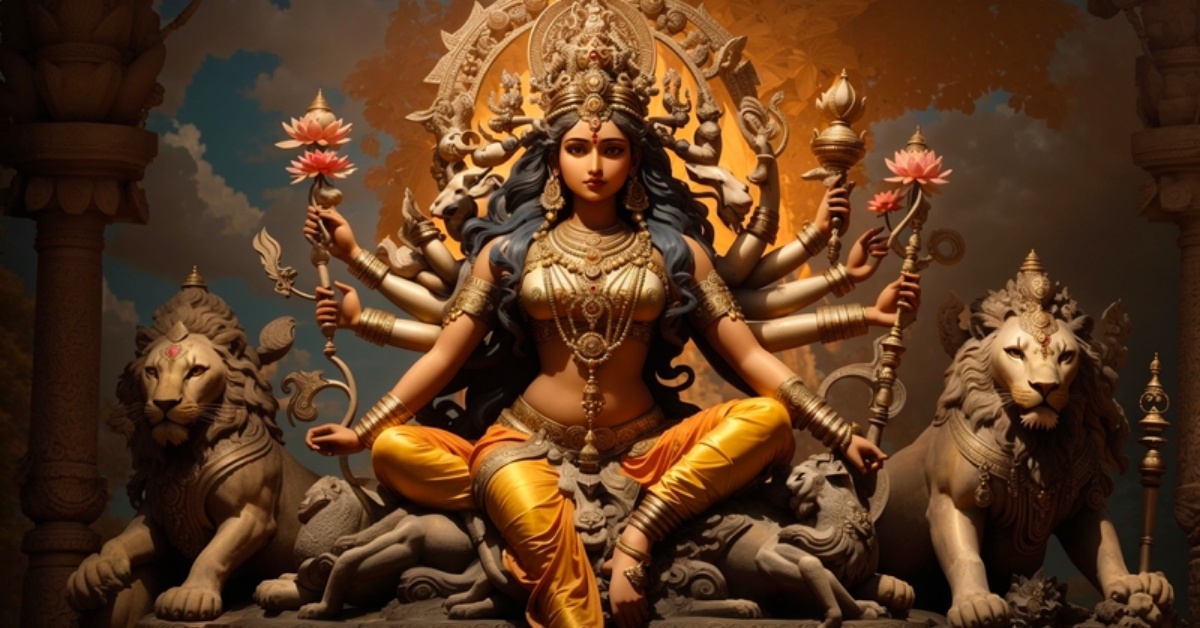
How Durga tends to be shown in art:
- Golden or fair-skinned, radiant, dressed in a red sari
- Calm, even faintly amused, in the middle of a battle
- Eight, ten, or up to eighteen arms, each holding a different god’s weapon
- Riding or standing beside a lion, or in some regions a tiger
- A third eye on her forehead
- Her trident driven into the buffalo demon, who is often shown climbing out of the buffalo’s severed neck in his own human form
Abilities
- Warfare — the combined might of every god, poured into one body
- Making goddesses — in her fury she produces new deities from herself, including Kali
- Sovereignty — she fights without a husband or an army; the gods stand back and watch
- Protection — she is the fortress her name describes, the refuge of anyone in danger
- Boon-giving — her hymns call her Jaya and Vijaya, “victory,” the one you pray to before a fight
Symbols
- The lion — her mount, a gift from the Himalaya, standing for power under control
- The trident — Shiva’s weapon, the one that ends Mahishasura
- The conch and the discus — Vishnu’s and Varuna’s gifts, sound and light
- The bow and arrow — from the wind god Vayu
- The lotus — held in one calm hand while the others fight
- The buffalo — her enemy, and by extension every rage that runs on its own strength
- Red — the sindoor, the hibiscus, the sari, the color of her festival
Traits
- Serene in combat; she smiles while she kills
- Quick to laugh, and her laugh is a weapon
- Sovereign, answering to no one
- A mother first, who fights because her children are threatened
- Generous, granting victory to anyone who calls her name
Festivals and Rituals
Her great festival is Navaratri, “nine nights,” held in the month of Ashvin (September or October) and again in spring. Each night belongs to one of the Navadurga, her nine forms: Shailaputri the mountain’s daughter, Brahmacharini the ascetic, Chandraghanta, Kushmanda, Skandamata, Katyayani the demon-slayer, Kalaratri the dark night, Mahagauri the shining one, and Siddhidatri, giver of powers. The tenth day is Vijayadashami, the day of victory.
In Bengal the same days are Durga Puja, the biggest festival of the Bengali year. Clay images of the goddess are built for months in the potters’ quarter of Kolkata, Kumortuli, and set up in temporary pavilions called pandals that turn every neighborhood into an art show. On the last day married women smear each other with red sindoor, and the images are carried in procession to the river and immersed. UNESCO added Kolkata’s Durga Puja to its Intangible Cultural Heritage list in 2021.
Nepal keeps the fifteen-day version, Dashain, the longest holiday in the Nepali calendar, when elders press rice, yogurt, and vermilion onto the foreheads of the young.
Legends associated with Durga
Durga’s stories are war stories. They come mostly from the Devi Mahatmya, and they share one shape: the gods fail, the goddess arrives, and the arriving is the point.
The demon no man could kill
Mahishasura was born of a demon father named Rambha and a she-buffalo, which is why he could wear either body. He was ambitious, and he did what ambitious demons do. He practiced austerities until Brahma appeared and offered him a boon.
Mahishasura asked for immortality. Brahma refused; everything born must die. So the demon asked for the next best thing: that no man, and no god, should ever be able to kill him.
Brahma agreed, and Mahishasura went to war.
The fight between the gods and the demons lasted a hundred years. At the end of it Mahishasura sat on Indra’s throne. He took the offices of the sun, the moon, the wind, the fire, and the ocean, and handed them to his own followers. The gods walked the earth like exiles.
They went to Vishnu and Shiva and told them everything. And the two great gods, hearing it, frowned.
A woman made of fire
That frown is where Durga begins.
Out of Vishnu’s furious face came a great light. Out of Shiva’s came another. Then from Brahma, from Indra, from the body of every god present, a blaze of energy, tejas, came pouring, and all of it ran together into one mass of fire that lit the three worlds.
The fire took shape. Shiva’s light became her face. Yama’s became her hair, Vishnu’s her arms, the moon’s her breasts, Indra’s her waist, Varuna’s her legs, the earth’s her hips, Brahma’s her feet, Agni’s her three eyes, and Vayu’s her ears. She stood there complete, and the gods, who had just lost everything, shouted for joy.
Then each one armed her. Shiva pulled a second trident out of his own and handed it over. Vishnu gave her a discus, Varuna a conch and a noose, Agni a spear, and Vayu a bow with two quivers that never ran empty. Indra gave her his thunderbolt and unhooked the bell from his elephant’s neck. Yama gave her his staff, Brahma a water pot, the sun god his own rays, and Time gave her a sword and shield. The ocean brought pearls, garments, and a lotus that never fades. The divine architect gave her an axe and armor. Kubera, god of wealth, handed her a cup of wine, and the Himalaya sent her a lion to ride.
She laughed. The sound shook the sky and the earth heaved. The demons heard it, picked up their weapons, and ran toward it.
The slaying of the buffalo demon
Mahishasura’s generals came at her first, with chariots, elephants, and armies in the millions, and she cut through them the way you cut through wheat. The first general’s sword shattered on her arm. Her lion took a second one’s head off with its paw. She killed the rest with stones, with trees, with her fists, with her feet.
Then the demon himself came, in the shape of a buffalo, tearing up the ground, knocking down mountains with his horns.
She threw her noose over him and he slipped out of the buffalo and became a lion. She cut off the lion’s head and a man stepped out of it holding a sword. She shot the man full of arrows and he became an elephant and reached for her lion with his trunk. She cut the trunk off. He turned back into a buffalo and bellowed.
Now the goddess did something the poem lingers on. She raised Kubera’s cup and drank. Her eyes went red. She laughed at him. “Roar, fool, roar a moment more, while I drink this wine,” she told him. “The gods will do the roaring soon, when I have killed you.”
She leaped. She came down on the buffalo with her foot on his neck and drove her spear into him, and when Mahishasura tried once more to escape, climbing half out of the buffalo’s mouth in his own human form, she took Time’s great sword and cut his head off.
That is how she is shown in a thousand temples: a serene woman, one foot on a buffalo, a man’s body slumped out of its neck. The city of Mysore takes its name from him, and its Chamundi Hill is one of the places where she is said to have finished the job. The gods gave her a new name that day, Mahishasuramardini, the slayer of Mahisha, and she is still called it.
Nine nights of battle
Tradition says the fight took nine days and nights, and that the goddess wore a different face on each of them. That is one story of where the nine forms of Navaratri come from: Durga as she was on the first night, the second, the ninth, until the tenth dawn brought victory.
It also explains why the festival feels the way it does. For nine nights the whole household is inside the battle, fasting, chanting the Devi Mahatmya, keeping the lamp lit. The tenth day is the head coming off.
Kali from her brow
The Devi Mahatmya has a third war, and a goddess is born in the middle of it.
Two demon brothers, Shumbha and Nishumbha, have taken heaven the way Mahishasura once did. They hear of a woman of astonishing beauty living on a Himalayan peak and decide to own her. They send two generals, Chanda and Munda, to bring her back by the hair if they have to.
The goddess sees the army coming up the mountain. Her face goes dark with rage, and from her furrowed brow leaps Kali, black as ink, sword in hand, wearing a tiger skin and a garland of skulls, her tongue lolling. Kali eats the army. She picks up elephants and swallows them. She brings Chanda’s and Munda’s heads to the goddess, who gives her a new name for it, Chamunda.
Then comes Raktabija, “blood-seed,” and every drop of his blood that touches the ground stands up as a new demon. The goddess can strike him forever and only make more of him. So she tells Kali to open her mouth. Kali drinks the blood as it falls, and the field is drained of demons.
The two goddesses are the same goddess. Durga is what happens when the calm Great Goddess picks up weapons; Kali is what happens when Durga loses her temper.
The goddess comes home
Bengal tells Durga Puja as a family story. The goddess is a married daughter living far away at Shiva’s mountain, and for these few days each year she comes home to her father’s house with her four children: Lakshmi, goddess of wealth, Saraswati, goddess of learning, and her sons Ganesha and Kartikeya. That is why a Bengali clay tableau shows five figures and a buffalo demon at her feet. The whole family came to visit.
The autumn timing has a legend of its own. Spring was the proper season for waking the goddess, but the hero Rama needed her before his war with Ravana, so he woke her early, in autumn, an akal bodhan, an “untimely invocation.” She granted him victory on the tenth day, which is why Vijayadashami is also the day Ravana’s effigies burn across northern India.
The clay images are made with earth from the Ganges bank. Tradition asks the potter to include a pinch of soil from outside a brothel, since the goddess belongs to everyone. The last thing painted is her eyes, in a ritual called chokkhu daan, “the gift of eyes,” and from that moment she is considered present. Four days later the same neighbors who welcomed her carry her to the river, weeping and drumming, and give her back.
An older Durga?
The oldest Hindu scriptures know almost nothing about her. The Vedas, composed a thousand years before the Devi Mahatmya, have no warrior goddess who rides a lion and slays a buffalo. The name durga turns up in a few late Vedic passages as a word or an epithet, and that is all. Her first real hymns arrive with the epics.
Those hymns are telling. In the Mahabharata, Yudhishthira prays to her as he enters the city of Virata, and he calls her the one who “lives forever on the Vindhya,” the mountain range that walls off central India. The Harivamsa describes her as a goddess worshiped by the Shabaras, Pulindas, and Barbaras, forest and hill peoples the Sanskrit tradition regarded as outsiders, and it says she is fond of meat and wine. Even in the Devi Mahatmya she drinks before the kill, an act no Vedic goddess performs.
Many historians of religion read that trail as pointing outside the Vedic world. David Kinsley, in Hindu Goddesses, puts it plainly: “Durgā’s historical origins seem to be among the indigenous non-Āryan cultures of India.” He points to the absence of any similar goddess in the Vedic pantheon and to the early texts that tie her to the Vindhyas, to tribal peoples, and to blood offerings. Ramaprasad Chanda argued a century ago that the first Durga was a fusion of mountain goddesses worshiped by the hill dwellers of the Himalaya and the Vindhyas. Her epithet Vindhyavasini, “she who dwells in the Vindhyas,” is still the name of a living temple at Vindhyachal on the Ganges, packed every Navaratri.
The buffalo-slayer seems older than her scripture too. Terracotta plaques from Nagar in Rajasthan, dated to the first century BCE or the first century CE, already show a goddess killing a buffalo. Kushan-era figures from Mathura show her with four or six arms, sometimes wrestling a demon in fully human form with her bare hands, before any text spelled out who handed her which weapon. On this reading, the Devi Mahatmya is the moment a much older local goddess, or several, received a Sanskrit biography. Some scholars push further back still; Asko Parpola sees a tiger-riding war goddess on an Indus Valley seal from Kalibangan, though that reading is contested.
None of this makes her less Durga. Whatever she was before, she walked into the Sanskrit tradition through the front door and took the throne. The point is that she was already there, in the hills, with her animal and her wine, waiting for the gods to need her.
Durga across cultures
Durga travels well, because armies do. Wherever Hindu kingdoms rose she came with them.
At Prambanan in central Java, the ninth-century Shiva temple keeps a statue of Durga killing the buffalo in its northern chamber. Local legend renamed her Rara Jonggrang, “the slender maiden,” a princess turned to stone by a spurned prince, but the stone is Mahishasuramardini, foot on the buffalo, and people still leave offerings. Her image appears across Cambodia and Vietnam from the same centuries, and in Nepal she is Taleju, protector of kings, whose temple in Kathmandu opens to the public one day a year, during Dashain.
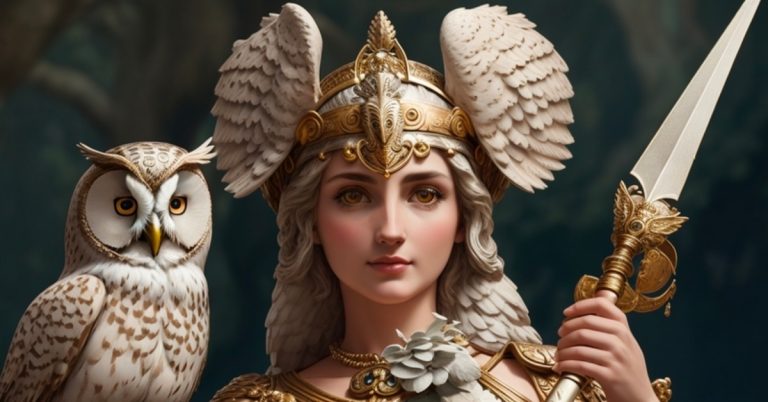
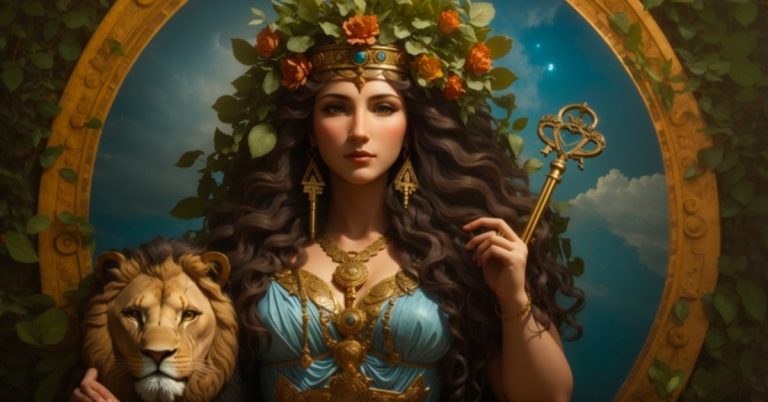
Her closest cousin lives on another continent. In Egypt, when humans rebelled against the sun god Ra, he sent out his Eye in the form of the lion goddess Sekhmet to destroy them. She did it so thoroughly that Ra had to trick her into stopping by flooding the fields with red beer she mistook for blood. A lioness dispatched by the gods to do what they cannot, who drinks in the middle of the slaughter, who has to be talked back down: the Egyptians knew her too. The Greeks had Athena, born armed and full-grown, though Athena wins by strategy where Durga wins by force. The Irish had the Morrigan, the crow on the battlefield.
What sets Durga apart is that the men who made her stand back afterward. In every version, once the goddess is armed, the gods become spectators. It is the rare war myth in which the strongest fighter is a mother, and everyone in the story knows it.
Final thoughts
In Kumortuli each autumn, a potter dips a brush and gives Durga her eyes, and a straw-and-clay figure becomes, for four days, the most powerful being in the universe. Then her neighbors carry her to the river and let the water take her apart. They do it every year. They cry every year. And every year she comes back.
That is the goddess in one gesture. She arrives when the situation is already lost. She fights alone and smiles while she does it. And she leaves before anyone can make her stay.
The buffalo demon made himself safe from every man and every god, and never once thought about a woman. Who is the fighter in your own story that nobody bothered to plan for?
Bibliography
- Pargiter, F. E., trans. The Markandeya Purana, Canto LXXXII: “The Devi-Mahatmya: Slaughter of the Army of the Asura Mahisha” and Canto LXXXIII: “The Slaying of Mahisha”. Via Wisdom Library.
- Kinsley, David. Hindu Goddesses: Visions of the Divine Feminine in the Hindu Religious Tradition. University of California Press.
- Coburn, Thomas B. Devī-Māhātmya: The Crystallization of the Goddess Tradition. Motilal Banarsidass.
- Bhatia, Vinod. “Representing Power”. Tarka Journal.
- “Durga Sthuthi by Yudhishtra”. Hindupedia.
- “Durga”, “Devi Mahatmya”, “Mahishasura”, and “Mahishasuramardini”. Wikipedia.
- “Navadurga”, “Navaratri”, “Durga Puja”, and “Dashain”. Wikipedia.
- “Vindhyavasini” and “Rara Jonggrang”. Wikipedia.
- “A Comparative Iconographic Study of Mahishamardini Durga”. Heritage: Journal of Multidisciplinary Studies in Archaeology, vol. 9.