Inari: Japanese Deity of Rice, Foxes, and Fortune
Ten thousand vermilion gates climb a mountain south of Kyoto, packed so close together that the forest path turns into a red tunnel.
Every one of them is a thank-you. A shop, a family, or a company paid to raise it, and the donor’s name runs down the back of each post in black ink. Walk through and you’re walking through centuries of gratitude to one deity.
That deity is Inari, kami of rice, foxes, and fortune, worshiped at more shrines than any other in Japan, and wearing more than one face.
Overview of Inari
Inari is the Shinto kami of rice, and in Japan rice has always meant more than food. It was wealth, tax, wages, and the measure of a lord’s domain. A deity who governs rice governs whether people eat, and Inari’s territory spread outward from there: the harvest, fertility, sake and tea, the forge, the shop, and eventually business success of every kind.
The name is usually traced to ine-nari, “rice growing,” and the characters used to write it read as “rice load” or “rice carrier.” That fits the oldest picture of the deity, someone arriving with grain in their arms.
Numbers tell the rest. Roughly a third of Japan’s Shinto shrines are dedicated to Inari, somewhere between thirty and forty thousand depending on who is counting, plus uncounted small altars in gardens, on rooftops, and behind shop counters. The head shrine is Fushimi Inari-taisha on Mount Inari, founded by tradition in 711 CE, and every Inari shrine in the country is, in principle, a branch of it.
One thing to settle up front: Inari’s gender. The young woman carrying rice is one of the deity’s most familiar forms, and the reason Inari sits among the goddesses here. Inari is as often an old man with a sheaf over his shoulder, and sometimes a jeweled figure on a flying white fox who is neither. Worshipers hold all three at once. The anthropologist Karen Smyers, who spent years at Inari shrines, found that the deity’s gender shifts with region, era, and the person praying, and that the priests prefer it that way.
Titles
- Inari Ōkami (“Great Kami Inari”)
- O-Inari-san (the everyday, affectionate name, the way you’d address a neighbor)
- Uka-no-Mitama-no-Kami (“august spirit of food,” the kami named at Fushimi’s main hall)
- Ta-no-Kami (“kami of the paddy field”)
- Inari Daimyōjin (“great shining deity,” the title from the centuries when shrine and temple shared the mountain)
Characteristics
How Inari tends to be shown, and there are three answers:
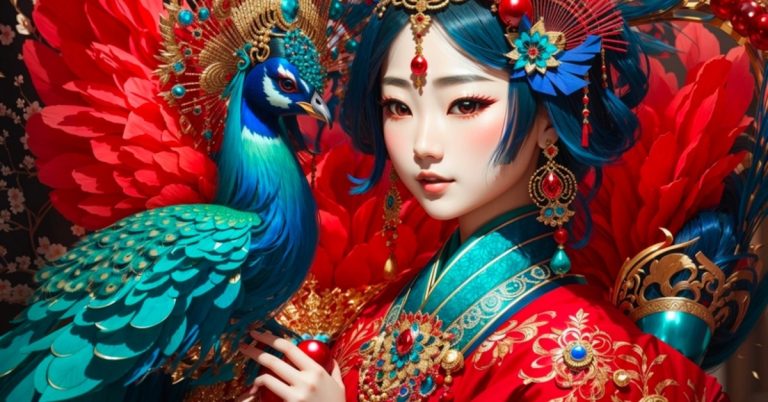
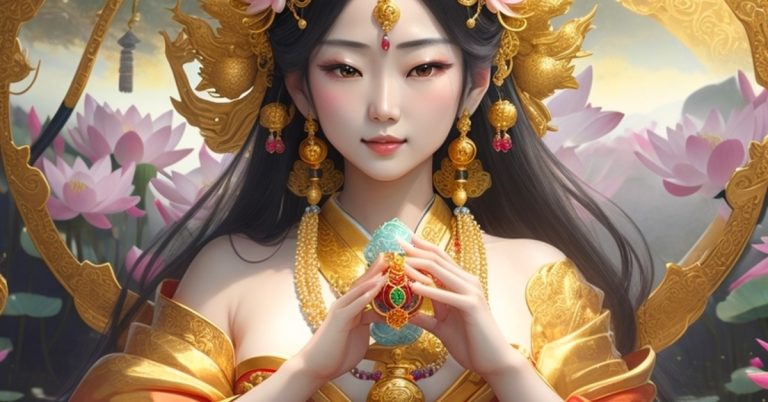
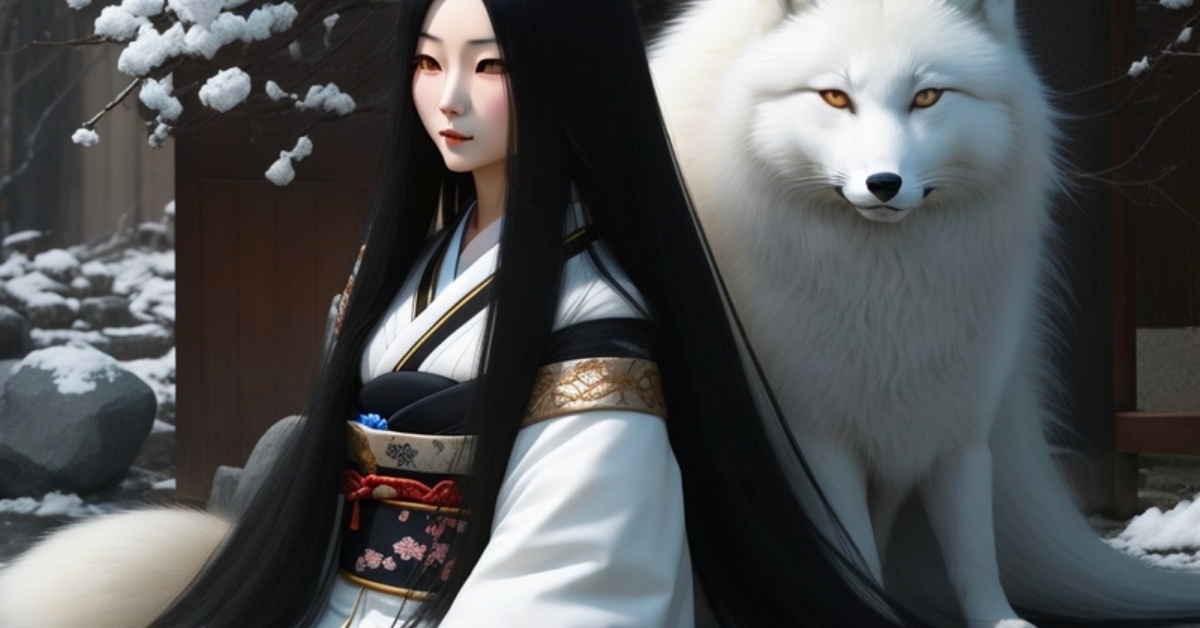
- A young woman, the rice or food goddess, carrying sheaves of rice or a bowl of grain, often standing or riding on a white fox
- An old man, white-bearded, with rice sheaves on his back and sometimes a sickle or a staff, the form the monk Kūkai is said to have met on the road
- An androgynous bodhisattva seated on a flying white fox and holding a wish-granting jewel: the Buddhist Dakiniten, whom medieval Japan folded into Inari
- In every form, attended by white foxes and framed in vermilion, the color of Inari’s gates and shrine buildings
Abilities
- Rice and the harvest — the foundational power, a good crop or a failed one
- Prosperity and business success — from the Edo period onward, the deity merchants pray to when they open a shop
- Fertility — of fields, families, and enterprises
- Craft and industry — patron of swordsmiths, blacksmiths, brewers, and tea growers, along with actors, fishermen, and the courtesans of the old pleasure quarters
- Protection and healing — guarding against fire, and credited in folk practice with curing coughs, toothaches, broken bones, and syphilis
Symbols
- The fox — white foxes, Inari’s messengers, in pairs at every shrine gate
- The vermilion torii — donated by the thousand, each one a wish or a thank-you
- The jewel — the wish-granting hōju, held in a fox’s mouth or under its paw
- The key — to the rice granary, the other object the foxes carry
- The sheaf of rice — the deity’s oldest attribute
- Fried tofu — aburaage, the foxes’ favorite food, offered as inarizushi
Traits
- Generous and close to ordinary people; priests at one temple call Inari “the closest deity to humans”
- Adaptable, following worshipers from the rice paddy into the city and the corporation
- Personal: each devotee prays to their own Inari, sometimes under a private name
- Exacting about respect for rice, as the archer who used a rice cake for target practice found out
- Protective, with a sharp edge in folklore: a neglected shrine or a mistreated fox invites trouble
Festivals and Rituals
Worship of Inari is alive and everyday. People stop at a neighborhood shrine on the way to work, leave rice, sake, or a packet of inarizushi, and tie a red bib on a fox statue. Companies keep small Inari altars on office rooftops. The big calendar events belong to Fushimi Inari-taisha.
Hatsuuma, the first Day of the Horse in February, marks the anniversary of the deity’s enshrinement on the mountain in 711. Worshipers climb the mountain and take home sprigs of cedar, shirushi no sugi, as a token of the visit.
The Inari Matsuri runs from late April into May. The five kami leave the mountain in portable shrines for a resting place in the south of the city near Tōji temple, the same temple Inari has guarded since the ninth century, and return home in early May in a procession through the streets.
Motomiya-sai, in July, is the homecoming. Devotees from branch shrines across Japan return to the “original shrine,” and on the festival’s eve thousands of stone and paper lanterns are lit across the whole mountain, turning the torii tunnels red from the inside.
And all year, the gates keep going up. Donating a torii, from a palm-sized one at a side altar to a full-size gate on the main path, remains the classic way of thanking Inari for a wish granted.
Legends associated with Inari
Inari has no chapter in the Kojiki or the Nihon Shoki, Japan’s eighth-century chronicles of the gods. The stories come instead from local gazetteers, temple records, and folklore, and they circle one theme: a deity who arrives carrying food, and the animals who carry the deity’s word.
The archer and the rice cake
The founding story of Fushimi Inari is recorded in the Yamashiro Fudoki, a regional gazetteer from the eighth century.
Hata no Irogu was a wealthy landowner, and his family had rice to spare, so much of it that one day he set up a mochi, a cake of pounded rice, as a target and shot an arrow at it.
The cake turned into a white bird and flew away.
Irogu followed. The bird landed on a peak of Mount Inari, and where it settled, rice sprang up out of the ground. Irogu understood what he had done. He had treated the staple of life as a plaything, and the kami of rice had answered. He built a shrine on the spot. The traditional date is the first Day of the Horse in the second month of 711.
The story has stayed with the shrine. Fushimi Inari keeps that date as its founding, and the family behind it, the Hata, were among the most powerful clans in the region. That matters for where Inari came from, and we’ll come back to it.
The rider on the white fox
A second story, told in folklore rather than in any chronicle, explains the deity’s arrival in Japan itself.
In the beginning the land was mostly marsh and water, and the people were starving. Inari came down from heaven riding a white fox, carrying sheaves of grain in both arms, and taught the people to plant it. The grain, the story says, was a marsh cereal older than rice, and rice inherited its name, ine.
Whatever the botany, the image stuck: a deity on a white fox, arms full of grain, coming to a hungry country. Nearly every later picture of Inari descends from it.
The old man carrying rice
In 823 the emperor gave the great temple of Tōji in Kyoto to Kūkai, the monk who had brought Shingon Buddhism home from China. The temple called for a guardian.
Tradition says he had already met one. On the road, the story goes, Kūkai encountered an old man carrying rice on his back and recognized the kami of Mount Inari. He invited the old man to protect the new temple, and Inari accepted. Tōji became an Inari temple as much as a Buddhist one, and Inari became a deity of the Shingon school, with everything that followed from that.
That bearded, rice-carrying old man is the male Inari, and this is the story that gave him a face.
Why foxes
Ask why a rice deity keeps foxes and you get several answers, and each of them holds some truth.
Foxes come down from the mountains in spring when the paddies are planted and go back up in autumn after the harvest, the same rhythm as the ta-no-kami, the field kami who descends to watch over the crop and returns to the hills when it’s in. Foxes eat the mice and voles that eat stored rice. A fox’s coat is the color of ripe rice in autumn, and its tail has the shape of a full sheaf.
By the medieval period the fox had become Inari’s tsukai, or messenger, and the white fox, byakko, its highest form. The foxes at a shrine are a specific kind: zenko, “good foxes,” in Inari’s service, and folklore sets them apart from the yako, wild foxes who trick, possess, and lead travelers astray. Both were believed to love fried tofu, which is why the sushi pocket of sweet fried tofu stuffed with rice is called inarizushi, and why a bowl of noodles topped with it is “fox udon.”
The statues at the gate come in pairs, and each holds something in its mouth or under a paw: a wish-granting jewel, a key to the granary, a sheaf of rice, or a scroll. Jewel and key is the most common pairing, and Smyers spent a whole book on what the two of them mean to the people who pray there.
One correction the priests insist on: the fox is the messenger, and Inari is the kami. Popular art has blurred the two for centuries, and a red-bibbed fox statue is now most people’s mental image of the deity. Shrine clergy, Shinto and Buddhist alike, discourage it.
From the paddy to the shop counter
The last of Inari’s transformations happened in plain sight, in the boomtown of Edo.
For most of Japanese history, rice was money. Samurai were paid in it, taxes were assessed in it, and a domain’s size was stated in koku, the amount of rice that feeds one person for a year. When the Tokugawa peace turned Edo into a city of a million people and coin began replacing rice as the measure of wealth, Inari’s portfolio widened to match. The kami of the harvest became the kami of the ledger.
Merchants arriving from Kansai, especially from Ise, brought Inari with them and hung Inari-patterned curtains over their shop doors. Small shrines went up in every district, in back gardens and on the grounds of samurai mansions. A saying from the period lists the three things you met on every block in Edo: “Ise shops, Inari shrines, and dog droppings.”
Fire prevention, money, a good year in trade: all of it now belonged to a deity who had started in a rice paddy. It’s the same move the torii make on the mountain today, where a bank’s name stands beside a noodle shop’s.
An older Inari?
Climb past the Senbon Torii, the famous tunnel of gates, and the tourists thin out. What fills the mountain instead is stranger: tens of thousands of small stone altars called otsuka, each carved with a name for Inari that some person or family chose for themselves. Smyers counted around ten thousand of them and concluded that Inari worship has no fixed orthodoxy, because “there is no central myth, dogma, or scripture that accompanies the symbols.”
That absence is the clue. A deity absent from the national chronicles, worshiped under thousands of private names in three different bodies, looks like several older figures braided together. Scholars have spent a century pulling at the strands.
The first strand is the mountain and the family who owned it. The Hata were immigrants from the Korean peninsula, settled around Kyoto by the fifth or sixth century, and they brought irrigation, silk, and sake brewing with them. Fushimi Inari’s own account says Inari worship began as mountain worship, with Mount Inari as a kannabi, a peak where a kami dwells. The historian Higo Kazuo argued that the Hata were venerating an agricultural kami on that mountain in the late fifth century, two hundred years before the official founding. On this reading, “Inari” started as the local rice kami of a wealthy immigrant clan, and the archer’s story marks the moment a family cult became a public shrine.
The second strand is a set of food goddesses who already existed. The kami named in Fushimi’s main hall is Uka-no-Mitama, “august spirit of food,” a child of Susanoo in the Kojiki and of Izanagi and Izanami in the Nihon Shoki. The old texts never state Uka-no-Mitama’s gender, and tradition has read the deity as female, alongside two close relatives: Toyouke, who was brought to Ise’s Outer Shrine to prepare food for Amaterasu, and Ukemochi, from whose slain body the first grains and silkworms grew. Inari has been identified with each of them at different times, and some shrines enshrine Ukemochi and Uka-no-Mitama side by side under the Inari name. The young rice goddess of the paintings is this layer showing through. So, in a smaller way, is the company Inari keeps at Fushimi, where the five enshrined kami include Sarutahiko, the road-guardian whose wife is the dancer Ame-no-Uzume.
The third strand is the fox, which arrived separately. Nothing in the eighth-century accounts of the Hata shrine mentions foxes. The fox’s ties to Inari appear over the following centuries, as the animal’s seasonal comings and goings were mapped onto the field kami and as Chinese fox lore, with its shapeshifters and possessions, settled into Japanese folklore. The messenger came later than the message.
The fourth strand is Buddhist, and it gave Inari a third body. After Kūkai installed Inari at Tōji, Shingon monks developed a rite to Dakiniten, a goddess descended from the flesh-eating dakinis of Indian tantra, tamed in Buddhist story and reworked in Japan into a deity of worldly success. Because Inari had foxes, and because Dakiniten came to ride one, the two were fused by the twelfth century. Dakiniten on her flying white fox, holding the wish-granting jewel and rice sheaves, carried Inari’s cult into temples and even into the imperial enthronement rites. The androgynous bodhisattva is this layer.
The gender fluidity, then, reads as a record. Some scholars go further and argue that the earliest Inari was female and was recast as male during the centuries of Buddhist-dominated government, when a number of powerful female kami were remade that way; the old man with the rice sheaves would be the result. The evidence is thin and the claim is contested. What can be said with confidence is that all three bodies are old, and all three are still here.
The last turn came in 1868. The Meiji government ordered Shinto and Buddhism separated, and at Fushimi the openly Buddhist buildings were pulled down. Dakiniten went to the temples, most famously Toyokawa Inari, a Zen temple in Aichi where “Inari” is worshiped to this day as Dakiniten on her fox. Ordinary people went on mixing the two anyway. Which is roughly where Inari began: a deity assembled by the people who asked for one, and still being assembled.
Inari across cultures
Inari’s fox has cousins across East Asia. China’s huli jing and Korea’s kumiho are the same animal in the same role, a shapeshifter who can be a beautiful woman, a scholar, or a trickster, and Japan’s kitsune inherited all of it. What Japan added was the promotion. Nowhere else did the fox become the official messenger of one of the most-worshiped deities in the land, with a statue at every gate and a sushi named after it.
The deity’s other half, the Buddhist half, traveled even farther. Dakiniten began in India as a dakini, one of the wild sky-dancers of tantric Buddhism, crossed China, arrived in Japan with Kūkai, and ended up on a fox. She has company. Benzaiten is the Hindu Saraswati under a Japanese name, and Kichijōten is Lakshmi; both arrived by the same Buddhist road, and both became goddesses of luck and money once they got here. Japan has a habit of taking in foreign deities and putting them to work on daily life, and Inari’s absorption of Dakiniten is the biggest example of it.
And the arc from harvest to money has parallels almost everywhere. The Roman Mercury was tied to the grain trade before he stood for commerce in general; Lakshmi’s wealth was once the wealth of good fields. Grain was the first money, so the gods of grain became the first gods of money. Inari made the trip in full view and kept one foot in the paddy the whole way, which is why a bowl of rice still sits on the altar of a company’s rooftop shrine.
Final thoughts
The foxes at the gate have one job, and it’s the same job the gates have: carry a message between a person and the deity.
That is what Inari has always done. A hungry country asked for food and got a deity carrying rice. Farmers asked for the harvest, smiths asked for the forge to hold, shopkeepers asked for customers, and the deity took each request with the sheaf of rice still in hand. Woman, old man, or rider on the white fox, Inari answered in whatever shape the person praying could recognize.
Ten thousand gates say the answers came. What would you thank a deity for, if the thank-you had to be a gate with your name painted down the back?
Bibliography
- Smyers, Karen A. The Fox and the Jewel: Shared and Private Meanings in Contemporary Japanese Inari Worship. University of Hawai’i Press, 1999.
- Cartwright, Mark. “Inari”. World History Encyclopedia.
- Wright, Gregory. “Inari”. Mythopedia.
- “Inari”. New World Encyclopedia.
- “Inari Ōkami”, “Fushimi Inari-taisha”, “Dakiniten”, “Ukanomitama”, and “Kitsune”. Wikipedia.
- Fushimi Inari Taisha. “About Fushimi Inari Taisha”. Official site.
- Dougill, John. “The Fox and the Jewel”. Green Shinto.
- “Motomiya-sai, Fushimi Inari Shrine”. Discover Kyoto.
- Davisson, Zack. “Edo period haiku” (the “Ise shops, Inari shrines, and dog droppings” saying). Bluesky.