Eos: Greek Goddess of the Dawn
A winged woman slips from a mortal’s bed before first light and climbs into her chariot.
Homer opens whole days that way. Dawn rises “from the bed of Tithonus” to bring light to gods and men, and by the time the sun clears the horizon she is already ahead of him, fingers pink, robe the color of saffron. The Greeks saw her more often than any other goddess: once a day, every day, for a few minutes at a time.
Her name is Eos. You have watched her a thousand times. Now you have her name.
Overview of Eos
Eos is the Greek personification of the dawn. She belongs to the older generation of gods, a Titan’s daughter rather than an Olympian, and she is one of the oldest figures in the Greek sky. Her parents are Hyperion, the Titan of the light above, and his sister Theia. Her siblings are Helios, the sun, and Selene, the moon. The three of them divide the day between them, and Eos takes the first shift.
Her job is the daily crossing. She lives in the far east, at the edge of the world-circling river Oceanus. Each morning she harnesses her horses, Lampus and Phaethon (“Shining” and “Blazing”), and drives up out of the sea ahead of her brother. Some poets give her two horses, some four. On the painted vases she often has great white wings and needs no chariot at all. Hesiod puts Night and Day passing each other on the doorstep of a house at the world’s edge, one going out as the other comes in, and Eos, sometimes merged with Hemera, “Day,” is the one who takes the sky from Nyx every morning.
She is everywhere in Greek poetry and almost nowhere in Greek worship. Homer names her more often than most Olympians, because his stories are measured in dawns. Yet the Greeks built her no temple that we know of, and the poets who loved her never gave her a festival. Her ritual was the morning itself.
Titles
- Rhododaktylos (“rosy-fingered”), Homer’s fixed epithet for her
- Erigeneia (“early-born”)
- Krokopeplos (“saffron-robed”)
- Chrysothronos (“golden-throned”)
- Aurora, her Roman name
Characteristics
How Eos tends to be shown in art:
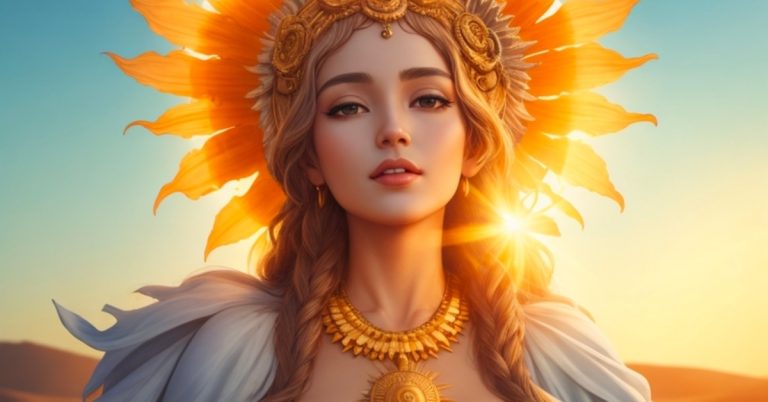
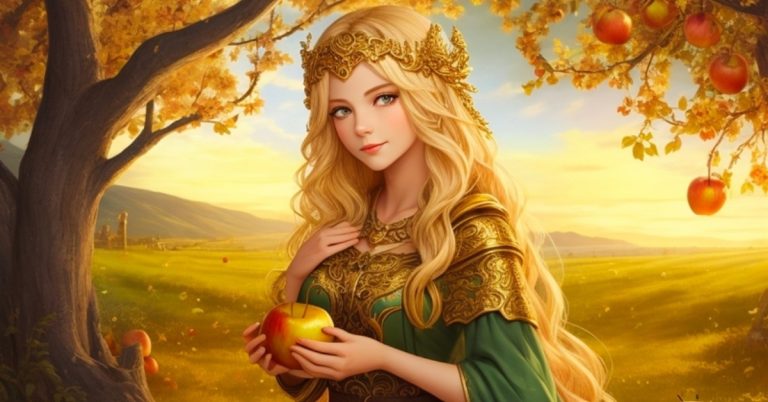
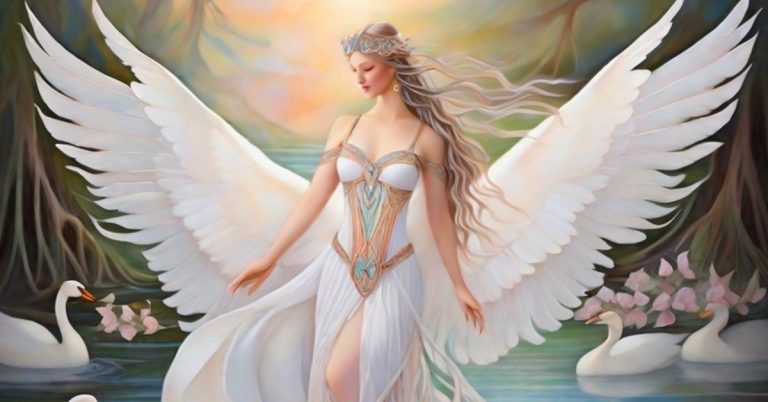
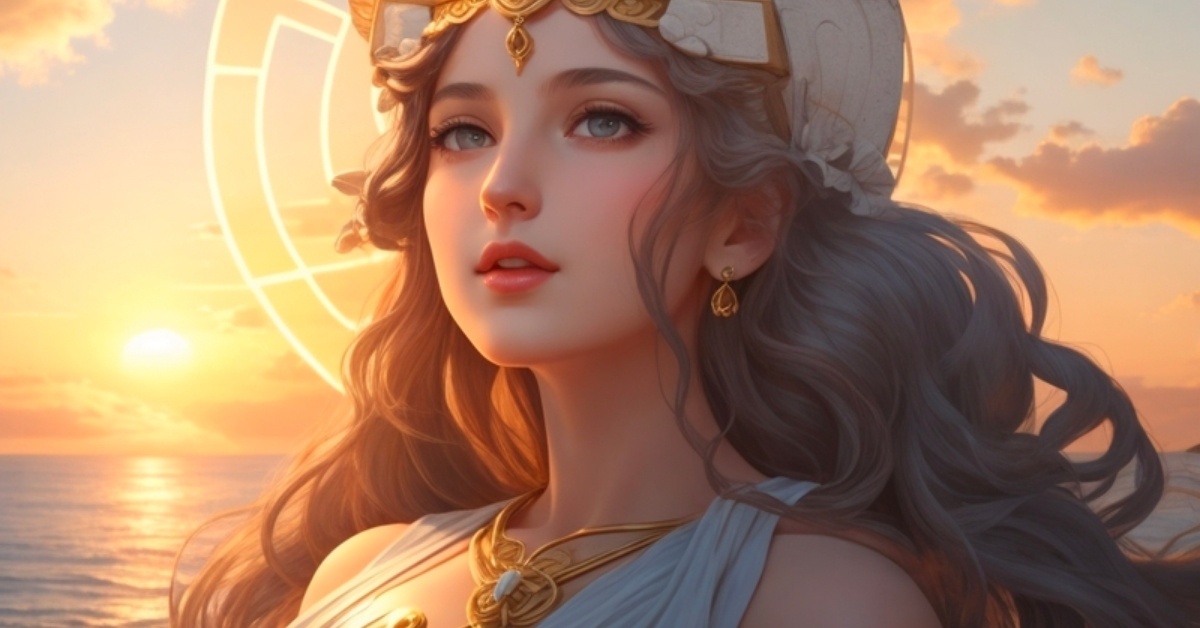
- A young woman, often crowned, with large white wings
- A saffron-yellow robe, “golden-armed” or “rosy-armed” in the poets
- Driving a chariot of two or four horses up out of the sea
- Carrying a pitcher in each hand, pouring out the morning dew
- In flight, with a young man held in her arms
Abilities
- Bringing the day — each dawn is her work, and she has never missed one
- Opening the sky — she runs ahead of Helios and clears the road for him
- Carrying off mortals — she takes her lovers in her arms and flies
- Winning favors from Zeus — immortality for Tithonus, honor for Memnon
- Mothering the winds and stars — the four winds and the morning star are her children
Symbols
- Rosy fingers — the first pink light on the horizon
- The saffron robe — the yellow band above it
- The chariot and white horses — her daily ride
- The morning star — Eosphorus, her son, who runs ahead of her
- Dew — her tears, spilled every morning for a dead son
- The cicada — what became of the lover she kept past his time
Traits
- Tireless, the most reliable of all the gods
- Ruled by desire, and by a different man each season
- Tender in the moment, careless about consequences
- A mother who grieves in public, every morning
Festivals and Rituals
There is almost nothing to report, which is itself the interesting fact. No temple, no priesthood, and no festival day survive for Eos anywhere in Greece.
The one firm trace is at Athens, where she received nephalia, offerings without wine, alongside other sky powers. A fragment of the Spartan poet Alcman has a chorus of girls singing at daybreak to a goddess called Aotis or Orthria, “She of the Dawn,” and some scholars read that as a genuine dawn cult; others read it as a nickname for Artemis or Helen. Rome, which inherited her as Aurora, moved actual dawn worship onto a different goddess, Mater Matuta, whose Matralia festival fell on June 11.
In practice, Eos was worshiped the way the sun is worshiped by anyone who gets up early. Greeks prayed at sunrise, poets counted their time by her, and that was enough.
Legends associated with Eos
Nearly every story about Eos is a love story, and nearly every one ends badly for the mortal. The pattern was so steady that the Greeks gave it a cause.
The curse of Aphrodite
Eos once shared a bed with Ares, the god of war. Ares was Aphrodite’s lover, and Aphrodite found out.
Her revenge was precise. According to Apollodorus, she made Eos “perpetually in love,” and with mortal men above all. From then on the dawn goddess would look down each morning at the waking world, see a beautiful young man, and take him.
The Greeks understood what that meant for the men. In the Odyssey, the nymph Calypso, ordered to give up Odysseus, complains to Hermes that the gods begrudge every goddess her mortal lover, and the first example she reaches for is Eos. Dawn chose Orion, Calypso says, and the gods resented it until Artemis killed him. Being loved by Eos was a gift with a short shelf life.
Tithonus and the gift that went wrong
The great Eos story is the one about the man she tried to keep.
Tithonus was a prince of Troy, a son of King Laomedon and an elder brother of Priam. He was beautiful, and that was enough. Eos swept him up and carried him to her house at the edge of the world, and for once she wanted more than a season. She went to Zeus and asked that Tithonus be made deathless, to live with her forever. Zeus bowed his head and granted it.
The Homeric Hymn to Aphrodite tells what she left out. “Too simple was queenly Eos,” the poet says. She asked for endless life and forgot to ask for endless youth.
For a while it went well. Then the first gray hairs came in at his temples and his chin, and Eos stopped coming to his bed. She still cherished him, the hymn says, and kept him in her house, fed him ambrosia, and dressed him in fine clothes. But the years kept coming, and there was no end to them. When Tithonus could no longer move his limbs at all, she laid him in a chamber and shut the shining doors. Inside, his voice “flows on endlessly,” and nothing else is left of him.
Later Greeks finished the story for her. The thing behind the doors shrank and dried until it was a cicada, the insect that is all voice and no body, that sings at the first light and never stops. That is why, they said, the cicadas are loudest at dawn. Some writers shifted the blame to Tithonus, who had asked for the wrong thing himself. The Roman poet Propertius took the other side and wrote that Aurora never left him, that she held his withered body and hated the gods for what it had become.
The story stayed alive because it hurt. Sappho, writing on Lesbos around 600 BC, used Tithonus as the image of her own aging in a poem that turned up on a scrap of papyrus in 2004. And Homer still has Eos rise “from the bed of Tithonus” every morning, long after he has stopped being anyone’s idea of a lover. She goes back.
Cephalus and the marriage she broke
One man fought being chosen.
Cephalus was an Athenian prince, a hunter, and a bridegroom of two months when Eos took him. Ovid tells this one in Roman dress, with the goddess as Aurora. Cephalus refused her. He talked about his wife, Procris, so much that Aurora lost her temper and let him go, with a parting shot: keep your Procris, and you will wish you had not.
The curse worked the way curses do, through his own head. Aurora had planted a doubt, and Cephalus went home in disguise to test his wife’s faithfulness. Procris held out for a long time, then wavered for a moment, and he threw off the disguise in triumph. She fled in shame to the hills and the company of Artemis, and came back later with two gifts: Laelaps, a hound that never lost its prey, and a javelin that never missed.
The marriage healed, and for years they were happy. Then a servant overheard Cephalus, resting from the hunt, calling out to “Aura,” the breeze, to come and cool him. The name sounded like a woman’s. Procris crept into the bushes to see for herself. Cephalus heard the rustle, thought it was game, and threw the javelin that never missed.
Hesiod, centuries before Ovid, adds one small note from the other side of the affair: Eos and Cephalus had a son, Phaethon, a boy so lovely that Aphrodite carried him off in turn to keep her temple.
Orion, Cleitus, and the price of being chosen
Orion the hunter was the greatest of Eos’s catches, and the shortest-lived.
Apollodorus says she loved him, carried him off, and brought him to the island of Delos. What happened next depends on the teller, and the tellers rarely agree about Orion. In Homer’s version, spoken by Calypso, the gods could not bear to see a goddess keep a mortal, so Artemis found him on Ortygia and shot him with her painless arrows. Other versions give Artemis her own reasons. Either way, Eos lost him, and the hunter went up into the sky as the constellation that still rises before dawn in the late summer.
Cleitus gets one line in the Odyssey, and it may be the only Eos love story with a happy ending. He was a grandson of the seer Melampus, and “golden-throned Dawn snatched him away for his beauty, so that he might live among the immortals.” No forgotten clause, no jealous god. Homer moves on. It is tempting to think the story ended well because nobody bothered to tell the rest of it.
Memnon and the morning dew
Eos bore Tithonus a son, and that son is the reason the ground is wet in the morning.
Memnon grew up to be king of the Aethiopians, the people the Greeks placed at the far edge of the world where the sun comes up. In the last year of the Trojan War, after Hector had fallen, Memnon marched to the defense of his father’s city with a great army, wearing armor that Hephaestus had made for him at his mother’s request. He was magnificent. He cut through the Greek line and killed Antilochus, the young son of Nestor and one of Achilles’s closest friends.
That brought Achilles. The two sons of goddesses, one born of the sea nymph Thetis and one of the dawn, met in single combat while Zeus set their fates on golden scales and watched to see which pan sank. Memnon’s did. Achilles killed him.
Eos went to Zeus. The lost epic Aethiopis, which told the whole episode, gave her a consolation: Zeus granted Memnon immortality, and she carried his body home. Ovid adds the rest. From the smoke of Memnon’s pyre rose a flock of birds, the Memnonides, that split into two armies and fought each other to the death over the ashes, and returned to fight again over his tomb every year on the anniversary.
Then the last lines. Aurora, Ovid says, is still grieving. Every morning she weeps for her son, and her tears fall on the whole world as dew.
Later Greeks and Romans found Memnon in Egypt. At Thebes stood two colossal statues of the pharaoh Amenhotep III, and after an earthquake cracked one of them, it began to make a sound at sunrise, a note like a snapped string, as the stone warmed. Travelers decided it was Memnon greeting his mother. Pausanias records it, and the emperor Hadrian came to hear it in 130 AD. The dawn goddess, who had no temple of her own in Greece, ended up with a singing statue on the Nile.
The mother of the winds
Before the mortal lovers, Eos had a husband of her own kind. Hesiod pairs her with Astraeus, “Starry,” a son of the Titans, and their children are the four winds, Boreas, Zephyrus, Notus, and Eurus, along with Eosphorus, the morning star, and the whole host of the stars.
It is the right family for her. The morning star runs ahead of the dawn, the winds pick up at first light, and the stars are what she puts out each morning.
An older Eos?
Say her name in Athens and you got Heos. In Sparta it was Aos; on Lesbos, Auos. Those dialect forms are the first clue that she is older than Greece.
Linguists trace all of them to a single reconstructed word, *h₂éwsōs, in Proto-Indo-European, the ancestor language spoken somewhere on the Eurasian steppe around five thousand years ago. Its root, *h₂ews-, means “to shine” or “to glow red.” The same word descended into Sanskrit as Ushas, the dawn goddess of the Rigveda; into Latin as Aurora; into Lithuanian as Aušrinė, the morning star; and into Old English as Ēostre, the goddess whose name the English kept for Easter. It also gave English the word “east,” the place where she comes from. Eos is cognate with every one of them. She is one of a handful of Greek gods whose Indo-European pedigree is beyond dispute, alongside Zeus and her brother Helios.
Comparing the cognates, scholars such as M. L. West and J. P. Mallory and D. Q. Adams have sketched what the shared ancestor looked like. She was a daughter of the sky god, *Dyēus, a title the Rigveda still gives Ushas, “Daughter of Heaven.” She was red and gold. She lived in the east, across the water, and came up out of it in a vehicle, probably a wagon before anyone had a chariot. She opened the doors of heaven so the sun could follow. And she could be slow: several traditions remember a dawn who lingers or refuses to come, and is punished for it. Indra smashes Ushas’s cart for exactly that.
Set Eos beside the sketch and the fit is close. She is “rosy-fingered” and “golden-armed”; the Rigveda calls Ushas “golden-handed.” She lives at the edge of Oceanus and drives up out of the sea. The Hymn to Aphrodite gives her house “shining doors.” West even suggests that the “rose” in rosy-fingered is a Greek refinement on an older formula about her hands. What Greece added was the family tree, Hyperion and Theia, and the string of mortal lovers.
All of this is reconstruction from words and formulas, which is what linguists have to work with; the shrine to *h₂éwsōs remains undug. What the words do establish is that Eos was already being praised at first light long before there was a Greek language to praise her in. Her thin cult in Greece may be the mark of a goddess so old that people had stopped building her anything and simply looked up.
Eos across cultures
Because she is a word as much as a goddess, Eos has more cousins than most.
Her closest is Roman Aurora, who is the same word after Latin changed its sounds, and who took over every Eos story wholesale: Tithonus, Cephalus, Memnon, and the dew. Guido Reni’s 1614 fresco of Aurora leading the sun’s chariot across a Roman ceiling is probably the most-copied image of the goddess ever made, and the northern lights, the aurora borealis, still carry her name.
In India, Ushas has around twenty hymns of the Rigveda to herself, more than any other goddess in the text. She drives a chariot of red cows or horses, wakes every living creature, is called the “life of all that breathes,” and is described as ancient and forever young at once. She is Eos with the poetry left in and the love affairs left out. In Lithuania, Aušrinė is the morning star who goes ahead of the sun goddess Saulė each day and readies her way, in a family story that recalls the Greek sun and dawn as siblings.
Beyond the Indo-European world the dawn tends to belong to the sun herself. Japan’s Amaterasu is a sun goddess whose first sunrise, after she hides in a cave, is the founding miracle of the tradition, and it takes a dancing goddess, Ame-no-Uzume, to bring her out. Where Greece split the morning into three siblings and gave the first light a name of its own, most cultures gave the whole day to one figure. Eos is what you get when a people decide the dawn deserves a goddess to itself.
Final thoughts
Every one of Eos’s stories ends with a loss, and every one of her mornings starts anyway.
That is the thing about her. Tithonus withers, Cephalus goes home, Orion goes up into the stars, Memnon dies in front of the walls of Troy, and the next day she is up before all of them, harnessing the horses. The Greeks gave her the saddest résumé in the pantheon and the most dependable job, and the two facts explain each other. The dew is her grief and the light is her work. She does both at once, every single day.
Bibliography
- Atsma, Aaron J. “Eos”. Theoi Greek Mythology.
- Miate, Liana. “Eos”. World History Encyclopedia, 2023.
- Kapach, Avi. “Eos”. Mythopedia.
- Homeric Hymn to Aphrodite, lines 218–238 (Tithonus). Trans. Hugh G. Evelyn-White, via Perseus.
- Homer. Odyssey 5.118–129 (Orion) and 15.248–252 (Cleitus). Trans. A. T. Murray, via Perseus.
- Hesiod. Theogony 371–382, 984–991. Trans. Hugh G. Evelyn-White, via Perseus.
- Apollodorus. Library 1.4.4 (Aphrodite’s curse, Orion). Trans. J. G. Frazer, via Perseus.
- Ovid. Metamorphoses 7.690–862 (Cephalus and Procris) and 13.576–622 (Memnon). Trans. Brookes More, via Perseus.
- West, M. L. Indo-European Poetry and Myth. Oxford University Press, 2007.
- Mallory, J. P., and D. Q. Adams. The Oxford Introduction to Proto-Indo-European and the Proto-Indo-European World. Oxford University Press, 2006.
- “Eos”, “Hausos”, “Tithonus”, and “Memnon (mythology)”. Wikipedia.
- “Ushas”, “Aušrinė”, and “Aurora (mythology)”. Wikipedia.