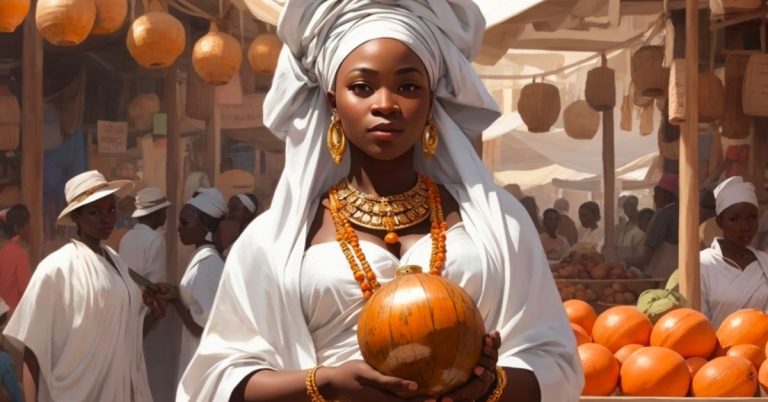
Gaia: The Greek Goddess of the Earth and Mother of All
On the Athenian Acropolis, beside the seventh column on the north side of the Parthenon, four short lines are cut straight into the bedrock. They read, in Greek, “Of Earth the Fruit-Bearer, according to an oracle.” Someone in the second century AD was told by a god to mark that patch of rock as hers, and did. A few steps away, the traveler Pausanias saw a statue of the same goddess with her hands raised, asking Zeus for rain.
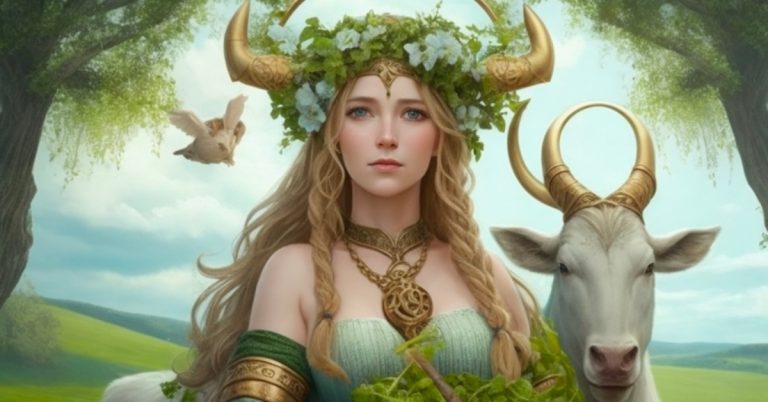
That goddess is Gaia, the Earth. In the oldest Greek account of how the world began, she is the second thing that ever existed, and everything with a body comes out of her: the sky, the mountains, the sea, the Titans, the monsters, and through them the gods of Olympus. An old Greek hymn calls her the eldest of all beings and promises that whoever she favors will have barns full of grain and a house full of good things. She was the beginning of the world and the source of the harvest at once, which makes her a fitting goddess for the season when people gather to eat what the ground has given.
Overview of Gaia
Gaia (pronounced GAY-uh or GUY-uh), also spelled Gaea, and in classical Greek prose usually simply Ge, is the Greek goddess of the earth and the earth itself. Her name is the ordinary Greek word for land and soil, the same ge that survives in geography and geology. When a Greek swore by Ge, the oath was taken on the ground under his feet.
Her story comes mostly from the Theogony, the poem Hesiod composed around 700 BC to explain the birth of the gods. There she appears at the start, right after Chaos, the yawning gap, and she does the first creating in the universe on her own. She bears the sky, Ouranos, “equal to herself,” so that he can cover her on every side, and she bears the long hills and the barren sea. Then, with Ouranos, she becomes the mother of the Titans, the one-eyed Cyclopes, and the three monstrous Hundred-Handers. Every later generation of gods descends from her.
She was a figure of myth first and a goddess of cult second. The Olympians received the great temples and festivals. Gaia had altars, small sanctuaries, a handful of oracles, and a permanent place in oaths and prayers. The Romans identified her with their own earth goddess, Terra, also called Tellus, and the poets borrowed Gaia’s stories for her.
Titles
Her names in Greek poetry and cult describe what she does and how she was approached:
- Ge or Gaia, “Earth”
- Pammetor, “Mother of All,” the title of the Homeric Hymn sung to her
- Kourotrophos, “Nurse of the Young,” her name at a shrine near the Acropolis entrance
- Karpophoros, “Fruit-Bearer,” on the inscription beside the Parthenon
- Eurysternos, “Broad-Breasted,” her name at an Achaean sanctuary, echoing Hesiod’s “broad-breasted Earth”
- Olympia, her title at a precinct in Athens beside the temple of Olympian Zeus
- Pandora, “All-Giving,” an epithet of the earth in Athenian ritual commentary
Characteristics
How the poets and painters show her:
- The oldest of the gods, older than the sky
- A mother who creates alone and also with a partner
- A strategist, who plans the overthrow of two kings of heaven and advises a third
- A prophet, whose voice is said to have spoken at Delphi before Apollo’s
- A protector of her own children, including the monstrous ones
- In vase painting, a woman rising waist-high out of the ground, her lower body still part of the earth
Symbols
- The ground itself: plowed field, rock, and cave
- Fruits and grain: the yield of the Fruit-Bearer
- The flint sickle: the weapon she made for Kronos
- The serpent: Python, guardian of her oracle, called her child in later sources
- The open hand raised from the soil: her pose when she hands over the infant Erichthonios
Legends associated with Gaia
Gaia’s legends almost all turn on the same moment: a father in power, a child in danger, and the earth deciding which side to take. Hesiod tells three of these crises in a row, and later writers added a fourth and a fifth.
The sky who buried his children
Ouranos, the sky, lay over Gaia every night. Ouranos hated their children from the first. As each one arrived he pushed it back down into a hiding place deep inside the earth, kept it from the light, and took pleasure in doing it. Hesiod says that vast Earth groaned, pressed tight within.
So she made a plan. She created gray adamant, the hardest substance there is, shaped it into a great sickle, and called her children together. She asked which of them would punish their father’s outrage. All of them were afraid except the youngest, Kronos, who took the blade. Gaia hid him in ambush. When Ouranos came at nightfall and stretched himself over the earth, Kronos reached out with his left hand and cut off his father’s genitals with the sickle, and threw them behind him.
Nothing of the sky was wasted. Earth received the drops of blood, and in time she bore from them the Erinyes, the avenging Furies, the armored Giants, and the ash-tree nymphs. The severed flesh fell into the sea and drifted, and from the white foam around it rose Aphrodite.
The stone in the swaddling clothes
Kronos ruled next, and Gaia and Ouranos told him a prophecy: a son of his own would overthrow him. He swallowed each of his children by the Titan Rhea as soon as it was born. When Rhea was about to give birth to her last child, she went to her parents and asked for a plan. They sent her to Lyktos in Crete, and there, Hesiod says, vast Earth received the newborn Zeus to nurse and raise, and hid him in a cave on a wooded mountain.
To Kronos they gave a great stone wrapped in swaddling clothes, and he swallowed it without looking. Years later, Hesiod adds, Kronos was tricked by Gaia’s cunning advice into vomiting up the stone and all the children he had eaten. The stone was set up at Delphi, where visitors were still shown it in Pausanias’s day.
Later writers filled in the nursery. Apollodorus, in his mythological handbook of the first or second century AD, puts the baby in a cave on Mount Dikte in the care of the Kouretes and two nymphs, with the goat Amaltheia giving him milk. Those details belong to later tradition. In Hesiod it is Earth herself who takes the child.
Earth’s counsel in the war of the Titans
When Zeus and his siblings fought the Titans for ten years without result, it was Gaia again who told them how to win. The Hundred-Handers had been locked away since Ouranos’s time. Gaia told the Olympians to bring them up into the light, and with their help Zeus broke the Titans and sent them down to Tartarus. Hesiod says that the gods took the throne “by the counsels of Earth,” and that it was on Earth’s advice, together with Ouranos’s, that Zeus swallowed his first wife, Metis, so that no son of hers would ever take his place.
The mother of Typhon
Gaia’s support for the new king had limits. After the Titans were driven from heaven, Hesiod says, she lay with Tartarus and bore her youngest child, Typhoeus, a monster with a hundred serpent heads, whose voices sounded at one moment like a bull, a lion, or a pack of dogs. He would have ruled gods and men, the poet says, and only Zeus’s quick eye stopped him. The fight shook the earth, the sea, and the underworld. Zeus burned the monster with thunderbolts and hurled him into Tartarus.
Apollodorus tells a fuller version and adds the Giants. In his account Gaia was angry over the fate of the Titans and sent her Giant sons against the gods. Learning that the Giants could be killed only with the help of a mortal, she searched for a herb that would make them safe even from that. Zeus forbade Dawn, the Moon, and the Sun to shine, so that no one could find it, and cut the plant himself. Here Eos and Selene appear in Gaia’s story as lights that Zeus switched off to keep the earth from protecting her children.
The child given to Athena
Some of Gaia’s stories end in a gift. When the smith god Hephaistos pursued Athena and his seed fell on the ground, Earth conceived. The child she bore was Erichthonios, an early king of Athens. In Athenian vase paintings of the scene, Gaia rises halfway out of the soil and lifts the baby up to Athena, who reaches down to take him. Athens claimed to be a city of people born from its own earth, and this image was its founding picture: the earth as the mother of the first Athenian, handing him to the goddess who would raise him.
Who held Delphi first?
The most famous oracle in the Greek world belonged to Apollo. Several ancient writers insist that it belonged to Earth before him, and they disagree about how it changed hands. Here they are side by side.
In Aeschylus’s Eumenides, first staged in 458 BC, the priestess of Apollo opens the play with a prayer that lists the oracle’s owners in order. First Earth, the first prophet. Then her daughter Themis. Then the Titan Phoebe, who gave the shrine to Phoebus Apollo as a birthday gift. In this telling the oracle passed from mother to daughter to grandson by consent, and no one was wronged.
Euripides, half a century later, tells it with a fight. In a choral song of his Iphigenia among the Taurians, the infant Apollo kills the serpent, Earth’s offspring, that guarded the oracle and takes the seat by force. Earth answers by sending dreams at night that tell mortals the truth without any god’s help, so that the priests at Delphi lose their trade. Apollo runs to Olympus and complains, and Zeus, amused, stops the dreams.
Pausanias, writing in the second century AD, records a third version. He says that in the earliest times the oracle belonged to Earth, who appointed a mountain nymph named Daphnis to be her prophetess. He also quotes a poem attributed to Musaeus, the Eumolpia, in which Earth and the sea god Poseidon held the oracle together: Earth spoke her own oracles, and Poseidon used a mouthpiece named Pyrkon. Earth gave her share to Themis, and Themis gave it to Apollo.
Each of the three keeps Earth as the first voice at Delphi. They differ on whether Apollo received the shrine as a gift or took it, and readers have drawn different lessons from that difference for centuries. One reading sees the violent version as the older memory of a cult displaced. Another sees Aeschylus’s peaceful succession as a deliberate correction by a poet who wanted the gods reconciled, which is the subject of the whole play. A third treats all three as later stories told to explain an old altar to Ge that stood in the sanctuary.
Older and other tellings of the beginning
Hesiod’s order of creation, Chaos and then Earth, became the standard one, and other Greek poets and thinkers told the beginning differently.
In the Iliad, Hera twice calls Ocean “the origin of the gods” and Tethys their mother, and Ocean is called the source from which everything comes. That line points to a cosmogony in which water stands at the start, and ancient readers noticed the disagreement with Hesiod.
The theogonies circulated under the name of Orpheus begin earlier still. In the versions known from the Derveni papyrus and from later Neoplatonist quotations, Night is the first great power, and in the long poem called the Rhapsodies a shining god, Phanes, hatches from a cosmic egg. Ouranos and Gaia appear later, as children of Night, and rule only after her.
The most striking variant comes from Pherecydes of Syros, a prose writer of the sixth century BC. In the surviving fragments, three powers always existed: Zas, Chronos, and a goddess called Chthonie, “she of the underground.” Chthonie received the name Ge when Zas married her and gave her the earth as a wedding gift. At the wedding he presented her with a great robe, embroidered with the land and the ocean. In this telling, the earth’s surface is a garment, and Gaia’s name is something the goddess under the ground was given.
Gaia in Greek worship
The great festivals went to the Olympians. Gaia’s worship was scattered and local. Its traces survive in oaths, small sanctuaries, and the notes of travelers.
Oaths sworn on the ground
The oldest and most constant form of her worship was the oath. In the Iliad, when the Greeks and Trojans swear a truce, the sacrificed lambs are offered to Earth, the Sun, and Zeus, and Agamemnon calls on Zeus, Earth, the Sun, and the Furies “who punish men beneath the earth.” The Athenian lawmaker Solon, defending his reforms in a poem around 590 BC, named Earth as his witness: “the great mother of the Olympian gods, black Earth,” from whose fields he had pulled up the boundary stones that marked debt, so that the land that had been enslaved was free.
Shrines and oracles
Pausanias’s guide to Greece records her cult in many places:
- Athens, a shrine of Ge Kourotrophos, Nurse of the Young, beside one to Demeter Chloe, “Demeter of the green shoots,” near the entrance to the Acropolis
- Athens, a precinct of Ge Olympia beside the temple of Olympian Zeus, where a cleft in the ground a cubit wide was said to be the place the waters of the great flood drained away, and where cakes of wheat and honey were thrown in every year
- The Acropolis, the statue of Earth praying to Zeus for rain, near the rock inscription to the Fruit-Bearer
- Olympia, an altar of Ge at the place called the Gaion, where Pausanias was told there had once been an oracle of Earth
- Aigai in Achaea, a sanctuary of Ge Eurysternos with one of the oldest wooden statues in Greece, whose priestess had to be chaste and was tested before taking office by drinking bull’s blood
The Achaean ritual says something about how seriously the earth was taken. A woman who lied about her qualifications, the local belief held, would be destroyed by the blood at once. The goddess who receives oaths demanded the truth from her own priestess first.
The earth goddess across cultures
Many peoples personify the earth, and they do it in different ways. Rome’s Tellus is Gaia’s closest relative, a goddess of the plowed field and the grave who, as her own post shows, had rites and almost no myths, the opposite of Gaia’s balance. In Phrygia and later in Rome, Cybele, the Mountain Mother, was identified with Rhea and honored as Mother of the Gods, and Greek writers sometimes merged her with Gaia as well.
Egypt reverses the pairing. There the earth is a god, Geb, and the sky is a goddess, Nut, arched over him with her hands and feet touching the horizon. The Vedic hymns of India pair Dyaus the sky father with Prithvi the earth mother, and in the funeral hymn of the Rigveda the earth is asked to cover the dead as a mother covers her child with the hem of her robe. Many Andean communities still make offerings to Pachamama before planting.
In 1905 the German scholar Albrecht Dieterich argued that all of these grew from a single primeval cult of Mother Earth, and the idea became popular. Later scholarship has been more cautious, pointing out how differently each culture describes its earth power and how often the earth is male, as in Egypt. Both views have defenders, and the comparison remains a live question.
Gaia in the modern world
Her name returned to wide use in the twentieth century through science. In the 1960s and 1970s the British scientist James Lovelock, working with the American microbiologist Lynn Margulis, proposed that living organisms and their inorganic surroundings form a single self-regulating system that keeps the planet habitable. His neighbor, the novelist William Golding, suggested the name: the Gaia hypothesis. Scientists still debate how far the idea holds, and the name stuck.
The same decades saw Gaia adopted by environmental movements and by modern earth-centered spirituality, where she often stands for the whole living planet. That modern Gaia, a kind and nurturing mother, is a new reading of an old figure. The Gaia of Hesiod is a mother too, and also a planner of coups and the mother of Typhon. Both images have their readers.
Final thoughts
The four lines on the Acropolis rock are a good place to end, because they hold most of what the Greeks believed about her. Someone consulted an oracle, perhaps in a dry year, and was told to give a piece of ground back to the ground’s own goddess. Earth the Fruit-Bearer, the oldest of the gods, mother of the sky and grandmother of Zeus, received a few square feet next to the most famous temple in the world, and a statue nearby showed her asking for rain.
The hymn to her promises abundance to anyone she honors: fields heavy with grain, pastures full of cattle, a house full of good things. It also calls her the mother of the gods and the wife of the starry sky, and the myths explain what that meant: she made the weapon that ended the first reign in heaven and gave the advice that secured the third. When you sit down at a full table this season, which Gaia comes to mind, the giver of the harvest or the oldest power in the world?
Bibliography
- Hesiod. Theogony. Trans. Hugh G. Evelyn-White. Loeb Classical Library, 1914. Lines 116-210 (Earth after Chaos, Ouranos, the sickle, the Furies, Giants, and Aphrodite); 453-506 (Zeus hidden in Crete, the stone); 617-735 (the Hundred-Handers); 820-880 (Typhoeus); 881-900 (the counsels of Earth, Metis).
- Homeric Hymn 30, To Earth the Mother of All. Trans. Hugh G. Evelyn-White. Loeb Classical Library, 1914. Eldest of all beings; the abundance promised to those she favors.
- Homer. Iliad 3.103-104, 3.276-279, 14.201, 14.246, 19.258-260. Earth in oaths; Ocean as origin of the gods.
- Aeschylus. Eumenides 1-8. The Pythia’s prologue: Earth, Themis, Phoebe, Apollo.
- Euripides. Iphigenia among the Taurians 1234-1283. Apollo kills Earth’s serpent; Earth’s dream-oracles; Zeus stops them.
- Apollodorus. The Library 1.1.1-1.2.1, 1.6.1-3, 3.14.6. Trans. James G. Frazer. Loeb Classical Library, 1921. The nursing of Zeus by the Kouretes, nymphs, and Amaltheia; Gaia’s search for the herb that would protect the Giants; Typhon; Erichthonios.
- Pausanias. Description of Greece 1.18.7, 1.22.3, 1.24.3, 5.14.10, 7.25.13, 10.5.5-6, 10.24.6. Trans. W. H. S. Jones. Loeb Classical Library, 1918. Ge Olympia and the flood chasm; Ge Kourotrophos; the statue praying for rain; the Gaion at Olympia; Ge Eurysternos and the bull’s-blood test; Earth, Daphnis, Poseidon, and Themis at Delphi; the stone Kronos swallowed.
- Solon, fragment 36 (West), quoted in Aristotle, Constitution of the Athenians 12.4. Black Earth, great mother of the Olympian gods, as witness.
- Pherecydes of Syros, fragments 7 B1-B2 (Diels-Kranz); see Hermann S. Schibli, Pherekydes of Syros (Oxford: Clarendon Press, 1990). Zas, Chronos, and Chthonie; the earth as a wedding gift and the embroidered robe.
- West, M. L. The Orphic Poems. Oxford: Clarendon Press, 1983. Night as first power; Ouranos and Gaia in the Orphic theogonies.
- Wallensten, Jenny. “Karpophoroi deities and the Attic cult of Ge. Notes on IG II² 4758.” Opuscula: Annual of the Swedish Institutes at Athens and Rome 7 (2014): 193-203. The rock-cut inscription to Ge Karpophoros by the Parthenon and the Attic cult of Ge.
- Dieterich, Albrecht. Mutter Erde: Ein Versuch über Volksreligion. Leipzig: Teubner, 1905. The thesis of a universal Mother Earth cult.
- Lovelock, James. Gaia: A New Look at Life on Earth. Oxford: Oxford University Press, 1979. The Gaia hypothesis.
- “Gaia”. Theoi Project. Collected ancient sources on Gaia’s myths and cult.
- “Gaia”. Wikipedia. Overview, etymology, and iconography, including the Erichthonios vase scenes.