Aje: Yoruba Orisha of Wealth and the Marketplace
The money came out of the sea. For centuries, a trader in a Yoruba market counted her price in small white shells, strung by the forty and the hundred, every one of them fished from an ocean thousands of miles away.
The Yoruba have a name for what those shells carry. It’s the same word for money itself, and it belongs to an orisha who rises from the deep and walks the market stalls, staying with the people who treat her well and leaving the rest.
Overview of Aje
Aje (Ajé, and in the Caribbean Aje Saluga or Aje Shaluga) is the Yoruba orisha of wealth, profit, and trade. Her name is the ordinary Yoruba word for money and riches, so to ask for ajé is to ask for her. She belongs to the Yoruba people of southwestern Nigeria and Benin, and she traveled with them across the Atlantic into the Ifá and Lucumí traditions of Cuba, Brazil, and the wider diaspora, where she is still called on today.
Her territory is precise. She rules wealth as it moves: the coin changing hands, the sale that closes, the increase that comes to a shop or a farm. Her home ground is the marketplace, and her sign is the cowrie shell, which was West Africa’s currency for the better part of four hundred years. She is a child of the sea, and her riches come up from it the way the shells did.
She is also a wanderer. In story after story Aje arrives, blesses, and moves on, and the whole discipline of her worship is about learning how to make her stay.
Her great public festival is Odun Aje in Ondo city, led each year by the town’s women chiefs.
Titles
- Aje Olokun (“Aje of Olokun,” marking her as the sea deity’s child)
- Aje Saluga / Aje Shaluga (the diaspora name, in Cuba and Brazil)
- Orisha of wealth and trade
- Treasurer of the orisha (a Lucumí praise title)
- Goddess of wealth and fertility (how Ondo names her at festival time)
Characteristics
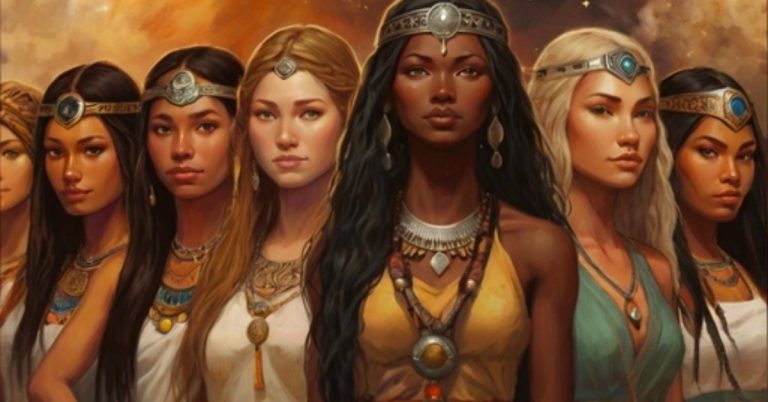
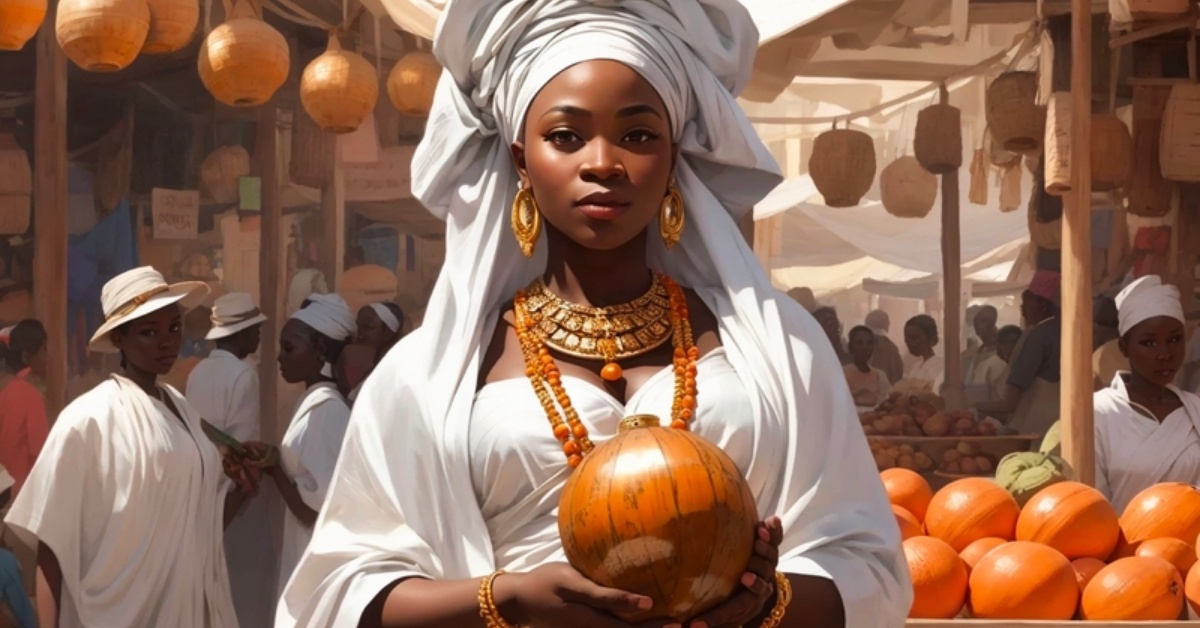
The old tradition describes Aje by her emblems rather than her face, so devotees and artists have settled on a look for her:
- Draped in white, the color of the sea deities, or in the yellow and gold of plenty
- Wearing cowries on her wrists, her neck, and her hem
- Carrying a calabash or a lidded vessel filled with shells and treasure
- Attended by birds, especially the parrot, whose red tail feathers are her emblem
- In Nigeria she is a woman and a daughter; in some Cuban houses Aje Shaluga is a man
Abilities
- Increase — she multiplies what is put in front of her: the stall, the harvest, the purse
- The blessing of trade — she makes a sale go through and a business take root
- Reversal of fortune — her praise song says she makes a servant a king and a wise man a fool
- Withdrawal — her most feared power; she leaves, and the money leaves with her
- Return — brought back by patience, sacrifice, and fair dealing
Symbols
- The cowrie shell — money itself, and her body in the world
- The tiger cowrie — the large spotted shell; finding one unexpectedly is read as her favor
- The calabash of riches — the vessel that holds what she gives
- The parrot — its red tail feathers appear on her shrines and in her praise
- The akoko leaf — the leaf of chieftaincy and coronation, named in her oriki
- The market — the place itself is her shrine
Traits
- Generous, and quick to bless anyone who receives her with respect
- Restless, refusing to be rushed or grabbed at
- Offended by greed, sharp dealing, and showing off
- Faithful to those who keep faith with her
- Ambivalent in the old sense of the word: she gives and takes back, and both are her nature
Festivals and Rituals
Aje’s public feast is Odun Aje in Ondo city, in Nigeria’s Ondo State. The women chiefs of the town, the Opojis, lead it, and the whole community turns out to honor the orisha of wealth and fertility. It falls on the eve of Odun Moko, a November festival kept by the Udoko people of Ondo, during which women withdraw from public view. Aje’s night, in other words, is the women’s night before the town’s men-only festival begins.
Offerings are simple and sweet: beans, ripe bananas and plantains, honey, pounded yam, and cool water or palm wine. Devotees in the Ifá tradition keep a shrine vessel for her, often a lidded pot dressed in cowries, and Monday is her day of veneration in many houses. Traders invoke her before opening the stall, and any marketplace with a shrine to Esu at its entrance is understood to be under her care as well.
The rule that runs through all of it is that Aje asks to be given something she can bless. An offering is seed money.
Legends associated with Aje
Aje’s stories in English are few, and most of them come down through Ifá verse and the diaspora rather than in a neat mythology. What survives circles one idea: wealth is a living thing with a temper, and it goes where it is welcome.
The daughter of the deep
Aje is a child of Olokun, the deity who owns the bottom of the sea and every treasure lying in it. The link is so close that Nigerian devotees often call her simply Aje Olokun.
The logic of the parentage is right there in the shells. Cowries are sea creatures, gathered from the Indian Ocean and hauled to the West African coast in the holds of ships. Money came up out of the water. So the orisha of the deep, whose gender shifts from coast to inland and whose wealth is hidden, has a daughter whose wealth circulates in daylight. Olokun keeps; Aje spends.
Some tellings place her beside Yemoja, the mother of waters, as sister or twin, born together out of the first sea. Devotees who approach Olokun are often told to greet Aje first. Anyone asking the deep for its riches pays respects to the one who carries them ashore.
The orisha who could not be caught
An Ifá story told in Nigeria explains why wealth comes to some people and hides from others.
When Aje first came into the world, every orisha wanted her. They went out looking, and they went out fast, elbowing and racing and grasping. Aje saw the hunger on them and hid. The harder they searched, the more thoroughly she disappeared.
Orunmila, the orisha of wisdom, went to divination first. He was told to make his sacrifice and go slowly, and to bring a goat. So he did. He took his time on the road and arrived at last with the animal Ifá had prescribed. Aje came out of hiding and followed him home.
The verse that carries this story is a warning in both directions: run too fast and you overshoot your fortune; dawdle and you lose it. Wealth, the story says, is a creature with eyes. It can tell the difference between a person who is ready to receive it and a person who is only desperate.
The day she left Orunmila
Even Orunmila lost her, in another Ifá telling.
Aje lived in his house and his house prospered. Then he grew careless with her. He took her for granted, spoke to her roughly, and stopped making her offerings. Aje did what she always does when she is mistreated. She left, without a word, and the wealth of the house walked out behind her.
Orunmila fell into hardship. Only when he consulted Ifá again, made the sacrifices, and changed his behavior did she agree to return. Diviners tell this one to clients who are asking why the money dried up. The answer is usually somewhere in how they treated it when they had it.
The washerwoman by the river
The best-known Aje story in the Americas is a love story, and it belongs to the Lucumí tradition of Cuba, where the orisha of wealth is Aje Shaluga.
Oshun, the orisha of sweet water and beauty, was poor. She owned a single dress, and every day she washed it in the river and wore it wet. Aje Shaluga, watching from the water, fell in love with her. He rose from the depths with his arms full of cowries and gold, laid them at her feet, and set her on the road to the wealth she is known for ever after.
That is why the two are so close that a gift to Oshun is said to please Aje as well, and why Oshun’s own attributes include the shells and the gold. In this telling wealth is a lover who chooses you, and that is a warning too. Lovers can leave.
The praise song
Aje has an oriki, a praise poem, recorded among Yoruba traders in the twentieth century, and it is the frankest portrait of her we have.
It calls her the benevolent provider of every human need and the only master whose call everyone answers. Then it turns. Aje, the poem says, turns the wise man into a fool and makes a fool of the wise. She makes a young man into an elder and a servant into a king. The oriki describes, with clear eyes, what money does to a room when it walks in.
An older Aje?
For roughly four centuries, the money in a Yoruba market was a shell, and the shell was sacred before it was money.
The cowrie in question is Monetaria moneta, a creature of the Indian Ocean, gathered mostly around the Maldive Islands. Arab caravans carried the shells across the Sahara from at least the medieval period, and by the early 1500s Portuguese, Dutch, English, and French ships were hauling them to the West African coast by the ton. Historians Jan Hogendorn and Marion Johnson calculated that between 1500 and 1875 at least thirty billion cowries entered the Bight of Benin, the stretch of coast that includes Yorubaland, where they were strung by the forty and the hundred and used for everything from a handful of peppers to a bride price. British colonial officers accepted them for taxes into the early twentieth century; in village markets they were still changing hands in the 1960s.
But the Yoruba had cowries before they had cowrie money, and they kept using them in ways that had nothing to do with buying. Cowries are sewn onto the beaded crowns of kings, onto the dress of Olokun and Yemoja devotees, and onto the vessels of the orisha. Sixteen of them make the erindinlogun, the divination set that priestesses of Oshun, Yemoja, and other orisha cast on a tray to read a client’s fate. The same object, in the same town, is coin, ornament, and oracle at once. When a trader made her offering to Aje in cowries, she was giving money to the orisha of money in the material the orisha was made of.
There is a second layer under that one, and it lives in the word itself. In Yoruba, àjé is also the term for a person, almost always a woman, who possesses an extraordinary spiritual power, and for the power itself. English writers have translated it as “witch” since the colonial period, and scholars have been objecting since at least the 1950s, when the German-born writer Ulli Beier argued the word misses the point. The Yoruba speak of these women with a title, Àwọn Ìyá Wa, “Our Mothers,” and honor them as Eleye, “owners of the bird,” because their power is imagined as a bird that flies out by night. The literary scholar Teresa N. Washington, who has written two books on the subject, describes àjé as a force at the root of creation, healing, justice, and retribution, feminine in its ownership even when men carry it, and older than any individual orisha. The Gelede festival of the western Yoruba, with its masks and its all-night dancing, exists to thank and appease the Mothers.
Scholars are careful to keep Aje the orisha and àjé the power distinct on paper, and the tradition treats them as different things. But the two share a name, and the overlap runs deep. The Mothers are understood to preside over markets; the head of the market women, the Iyaloja or Iyalode, holds an office that is economic and spiritual in one. Oshun, whose shells and gold come from Aje Shaluga’s hands, is honored in Ifá verse as one of the Mothers herself, the one the male orisha needed before they could finish making the world. Wealth in this worldview is alive. It comes and goes by a feminine will, it punishes the greedy and the boastful, and it asks to be shared. Washington notes that the principles of àjé forbid the display of wealth and require its redistribution, which is close to word for word what the traders’ oriki says about the orisha. Under the goddess of cowries there seems to be a much older idea: that the power to make things increase is a power that belongs to women, and that the marketplace is where it does its work.
Aje across cultures
The Yoruba proverb Ayé l’ọjà, ọ̀run n’ilé says the world is a market and heaven is home. Life is a trading trip. You come, you deal, you go back. Every Yoruba market has a shrine to Esu, the orisha of the crossroads, at its gate, and the market days that structure the calendar are sacred days, when the living and the ancestors are believed to mingle among the stalls. Aje’s territory is holy ground.
Other cultures arrived at the same instinct. Other peoples made money out of the sea too; the Chinese wrote with cowries as well as spending them, and the characters for buy, sell, goods, treasure, and wealth still carry the little pictograph of a shell at their heart. Half a world from the Bight of Benin, the same animal became the same idea.
The nearest kin among goddesses is Lakshmi of the Hindu world, who rose out of the churning ocean of milk with her arms full of gifts, and whose blessing comes to a clean house and a generous hand and departs from a mean one. Fortuna of Rome turned her wheel and made kings of beggars and beggars of kings, exactly as Aje’s oriki describes. And Oshun, Aje’s beloved in the Cuban story, is her closest relative of all, an orisha of sweet water who carries the wealth Aje gave her into every river of the diaspora. The pattern holds across all of them: prosperity is a goddess, the goddess is a guest, and guests can be made to feel welcome or driven away.
Final thoughts
Aje is the orisha you already know if you have ever watched money leave a room.
She arrives on her own terms and stays for the people who receive her with patience, fairness, and an open hand. She hides from the ones who grab. She walks out on the ones who forget her. And she asks for something she can bless, a stall, a plan, a first small offering, because she is the power of increase, and increase needs a seed.
Her shells were currency for four hundred years and they were sacred for far longer. That is the whole of her in one small object: money that came out of the sea and is still an oracle.
If wealth really did choose its own company, whose door would it stop at first, and what would it find waiting there?
Bibliography
- Belasco, Bernard I. The Entrepreneur as Cultural Hero: Preadaptations in Nigerian Economic Development. Praeger, 1980. Oriki reproduced as “Salute to Aje, Orisha of Wealth”. African Poems.
- “Yoruba Mythology: Female Orishas and Their Roles”. The Guardian (Nigeria).
- Akinkuolie, Victor. “Aje Festival in Ondo Kingdom”. Olalekan Oduntan.
- “Ondo State: The Sunshine State”. Yoruba Lessons.
- “Ajé-Shaluga”. Occult World.
- “Olokun”, “Iyami Aje”, and “Shell money”. Wikipedia.
- Hogendorn, Jan, and Marion Johnson. The Shell Money of the Slave Trade. Cambridge University Press, 1986.
- “Cash Cowries”. Michael C. Carlos Museum, Emory University.
- Washington, Teresa N. Our Mothers, Our Powers, Our Texts: Manifestations of Àjé in Africana Literature. Indiana University Press, 2005.
- Washington, Teresa N. The Architects of Existence: Àjé in Yoruba Cosmology, Ontology, and Orature. Oya’s Tornado, 2014.
- Drewal, Henry John, and Margaret Thompson Drewal. Gelede: Art and Female Power among the Yoruba. Indiana University Press, 1983.
- Lawal, Babatunde. The Gelede Spectacle: Art, Gender, and Social Harmony in an African Culture. University of Washington Press, 1996.
- “Spiritualizing Public Places in Historical Perspective: The Case of Jankara Traditional Market in Lagos”. ResearchGate.
- “Iyalode & Iyaloja: Twin Pillars of Precolonial Yoruba Economic Empire”. Oriire.
- “Aje in the Ifá Tradition: Essential Insights for Ifá Beginners”. Asanee 44.