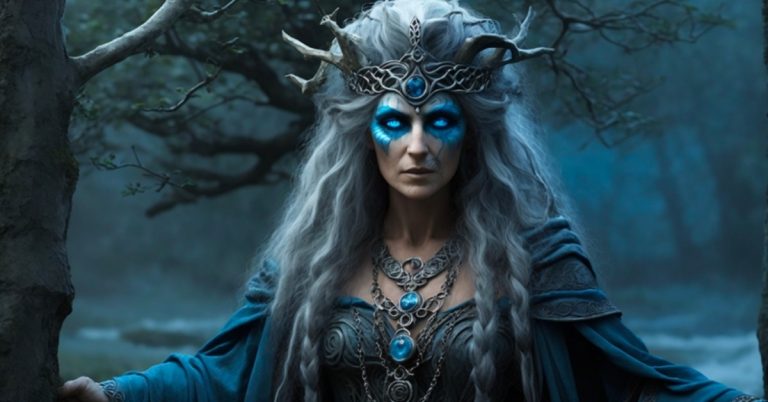
Frigg: The Norse Queen of the Gods, Mother of Baldr, and Keeper of Fate
At a feast in the hall of the sea giant Ægir, Loki stood up and insulted every god and goddess at the table, one after another. When he turned on Frigg, the queen of the gods, another goddess stopped him with a warning. Frigg knows the fate of all things, she said, even though she speaks none of it aloud.
That line, from the Eddic poem Lokasenna, sums up the goddess as the Norse sources remember her. Frigg sat beside Odin on the high seat that looks out over every world. She knew what was coming, and in the most famous story told about her, she spent everything she had against it. Her son Baldr died anyway, and the Norse poets dated the end of the world from that loss. Her story also reaches well beyond Iceland: a tenth-century German healing charm, an Italian historian’s account of a tribe’s origin, and a Danish chronicle that casts her as a vain queen who stripped the gold from her husband’s statue.
Overview of Frigg
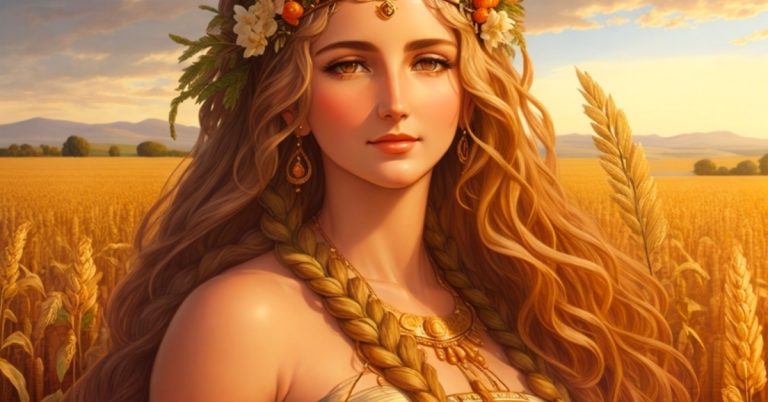
Frigg (pronounced FRIG, rhyming with “big”) is the highest-ranking goddess of the Æsir, the main family of Norse gods. She is Odin’s wife and the mother of Baldr. Snorri Sturluson, the Icelandic scholar who wrote the Prose Edda around 1220, calls her the foremost of the goddesses and names her father as Fjörgynn. She lives in a hall called Fensalir, “Fen Halls” or “Marsh Halls,” and she shares Odin’s seat Hliðskjálf, from which the two of them can look out over every world.
Her name comes from a Proto-Germanic word, Frijjō, related to words for “beloved” and “dear” (Sanskrit priyā is a distant cousin). The same goddess appears in Old High German as Frija, among the Lombards as Frea, and in Old English as Frīg. English speakers still say her name every week: Friday comes from the Old English Frīgedæg, “Frig’s day,” a Germanic rendering of the Roman day of Venus.
The Norse sources give her a clear set of roles. She is a wife and a mother, the head of a household of attendant goddesses, a counselor to Odin, and a figure with knowledge of what is fated. She is also the goddess whose grief opens the road to Ragnarök.
Titles
The poems and Snorri’s handbook give her a range of names and poetic descriptions:
- Queen of the Æsir and the Ásynjur (the gods and goddesses), in Snorri’s Skáldskaparmál
- Lady of Fensalir, after her hall
- Wife of Odin, mother of Baldr, and mother-in-law of Nanna
- Daughter of Fjörgynn, in Lokasenna and Snorri
- Lady of the falcon shape, from Snorri’s list of ways to name her
- Hlín, a name the poem Völuspá seems to use for her, though Snorri counts Hlín as a separate goddess
Characteristics
How the Old Norse sources portray her:
- A seer who knows all fates and keeps that knowledge to herself
- A protective mother who tries to make her son safe from everything in the world
- Odin’s counselor, sometimes his rival, and in one poem the winner of a wager against him
- The head of a household of goddesses who carry her messages and keep her secrets
- A goddess people prayed to for children, in the Völsunga saga
Symbols
- The distaff and spindle: her association with spinning comes from later folk tradition, including a Swedish name for the stars of Orion’s Belt (more on that below)
- Falcon feathers: Snorri mentions a falcon shape that belongs to her, which Loki borrows for flight
- The ashwood box: carried for her by her attendant Fulla
- Mistletoe: the plant she overlooked when she asked the world to spare Baldr
- Fensalir: her hall in the marshes, a name some scholars link to water and wetland offerings
Legends associated with Frigg
Most of what survives about Frigg comes from two Icelandic collections, the Poetic Edda, a set of anonymous poems, and Snorri’s Prose Edda, which retells many of them. The stories show her in four roles: the mother fighting fate, the mourner, Odin’s equal, and the queen under attack.
The oath of all things
Baldr, the son of Odin and Frigg, began to have dreams that threatened his life. When he told the gods, they decided to ask for protection for him from every possible danger. In Snorri’s telling, Frigg went out and took oaths from fire and water, iron and every metal, stones and earth, trees, sicknesses, animals, birds, poisons, and snakes, that none of them would harm Baldr.
The gods turned this into a game. They stood Baldr in the middle of their assembly and threw spears, stones, and axes at him, and nothing left a mark. Loki disliked the sight. He took on the shape of a woman and went to Frigg at Fensalir, and she asked the stranger what the gods were doing. When the woman told her, Frigg said that every weapon and every tree had sworn. Had everything sworn? the visitor asked. A small shoot grew west of Valhalla, Frigg answered, called mistletoe, and it had seemed too young to ask for an oath.
Loki pulled up the mistletoe and brought it to the assembly. Baldr’s brother Höðr, who was blind, stood at the edge of the circle because he had nothing to throw. Loki handed him the mistletoe and guided his aim. The shoot went through Baldr, and he fell dead. Snorri calls it the greatest misfortune ever to strike gods and men.
Frigg wept in Fensalir
The older poem Völuspá, a seeress’s account of the world from creation to its end, compresses the same moment into two lines. Baldr’s death was fated, and “Frigg wept in Fensalir” over the sorrow of Valhalla. The poem later calls Odin’s own death at Ragnarök, when the wolf Fenrir swallows him, the second grief of Hlín, the name it seems to use for Frigg there.
In Snorri’s account she turned grief into action. Frigg asked which of the gods would earn her love and favor by riding to the underworld to offer Hel a ransom for Baldr. Hermóðr, Odin’s son, took the eight-legged horse Sleipnir and rode for nine nights. Hel agreed to release Baldr if every thing in the world wept for him. Baldr sent back Odin’s ring, and his wife Nanna sent Frigg a linen robe and other gifts. The gods asked all creation to weep, and everything did, except one giantess in a cave, who refused. Baldr stayed with Hel.
The wager over two foster sons
The prose introduction to the poem Grímnismál shows Frigg in a different light, as Odin’s sharp-witted equal. Two young princes, Agnarr and Geirröðr, were shipwrecked as boys and spent a winter with an old couple, who were Odin and Frigg in disguise. Frigg fostered Agnarr and Odin fostered Geirröðr. In time Geirröðr pushed his brother’s boat out to sea and became a king, while Agnarr ended up in a cave with a giantess.
Years later, the two gods sat in Hliðskjálf and looked out over the worlds. Odin pointed out that his foster son was a king, while hers was fathering children with a giantess in a cave. Frigg answered that Geirröðr was so stingy with food that he tortured his guests if too many arrived. Odin called that a lie, and they made a wager. Frigg then sent her attendant Fulla to warn the king that a sorcerer was coming, one no dog would attack. The poem’s prose says the charge of stinginess was false, but the warning worked. When Odin arrived in disguise, Geirröðr seized him and set him between two fires for eight nights. Agnarr, the king’s young son named after the lost brother, brought the stranger a horn to drink. Odin then revealed himself, Geirröðr fell on his own sword, and the young Agnarr became king.
Readers have taken the story in more than one direction. Some see Frigg winning by a trick. Others see a goddess who knew how the test would end before she set it.
Counsel before a contest of wisdom
The poem Vafþrúðnismál opens with Odin asking Frigg for advice. He wants to visit Vafþrúðnir, the wisest of the giants, and test him in a contest of knowledge with a life as the stake. Frigg says she would rather keep him at home, because no giant she knows is as mighty. When he insists, she sends him off with a blessing: travel safely, come back safely, and may his wits serve him well. Odin goes, and wins.
Loki at the feast
In Lokasenna, Loki works his way down the table at Ægir’s feast. When Frigg tells him that the gods’ old deeds are best left unspoken, he answers with an insult about her: while Odin was away, she took his brothers Vili and Vé as lovers. The Ynglinga saga, Snorri’s history of the Swedish kings, tells a similar story of Odin’s long absence, when his brothers divided his inheritance and shared Frigg.
Frigg replies that if she had a son like Baldr in the hall, Loki would not leave alive. Loki answers that he is the reason she will never see Baldr ride home again. That is when Freya breaks in to say that Frigg knows all fates and speaks none of them. Snorri quotes the same line in his own description of Frigg, so he took it as a statement about her nature.
Baldr in another telling
The Icelandic version of Baldr’s death is the best known, but the Danish chronicler Saxo Grammaticus tells a strikingly different story. Saxo wrote his Gesta Danorum, the “Deeds of the Danes,” in Latin around 1200, at almost the same time as Snorri, and he presents the old gods as powerful human sorcerers whom people mistook for gods.
Saxo’s Balder
In Saxo’s account, Balder, the son of Odin, and a human prince named Høtherus are rivals for the hand of Nanna, the daughter of King Gewar. Nanna prefers Høtherus. Balder’s body is proof against steel, so Høtherus seeks out a sword that can wound him. The two fight several battles, with the gods fighting on Balder’s side. At last Høtherus meets Balder alone and stabs him in the side, and Balder dies of the wound three days later.
Saxo’s version leaves out the mistletoe, the game of throwing weapons, the blind brother, and the weeping of all things, and Frigg has no part in the death. Scholars still debate whether Saxo drew on a separate Danish tradition, reworked the same myth Snorri knew, or shaped the story to suit his own history.
Saxo’s Frigga
Saxo does tell a story about Frigga, and it is unflattering. Northern kings sent a golden statue of Odin to Byzantium, its arms covered in bracelets. Frigga wanted to wear the gold, so she had smiths strip it, and Odin hanged them. She then took a servant as a lover, and on his advice she broke the statue and kept the gold. Odin, shamed twice over, went into exile, and an impostor took his place until he returned.
Saxo was a Christian cleric writing about the gods his people had once worshipped, and his narrator openly mocks them. His Frigga sits beside the Lokasenna insult as a second hostile portrait from the medieval sources. Readers can set it beside the grieving mother of the Icelandic poems and weigh both.
Frigg beyond Scandinavia
Long before the Icelandic texts were written, Frigg appeared in sources from the European mainland. These are the oldest records of her name, and they show a goddess who was already a powerful advocate in Odin’s household.
The naming of the Longbeards
The Origo Gentis Langobardorum, a short seventh-century account of the Lombards’ origins, tells how the tribe got its name. The people were called the Winnili, ruled by a woman named Gambara and her two sons. When the Vandals threatened them, the Vandals prayed to Godan (Odin) for victory, and he promised it to whichever people he saw first at sunrise. Gambara and her sons appealed instead to Frea, Godan’s wife.
Frea told the Winnili women to come out at dawn with their husbands, with their long hair let down over their faces like beards. Then she turned Godan’s bed so that he would face east when he woke. At sunrise he looked out and saw the Winnili. “Who are these longbeards?” he asked. Frea answered that since he had given them a name, he should give them victory as well. From that day the Winnili were the Langobards, the Longbeards.
Paul the Deacon retold the story in his History of the Lombards in the late eighth century, with Godan looking out through a window toward the east. Paul, a Christian monk, called it a laughable tale told by old men, then wrote it down anyway. Saxo also nods to it, saying that according to Paul the goddess Frigg prompted the migrants to take the Lombard name. In this tradition, a turned bed decides a war.
The healing charm from Merseburg
A tenth-century manuscript kept at Merseburg in Germany preserves two pagan charms in Old High German. In the second, Phol and Wodan ride into the woods, and the foot of Balder’s foal is wrenched. Four goddesses sing charms over it in turn: Sinthgunt and her sister Sunna, then Frija and her sister Volla. Finally Wodan, who knows the charm best, sings it: bone to bone, blood to blood, limb to limb, as if they were glued.
Frija is Frigg’s continental name, and Volla matches Fulla, her attendant in Snorri. The charm puts Frija among the healers several centuries before the Icelandic sources describe her household, and it ties her to Balder’s world on the mainland too.
The spindle and midwinter: what is attested and what is later
Frigg is often called a goddess of spinning and of Yule in modern writing. The connections are real in some places and reconstructed in others, and the evidence comes from very different centuries. This section sorts it out source by source.
Frigg’s distaff in the stars
Attested in folk tradition. In Swedish folk astronomy, the three stars of Orion’s Belt were called Friggerock, “Frigg’s distaff,” and also Frejerock, “Freyja’s distaff.” Jacob Grimm recorded the names from Swedish country people in the nineteenth century, noting that no Icelandic text preserves them, and the Swedish folklorist Ebbe Schön has documented them since. Grimm also recorded the name Mariärock, “Mary’s distaff,” and explained it as the old name passing to Mary, the heavenly mother, after the conversion.
A twelfth-century wall painting in Schleswig Cathedral, in northern Germany, shows two cloaked, otherwise nude women, one riding a large cat and the other riding a distaff. Some scholars have proposed that they depict Freyja and Frigg, and the identification remains a theory.
Later art. The image of Frigg at a wheel, spinning the clouds, belongs to nineteenth-century retellings and paintings. The Eddic poems and Snorri describe her hall, her household, and her foresight, and leave her spinning to the folk tradition.
Spinners in the Twelve Nights
Attested in German folklore, linked to Frigg by later scholarship. German folk tradition tells of Holda and Perchta, female figures who travel during the Twelve Nights of the midwinter season and check whether the household spinning is finished, rewarding the diligent and punishing the lazy. Grimm proposed that these figures preserve older goddesses, and he connected them with Frigg. That link is a nineteenth-century theory, which some scholars accept and others set aside.
English folk custom had its own midwinter spinning day, St. Distaff’s Day on January 7, when women went back to their spinning after Christmas. No early source connects it to Frigg.
Mothers’ Night
Attested, with the Frigg connection modern. The English monk Bede, writing in 725, says that the pagan English began their year on December 25, and that they called that night Modranecht, “mothers’ night,” because, he suspected, of ceremonies held through the night. That is all he says. Scholars such as Rudolf Simek connect it with the Matronae, groups of mother goddesses honored on Roman-era altars in the Rhineland, and with the Scandinavian dísablót, a sacrifice to female spirits.
No early source ties Mothers’ Night to Frigg, and no Old Norse text links her to Yule. Many modern Heathens honor Frigg at Yule or on Mothers’ Night as part of a reconstructed practice, and that practice is its own living tradition.
The mistletoe kiss is younger still. It turns up in English Christmas custom in the late eighteenth century, and the Eddas say nothing about it. The popular story that Frigg declared mistletoe a plant of love after Baldr’s death has no medieval source.
One goddess or two, and the women of her household
Frigg rarely appears alone in the sources. Two questions follow her everywhere: how she relates to Freya, and who the goddesses around her are.
Frigg and Freya
Frigg and Freya share a great deal. Both have falcon feathers for shape-shifting, both are linked with the distaff in Swedish star-lore, and both have names that come from the same root of love and belonging. Some scholars argue that they began as a single Germanic goddess who split in two in the North, pointing out that the continental sources name only Frija or Frea. Others argue that they were always distinct, one a queen and mother among the Æsir and the other a goddess of the Vanir with her own magic and her own hall. The scholar Stephan Grundy called the question a difficult one, made harder by how few early references survive. The Freya article lays out that debate in more detail.
Fulla, Hlín, Gná, and Lofn
Snorri gives Frigg a household of attendant goddesses. Fulla wears her hair loose with a gold band, carries Frigg’s ashwood box, looks after her shoes, and shares her secrets. Hlín protects the people Frigg wishes to keep from harm. Gná rides the horse Hófvarpnir through the air and over the sea on Frigg’s errands. Lofn has permission from Odin or Frigg to bring together couples whose marriages were forbidden.
Snorri’s list of goddesses also includes Eir, the best of physicians, Gefion, and Snotra, the wise and courteous. Some of these names appear only in Snorri, and scholars disagree about whether he preserved old goddesses or turned the qualities of Frigg into figures of their own. Fulla at least is old: as Volla, she stands beside Frija in the Merseburg charm.
Final thoughts
Frigg’s story is mostly a story of knowledge carried and held. She sits with Odin above the worlds, and according to the poem she sees what is coming. She asked fire, iron, stone, and sickness to spare her son, and she let one small shoot go because it seemed too young to matter. When the worst came, she asked who would ride to the underworld to bring him home.
Around that center the other tellings gather: the strategist who turned Odin’s bed toward the morning, the healer singing over a wounded foal, the queen in Saxo who stripped the gold from a statue, the distaff in the winter stars. Each source remembers a different side of her. Given one question for Frigg about a fate she knows and keeps to herself, what would you ask her?
Bibliography
- The Poetic Edda. Trans. Carolyne Larrington. Rev. ed. Oxford World’s Classics, 2014. Völuspá (Frigg weeps in Fensalir; “the second grief of Hlín”); Vafþrúðnismál 1-4 (Frigg’s counsel); Grímnismál prose (the wager over Agnarr and Geirröðr, Fulla’s warning); Lokasenna 25-29 (Loki and Frigg; Freya’s line that Frigg knows all fates).
- The Poetic Edda. Trans. Henry Adams Bellows. American-Scandinavian Foundation, 1923. Lokasenna 26-30 at voluspa.org. “The fate of all does Frigg know well, though herself she says it not.”
- Snorri Sturluson. Edda. Trans. Anthony Faulkes. Everyman, 1987. Gylfaginning 9, 20, 35, 49 (Frigg daughter of Fjörgynn; foremost of the goddesses; Fensalir; Fulla, Hlín, Gná, Lofn; the oaths, the mistletoe, Loki in a woman’s shape, Hermóðr’s ride); Skáldskaparmál (the ways to name Frigg; Loki borrows her falcon shape).
- Snorri Sturluson. The Prose Edda. Trans. Arthur Gilchrist Brodeur. American-Scandinavian Foundation, 1916. Public-domain translation of Gylfaginning and Skáldskaparmál used for cross-checking.
- Snorri Sturluson. Ynglinga saga 3, in Heimskringla. Vili and Vé share Frigg while Odin is away.
- The Saga of the Volsungs. Trans. Jesse L. Byock. University of California Press, 1990. Frigg hears King Rerir’s prayer for a child.
- Saxo Grammaticus. The Danish History, Books I-IX. Trans. Oliver Elton. 1894. Book I: Frigga, the golden statue, the smiths, the servant, Odin’s exile and Mit-othin. Book III: Balder, Høtherus, and Nanna; Balder dies of his wound after three days. Book VIII: the note that, according to Paul, Frigg prompted the Lombard name.
- Origo Gentis Langobardorum. 7th century. Gambara, her sons, Frea, Godan, and the naming of the Langobards.
- Paul the Deacon. History of the Langobards 1.8. Trans. William Dudley Foulke. University of Pennsylvania, 1907. Frea turns Godan’s bed toward the eastern window; Paul calls the tale laughable.
- The Merseburg Charms. Merseburg, Domstiftsbibliothek, Cod. 136, fol. 85r (10th century). Second charm: Phol and Wodan, Balder’s foal, Sinthgunt and Sunna, Frija and Volla.
- Bede. The Reckoning of Time (De temporum ratione) 15. Trans. Faith Wallis. Liverpool University Press, 1999. Modranecht, “mothers’ night,” at the start of the English year.
- Grimm, Jacob. Deutsche Mythologie, 4th ed., 1875-1878; English: Teutonic Mythology. Trans. James Steven Stallybrass. 4 vols. London, 1882-1888. Friggerock, Frejerock, and Mariärock for Orion’s Belt; Holda and Perchta in the Twelve Nights; the proposed link to Frigg.
- Schön, Ebbe. Asa-Tors hammare: Gudar och jättar i tro och tradition. Hälsingborg: Schmidts Boktryckeri, 2004. Swedish folk names for Orion’s Belt.
- Simek, Rudolf. Dictionary of Northern Mythology. Trans. Angela Hall. D. S. Brewer, 1993. Entries on Frigg, Fensalir, Hlín, Fulla, and Mōdraniht.
- Lindow, John. Norse Mythology: A Guide to the Gods, Heroes, Rituals, and Beliefs. Oxford University Press, 2001. Frigg, Baldr, and the Saxo comparison.
- Grundy, Stephan. “Freyja and Frigg.” In The Concept of the Goddess, ed. Sandra Billington and Miranda Green. Routledge, 1996. The one-goddess-or-two question.
- Jones, Prudence, and Nigel Pennick. A History of Pagan Europe. Routledge, 1995. The Schleswig Cathedral painting read as Freyja and Frigg.
- “Frigg”. Wikipedia. Overview of the sources, the etymology, the Schleswig Cathedral painting, and the Lombard story.
- “Mistletoe”. Wikipedia. The earliest English references to kissing under the mistletoe, 1784 and 1787.
- “Frigg and Freyja common origin hypothesis”. Wikipedia. The scholarly arguments on both sides; the Orion’s Belt names.
- “Mōdraniht”. Wikipedia. Bede’s text and the proposed links to the Matronae and the dísablót.