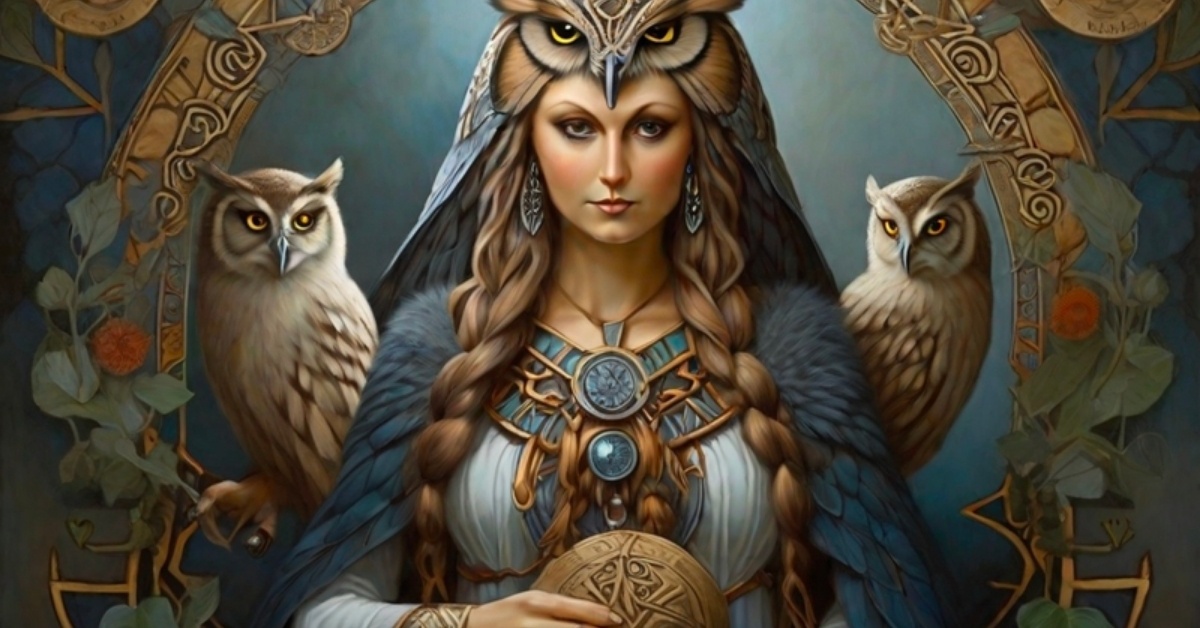
Snotra: Norse Goddess of Wisdom and Prudence
Thirteenth in the list, one sentence long.
That is the whole of Snotra’s record. Across everything that survives of Norse literature she gets a single line from Snorri Sturluson, a name in a poet’s word-list, and silence after that. What she keeps is a word, and the word turns out to be one the Norse cared about enormously.
Overview of Snotra
Snotra is one of the Asynjur, the goddesses of the Æsir, and she owes her survival to a single medieval Icelander. Around 1220, Snorri Sturluson wrote the Prose Edda, a handbook for poets, and in its first part, Gylfaginning, he has a disguised king ask which goddesses there are. The answer runs through sixteen names, from Frigg at the head to Sól and Bil at the end, and Snotra comes thirteenth. In Arthur Gilchrist Brodeur’s 1916 translation: “she is prudent and of gentle bearing; from her name a woman or a man who is moderate is called snotr.” Anthony Faulkes renders the same line as “wise and courteous.”
Her name shows up once more, in the versified word-lists at the back of Skáldskaparmál, among twenty-seven names for goddesses. That is the second and last attestation. She appears in no poem of the Poetic Edda, no saga, no runic inscription, and no place name.
So the substance of Snotra is her name. Old Norse snotr means wise, clever, prudent, and, by extension, well-conducted: the sort of person who knows what to say and when to keep still. Its opposite, ósnotr, is the standard word for a fool in the Hávamál, the great Eddic poem of practical counsel. Modern Icelandic kept the word and let it drift, so today snotur means neat, pretty, well turned out. The wise person became the well-presented one, which tells you something about what wisdom meant in the North. It showed on the outside.
Snorri’s line says the word came from her. Most scholars read the arrow the other way, and that question gets its own section below.
Titles
Snotra carries no epithets in any medieval source. The names below are the ones she has been given since.
- Snotra (Old Norse snotr, “wise, clever, well-mannered”)
- The Thirteenth Ásynja, her place in Snorri’s list
- Goddess of prudence and self-possession, the modern reading of her one line
- Handmaiden of Frigg, a label from contemporary Heathen practice; Snorri lists her among the goddesses without assigning her to Frigg’s household
Characteristics
No medieval text describes her appearance. Modern artists, working from the one line, tend to show her as:
- A composed, upright woman with a level gaze
- Dressed plainly and well, often in pale colors or white
- Still where the other goddesses are in motion
- Sometimes holding a book or scroll, a detail borrowed from Athena and absent from every Norse source
Abilities
- Wisdom — the snotr of her name, the practical judgment that shows in how a person conducts herself
- Prudence and moderation — knowing how much to say, drink, and claim
- Courtesy — Faulkes’s word for her; the social grace the Hávamál treats as a survival skill
- Self-possession — Brodeur’s “gentle bearing,” the composure that holds under pressure
- Naming — the one power Snorri grants her outright: a wise person is called snotr “from her name”
Symbols
Nothing is attested. Every symbol attached to Snotra is a modern devotional choice, and it helps to know which is which:
- The owl — imported from Athena; no Norse source pairs an owl with any goddess
- The book or scroll — a modern shorthand for learning, in a culture whose wisdom was spoken and remembered
- The hearth and the spindle — household emblems given to her by modern practitioners who count her among Frigg’s attendants
- Her own name — the closest thing she has to a genuine emblem, since the word is the goddess
Traits
- Measured: speaks after thinking, and only as much as the moment needs
- Courteous and watchful; the Hávamál‘s courtesy keeps its eyes open
- Self-contained, her worth staying put with or without the room’s approval
- Discreet, keeping other people’s confidences
- Reliable in company, the guest a host is glad to seat
Festivals and Rituals
No festival, temple, priest, or offering to Snotra is recorded anywhere. Norse religion did keep a winter rite for its female powers, the dísablót, offered to the dísir, the protective spirits of a family or district, and if figures like Snotra were ever honored, that private household rite is where it would have happened. The record is silent.
In modern Heathenry she is honored as one of the “handmaidens of Frigg,” a group assembled from Snorri’s list, with small offerings and with a practice that fits her better than any altar: choosing the measured word over the sharp one for a day, and calling that her rite.
Legends associated with Snotra
Snotra has no myth. What she has is one line, one word, and a poem that shows what the word meant in practice, and that is enough to tell a story about her, as long as the story stays honest about where it comes from.
The one line
Gylfi, a king of Sweden, walks into a hall in disguise and puts questions to three enthroned figures, High, Just-as-High, and Third. When he asks about the goddesses, High names them in order. Frigg first. Then Sága, Eir the physician, Gefjun, Fulla, Freya, Sjöfn, Lofn, Vár, Vör, Syn, Hlín, and thirteenth, Snotra, “prudent and of gentle bearing.” Then Gná, who rides Frigg’s errands through the sky, and the sun and the moon’s companion to close.
That is the scene. The goddess of wisdom speaks no line and takes no action. She is named, described in six words, and passed over for the next.
The word at work in the Hávamál
The Hávamál, “Sayings of the High One,” is the Poetic Edda’s manual for getting through life in one piece, and snotr is its word for the person who manages it. Three consecutive stanzas, 54 through 56, open on the same phrase, meðalsnotr skyli manna hverr, “moderately wise should every man be,” and each adds a reason. The fairest life belongs to those who know many things well. The middling-wise sleep easiest, since no one should learn their fate in advance. The deeply learned heart is seldom glad.
Before that, the poem has already drawn the fool, ósnotr, across a run of stanzas. He thinks everyone who laughs with him is a friend. He thinks he knows everything as long as he has a corner to sit in. When he comes among people the best thing he can do is keep quiet, since nobody will find out how little he knows unless he talks too much. Elsewhere the poem counsels the guest to sit in wary silence, eyes and ears open, and to drink mead in moderation, saying something useful or saying nothing.
Read those stanzas and Snotra fills in. Her wisdom is a wisdom of the hall and the table: knowing when to speak, how much to drink, whom to trust, and how to carry yourself so that nothing of value is given away. Snorri could have picked any virtue for his thirteenth goddess. He picked the one the Norse had a whole poem about.
The stories that grew later
Search for Snotra online and you will find her mediating between warring tribes, counseling the gods through a crisis, and receiving owls and scrolls as her emblems. None of that appears in any medieval source. Those tales grew in the last few decades, as modern writers filled the space Snorri left, and some of them are lovely. They belong to her modern life, the way the “handmaiden” title does, and it matters to keep the two layers apart: the goddess the Vikings may have known, and the one being built now.
An older Snotra?
The question underneath Snotra is bigger than her. Snorri’s list contains a whole group like her: Sjöfn, who turns minds toward love; Lofn, who wins permission for forbidden marriages; Vár, who hears oaths; Vör, from whom nothing can be hidden; Syn, who bars the hall door; Hlín, who shelters those Frigg wants kept safe; Snotra; and Gná. Each gets a line or two, each is defined by a single abstract quality, and for most of them Snorri is the only real witness. Set them beside Frigg and Freya, or beside Gefion, who sits in the same list and comes with an actual story about plowing the island of Zealand loose from Sweden, and the difference is stark. Scholars have argued for a century about what these thin goddesses are, and the argument has three main positions.
The first says Snorri made them up, or at least made them into goddesses. He was writing in the 1220s, a Christian two centuries after Iceland’s conversion, compiling a manual so that poets could go on using pagan imagery. Rudolf Simek, in his Dictionary of Northern Mythology, suggests Snotra may be Snorri’s own creation, derived from the adjective snotr and nothing else; Andy Orchard allows the same reading. On this view the arrow points from the word to the goddess, and Snorri’s claim that the word comes “from her name” is backwards. The same reasoning has been applied to her neighbors. Vár looks like a personification of várar, “vows.” Sjöfn may come from sjafni, a word for love that turns up in the poets’ lists. Hlín appears in the Völuspá in a way that reads like another name for Frigg, and Simek thinks Snorri misread the passage and minted a separate goddess from it.
The second position says the names are old and the thinness is ours. Several of these goddesses appear as base-words in skaldic kennings for “woman,” and the poets’ lists preserve names nobody bothered to explain, which is odd behavior for pure inventions. John Lindow notes that for Sjöfn the word sjafni really is attested as “love,” and that outside Snorri’s line nothing else about her survives, which cuts both ways: the silence fits a lost tradition as well as it fits an invented one. Orchard allows that Snorri may have drawn on sources now gone. Joseph Hopkins, arguing in 2017 that Hlín and Frigg are distinct goddesses, warns against dismissing a figure because the Prose Edda is her only witness.
The third position is Simek’s own, and it is the most interesting. Whatever the origin of the names, he argues, this cluster should be read together as female protective powers, each responsible for a specific area of the private sphere, and in that respect they resemble the Matronae: the “Mothers,” worshipped in groups of three across the Rhineland and Gaul from the first to the fifth century, with more than a thousand inscribed altars surviving. The Matronae watched over families, fertility, and childbirth, and they too carried specialized bynames. Simek links them, in turn, to the Norse dísir, the female guardians of house and clan who received the dísablót. On this reading the list-goddesses are the last, half-remembered echo of a very old habit in Germanic religion: naming the powers that keep a household in order, one power per task.
Which is right is unsettled, and the honest answer for Snotra is that all three fit. She may be a poet’s tidy personification, a genuine goddess whose stories died with the people who told them, or the memory of a household guardian whose job was making sure the family knew how to behave. The one sentence supports each reading equally, and that, as much as the sentence itself, is her record.
Snotra across cultures
Goddesses who are a virtue with a name attached turn up wherever people had a virtue they wanted to keep. The Greeks had Sophrosyne, the personified spirit of moderation and self-restraint, exactly the quality of the Hávamál‘s middling-wise man. Rome went further and built temples to its personified virtues: Pudicitia for modesty, Fides for good faith, Concordia for civic peace, each with a cult, a priesthood, and a place on the coinage. Athena and Minerva stand at the far end of the same road, wisdom grown into a full goddess with a city and a festival, and it says something that the Norse left Snotra where she was.
The closer parallel may be the one Simek points to: the Matronae of the Roman Rhineland, three seated women on an altar with a basket of fruit, honored by soldiers and farmers for the safety of the household. They too were defined by what they did for a family, with no story of their own. Snotra, on that reading, keeps company with them: a small, exact power for a small, exact need, the need to know how to behave.
Final thoughts
One line has held for eight hundred years. Snorri wrote down sixteen goddesses and gave the thirteenth six words, and those six words were enough for her to be painted, prayed to, and argued over in the twenty-first century.
Whatever she was, she is a good goddess to have on a list. She is a reminder that the Norse counted knowing-how-to-behave among the divine things, and that their word for a wise person was also the name of a goddess. So here is the question she leaves behind: when a people keeps a name and lets the story go, what were they choosing to keep?
Bibliography
- Snorri Sturluson. The Prose Edda, Gylfaginning ch. 35. Trans. Arthur Gilchrist Brodeur, 1916. Wikisource.
- Snorri Sturluson. Edda. Trans. Anthony Faulkes. Everyman, 1995.
- Hávamál. Old Norse text. Heimskringla.no.
- Hávamál. Trans. W. H. Auden and P. B. Taylor.
- Cleasby, Richard, and Guðbrandur Vigfússon. “snotr”. An Icelandic-English Dictionary, 1874.
- Simek, Rudolf. A Dictionary of Northern Mythology. Trans. Angela Hall. D. S. Brewer, 2007.
- Lindow, John. Norse Mythology: A Guide to the Gods, Heroes, Rituals, and Beliefs. Oxford University Press, 2001.
- Orchard, Andy. Dictionary of Norse Myth and Legend. Cassell, 1997.
- Hopkins, Joseph S. “Goddesses Unknown III: On the Identity of the Old Norse Goddess Hlín.” RMN Newsletter 12–13 (2016–2017): 30–36.
- “Snotra”, “Sjöfn”, and “Hlín”. Wikipedia.
- “Matres and Matronae” and “Dís”. Wikipedia.