Minerva: Roman Goddess of Wisdom, Craft, and War
Rome’s high priest once walked into a burning temple for her. He came out blind, carrying a small wooden statue that the whole city believed kept Rome standing.
That was Minerva. She sat beside Jupiter and Juno on the Capitol, ran the schools and the workshops, and heard the prayers of doctors, weavers, and poets. Rome called her the twin of Greek Athena. Rome was about half right.
Overview of Minerva
Minerva is the Roman goddess of wisdom, craft, and war, and one of the three deities of the Capitoline Triad, the heart of Roman state religion. With Jupiter and Juno she shared the great temple on the Capitoline Hill, where consuls took office and victorious generals ended their triumphs.
Her portfolio was enormous. Ovid called her “the goddess of a thousand works.” Weaving, dyeing, shoemaking, sculpture, painting, medicine, teaching, poetry, and the flute all belonged to her. So did war, though Rome already had Mars for the fighting and leaned on Minerva for the thinking side of it.
Her name is Italic, and older than Rome’s contact with Greece. Most linguists trace it to a root meaning “mind” or “memory,” the same root behind the Latin mens and memini. She reached Rome by way of the Etruscans, who called her Menrva, and the Romans themselves remembered that one of her cult statues had been carried to the city from the Faliscan town of Falerii.
Her great festival was the Quinquatrus, five days in March that emptied every school in Rome.
Titles
- Minerva Medica (“the Physician”)
- Minerva Capta (“the Captive,” her shrine on the Caelian Hill)
- Armipotens (“mighty in arms,” Virgil’s name for her)
- Pallas and Tritonia (poetic names borrowed from Athena)
- Aventine Minerva (patron of the guild of writers and actors)
- Sulis Minerva (her healing-spring form at Bath in Britain)
Characteristics
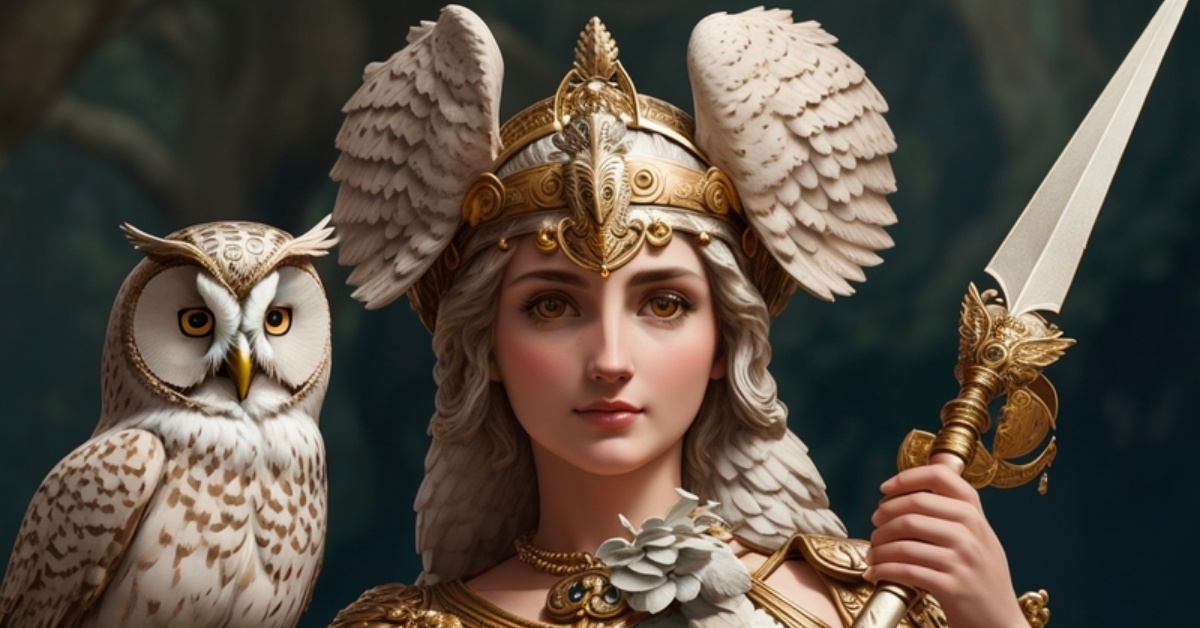
How Minerva usually looks in Roman art:
- A crested helmet, often pushed back from her face
- A long gown under a breastplate or the aegis, with the Gorgon’s head on her chest
- A spear in one hand, a shield resting at her side
- A mature, level, unsmiling face
- An owl at her feet
- On Domitian’s coins, a thunderbolt in her hand, a detail Greek Athena never carried
Abilities
- Wisdom and counsel — the scholar Varro made her the “plan” of the universe itself
- Craft mastery — loom, kiln, forge, chisel, and brush
- Healing — as Minerva Medica she received clay eyes, hands, and feet from grateful patients
- War — strategy, the defense of the citadel, and the guarantee of Rome’s survival
- Invention — the flute, and in the tale she shares with Athena, the olive tree
Symbols
- The owl — wisdom, watchfulness, and seeing in the dark
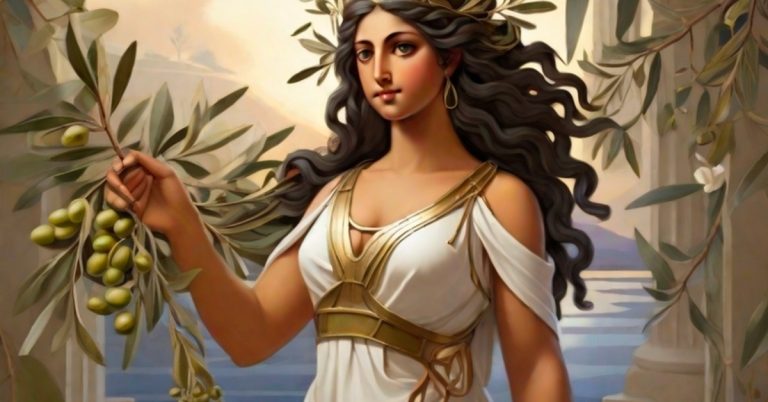
- The olive tree — peace, oil, and the gift that won a city
- The aegis and Gorgoneion — the snake-fringed breastplate bearing Medusa’s head
- The spear and shield — her warrior’s gear
- The spindle and loom — the tools of every weaver who prayed to her
- The Palladium — the ancient image of her that Rome guarded above all others
Traits
- Exacting, and merciless toward mortals who claim to rival her
- Chaste, refusing every suitor
- Practical, more at home in a workshop than on a battlefield
- Fiercely loyal to her city
- Vain enough to throw away her own invention over a reflection
Festivals and Rituals
The Quinquatrus ran from March 19 to March 23. Ovid says the first day was Minerva’s birthday, so no blood could be shed. The next four made up for it with gladiator fights, because the “warlike goddess delights in naked swords.”
This was the holiday of anyone who worked with their hands or their head. Ovid tells girls learning to spin and weave to pray to her, then fullers, dyers, shoemakers, doctors, sculptors, painters, stone-carvers, and poets. Schoolteachers should ask her for new pupils, and the fee they collected in her name was called the Minerval. Students got the days off. Women consulted fortune-tellers. The emperor Domitian, her most devoted worshiper, staged plays, wild-beast shows, and poetry contests for her at his villa in the Alban Hills.
A Lesser Quinquatrus followed on June 13, when the city’s flute-players paraded in masks to her temple. She had, after all, invented their instrument.
Her temples were everywhere. The Capitoline temple she shared with Jupiter and Juno. The Aventine temple, where in 207 BC Rome’s first guild of poets and actors met to make their offerings. The shrine of Minerva Medica on the Esquiline, with its heaps of votive body parts. And the temple Domitian built her in the Forum of Nerva, finished the year after his assassination.
Legends associated with Minerva
Rome borrowed most of Minerva’s stories from Greece, then retold them in Latin with its own emphasis: on craft, on pride, and on the safety of the city.
Born on the nineteenth of March
The Romans took the Greek birth story whole and gave it a date.
Jupiter had swallowed his first wife, Metis, the wisest of the Titans, because a prophecy said her child would outgrow him. The child was already growing. When the headache came, Jupiter had his own skull split open, and out came Minerva, full-grown, armed, and shouting.
Roman poets loved the detail of the head. Ovid even offers it as one explanation for her title Capta: she “leapt, with a shield, from the crown of her father’s head,” and the Latin for head is caput. Rome fixed her birthday on the first day of the Quinquatrus, and forbade bloodshed on it, which is a strange courtesy for a goddess who arrived with a spear.
Arachne at the loom
This is the story Rome told best, and Ovid tells it with Minerva’s name on it.
Arachne was a girl from Hypaepa in Lydia, the daughter of a wool-dyer. Nobody in her family was anybody. But her weaving was so fine that the nymphs came down from the mountains and out of the river to watch her work, and people said Minerva herself must have taught her.
Arachne hated the compliment. She had learned from no one, she said, and if the goddess wanted to prove otherwise, she could come and compete.
Minerva came, disguised as an old woman with white hair and a stick. Take the advice of age, she said. Be the best of mortals, and ask the goddess’s forgiveness. Arachne glared at her and told her to save the lecture for her daughters-in-law. So the old woman dropped the disguise. The nymphs bowed. Arachne blushed, briefly, and held her ground.
They strung two looms and wove.
Minerva’s tapestry showed the twelve gods enthroned and her own contest with Neptune for the city of Athens: his trident striking the rock, her spear striking the ground, and the olive tree rising, gray-green and heavy with fruit. In the four corners she added small warnings, mortals who had challenged gods and been turned into mountains, birds, and temple steps. She bordered the whole thing with olive.
Arachne’s tapestry showed the gods too, from below. Jupiter as a bull carrying Europa out to sea, the girl looking back at the shore. Jupiter as a swan with Leda, as a shower of gold with Danae, as a satyr, as a flame, as a shepherd. Neptune as a bull, a river, a ram, a dolphin. Apollo dressed as a hawk, a lion, a farmer. Every disguise the gods had ever worn to get what they wanted, woven so well that you could believe the bull was breathing. She bordered it with ivy and flowers.
Minerva searched the work for a flaw and found none. Ovid says that even Envy could not have faulted it.
The goddess tore it to pieces. She struck Arachne across the forehead with her boxwood shuttle, three times, four times. The girl could not bear it and put a noose around her neck. Minerva, seeing her hanging there, felt something like pity and lifted her down, then sprinkled her with the juice of a poisonous herb. Arachne’s hair fell out, then her nose and ears. Her head shrank. Her fingers stuck to her sides and became legs, and the rest of her became belly, “from which she still spins a thread, and, as a spider, weaves her ancient web.”
The Greeks told this story about Athena. The version the world remembers, with its long inventory of divine crimes and its terrible ending, is Ovid’s, and it is Minerva who swings the shuttle. The tapestry told the truth, and the goddess punished her for it.
The flute she threw away
One story about her is nearly a comedy, and Ovid puts it in the goddess’s own mouth.
Minerva invented the pipes. She bored holes in a length of boxwood and found that the sound pleased her. At a banquet of the gods she played for the company, and Juno and Venus began to laugh. They were laughing at her face: cheeks puffed out, lips pursed around the reed.
She went to a pool and looked at her reflection while she played. The goddess of wisdom saw what they had seen. “You are not worth that much to me,” she told the flute, and threw it into the grass.
A satyr called Marsyas found it lying there. He learned to play it so well that he challenged Apollo, lost, and was flayed alive for the presumption. The flute-players of Rome, who marched to her temple every June 13, were carrying around the goddess’s discarded vanity.
Medusa’s hair
Minerva wears a monster’s face on her chest, and Ovid explains how it got there.
Medusa was once beautiful, and her hair was the loveliest thing about her. Neptune raped her in Minerva’s temple. The goddess, Ovid says, hid her eyes behind her aegis, and then punished Medusa while Neptune walked away: she turned the woman’s hair into a mass of snakes.
Later Minerva guided Perseus to the sleeping Gorgon, lent him her polished shield so he could aim by the reflection, and took the severed head for herself. It has stared out from her breastplate ever since. It is the harshest of her stories, and Ovid tells it straight.
The Palladium and the blind priest
The last legend belongs to Rome alone.
Long before the Trojan War, a wooden image of armed Pallas fell from the sky at Troy. As long as it stayed inside the walls, the city could not fall. The Greeks learned this from a captured Trojan prophet, and Odysseus and Diomedes crept in by night and stole it. Only then could Troy burn.
The Romans told the ending differently. The image the Greeks took was a copy, they said, or Diomedes surrendered it later in Italy. Either way, the true Palladium came west with Aeneas, the Trojan prince who carried his father, his household gods, and the future of Rome out of the burning city. In Rome it was kept in the round temple of Vesta, where the Vestal Virgins tended it and they alone were permitted to see it. It was counted among the pignora imperii, the pledges on which the empire’s survival depended.
In 241 BC the Temple of Vesta caught fire. The pontifex maximus, Lucius Caecilius Metellus, ran inside and brought the Palladium out. The tradition says the fire took his sight, and that the Senate granted him the unique honor of riding to its meetings in a chariot, because Rome owed him its life. Centuries later the emperor Elagabalus moved the image into his own shrine, and legend says Constantine carried it off to bury under the foundations of Constantinople. Whatever the truth of that, the Romans believed for a thousand years that their city stood because a small wooden Minerva was safe.
An older Minerva?
Take away everything Rome borrowed from Athens and a goddess is still standing there. She is Etruscan, and her name is Menrva.
The Etruscans, whose cities lay just north of Rome, knew Menrva as a goddess of war, wisdom, craft, and healing, the daughter of their sky god Tinia and his queen Uni. The three of them formed a triad, and most scholars think Rome’s Capitoline Triad of Jupiter, Juno, and Minerva was built on that Etruscan model. Around 510 BC the Etruscans of Veii raised a sanctuary to Menerva at Portonaccio, one of the earliest Etruscan-style temples known, where she was worshiped as a war goddess, a nurturer, and an oracle. The famous terracotta Apollo of Veii came out of the same complex. Menrva also turns up on engraved bronze mirrors from Praeneste and Bolsena, where she shields Hercle and Perseus, watches the Judgment of Paris, and in one scene presents a mysterious child, Epiur, to Tinia.
She had traits all her own. Etruscan artists gave her a thunderbolt to throw, and the Greeks never connected Athena with weather at all. Her name is another clue. It fits an Italic root for mind and memory, and the same root gave Latin its word for thinking. Some linguists read it instead as “she who measures,” from a word for the moon. One scholar, Benjamin Fortson, argues that the wisdom sense was a later gloss laid over her by Athena’s influence, and that the original Italic goddess may have been something else. The debate is open.
The Romans themselves kept a record of a Minerva who came from outside. Ovid writes that the shrine of Minerva Capta on the Caelian Hill got its name because the goddess “came to us as a captive from the conquest of Falerii,” a Faliscan town taken in 241 BC, and adds that an ancient inscription said so. Rome’s memory, in other words, was of an Italic Minerva who was Italian before she was Greek.
The poets’ Minerva stays. Behind her, though, stands an older figure from Etruria and the Italic hills, a goddess of mind and craft with lightning in her hand, who was already ancient when the first Greek stories reached her.
Minerva across cultures
Rome met other wise goddesses and, as a rule, absorbed them.
The obvious case is Athena herself. By the late Republic the Romans treated the two as one goddess with two names, and Latin poets called Minerva “Pallas” without a second thought. Almost every myth in this post came across that bridge.
The stranger case is in Britain. At the hot springs of Bath the Celtic Britons worshiped a goddess called Sulis. When the Romans built their baths there, they called her Sulis Minerva, put a gilded bronze head of Minerva in her temple, and lit an altar fire with coal instead of wood. Sick people came to bathe; the wronged threw curses written on lead into her spring. The Romans made the same move with every goddess who mattered: Ceres took on the Greek Demeter’s stories, and the Trojan mother Cybele was shipped to Rome as a black stone during the war with Hannibal. Minerva was the pattern for the method.
Her owl has had the longest afterlife of all. In 1820 the philosopher Hegel wrote that “the owl of Minerva spreads its wings only with the falling of the dusk,” meaning that wisdom arrives after the fact. Universities, libraries, and learned societies still put her on their seals. A city that named its schools’ holiday after her would approve.
Final thoughts
Minerva was the goddess a city would rather lose its eyes than lose.
She was also the goddess of the dye vat, the schoolroom, the surgery, and the flute. Rome trusted her with its survival and with its homework, and saw one goddess in both. Underneath the borrowed Greek armor she is older than Rome, an Italic goddess of the working mind who took the stories that suited her and kept the thunderbolt anyway.
Bibliography
- Cartwright, Mark. “Minerva”. World History Encyclopedia.
- Apel, Thomas. “Minerva”. Mythopedia.
- Ovid. Metamorphoses, Book VI (Arachne). Trans. A. S. Kline, Poetry in Translation.
- Ovid. Metamorphoses, Book IV (Medusa). Trans. A. S. Kline, Poetry in Translation.
- Ovid. Fasti, Book III (the Quinquatrus and Minerva Capta). Trans. A. S. Kline, Poetry in Translation.
- Ovid. Fasti, Book VI (the flute). Trans. A. S. Kline, Poetry in Translation.
- de Grummond, Nancy Thomson. Etruscan Myth, Sacred History, and Legend. University of Pennsylvania Museum, 2006.
- Bonfante, Larissa, and Judith Swaddling. Etruscan Myths. British Museum Press, 2006.
- “Minerva”, “Menrva”, and “Quinquatria”. Wikipedia.
- “Palladium (classical antiquity)”, “Portonaccio”, and “Owl of Athena”. Wikipedia.