Hathor: Egyptian Goddess of Love, Joy, and Music
The gods once saved the human race with seven thousand jars of beer.
The goddess they were saving it from was Hathor. The goddess who woke the next morning, mild and merry and ready to dance, was also Hathor. That one night holds the whole riddle of her: the lady of love and music and the lioness who nearly emptied the world of people are the same woman.
Egypt adored her for three thousand years anyway. This is why.
Overview of Hathor
Hathor is one of the great goddesses of ancient Egypt, and for most of its history the best loved. She is a goddess of the sky and of the sun, the daughter of Ra, and in the oldest tellings the mother of Horus, the falcon-god whose name she carries. Her domain is everything that makes life sweet: love, joy, music, dance, drink, beauty, sex, motherhood, and the fertility of fields and wombs.
She had a second job too. When a soul reached the western horizon, Hathor was there to meet it, leaning out of a sycamore tree with bread and water, and each morning she greeted the sun as it climbed out of the east. Miners in the Sinai prayed to her for turquoise, sailors prayed to her on the way to Byblos and the land of Punt, and every pharaoh drank her milk, at least on the temple walls.
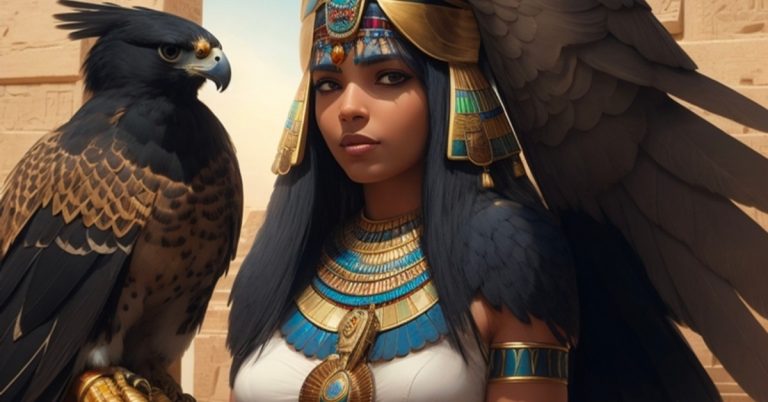
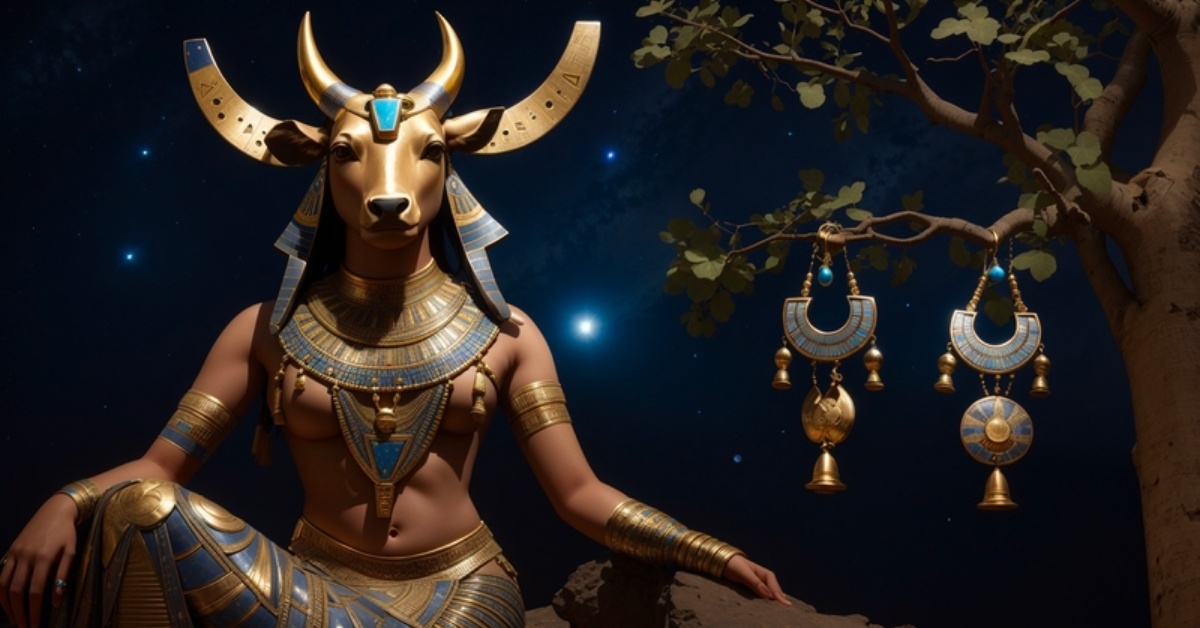
Her form is the cow. Egyptian artists showed her as a cow, as a woman with a cow’s ears looking straight out of the wall (a rare thing in an art that almost always drew faces in profile), or as a woman crowned with cow horns cradling the sun disk between them. Her great temple at Dendera in Upper Egypt still stands, most of it built in the last century BCE, her face carved four times around the top of every column in the hall.
Her name, Hwt-Hor, means “House of Horus.” The sky is the house the falcon flies through, and Hathor is the sky.
Titles
- The Golden One
- Mistress of the Sky, Mistress of the Stars
- Lady of the Sycamore
- Mistress of Dendera
- Lady of Turquoise (at the Sinai mines)
- Mistress of the West (as Imentet, who receives the dead)
- Mistress of Music, Dance, Garlands, Myrrh, and Drunkenness
- Hand of Atum
Characteristics
How Hathor tends to be shown in art:
- As a cow, with the sun disk between her horns, often stepping out of the western mountain
- As a woman wearing a crown of outward-curving cow horns with the sun disk cradled between them
- Face-on, with a cow’s ears on a human face, a pose Egyptian art reserved for her and a handful of others
- Holding a sistrum, the sacred rattle, and wearing the menat, a heavy beaded collar
- As a lioness, when she is the Eye of Ra in her anger
- As a sycamore tree, or a woman leaning out of one, pouring water for the dead
Abilities
- Joy — music, dance, and drink are her instruments, and she uses them to soothe gods and mortals alike
- Love and fertility — the pull that draws lovers together and brings children after
- Motherhood and nursing — her milk feeds the pharaoh and makes his rule legitimate
- The sun’s fury — as the Eye of Ra she is the sun’s heat turned into a weapon
- Guiding the dead — she meets souls in the west and feeds them for the road
- Fate — as the Seven Hathors she announces a newborn’s destiny
Symbols
- The cow — nourishment, motherhood, the sky itself
- The sun disk between horns — her crown, later borrowed by Isis
- The sistrum — the rattle shaken in her rites, its handle often carved with her face
- The menat — the beaded collar shaken like a rattle and worn for healing and rebirth
- The sycamore tree — her tree at the desert’s edge, giving shade and drink to the dead
- The mirror — Egyptian mirrors carried her face on the handle, and people gave them to her as offerings
- Turquoise and malachite — the green stones of her Sinai mines
Traits
- Warm, sensual, and generous, the goddess Egyptians turned to for pleasure and comfort
- Playful, willing to do whatever it takes to make the sun god laugh
- Fierce past all reason when roused, with a bloodlust only drink can stop
- Motherly toward kings, the dead, and every child born
- Fond of foreigners and far places, worshipped by miners, sailors, and traders
Festivals and Rituals
Dendera was the heart of it. The temple there was built around her: a birth house for her son Ihy, the child god of music, crypts under the floor for her ritual gear, and a chapel on the roof where her statue was carried at New Year so the first sunrise could touch it.
The Festival of Drunkenness came on the twentieth day of the first month, as the Nile flood rose. It replayed the myth you’ll read below. People drank in the temple courts until they passed out, slept where they fell, and were woken at dawn by drums to meet the goddess face to face. Archaeologists digging at the temple of Mut at Karnak found the hall where Hatshepsut hosted it, around 1470 BCE, which her inscription calls a “columned portico of drunkenness.”
Once a year her statue left Dendera by boat and sailed upriver to Edfu for the Beautiful Reunion, two weeks of feasting while Hathor stayed with Horus in his own temple.
Everyday worship was smaller and warmer. Women hoping for children left offerings at her shrines. People gave her mirrors and cosmetic palettes, because beauty itself counted as devotion. Musicians shook the sistrum and the menat for her, since noise was how you called her and how you kept her sweet. In the Old Kingdom, many elite women held the title “priestess of Hathor,” one of the few priesthoods routinely open to women.
Legends associated with Hathor
Hathor’s stories run between two poles. At one end she cheers up the sun. At the other she nearly drinks the world dry of blood. Everything the Egyptians told about her sits somewhere on that line, and the biggest story sits at both ends at once.
The destruction of mankind
This one was written inside the gilded shrines of Tutankhamun and on the tomb walls of Seti I and Ramesses II, in a text Egyptologists call the Book of the Heavenly Cow. It is the closest thing Egypt has to a flood myth, and the flood is beer.
Ra had grown old. The sun god had ruled gods and humans together since the beginning, and now his bones were silver, his flesh gold, his hair lapis lazuli, and humankind noticed. Out in the desert they muttered against him and plotted. Ra heard. He called the gods to a secret council, Nun the primeval water and Shu and Geb and Nut and the rest, and asked them what to do about the creatures born from his own tears.
Send your Eye, they told him. The Eye of Ra was the sun’s own fire made into a goddess, and the goddess Ra sent was Hathor.
She went down as a lioness. In the desert she found the rebels and slaughtered them, and she found she liked it. She waded in blood. Her name in that form is Sekhmet, “the Powerful One,” and by the end of the first day she had stopped telling rebels from anyone else. She came back to her father glowing and told him it had been sweet to her heart. Then she went to bed, meaning to finish the job in the morning.
Ra changed his mind. Whatever the humans had done, he meant to keep a world with people in it. But the Eye, once loosed, obeyed nobody, himself included, so he had to be clever.
He sent runners to Elephantine, at the southern edge of Egypt, for red ochre. His priests ground it and his maidservants brewed beer, and the two were mixed together, seven thousand jars of it, the color of blood. In the last hours of the night he had it poured across the fields where the goddess would hunt at dawn, until the land stood three palms deep in it.
Hathor rose with the sun and came down to the killing ground, and it was already red. She saw her own beautiful face in the surface of it. She bent and drank, and drank, and the drink was good, and she drank until she was too heavy to hunt. She wandered home to her father with her lion’s mouth stained and her mind fogged, and she had forgotten what she came for. The lioness lay down, and it was Hathor who woke up: golden, laughing, the lady of music, humanity’s friend.
The Egyptians did two things with this story. They made it the charter of their Festival of Drunkenness, since the text itself closes by ordering that strong drink be brewed for her feast from then on. And they let Ra retire. Worn out, he climbed onto the back of the sky goddess Nut, who had taken the shape of a great cow, and rode up out of the world, leaving the stars scattered along her belly and the gods to run things without him.
The Seven Hathors and the doomed prince
Hathor multiplies. Egyptian texts speak of Seven Hathors, and one list at Dendera counts 362 of her, close to one for every day of the year, but seven is the number that mattered to ordinary people. The Seven Hathors came to a cradle at birth and announced how the life inside it would go and how it would end, fairy godmothers with the sweetness left out.
The Tale of the Doomed Prince, copied in the New Kingdom, tells it best. A king prayed for years for a son, and when the boy was finally born, the Seven Hathors arrived and spoke: he would die by a crocodile, a snake, or a dog. The king built the child a stone house in the desert and kept him inside it. The prince grew up, saw a dog through the window, and asked for one. He rode out into the world, won a Syrian princess by leaping to her tower window, and survived the snake because his wife sat up all night with a bowl of milk and an axe. Then the papyrus tears off. Three thousand years later, the ending is still lost, and readers still argue about whether he beat his fate.
The Seven Hathors show up again in the Tale of Two Brothers, where they pronounce doom on a woman the gods made for the hero, and in love charms, where they are asked to bind the beloved’s heart. Fate, love, and birth all wore the same face.
The goddess who made the sun laugh
In the long lawsuit between Horus and Seth over the throne of Egypt, the tribunal of the gods dragged on for eighty years, and at one point the baboon god Baba insulted Ra to his face: “Your shrine is empty.” Ra took it hard. He walked out of the court, lay down on his back in his pavilion, and sulked, and the business of heaven and earth stopped with him. The sun god’s activity is what keeps daylight and order, Maat, in motion.
Hathor went in to him. She stood in front of her father, lifted her dress, and showed him everything. Ra laughed. He got up, went back to the tribunal, and the case resumed.
The Egyptians told this with a straight face, and they meant something by it. Joy, sex, and laughter were sacred forces to them, strong enough to restart the sun, and the goddess who owned them ranked accordingly.
The herdsman in the marsh
A torn Middle Kingdom story called the Tale of the Herdsman shows the other side of her pull. A herdsman driving his cattle through the marsh meets a woman there. Her hair is wild, her skin is unlike a human’s, and she frightens him so badly he tries to ward her off with spells. The next day she comes back naked and beautiful, and the papyrus gives out before we learn what she is after. Most readers take her for Hathor, at home in the marsh and the pasture, the cow goddess among cows, whose approach could be terrifying or irresistible depending on which face she chose to show.
The cow in the western mountain
Some Hathor stories are pictures rather than plots. On the west bank at Thebes, where the tombs were, the cliff itself was understood as her body: a cow stepping out of the mountain, sun disk between her horns, papyrus at her feet, coming to fetch the dead. In tomb scenes she is the Lady of the Sycamore, a tree goddess leaning from the branches to pour water into the cupped hands of the newly dead and to hand them bread. Tomb owners asked to “follow Hathor,” and by the later periods a dead woman was addressed as a Hathor the way a dead man was addressed as an Osiris. Whichever way you passed, into the west or out of a womb, she was the door.
An older Hathor?
On the Narmer Palette, the carved slate that records the unification of Egypt around 3100 BCE, two cow-faced goddesses look out from the top corners above the king, horns curling inward. They are the oldest divine faces in Egyptian art, and they are usually read as Bat, a cow goddess of the seventh Upper Egyptian nome whose shrine was called the Mansion of the Sistrum. Cow goddesses were everywhere in Predynastic Egypt; a painted clay figure from Naqada, around 3500 BCE, raises her arms over her head in the curve of horns. Hathor by name turns up in the Fourth Dynasty, around 2500 BCE, in the triad statues of King Menkaure at Giza, where she stands beside the king as his equal. By the Middle Kingdom, Bat had been absorbed into her. Hathor kept Bat’s frontal face, her sistrum, and her cow’s ears; only the horns changed, curving out now instead of in. Egyptologists disagree about whether the Narmer cows are Hathor or a predecessor she swallowed, and the record is too thin to settle it. What it does show is a cow-goddess type older than the pharaohs, with Hathor as the form that won.
The same thing then happened to her. From the New Kingdom on, Isis began to appear in roles that had been Hathor’s alone, riding in the sun’s boat, nursing the king, and she took the crown along with the jobs. The horned sun disk that belongs to Hathor in every Old Kingdom image sits on Isis’s head in every Ptolemaic one, and unless the artist wrote a name beside the figure, there is no telling which goddess is meant. Isis kept Hathor’s music, her cow, and her welcome of the dead, and became the most popular goddess in Egypt and then across the Roman world. Hathor kept her own temples to the end of paganism, Dendera above all, but the long arc is plain: a Predynastic cow goddess grew into Hathor, and Hathor was folded into Isis.
Hathor across cultures
The Greeks who settled in Egypt looked at Hathor and saw Aphrodite, and towns sacred to her appear on Greek maps as Aphroditopolis. The match was fair: goddess of love, beauty, and pleasure on both sides, each with a temper. When Herodotus wrote that Egyptians would sooner starve than sacrifice a cow, because the animal was sacred to Isis, he was describing a rule Hathor had made first.
The cow as mother of the world is a far older and wider idea. In Norse myth the primeval cow Audhumla licks the first god out of the salt ice and feeds the giant Ymir from four rivers of milk. In India the wish-granting cow Kamadhenu is the mother of all cattle and the source of every good thing, and the cow remains sacred there today. Homer calls Hera, queen of heaven, “cow-eyed,” and the Greek heroine Io, turned into a cow and driven to Egypt, was identified there with Isis-Hathor. The instinct is the same everywhere: the animal that gives milk without dying is the closest thing the ancient world had to a picture of a generous sky.
Egypt’s own pantheon holds her cousins too. Bastet the cat and Sekhmet the lioness share the Eye of Ra with her, and Egyptians themselves said the three were one goddess in three moods. Hathor is the mood you hope for.
Final thoughts
Egypt handed the goddess of the hangover the keys to the sunrise, and it worked for three thousand years.
Hathor is the case for pleasure. Music, wine, sex, dancing, a well-made face in a mirror: the Egyptians filed all of it under worship, because the goddess who owned those things was also the one who met you at death and the one who could, on a bad day, end the world. Keeping her happy was the whole point of the calendar. The myth admits that joy is what turns rage back into love, and it admits it with a wink.
Which leaves the question the Egyptians answered every year with a festival. What do you do with the part of yourself that could burn everything down, once you know it is also the part that dances?
Bibliography
- Mark, Joshua J. “Hathor”. World History Encyclopedia.
- Bryan, Betsy M. “The Altered State of Religion: Sekhmet and Ritual Revelries” (lecture transcript). American Research Center in Egypt.
- “Betsy Bryan on the Egyptian festival of drunkenness”. Johns Hopkins Hub.
- Pinch, Geraldine. Egyptian Mythology: A Guide to the Gods, Goddesses, and Traditions of Ancient Egypt. Oxford University Press.
- Wilkinson, Richard H. The Complete Gods and Goddesses of Ancient Egypt. Thames & Hudson.
- Lichtheim, Miriam. Ancient Egyptian Literature, Volume II: The New Kingdom (the Heavenly Cow, the Doomed Prince, the Two Brothers). University of California Press.
- Herodotus. Histories, Book II, 41. Trans. A. D. Godley, via Perseus.
- “Hathor”, “Book of the Heavenly Cow”, and “Bat (goddess)”. Wikipedia.
- “Tale of the Doomed Prince”. Wikipedia.
- “Hathor”. Encyclopaedia Britannica.