Isis: Egyptian Goddess of Magic and Motherhood
Her name is a chair.
Write it in hieroglyphs and you draw a throne, the seat every pharaoh sat on, and that is the oldest thing anyone knows about Isis. Out of that chair grew the strongest magician in Egypt, the widow who put her murdered husband back together with her own hands, and the mother whose worship outlived the pharaohs by centuries.
Overview of Isis
Isis is the Greek form of her name. Egyptians called her Aset, and the word means “seat” or “throne.” She is a daughter of Geb, the earth, and Nut, the sky, which makes her one of the four youngest gods of the great family of Heliopolis: Osiris, Isis, Set, and Nephthys. She married Osiris, her brother, and bore Horus, the falcon god every living king claimed to be.
Her territory is enormous. Magic, which the Egyptians called heka, and hers was stronger than any other god’s. Healing, especially the poison of scorpions and snakes. Motherhood and the fierce defense of a child. The care of the dead. And kingship itself: the pharaoh sat on her lap the way the infant Horus did, and from that seat he kept Maat, the order and truth of the world, in place.
She enters the written record in the Pyramid Texts of the Fifth Dynasty, around 2350 BCE, and she is still there when the Romans are building her temples in London and Pompeii two and a half thousand years later. Egyptians also saw her in the sky. The star Sirius, which they called Sopdet, rose just before dawn each year as the Nile began to flood, and Sopdet became Isis, the goddess whose tears for Osiris swelled the river.
Titles
- Aset, her Egyptian name, “the throne”
- Weret-Hekau, “Great of Magic”
- Mut-Netjer, “Mother of the God”
- Nebet-Pet, “Mistress of Heaven”
- Isis-Sothis, the star Sirius
- Myrionymos, “of ten thousand names” (her Greek title)
- Queen of Heaven (her Roman title)
Characteristics
How Isis tends to be shown in art:
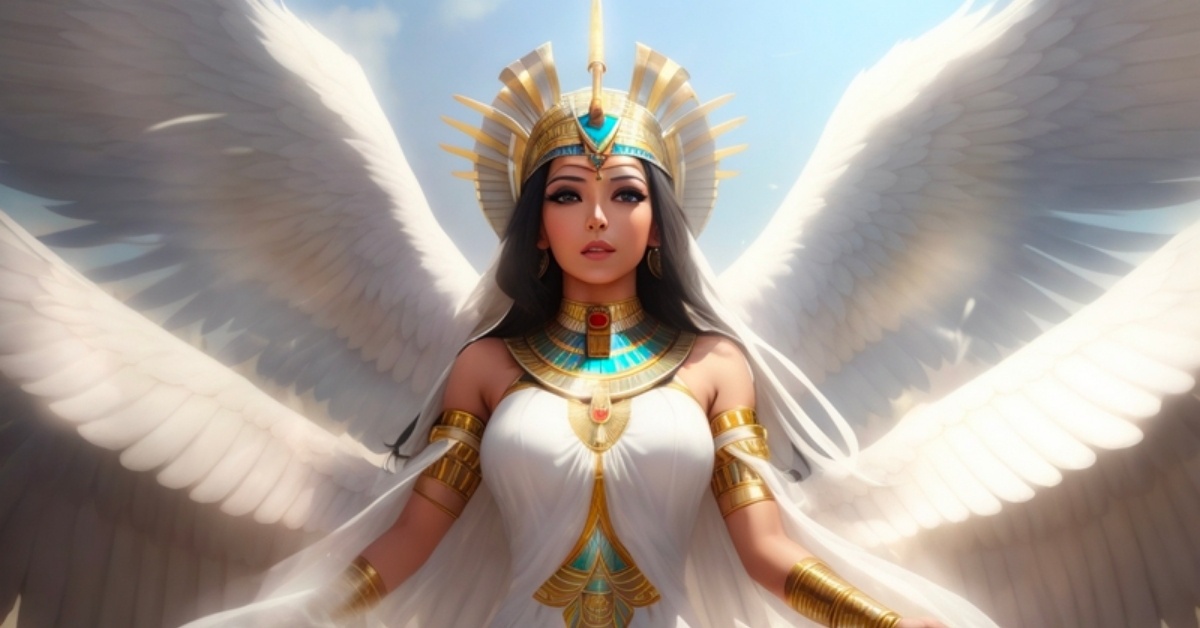
- A slender woman in a long, close-fitting sheath dress
- The throne hieroglyph worn on her head like a crown
- From the New Kingdom on, the cow horns and sun disk she took over from Hathor
- Great outspread wings, kneeling at the head or foot of a coffin
- As a kite, a small hawk, hovering over the body of Osiris
- Seated, nursing the infant Horus on her lap
- Sometimes with the vulture headdress of Mut
Abilities
- Magic — the greatest of all the gods, strong enough to outwit the sun himself
- Healing — her spells against venom were recited over real patients for a thousand years
- Resurrection — she reassembled Osiris and drew life back into him
- Protection of the dead — she guards the coffin, the canopic jars, and the road through the underworld
- Shapeshifting — she flies as a kite, and walks Egypt as an old beggar woman
- Speech — in Egyptian texts, no deity talks as much as Isis, and her words are her weapon
Symbols
- The throne — her name, her crown, and the seat of every king
- The tyet — the “knot of Isis,” a looped amulet of red jasper laid on the mummy’s throat
- The kite — the mourning bird she and Nephthys become
- Wings — spread in protection over the dead
- Sirius — her star, the herald of the flood
- The sistrum — the rattle shaken in her temples in the Greek and Roman age
- The scorpion — her seven bodyguards in the marshes
Traits
- Relentless, willing to search a whole country for a single missing piece
- Cunning, and happy to win by trickery when force fails
- Tender toward the poor and the sick who take her in
- Ambitious for her son, and patient for decades to see him crowned
- Merciful even to her brother’s murderer, at the one moment mercy costs her most
Festivals and Rituals
The great Egyptian festival of Isis was the Osiris mysteries in the month of Khoiak, as the flood drained off the fields. Two women played Isis and Nephthys and sang the mourning laments that survive in temple papyri. Priests raised the djed pillar, Osiris’s backbone, to stand him upright again. And they planted “Osiris beds,” mummy-shaped trays of soil sown with grain, so the god sprouted green in his own tomb.
Her greatest house was Philae, the island temple at the First Cataract, begun under the last native dynasty and expanded by the Ptolemies. Every ten days her statue crossed to the island of Bigeh to visit the tomb of Osiris. The last hieroglyphic inscription anywhere in Egypt was carved at Philae in 394 CE, and the temple stayed open long after the rest of Egypt had gone Christian, until the emperor Justinian ordered it closed in 537 CE.
Rome gave her two festivals of its own. On March 5 the Navigium Isidis, “the ship of Isis,” opened the sailing season with a procession to the shore and a ship launched in her name. In late October the Isia acted out the search for Osiris, days of grief ending in a shout of joy when he was found. Herodotus had called Bastet‘s festival at Bubastis the biggest party in Egypt. Isis’s outgrew it, and then outgrew Egypt.
Legends associated with Isis
Nearly every story about Isis is one story: the murder of Osiris and everything she did about it. It is the longest and most loved myth in Egypt, told in the Pyramid Texts, sung in temple hymns, and written out in full by the Greek priest Plutarch in the second century CE. The rest of her legends hang off it like charms off a bracelet.
Born of sky and earth
In the beginning there was only dark water. Atum, the first god, raised himself on a mound of earth and spat out Shu, the air, and Tefnut, the moisture. Those two bore Geb, the earth, and Nut, the sky, and Geb and Nut bore four children in one litter: Osiris, Isis, Set, and Nephthys. Nine gods in all, the Ennead of Heliopolis, and Egypt’s whole story starts with the four youngest.
Osiris took the throne and Isis beside him as his queen. He taught Egypt to farm and to worship. She taught the women to grind grain and weave cloth, and she taught everyone how to heal. It was a golden age, and it lasted exactly as long as Set could stand it.
The death of Osiris
Set wanted the throne, and he wanted Osiris dead, and he was patient about both.
He measured his brother’s body in secret and had a chest built to fit it exactly, cedar and ebony, inlaid with gold. Then he threw a banquet. When the wine was flowing he had the chest carried in and announced a game: whoever the chest fit could keep it. One by one the guests climbed in and came up short. Then Osiris lay down, and the lid slammed, and Set’s men nailed it shut, poured lead over the seams, and carried the coffin to the Nile.
The river took it out to sea. It washed ashore at Byblos, on the coast of Lebanon, and a tamarisk tree grew up around it so fast that the coffin vanished inside the trunk. The king of Byblos admired the tree, cut it down, and set it up as a pillar in his own hall, with the body of a god sealed inside.
Isis cut her hair, put on mourning, and went looking. She followed the coffin all the way to Byblos and sat by the palace well until the queen’s maids found her. She braided their hair, breathed perfume onto their skin, and was taken into the palace as nurse to the queen’s infant son. At night, Plutarch says, she laid the baby in the fire to burn away his mortal parts, and flew around the pillar as a swallow, wailing. When the queen walked in and screamed, Isis stood up as a goddess, asked for the pillar, and took her husband home.
The scattered body
She hid the coffin in the marshes of the Delta. Set found it anyway, hunting by moonlight.
This time he took no chances. He cut the body into pieces, fourteen in Plutarch’s count, and scattered them the length of Egypt. Later temple lists ran the number as high as forty-two, one piece for every province, so every city could claim a burial of the god.
Isis got into a papyrus boat and went after them. Nephthys came with her, sister to the murderer and to the murdered both, and together they searched the river from the cataracts to the sea. Everywhere Isis found a piece she raised a shrine, which is why, the Egyptians said, Osiris had so many tombs. Every piece came back except one. Plutarch says a fish had eaten it, and Isis made a replacement.
Anubis, the jackal god, embalmed what she had gathered. He bound the body in linen and made Osiris the first mummy. Then Isis did the thing that made her the greatest magician of the gods. She turned herself into a kite and hovered over the corpse, beating her wings to fan breath into his mouth. A hymn to Osiris from the Eighteenth Dynasty, around 1400 BCE, describes it: she “made shade with her plumage, created breath with her wings,” and “raised the weary one.” Osiris stirred, long enough to give her a son. Then he went down to rule the dead, and Isis was left alive with a child inside her and Set on the throne.
The marsh child and the seven scorpions
Set kept her prisoner in a spinning house. Thoth, the god of wisdom, let her out one night and told her to hide in the Delta until the child was born.
She went into the papyrus swamps near Buto with seven scorpions for bodyguards. Their names are written on a healing stela from the fourth century BCE, the Metternich Stela: Tefen, Befen, Mestet, Mestetef, Petet, Tjetet, and Matet. Three walked ahead, two at her sides, two behind, and she made them promise to keep their stingers down and their eyes on the road.
Tired and disguised as a beggar, she knocked at the house of a rich woman named Usert. The woman looked at the stranger and her seven scorpions and slammed the door. A poor girl of the marshes, a fisherman’s daughter, opened hers.
The scorpions took the insult personally. Six of them poured their venom into Tefen, and Tefen crept under Usert’s door and stung her little boy. The child went rigid. Usert ran screaming through the village and no one would help her.
Isis heard the screaming and came back. She had every reason to walk on and she did the opposite. She laid her hands on the boy and spoke the names of her seven scorpions aloud, one by one, telling the poison to come out and fall to the ground. It did. The child breathed. Usert, ashamed, gathered up everything she owned and carried it to the poor girl’s hut. Egyptian healers recited that spell over real scorpion stings for centuries afterward.
The sting and the stopped sun
Isis bore Horus in the swamp at Khemmis, on a floating island, and raised him there in hiding. Set was hunting for the boy the whole time.
One day she came back from begging food and found the child stiff and foaming, stung by a scorpion Set had sent. She had healed a stranger’s son with a word. For her own she had nothing. Her scream brought Nephthys, the scorpion goddess Serket, and the people of the marsh, and none of them could help.
So Isis did something larger. She cried out to the sky, and in the sky the boat of the sun god Ra stopped dead. Day would stay frozen, she told him, and the world with it, until her son breathed again. Thoth came down from the boat carrying the words of Ra, spoke them over Horus, and the poison left him. Only then did the sun move on. Egyptians carved this story onto healing stones and poured water over the words, then drank it. If the spell could save Horus, it could save anyone.
The throne of Horus
Horus grew up and claimed his father’s throne. Set claimed it too. Their trial before the gods dragged on for eighty years.
Isis won most of it by wit. The gods had barred her from the courtroom, so she bribed the ferryman, crossed to their island, and turned herself into a beautiful widow. Set found her weeping and asked what troubled her. A stranger had taken her dead husband’s cattle, she said, and meant to throw her son off the land. Set was outraged. The stranger should be beaten, he said, and the son should have his father’s property. Isis turned into a kite, flew to a treetop, and told him he had just judged his own case.
The fight got uglier. Horus and Set turned themselves into hippopotamuses and dove into the river. Isis threw a harpoon and hit her son by mistake, pulled it out, and threw again. This time it sank into Set. He cried out to her as her brother, born of the same mother, and she let him go. Horus came out of the water in a rage and cut off his mother’s head. Thoth put a cow’s head on her shoulders in its place, which is one reason, the Egyptians said, that she wears horns.
They forgave each other. In the end Osiris wrote from the underworld to remind the gods who had given them grain, and what his demons could do to anyone who crossed him. The gods crowned Horus. Isis had waited since before he was born and lost her head for it. She got her son on the chair that bore her name.
The secret name of Ra
The story that explains her power is written on a papyrus from around 1200 BCE, and it is the coldest thing she ever did.
Ra was old. He had made the world, but he shuffled now, and his spit ran into the dust. Isis followed him and scooped up a little of that spit, kneaded it with earth into a serpent, and left it on the road he walked each morning. Ra stepped over it and the serpent bit him.
The poison ran through him like fire. Ra called the gods. They came, stood around him, and looked at each other, at a loss. Then Isis stepped forward. She could cure him, she said, with one thing: his true name, the secret one he had never spoken.
Ra stalled. “I am Khepri in the morning,” he said, “Ra at noon, and Atum in the evening.” Isis let the poison work. He gave her more names, dozens of them, and she waited through every one while he burned. At last he gave in. The name passed out of his body and into hers, and she spoke the spell and the poison fell away.
She has held the name ever since. Whoever knows the true name of a thing has power over it, and from that morning on, Isis held the name of the sun. The papyrus closes with instructions for reciting the story over a real snakebite, so that any healer could borrow her hold on the sun.
An older Isis?
The sources hold two more Isises, one on either side of the storybook goddess, and she is built out of both.
The first is a piece of furniture. Her name means throne, and that is close to all she is in the Pyramid Texts, where she first appears around 2350 BCE. Many Egyptologists, Geraldine Pinch among them, read the early Isis as the royal seat itself, made a person: the king sat on her, the king was Horus, and the throne that made him king was his mother. She had no temple of her own for centuries and stood well behind Hathor and Neith in rank. Then, across three thousand years, she grew. In the New Kingdom she took Hathor’s horns and sun disk, and along with them Hathor’s music, sex, and tenderness. She took Mut’s vulture crown. She took Sopdet’s star, the mourning bird, the healing spells, and in the end the mysteries of Osiris himself, which by the Roman age were celebrated in her name more than his. Some scholars argue the throne sign in her name is only a sound sign and the whole “throne goddess” theory is a pun taken too seriously. Either way, the goddess of the myths is the sum of a long collecting habit, and the bare seat is what she started with.
The second Isis is everything at once. When the Greeks took Egypt she left home, and by the second century CE she had temples from the Thames to the Black Sea, with initiations, shaved priests, and a mystery cult that promised its members a better afterlife. The Romans called her Myrionymos, the goddess of ten thousand names. In Apuleius’s novel The Golden Ass, she rises from the sea and tells the hero that the Phrygians call her the Mother of the Gods, the Athenians call her Minerva, the Cypriots Venus, the Cretans Diana, the Sicilians Proserpina, and the Eleusinians Ceres, but the Egyptians, “who excel in ancient learning,” call her by her true name, Queen Isis. Plutarch reports an inscription on a seated statue in the temple at Sais: “I am all that has been and is and shall be, and no mortal has yet lifted my veil.” Plutarch attributes the statue to Athena, “whom they consider to be Isis,” so the line may belong to the Egyptian goddess Neith, and Assmann has argued the Greek may even mistranslate an Egyptian phrase meaning “there is no one besides me.” Proclus, three centuries later, added a line: “the fruit of my womb was the sun.”
Some historians draw the line one step further. The image of Isis seated with the infant Horus at her breast was one of the most common devotional figures in the late Roman world, and when Egypt turned Christian in the fourth and fifth centuries, the Virgin nursing her child took over the same pose, the same title of Queen of Heaven, and, some argue, the same name of Star of the Sea. Whether that is borrowing or coincidence is argued on both sides. What the sources agree on is the sequence: a chair, then a goddess, then, for a few centuries, the one goddess half the Mediterranean called on.
Isis across cultures
Herodotus, visiting Egypt in the fifth century BCE, looked at Isis and saw Demeter, and the match is closer than it looks. Both are mothers who lose someone to death and refuse to accept it. Both wander in disguise. Both are taken in as nursemaid by a foreign queen, and both set about making the queen’s baby immortal by holding it in the fire, until the mother walks in and ruins it. Demeter does it at Eleusis, Isis at Byblos. Either one story traveled, or two peoples reached for the same image of grief.
The wife who gathers her husband’s scattered body has cousins too. In Sumer, Inanna’s descent to the underworld and return set the pattern of a goddess who goes down after the dead. Among the Yoruba, Oshun is the river mother whose water is both healing and fertility, and whose anger can dry up a kingdom, which is more or less what Isis threatened to do to the sun. And the seated mother with a child on her lap is one of the oldest pictures in the world. Isis owns the most famous version of it, and a hundred other cultures own the rest.
Final thoughts
Set won, for a while. He killed the king, hid the body, and then cut it into pieces so no one could ever bring him back. Then a woman in a papyrus boat went and found every piece.
That is the whole of Isis. She refuses. She refuses the coffin, the scattered body, the poisoned child, the eighty-year trial, and the sun god’s silence, and she wins every one of them with her hands, her voice, or her nerve. The Egyptians gave her the throne. She turned it into the biggest religion in the ancient world, and the pose she invented, a mother with a child on her lap, is still on altars today. So which Isis would you have prayed to: the magician, the widow, or the mother?
Bibliography
- Mark, Joshua J. “Isis”. World History Encyclopedia.
- “Isis”. Encyclopaedia Britannica.
- “Isis”. Mythopedia.
- Plutarch. On Isis and Osiris. Loeb ed., via LacusCurtius.
- Apuleius. The Golden Ass, Book XI. Trans. William Adlington, via Project Gutenberg.
- Bommas, Martin. “‘I Am Isis’: The Role of Speech in the Cult of Isis”. Egypt and the Classical World. Getty Publications.
- “Isis and the Seven Scorpions”. Ancient Egypt Online.
- Assmann, Jan. Moses the Egyptian: The Memory of Egypt in Western Monotheism. Harvard University Press.
- Pinch, Geraldine. Egyptian Mythology: A Guide to the Gods, Goddesses, and Traditions of Ancient Egypt. Oxford University Press.
- “Isis”, “Osiris myth”, and “Veil of Isis”. Wikipedia.
- “Metternich Stela” and “Philae temple complex”. Wikipedia.