Rhiannon: Welsh Goddess of Horses and Sovereignty
A woman on a white horse walks past a hill in Dyfed, and every rider who spurs after her falls farther behind. Her horse never once breaks into a trot.
That is Rhiannon’s entrance in the Mabinogi, and it sets the terms for everything she does after: she is caught by courtesy, and by nothing else.
She chooses her own husband, outwits the man she was promised to, survives the worst accusation a mother can face, and sits out a punishment built to humiliate her without losing her seat at the high table. Her birds, they say, can wake the dead.
Overview of Rhiannon
Rhiannon is the great lady of the Mabinogi, the four medieval Welsh tales that carry most of what survives of Welsh myth. She rides out of the Otherworld in the First Branch, marries Pwyll, prince of Dyfed, and mothers the hero Pryderi. In the Third Branch she marries again, to Manawydan, and vanishes with her son into an enchanted fort before her second husband bargains her back.
The tales were composed around the eleventh or twelfth century and preserved in two fourteenth-century manuscripts, the White Book of Rhydderch and the Red Book of Hergest. They never call her a goddess. They call her a lady, a queen, a wife. Like Ceridwen, she reaches us as a character in a story rather than a name on an altar. The divinity is in the details: the horse no one can catch, the birds whose song crosses the sea, the name that translates as “Great Queen.”
She has no known temple, no recorded priesthood, and no festival in the ancient sources. What she has instead is one of the best stories in Celtic literature, and a name that scholars have traced back to a goddess.
Titles
- Rhiannon, from the reconstructed Brittonic *Rīgantonā, “Great Queen” or “Divine Queen”
- Daughter of Hefeydd Hen (Hefeydd the Old)
- Lady of Dyfed, as wife to Pwyll and later to Manawydan
- Mother of Pryderi
- Keeper of the Adar Rhiannon, the birds of Rhiannon
Characteristics
How the Mabinogi describes her, and how artists have followed it:
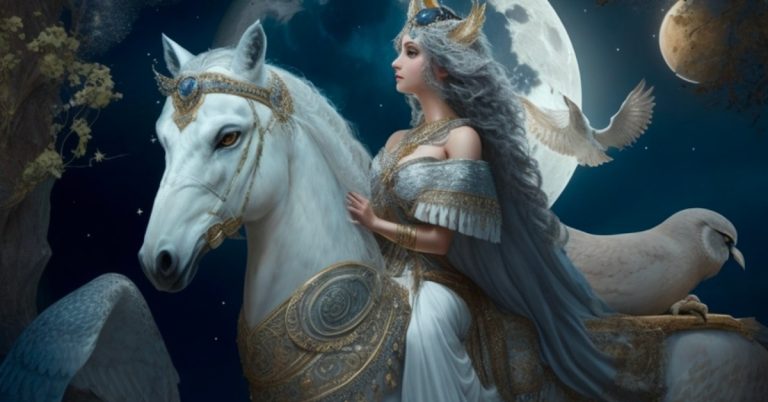
- Riding a large, pale-white horse at an unhurried walk
- Dressed in a shining garment of gold brocade
- Calm and level, never seen to hurry even when pursued
- Beautiful enough that Pwyll forgets his own court while watching her
- Sharp in speech; she scolds both husbands and gets away with it
- In modern art, often shown with three small birds
Abilities
- The uncatchable pace — her horse ambles, yet the fastest horses in Dyfed never close the gap
- Enchantment — the small bag that can never be filled, which traps Gwawl
- Command of the birds — the Adar Rhiannon, whose song wakes the dead and lulls the living to sleep
- Otherworld passage — she crosses from her father’s country into Dyfed and back at will
- Endurance — seven years of penance, borne without breaking
Symbols
- The white horse — her mount, and the oldest clue to who she was
- The birds — three singing birds, far off yet close, in the Second Branch and Culhwch and Olwen
- The bag — the bottomless sack from the wedding feast
- The horse block — the mounting stone by the gate where she served her penance
- Gorsedd Arberth — the mound where she first appears and where the enchantment later falls
Traits
- Decisive; she picks her husband and tells him so
- Quick-witted, with a plan ready before Pwyll has finished panicking
- Blunt to the point of scolding
- Steadfast under accusation, keeping her seat in the hall through seven years of shame
- Loyal to her son past the point of good sense, following him into the fort
Festivals and Rituals
The ancient record is empty. No Welsh or British inscription names Rhiannon, no calendar marks her day, and the Mabinogi describes feasts at her wedding, never worship.
Modern Pagans who honor her work from the story itself. May Eve, Calan Mai in Welsh, is her night: it is when her infant son disappears and when Teyrnon’s mare foals, the two halves of the same mystery. Some also borrow December 18, the feast of the Gaulish horse goddess Epona recorded on a Roman farming calendar from Guidizzolo, on the strength of the link between the two. Both are modern choices, and honest ones, since the medieval text leaves the question open.
Legends associated with Rhiannon
Rhiannon’s story is one long story told in two sittings. The First Branch of the Mabinogi gives her the courtship, the marriage, the lost child, and the penance. The Third Branch, a generation later, gives her a second husband and a second disappearance. Threaded through both, and through two other tales, are her birds.
The rider on the mound
Pwyll, prince of Dyfed, sits one evening on Gorsedd Arberth, a mound with a reputation. Whoever sits there, the story says, will either take a beating or see a wonder. Pwyll takes his chances.
What he sees is a woman on a large, pale-white horse, dressed in shining gold, riding along the road below at a walk. He sends a man on foot to learn who she is. The man never gets near her. The next evening Pwyll brings the fastest horse in the court, and the rider gallops after her until his mount is spent. She never speeds up, and the gap never shrinks.
On the third evening Pwyll rides after her himself, on his own horse, and fares no better. Finally, out of ideas, he calls out and asks her to wait for him.
She stops at once. “I will stay gladly,” she tells him, “and it would have been better for your horse if you had asked long ago.”
Her name is Rhiannon, daughter of Hefeydd Hen, and she has come for him. Her people intend to marry her to a man she has refused, and she has chosen Pwyll instead. She sets the terms: a year from that night, a wedding feast at her father’s court. Pwyll agrees to everything. He has been outridden, outwitted, and proposed to inside a single conversation.
Gwawl and the badger in the bag
The feast is underway when a tall, auburn-haired young man walks in and asks Pwyll for a favor. Pwyll, expansive with wine and happiness, grants it before hearing what it is.
Rhiannon groans. Never did a man make worse use of his wits, she tells him. The stranger is Gwawl son of Clud, the suitor she refused, and the favor he wants is her. A prince’s word binds him, so Rhiannon takes over. She will marry Gwawl a year from tonight, she announces, at this same feast. Then she hands Pwyll a small bag and explains the plan.
A year later Gwawl sits at the head of Hefeydd’s hall. A ragged beggar shuffles in and asks for a modest boon: enough food to fill his little bag. Gwawl, feeling generous, agrees. Servants pour in bread and meat, and the bag stays empty. It will only be full, the beggar explains, when a nobleman of true rank treads the food down with both feet. Rhiannon, beside Gwawl, urges him to get up and do it.
The moment both his feet are in, Pwyll pulls the bag up over Gwawl’s head and knots it shut. He blows his horn. His hundred men, waiting in the orchard, storm the hall. Each one, passing the bag, gives it a kick or a blow with a stick and asks what’s inside. “A badger,” comes the answer. And so, the text says, they invented the game of Badger in the Bag.
Gwawl is released only after swearing to give up his claim to Rhiannon and any thought of revenge. He keeps his word. A friend of his holds the grudge for him, and it comes back a generation later.
The night the child vanished
Rhiannon marries Pwyll and rules Dyfed at his side, and in the third year she bears a son at Arberth. Six women are set to watch over mother and child that night. All six fall asleep, and so does she.
When the women wake before dawn, the cradle is empty.
They understand at once what an empty cradle means for them, and they act to save their own lives. They kill a staghound bitch and her whelps, smear the blood on Rhiannon’s face and hands, and scatter the bones beside her. When she wakes and asks for her son, they tell her, with a great show of horror, that she killed and ate him in the night, and that they fought her and failed to stop her.
Rhiannon knows exactly what is happening. She promises to protect them if they only tell the truth. She swears by God that she will bear no grudge. They refuse. Six voices against one, and the one has blood on her mouth.
The queen at the horse block
The nobles of Dyfed demand that Pwyll put his wife aside. He refuses. She has given him no cause to, he says, and if she has done wrong, let her do penance for it. He leaves the question of guilt hanging and keeps his wife.
Rhiannon chooses penance over a fight she has already lost. The terms: for seven years she will sit each day beside the horse block outside the gate of Arberth, the stone travelers use to mount and dismount. To everyone who arrives she must tell the whole story of what she is accused of. And she must offer to carry each guest on her back into the hall, like a horse.
Almost nobody accepts the ride. The offer itself is the humiliation. And yet the text is careful to add that she still sits beside Pwyll at the feast every night. A queen by the mounting block by day, a queen in the hall by night, saying nothing about the gap between the two.
Readers have pulled two different things from this scene. One is a wronged wife bearing injustice with steel in her spine. The other is a goddess doing what horse goddesses do, carrying riders. Hold on to that second reading; we’ll come back to it.
Teyrnon, the foal, and the boy called Worry
Meanwhile, in Gwent Is Coed to the east, a lord named Teyrnon Twrf Liant has a problem with his mare. She is the finest in the kingdom, and every May Eve she foals, and every May Eve the foal is gone by morning. This year he decides to sit up with her, armed.
The mare drops a fine colt. Teyrnon is admiring it when a huge clawed arm comes through the window and seizes the foal by the mane. He hacks at the arm with his sword, severs it at the elbow, and runs outside to see what he has wounded. The night is too dark, and there is a roaring in the storm. When he comes back to the door he finds a small boy wrapped in satin, left on the threshold.
Teyrnon and his wife raise the child as their own and name him Gwri Wallt Euryn, Gwri Golden-Hair, for the color of his hair. He grows at an unnatural pace, larger at one than most boys at three, and he loves horses. Teyrnon gives him the colt born the same night.
Word travels, and so does the boy’s face. As he grows, Teyrnon sees Pwyll in him, unmistakably, and he has heard what Rhiannon sits by the gate each day and says. He does the honorable thing. He rides to Arberth with the boy. Rhiannon rises from the horse block and offers to carry them in. Teyrnon declines.
At the feast, when Teyrnon tells his story and hands the boy over, Rhiannon’s first words are that if this is true, her worry is at an end. In Welsh the word is pryder, and Pendaran Dyfed, an elder of the court, says it at once: let the boy be called Pryderi. She named him without meaning to, and the name stuck to him for the rest of his life and two more Branches of the story.
Manawydan and the empty land
Pwyll dies, and Pryderi rules Dyfed. The Second Branch takes Pryderi to Ireland with the giant king Brân, and he comes home one of seven survivors. Another survivor is Manawydan son of Llŷr, Brân’s brother, a man left without land after a usurper takes Britain in his absence, and with no appetite for another war.
Pryderi offers him a home and, with it, his mother. He tells Manawydan that Rhiannon is the best conversation he will ever hear from a woman, and that he will find no one finer. Rhiannon, asked, says she will abide by it gladly. The two fall into easy company, and the text says plainly that they take to each other.
Then the four of them, Manawydan and Rhiannon, Pryderi and his wife Cigfa, climb Gorsedd Arberth after a feast. Thunder cracks. A mist falls so thick that none of them can see the others. When it lifts, the land is bare. Every house, every herd, every person in Dyfed is gone. Only the four of them remain.
They live for a while on hunting, then go into England to earn a living by craft: saddles at Hereford, then shields, then shoes, each so fine that the local craftsmen threaten to kill them and they move on. Back in the empty Dyfed, Manawydan and Pryderi follow a shining white boar to a fort that was never there before. Manawydan smells magic and stays outside. Pryderi goes in, finds a marble fountain and a golden bowl hanging from four chains, touches the bowl, and freezes, his hands stuck to the gold and his feet to the floor.
Manawydan waits until evening and goes home alone. Rhiannon’s reply is a whip-crack: a bad companion you have been, and a good companion you have lost. She goes straight to the fort, finds her son, seizes the bowl, and is caught the same way. The mist comes down, and the fort, the bowl, Pryderi, and Rhiannon all vanish.
What follows is one of the strangest rescues in medieval literature. Manawydan, alone with Cigfa, farms three fields of wheat. Mice strip two of them in a night. Guarding the third, he catches one fat, slow mouse and announces he will hang it as a thief on Gorsedd Arberth. A scholar, a priest, and finally a bishop appear on that empty road, each offering more to ransom the mouse. Manawydan refuses every price except one: the release of Rhiannon and Pryderi, and the lifting of the enchantment from Dyfed forever.
The bishop is Llwyd son of Cil Coed, a friend of Gwawl, and the mouse is his pregnant wife. He cast the mist, he explains, to avenge the Badger in the Bag. He gives everything Manawydan asks. Rhiannon and Pryderi walk back out of the air. Where they were, Llwyd admits, Pryderi wore the gate-hammers of the court around his neck, and Rhiannon wore the collars of the asses after they had carried hay.
Twice enchanted, twice yoked like a beast of burden, twice restored. The pattern holds, and it will matter in a moment.
The birds of Rhiannon
The Adar Rhiannon sing in two other tales. In the Second Branch, after Brân’s ruinous war in Ireland, his seven surviving companions sit at Harlech for seven years with his severed head for company, and three birds come and sing to them. The birds seem to be far out over the sea, and yet their song sounds as if they were in the room. In Culhwch and Olwen, the giant Ysbaddaden names them among the impossible things he demands before he will give up his daughter, and describes their power: they wake the dead and lull the living to sleep.
The Mabinogi never explains what the birds are or why they belong to her. Given everything else about Rhiannon, a rider who crosses between worlds, a queen who is twice taken into the air and twice returned, birds that stand at the exact border of sleep and death seem like the right companions.
An older Rhiannon?
Start with the name, because the scribes who wrote the Mabinogi down handed us a clue they may never have noticed. Rhiannon comes from an unattested Brittonic form that linguists reconstruct as Rīgantonā: rīgan-, “queen,” with the -on- suffix that marks divine names elsewhere in Celtic, as in Maponos, Matrona, and Epona. It means something like “Great Queen” or “Divine Queen.” Patrick K. Ford points out that Teyrnon, the foster father of her son, carries the same suffix: Tigernonos, “Great Lord.” Whatever the medieval author thought she was, her name says goddess.
Then look at what the story keeps doing to her. She enters on a horse no one can catch. Her penance is to wait at the horse block and carry people on her back. Her son is born the same night as a foal, both are taken by the same claw, and they are raised together. In the Third Branch she is yoked with the collars of asses. A horse keeps surfacing beneath the queen. The Gaulish horse goddess Epona was worshiped across the Roman Empire by cavalry and carters alike, shown riding side-saddle on a mare or seated between foals, and her dedications sometimes give her the title Regina, “queen.” Across the water, the Irish Macha, often counted as one of the three sisters who make up the Morrígan, is forced while heavily pregnant to race the king of Ulster’s horses; she wins, gives birth at the finish line, and curses the men of Ulster for it. A queen made to run or carry like a horse, wronged around a birth, and vindicated: the shape is the same in Wales and Ireland.
Scholars have built on this. W. J. Gruffydd’s 1953 study Rhiannon argued that the First and Third Branches preserve a broken-up myth of a mother goddess and her divine son. Ford reads her as the horse goddess and the sovereignty goddess in one, the figure a king had to win to rule legitimately; Pwyll, notice, only becomes worthy of her when he stops chasing and asks. Proinsias Mac Cana saw in her the goddess of sovereignty who makes a spouse a lawful king. Miranda Green describes her as two archetypes fused, the bountiful queen and the wronged wife.
There is a dissent, and it deserves its place. Ronald Hutton points out that the Mabinogi is a work of medieval literature, that Rhiannon is attested nowhere before it, and that no inscription or image of Rigantona has ever been found. The goddess is a reconstruction, built from a name and a pattern, and reconstructions can be wrong. Both things can be true at once: the Rhiannon we can read is a medieval queen, and the reasons to suspect a goddess behind her are real reasons.
Rhiannon across cultures
The queen who is also a horse turns up far outside Wales. Epona and Macha are her nearest kin, and the three are often treated as a single Celtic type: a horse-shaped goddess who confers kingship and punishes the king who disrespects her. The pattern reaches farther. In Arcadia, Pausanias describes a Demeter worshiped at Phigalia with a horse’s head, who fled Poseidon in the form of a mare and bore him a daughter and a divine horse. In the Rigveda, Saranyu, wife of the sun, turns herself into a mare and in that form bears the twin horsemen, the Ashvins. Divine mothers who become horses, and horse-mothers whose children are half wonder, are older than any one people.
She has an Irish sister of a different kind, too. Brigid crossed from goddess into a Christian saint’s legend and kept her fire lit through the change; Rhiannon crossed into secular literature and kept her horse. Both survived by being written down as something other than a goddess. Fleetwood Mac gave Rhiannon a third life in 1975, when Stevie Nicks wrote a song around a name she had picked up from a novel, and only afterward learned the Welsh story; she has said the match unsettled her. It usually does.
Final thoughts
Everyone who chases Rhiannon loses her. The one man who asks gets scolded and then married, and it is the best decision of his life.
That’s the story in a sentence, and it holds all the way through. She sets her own terms, she pays a price she never owed without giving up her seat, and she walks back out of the mist with her dignity in one piece and a sharp word ready for her husband. Goddess or queen, medieval invention or something far older, she is the rider on the road who slows for courtesy and for nothing else.
Which reading of the horse block sits better with you: the wronged wife holding her ground, or the goddess doing what she was always for?
Bibliography
- Davies, Sioned, trans. The Mabinogion. Oxford World’s Classics, 2007.
- Guest, Lady Charlotte, trans. “Pwyll Prince of Dyfed”. Celtic Literature Collective.
- “Manawydan, Son of Llŷr: The Third Branch of the Mabinogi”. Mabinogi.net.
- Gruffydd, W. J. Rhiannon: An Inquiry into the Origins of the First and Third Branches of the Mabinogi. University of Wales Press, 1953.
- Ford, Patrick K. The Mabinogi and Other Medieval Welsh Tales. University of California Press, 1977.
- Green, Miranda. Celtic Goddesses: Warriors, Virgins and Mothers. British Museum Press, 1995.
- Hutton, Ronald. Pagan Britain. Yale University Press, 2013.
- “Rhiannon”. Encyclopaedia Britannica.
- “Rigantona: The Theoretical Goddess”. We Are Star Stuff.
- “Rhiannon”, “Adar Rhiannon”, and “Manawydan fab Llŷr”. Wikipedia.
- “Epona” and “Macha”. Wikipedia.
- “Despoina” and “Saranyu”. Wikipedia.