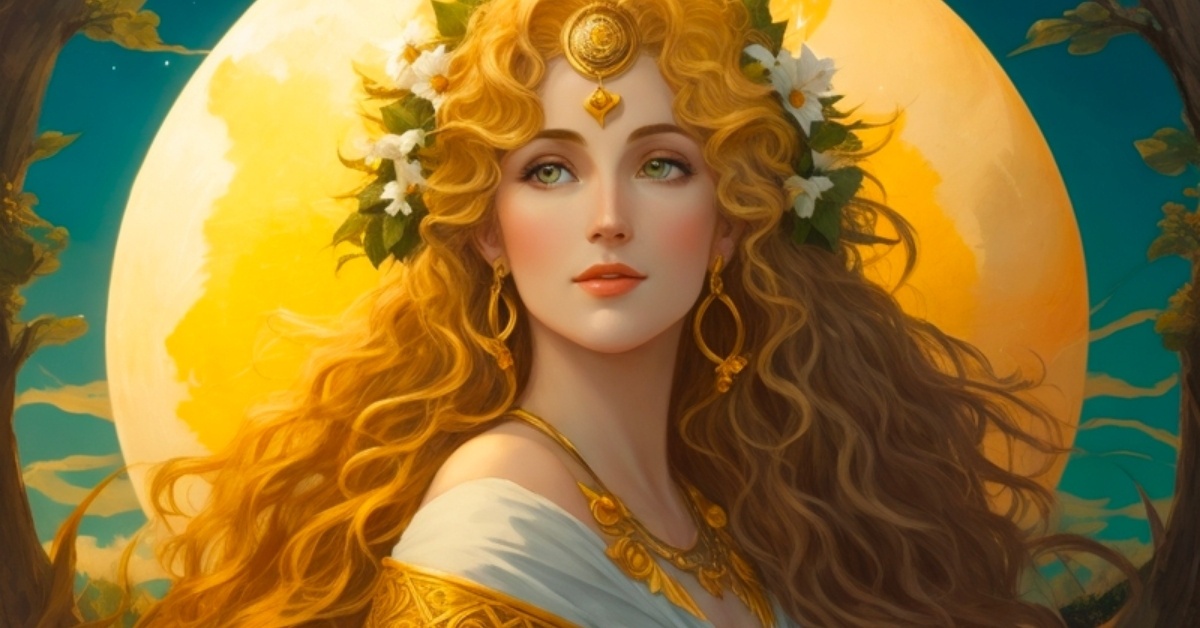
Áine: The Irish Goddess of Midsummer and Sovereignty
A ninth-century Munster storyteller needed to explain why one of the province’s founding kings had a ruined ear. His answer begins on a hill at Samhain. Ailill, the ancestor of the dynasties that would rule the south of Ireland for the better part of a thousand years, had put his horses out to graze there, and twice the grass was stripped to the roots overnight, the culprit unseen. He went up to watch. Out of the hill came its king, Eógabal, and behind him his daughter, playing a bronze harp. Ailill’s poet killed the father. Ailill raped the daughter. She took hold of his ear and tore it so that neither flesh nor skin was ever on it again, and she told him that when they parted she would leave him nothing to answer her with.
The daughter was Áine, and the hill was hers. It is still called Knockainey, Cnoc Áine, in County Limerick, and until the late nineteenth century the farming families around it climbed it on Midsummer Eve with burning straw tied to poles and carried her fire down through their crops and among their cattle. A goddess who maims a king and a goddess who blesses the hay are the same woman. The distance between those two pictures is where most of her story lives.
Overview of Áine
Áine (pronounced AWN-ya) belongs to the Tuatha Dé Danann, the god-race of Irish myth who withdrew into the hills and became the people of the sídhe, the fairy mounds. Her name is an ordinary Irish word: áine means brightness, radiance, splendor. The medieval texts make her the daughter of Eógabal, king of the fairy mound at Knockainey, and the sister of Fer Í, a harper whose three strains of music, weeping, laughter, and sleep, set off a war later in her story. Eógabal is sometimes called a foster son of the sea god Manannán mac Lir, and a few later tellings make Áine Manannán’s own daughter or wife.
Her country is east County Limerick, the rich grassland known as the Golden Vale. Knockainey stands a few miles from Lough Gur, the horseshoe lake where people have farmed since around 3000 BCE and where Ireland’s largest stone circle stands at Grange. The medieval genealogists made Áine the ancestress of the Eóganachta, the dynasty that held the kingship of Munster for most of the first millennium and survived as kings of Desmond into the sixteenth century, and one branch of that family, the Eóganacht Áine, took its name from her hill. When the Norman FitzGeralds, Earls of Desmond, took the same land in the thirteenth century, local storytellers married them to her as well.
In the folklore recorded from the eighteenth century onward she is the fairy queen of Limerick, the bean sí of the FitzGeralds, a woman seen combing her hair at the edge of Lough Gur, and, in the words of the country people interviewed in 1879, “the best-hearted woman that ever lived.” Her name sits on wells, forts, and hills from Donegal to Louth, though scholars are divided on whether every Áine on the map is this one.
Titles
- Áine Chlíach, Áine of Cliu, after the old territory around her hill
- Daughter of Eógabal, in the Cath Maige Mucrama and the Cóir Anmann
- Ancestress of the Eóganachta, the royal dynasty of Munster
- Queen of the fairies of Limerick, her title in local folklore
- Bean sí of the FitzGeralds, Earls of Desmond
- Áine of Knockainey, Cnoc Áine
Characteristics
How the saga, the genealogies, and the Limerick storytellers describe her:
- A musician, carrying a bronze harp when she first steps out of the hill
- Unforgiving when wronged: the ear she tears off and the curse she speaks are her first recorded acts
- A mother of kings, by Ailill in the medieval texts and by a FitzGerald earl in the later ones
- Generous to the land and the people who work it
- Seen on her own terms, letting chosen girls watch her troop through a ring while everyone else sees an empty hill
Symbols
- The hill — Knockainey, with its ring barrows on the summit
- The straw torch — the clíar carried in procession on Midsummer Eve
- The lake — Lough Gur, where she combs her hair and the earl sleeps
- The harp — the instrument she and her brother carry out of the mound
- The ear — the mark she left on a king
Legends associated with Áine
Áine’s stories come in two layers written roughly a thousand years apart. The older is a dynastic saga of the ninth century, copied into the Book of Leinster, which explains how the kings of Munster came to exist. The younger is the folklore of Limerick, collected mostly in the nineteenth and twentieth centuries, in which she is a fairy queen married into a Norman family. The second layer retells the first with new names, and reading them side by side shows how a local goddess outlived two ruling houses.
The hill stripped bare at Samhain
The Cath Maige Mucrama, the Battle of Mag Mucrama, opens with the scene from the top of this post. Ailill, king of Munster, pastures his horses on Áne Chlíach at Samhain, and the hill is grazed bare in the night. It happens a second time. Ailill sends for the poet Ferchess mac Commáin, and the two of them wait on the hill on the next Samhain night, Ailill on the summit and Ferchess posted outside.
Eógabal, king of the sídhe, comes out of the mound with his daughter, who is playing a harp of bronze. Ferchess strikes Eógabal as he passes and breaks his back. Ailill seizes Áine. In the saga’s words, she strikes his ear “so that she left neither flesh nor skin upon it, and none ever grew upon it from that hour,” and she tells him: “I will outrage thee for this. I will not leave thee a reprisal when we shall part.” From that night he is Ailill Ólom, Bare-ear, and the name stuck to him through every later king-list.
A later text, the Cóir Anmann or “Fitness of Names,” gives her a fuller speech. “Thou hast killed my father tonight, O Ailill,” she says, “and there on thee is my share of vengeance for my father.” It adds that when Ailill drove his spear into the ground afterward, its point struck stone, and the poisoned blade left him with a blackened tooth and foul breath, blemishes that in Irish tradition unfit a man for kingship. The storytellers knew exactly what they were doing. The founding king of Munster carries, in his own body, the marks of the goddess he wronged.
The harper in the yew tree
Áine’s son by Ailill is Eógan, and the saga follows him into the war that gives it its name. Eógan and his foster brother Lugaid Mac Con are out walking when they hear music coming from a yew tree above a waterfall. In the tree sits a small man with a harp of three strings. He is Fer Í, son of Eógabal, Áine’s brother. He plays the strain of weeping and they weep; he plays the strain of laughter and they laugh until they are helpless; he plays the strain of sleep and they sleep until the next day.
When they wake, Lugaid claims the music and Eógan claims the musician, and they bring the quarrel to Ailill, who rules for his own son. Lugaid goes into exile, raises an army in Scotland, and returns to fight at Mag Mucrama in Connacht. Eógan dies in the battle. His son Fiachu, born after his death, carries the line forward, and from Fiachu descend the Eóganachta. In the saga’s own logic, a dynasty was founded on a rape, judged by a mutilated king, and broken on the music of the victim’s brother. Áine’s curse that she would leave Ailill no reprisal plays out across two generations.
The earl who took her cloak
Seven centuries after the saga was written, the people of Limerick were telling the story again, and the king had become a Norman earl. In the folk cycle collected by Dáithí Ó hÓgáin and others, Maurice FitzGerald, first Earl of Desmond, comes upon Áine bathing in Lough Gur, or in the river Camóg that feeds it. He takes her cloak from the bank. Whoever holds the cloak holds her; without it she is bound to the land. He forces her to become his wife, and she bears him a son, Gearóid, on one condition: his father must never show surprise at anything the boy does.
The son was a real man. Gerald FitzGerald, third Earl of Desmond (c. 1335–1398), was Lord Justice of Ireland and one of the earliest Norman lords to compose poetry in Irish; his poems survive in the fifteenth-century Book of Fermoy under the name Gearóid Iarla, Earl Gerald. In the story, he grows up with his mother’s gifts. At a feast at the castle, he leaps into a bottle and out again, or shrinks himself to nothing and back, and his father cries out in astonishment. The condition is broken. Gearóid walks out of the hall, down to the water, and either turns into a goose on the Camóg or walks straight into Lough Gur and stays beneath it.
The historical earl vanished in 1398, and the folklore has kept him under the lake ever since. Every seven years he rides out at night around the shore on a white horse shod with silver, and when the shoes are worn thin he will come back for good. Some versions of the tale add a second ending in which Áine takes her revenge on the earl himself, changing him into a goose, killing him, or both. Others have her enchant the hillside of Knockainey afterward so that a field of peas springs up overnight. The storytellers disagreed about the earl, the river, and the ending. They agreed that the Geraldines, like the Eóganachta before them, held their land because a goddess had borne one of them a son.
Midsummer on the hill
The rite that kept her name alive was recorded in the summer of 1879 by a folklorist named David Fitzgerald, writing in the Revue Celtique, and repeated by W. Y. Evans-Wentz in his 1911 survey of the fairy faith. On St John’s Eve, the night of June 23, the people of the district gathered on the summit of Knockainey, in Evans-Wentz’s phrase, “to view the moon.” Then they lit clíars, bunches of straw and hay tied to poles, and carried them in procession around the hill. Afterward they ran with the burning torches through their own fields and among their cattle, to bring luck for the year.
Two stories attached to the custom. In one, a group of girls stayed late on the hill, and Áine herself came up to them and asked them to go home, because her people wanted the hill to themselves. She held up a ring and let them look through it, and the hill they had thought was empty was crowded with the folk of the sídhe. In the other, the procession was skipped one year because of a death in the neighborhood, and that night the people below saw the torches moving on the hill anyway, more of them than ever, with Áine walking at the front.
Those are the last firsthand accounts of a goddess receiving fire on her own hill in Ireland. The custom was still remembered in 1911. It has since lapsed, though Midsummer bonfires continue elsewhere in the country.
Sun goddess, sovereignty goddess, or fairy queen?
Modern writers call Áine three different things, and the sources support each of them to a different degree.
The first reading makes her a goddess of sovereignty, the woman who embodies a territory and confers the right to rule it. The pattern is consistent across both layers of her story. She mates with the founding ancestor of the Eóganachta and bears the heir; when the FitzGeralds take the same land, she mates with their founder and bears his heir too. The folklorist Patricia Lysaght, whose study of the banshee remains the standard work, groups Áine with Clíodhna of Cork and Aoibheall of Clare as a triad of Munster land-goddesses, each tied to a district and to the family that ruled it, each remembered later as a fairy queen whose keening foretells a death in the house. Ó hÓgáin reads the FitzGerald cycle the same way: an incoming family borrowing the native goddess to legitimize its hold on her land. Marie-Louise Sjoestedt’s 1940 study treated the goddesses of Ireland as local mother-goddesses of territory and fertility, and Áine, with her hill, her cattle rite, and her royal sons, fits that description closely.
The second reading makes her a sun goddess. Her name means brightness, her festival is Midsummer, and her rite was fire. Seven miles from Knockainey stands another hill, Cnoc Gréine, named for Grian, whose name is the Irish word for the sun; some writers read Áine and Grian as sisters or as two faces of one goddess, the bright half and the dark half of the year, on the model of Brigid and the Cailleach. The case rests on names and on the calendar. The medieval texts are silent on the sun, and the one detailed account of her rite says the crowd gathered on the hill to look at the moon before they lit their torches, which complicates the picture. The broader question has its own home in this site’s survey of sun goddesses.
The third reading takes the recorded sources at their word. Every text that names her title calls her a woman of the sídhe, a fairy queen, or a bean sí. The word “goddess” is a modern inference from the pattern, and some scholars prefer to stop at what the Irish themselves said. The same caution applies to the attempt to fold her into Anu or Danu, the mother of the Tuatha Dé Danann, a connection many commentators have felt and that still waits for proof.
What the record holds is a woman who came out of a hill with a harp, maimed a king, mothered two dynasties, and was still being given fire in 1879. Each of the three readings explains part of that. The whole of her outruns all three.
Áine and the goddesses of the land
Ireland is full of goddesses who are also places. Boann is the river Boyne; Clíodhna is a wave in Glandore harbor; the Morrígan has a pair of hills in County Meath, Dá Chích na Morrígna, named as her breasts. Áine is a hill, and more than most of her sisters she kept a living rite attached to it. Where Brigid survived the coming of Christianity by becoming a saint, Áine survived by becoming a fairy queen, and her hill’s Midsummer fire was folded into the eve of St John the Baptist.
Her stolen cloak has cousins far beyond Ireland. A man who takes a supernatural woman’s garment and so compels her to marry him is the swan-maiden story, told of selkies in Scotland, of the lake-woman of Llyn y Fan Fach in Wales, and of the celestial bride in Japan. Her closest relative is Mélusine of Lusignan in France, the fairy who founds a noble house, bears it gifted children, and leaves it when her husband breaks the one prohibition she set. Áine and Mélusine are both ancestress-goddesses adopted by medieval dynasties that needed an older claim to their land than a charter could give.
The Midsummer fire travels too. Bonfires on St John’s Eve were lit across Europe, from Brittany to Scandinavia to Spain, and running cattle and torches through the fields for luck is attested far outside Limerick. What is unusual about Knockainey is that the fire had a woman’s name on it, and that the people who carried it could tell you whose hill they were standing on.
Final thoughts
The king lost his ear and kept his throne. That is how most of the old stories about Áine end, and it is easy to read them as the goddess losing. Read them from the other side and the balance shifts. The dynasty that descended from Ailill carried her name in one of its branches and claimed her as its mother. The Norman family that replaced them did the same. The farming families who followed both carried her fire through their fields for as long as anyone was writing it down. Every ruling house in that corner of Munster, for a thousand years, leaned on her harder than she ever leaned on them.
The hill is still there, a few miles from Lough Gur, with the ring barrows on top and a nineteenth-century church dedicated to St John at its foot. When a people keeps carrying fire to a goddess long after they have stopped calling her one, who is it that has really changed?
Bibliography
- O Daly, Máirín, ed. and trans. Cath Maige Mucrama: The Battle of Mag Mucrama. Irish Texts Society 50, 1975; text and translation online at Irish Sagas Online, University College Cork. The Samhain scene on Áne Chlíach, the ear, Áine’s curse, Fer Í’s three strains, and the battle.
- Stokes, Whitley, ed. and trans. Cóir Anmann: Fitness of Names. In Irische Texte III.2, 1897. Áine’s speech to Ailill, the spear against the stone, and the blemishes of the king.
- Fitzgerald, David. “Popular Tales of Ireland.” Revue Celtique IV (1879–80), pp. 185–200, esp. 187–88. The St John’s Eve clíars on Knockainey, the girls and the ring, Áine combing her hair at Lough Gur, and “the best-hearted woman that ever lived.”
- Evans-Wentz, W. Y. The Fairy-Faith in Celtic Countries. Oxford University Press, 1911, p. 81. The procession “to view the moon,” the torches through the fields and cattle, and the year the rite lapsed.
- Ó hÓgáin, Dáithí. The Lore of Ireland: An Encyclopaedia of Myth, Legend and Romance. Boydell Press, 2006. The FitzGerald cycle: the cloak, Gearóid Iarla, the goose, Lough Gur, and the seven-year ride.
- Lysaght, Patricia. The Banshee: The Irish Supernatural Death-Messenger. Glendale Press, 1986. Áine, Clíodhna, and Aoibheall as Munster land-goddesses attached to ruling families.
- MacKillop, James. A Dictionary of Celtic Mythology. Oxford University Press, 1998. Etymology, Eógabal and Fer Í, Manannán, Grian, and the sites that carry her name.
- Sjoestedt, Marie-Louise. Gods and Heroes of the Celts. Trans. Myles Dillon. Methuen, 1949 (French original 1940). The goddesses of Ireland as local mother-goddesses of territory and fertility.
- Byrne, Francis John. Irish Kings and High-Kings. Batsford, 1973. The Eóganachta, the Eóganacht Áine, and the dynastic purpose of the Mag Mucrama saga.
- “Ailill Ólom”. Dictionary of Irish Biography, Royal Irish Academy. The saga tradition and Ailill’s place in the Munster king-lists.
- “Gerald FitzGerald, 3rd Earl of Desmond”. Wikipedia. His dates, his Irish poetry in the Book of Fermoy, his disappearance in 1398, and the sleeping-earl legend.
- “Lough Gur”. Wikipedia. Settlement from c. 3000 BCE, the Grange stone circle, and Gearóid Iarla’s silver-shod horse.
- “Knock Áine”. Voices from the Dawn. Field description of the hill, the Fitzgerald and Evans-Wentz passages in context, and the leaping-contest version of Gearóid’s disappearance.
- “Áine”. Wikipedia. Survey of the attestations, the variants of the FitzGerald tale, and her Ulster place-names.