Hecate: Goddess of Magic, Witchcraft, and the Night
Zeus overthrew the Titans and stripped most of them of everything. Hecate, he left alone. He gave her a share of earth, sea, and sky, and honored her, Hesiod says, “above all.”
That’s strange enough to notice. Stranger still: this is the same goddess later ages would push to the crossroads at midnight, keys in hand, dogs at her heel, and call the patroness of witches. Two very different goddesses, and both of them are Hecate.
Here’s the one behind the torches.
Overview of Hecate
Hecate rules an unusually wide territory for a single goddess: magic and witchcraft, the moon and the night, the crossroads and the threshold, the restless dead, and, in her oldest attested form, success in war, at the hunt, in court, and at sea. Ancient devotees invoked her over all of it.
Her cult’s roots may not even be Greek. The clearest concentration of names built from hers turns up among the Carians of ancient Anatolia, and philologists who doubt a Greek origin for her name have proposed she came into the Greek world from there, adopted rather than native. Whatever her origin, by the Archaic period she was fully at home in Greek religion, worshipped at doorways and crossroads across the Mediterranean.
Her name’s own meaning is still argued over. Some trace it to hekōn, “willing,” others to Hekatos, an old epithet of Apollo meaning “the far-reaching one.” Neither has won the argument outright.
Titles
- Trioditis / Triodia (“of the three ways,” the crossroads goddess)
- Kleidouchos (“keeper of the keys”)
- Phosphoros (“light-bringer”)
- Soteira (“savior”)
- Nyktipolos (“night wanderer”)
Characteristics
How Hecate tends to be shown in art:
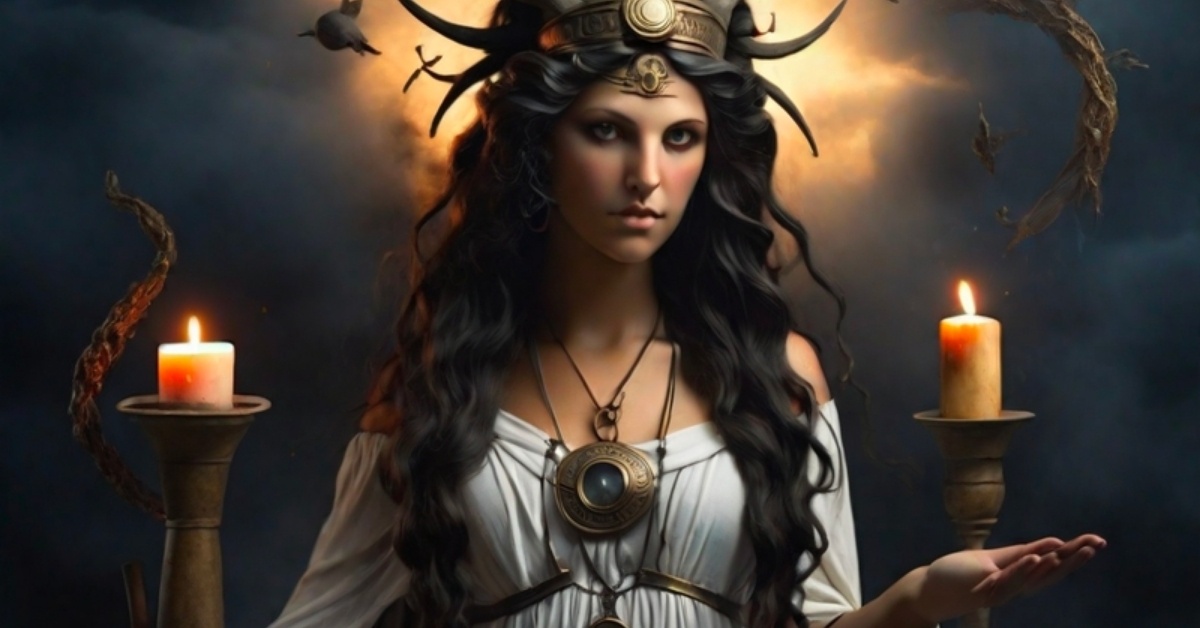
- In her earliest images, a single figure, most often carrying twin torches
- From around the 5th century BCE onward, standing three-formed and three-faced, back to back to back, a shape unique to her among the Greek gods
- A key in one hand, marking her as guardian of doors and passages
- Dogs at her side, her most constant animal companion
- Sometimes shown with a rope or leash of serpents, or crowned with them
Abilities
- Command over magic and witchcraft — the source and teacher of the arcane arts, invoked by every practitioner who came after her
- Guardianship of thresholds — doors, gates, city walls, and crossroads all fall under her protection
- Power in the Underworld — free passage between the world of the living and the world of the dead
- Command of ghosts — she leads the restless dead and the creatures of the night
- Lunar and nocturnal power — dominion over the moon and everything that moves after dark
Symbols
- The torch — her signature attribute in every period, a light carried into the dark rather than kept from it
- The key — the mark of a goddess who can open what is shut, especially the gate between the living and the dead
- Dogs — her most sacred animal, kept as watchers and said to herald her approach with their howling
- The crossroads — three roads meeting at once, the place her triple-formed statues, the Hekataia, stood watch over the intersections of ancient cities
Traits
- Rewards those who honor her and turns sharply against those who don’t
- Neither wholly benevolent nor wholly malevolent, closer to a force to be respected than a character to be liked
- Fiercely protective of thresholds and of the boundaries between worlds
- Solitary by nature, most at home at night and at the edges of things
- A teacher: myth casts her as the source that later witches and sorceresses, mortal and divine, learn from
Festivals and Rituals
Hecate’s central rite was the Deipnon, her monthly supper, held on the night of the dark moon. Households set out offerings, cakes, bread, fish, eggs, and honey among them, at crossroads shrines by the front door. The meal fed Hecate and the restless dead who traveled in her company, and it did double duty: honoring the goddess while placating the dead who “longed for vengeance,” and clearing the house of the month’s accumulated wrongs before the new moon began.
Hecate’s presence at doorways came permanently housed in the Hekataia, the three-bodied statues set up at city gates and private thresholds across the Greek world, standing guard where three roads or three ways of the world (the living, the dead, the divine) came together.
Legends associated with Hecate
Hecate’s myths return again and again to the same idea: she stands where paths cross, and she is with you exactly when no one else can be.
A Titan Zeus didn’t dare touch
Hecate’s parentage is contested even within antiquity. Hesiod’s Theogony names her daughter of the Titan Perses and the star-goddess Asteria, sister of Leto. Later writers gave her other parents, in one version making her Zeus’s own daughter by a Titaness who shared her name.
What every version agrees on is what happened next. When the Olympians overthrew the Titans, most of that older generation lost their power along with the war. Hecate didn’t. Hesiod says Zeus “honored her above all” and let her keep her portion of earth, sea, and heaven, granting favor to whoever she chose in war, in sport, in court, at sea, at the hunt. It’s the kind of privilege Hesiod otherwise reserves for Zeus’s own children, handed instead to a Titan he had every reason to sideline.
The only one who heard her
The Homeric Hymn to Demeter gives Hecate her best-known story, the one that would define her for millennia after.
When Hades tore the earth open and dragged Persephone down into the Underworld, the girl screamed for help. Nearly every god in the sky was too far, or too indifferent, to notice. Only two beings heard her: Helios, the sun who sees everything, and Hecate, listening from her cave.
For nine days Demeter searched the earth for her daughter, refusing food, refusing rest. On the tenth, Hecate came to her carrying a torch, and told her all she’d heard, though not who had taken her. It was Helios who finally named Hades. But it was Hecate who stayed. When Persephone was finally allowed to return each spring, Hecate became her companion and guide, walking beside her on the twice-yearly journey between the world above and the world below, “minister and companion” from that day forward. The two roads Hecate rules, the road down and the road back, met, in the end, in one goddess who never let go of the girl she’d heard crying.
Against Clytius, at the side of the gods
Hecate is counted among the Olympians’ allies in the Gigantomachy, the war against the earth-born Giants who rose to unseat them. Wielding her torches as weapons, she is credited with striking down the Giant Clytius, standing on the side of the gods she had once outranked as a Titan.
The witch’s teacher
By the classical period, Hecate had become the source every witch in Greek myth answered to, and her most famous student was Medea. In Apollonius of Rhodes’ Argonautica, Medea is a priestess of Hecate, taught by her directly in the arts of poison and spell.
The epic gives Jason himself a taste of what dealing with Hecate demanded. Before his trial, Medea instructs him to bathe at midnight, dress in dark robes, dig a pit, and burn a ewe there as a whole offering, pouring out honey after it, then walk away without looking back, “even if he hears the sound of footsteps or barking dogs.” Every element of the rite, the midnight hour, the pit dug into the earth, the command never to look back, marks Hecate as chthonic in the fullest sense: a goddess reached only through the ground, and only by those willing not to look at what answers.
An older Hecate?
Hecate’s dogs have their own myth, and it points somewhere unexpected.
Later writers tell of Hecuba, the queen of Troy, enslaved and grieving after the city’s fall, who threw herself into the sea rather than live in bondage. Hecate transformed her mid-fall into a dog, one of the very hounds that would come to walk at the goddess’s own side. A queen becomes a goddess’s familiar; grief and transformation sit at the center of the story, the same way they sit at the center of Hecate’s whole cult.
That pattern, a goddess who governs the crossing from one state into another, from queen to hound, from the world above to the world below, from one moon to the next, is what later writers on the Great Goddess have pointed to in Hecate specifically. Sjöö and Mor’s The Great Cosmic Mother reads her as the Crone face of the old maiden-mother-crone triad, tied to the dark of the moon, standing at the far end of a cycle every other goddess in the book runs through in miniature. The three-bodied Hekataia that stood at Greek doorways may be the same idea in stone: not one goddess but the whole arc of a life, kept watch at the one place, the door, where every arc has to pass.
Hecate across cultures
The Romans folded Hecate into their own crossroads goddess, Trivia, whose very name means “three roads” and who took over guardianship of intersections across the Roman world. It’s less a borrowing than a recognition: two cultures independently decided that the place where three roads meet needed a goddess standing in it.
That instinct, a guardian posted at the threshold, turns up again in an unrelated tradition. Among the Sami of the Nordic Arctic, Uksákká, the “Door Wife,” keeps her own post beneath the entrance to the home, watching over everyone who crosses it, especially at birth. Neither goddess owes the other anything. But two peoples with no contact between them both decided the doorway was sacred ground, and both put a goddess there to keep it.
Final thoughts
Hecate is the goddess you find at the point where one thing becomes another: maiden into crone, night into day, the living into the dead, a queen into a hound. She was honored above the other Titans when Zeus had every reason to cast her down, and she was the only one who heard a girl scream from the dark. Torch in hand at every doorway, she still marks the places where something is about to change.
Bibliography
- Hesiod. Theogony, on Hecate’s honors after the Titanomachy. Trans. via Theoi.
- “Homeric Hymn to Demeter”. Internet Sacred Text Archive.
- Apollonius of Rhodes. Argonautica, on Medea, Hecate, and Jason’s rite. Trans. via Theoi.
- Atsma, Aaron J. “Hecate (Hekate)”. Theoi Greek Mythology.
- Cartwright, Mark. “Hecate”. World History Encyclopedia.
- Kapach, Avi. “Hecate”. Mythopedia.
- Sjöö, Monica, and Barbara Mor. The Great Cosmic Mother. HarperOne.
- “Hecate”. Wikipedia.