Ran: Norse Goddess of the Sea and the Drowned
Somewhere under the North Atlantic there is a hall, and every sailor who ever slipped beneath the waves is sitting in it.
That was the Norse belief, and the woman who keeps the hall is Ran. She has a net, and she goes out and gets her guests herself.
Her husband throws the finest feasts the gods ever attended. Ran handles the guest list from the other end.
Overview of Ran
Ran, spelled Rán in Old Norse, is the goddess of the sea’s depths and of everyone who dies in them. She and her husband Aegir (Ægir) are a matched pair. Aegir is the ocean as host: the calm surface, the brewing, the golden hall where the gods come to drink. Ran is the ocean as taker. Between them they are the whole sea, the part that feeds you and the part that keeps you.
She belongs to the giants rather than the Aesir, which puts her among the old powers that were there before the gods and will still be there after them. The gods accepted her hospitality all the same. They visit Aegir’s hall under the sea more than once in the surviving poems, and they do so as guests, on friendly terms.
Her name is her job description. In Old Norse, rán is a common noun meaning robbery, plunder, or theft. Scholars from Rudolf Simek to John Lindow read the goddess as “the robber,” and the poets treated her the same way. When a skald wanted to say a man drowned, he said the man had gone to Ran.
Her home, as far as the poems place it, is under the sea near Hlesey, the Danish island now called Læsø. It is named for Aegir under his other name, Hler, so the Danes gave the sea-giant an island in the same way they gave Gefion the whole of Zealand.
Titles
Every title Ran has comes from the poets. These are the names they built out of her:
- The Robber (the plain sense of rán)
- Wife of Aegir, the sea-giant
- Mother of the nine waves
- “Ran’s land,” “Ran’s bed,” and “Ran’s road,” all kennings for the sea itself
- “Ran’s fire,” a kenning for gold
Characteristics
The sources describe her hardly at all, so her look comes down to us mostly through later art:
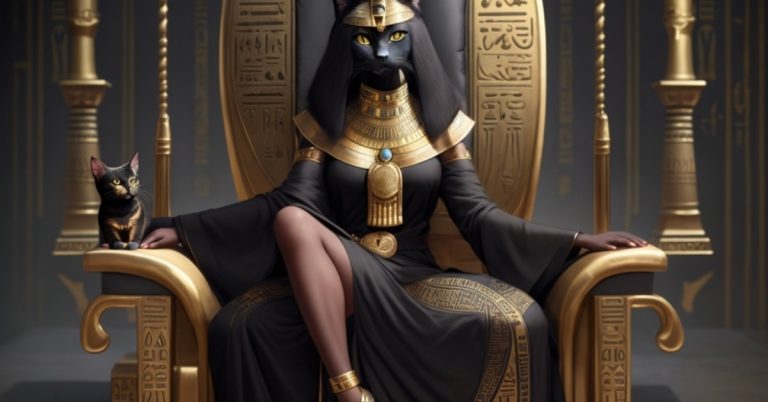
- A woman of the deep water, often shown pale or sea-green, with long hair loose in the current
- Always with her net, held open or already cast
- Sometimes crowned or ringed with pearls, coral, and gold, the wealth of every wreck
- Nine daughters around her, each one a wave
Abilities
- The net — her defining tool; she catches sailors in it and drags them to the bottom
- Rule over the drowned — the dead of the sea go to her hall and stay there
- The storm’s edge — with her daughters she raises the seas that sink ships
- Wealth — every gold ring that ever went down with a ship belongs to her
Symbols
- The net — so tied to her that Loki has to borrow it when he needs one
- Gold — carried by sailors as her price, and kenned as the fire of the sea
- The wave — her nine daughters personified as breakers, foam, and swell
- The drowned — her guests, and the reason her name meant robbery
Traits
- Grasping, in the literal sense: she takes and she keeps
- Hospitable in her own fashion, welcoming the drowned who come bearing gold
- Impersonal as weather; she takes whoever the storm hands her
- Loyal to her husband and her daughters, the three of them forming one sea
Festivals and Rituals
Ran’s worship survives as a handful of customs, and they all come down to the same fear.
The best documented is carrying gold. A Norse sailor who thought he might drown wanted gold on his body when he went, because those who arrived in Ran’s hall empty-handed got a poorer welcome than those who came with a gift. In one saga a captain in a killing storm breaks up a gold ring and hands a piece to every man aboard so that each of them goes to Ran with a gift. Gold as a bribe to the sea is the reason the poets could call it “Ran’s fire” and be understood.
There was also a belief about the funeral ale, the feast held for a dead man. If the drowned showed up at their own, it was a good sign. It meant Ran had received them well.
Modern Heathens who honor her tend to do it at the shoreline, with offerings of gold-colored things, coins, or drink given to the water. That practice is new, and the people who follow it generally say so.
Legends associated with Ran
Ran appears in the sources the way the sea appears in a sailor’s life: at the edges, in moments of danger, and always with a cost attached. Her stories are short and they are scattered, but put together they show a goddess who is on a first-name basis with the gods and who takes what she is owed from everyone else.
The feast under the sea
Aegir came up to Asgard once, and the gods entertained him so well that he invited them back.
His hall lay under the water off Hlesey, and when the gods came down to it they found it lit without a single fire. Shining gold was carried in and set around the benches, and it threw light the way flames do. The ale poured itself. From that night on, the skalds could call gold “the fire of Aegir,” “the fire of the sea,” or “Ran’s fire,” and every listener would picture that hall.
The gods came back more than once. One time Aegir needed a kettle big enough to brew for all of them, and Thor and Tyr went to fetch one from the giant Hymir, which is a whole story on its own. Another time Loki walked in uninvited, killed a servant out of spite, got thrown out, walked back in, and insulted every god and goddess at the table one by one. Ran stays out of that quarrel. She and Aegir kept serving.
That is the setting to hold onto. The hall of the sea is a place of gold, light, and drink, and the gods are at home there. When the Norse imagined the drowned going to Ran, this is the hall they had in mind.
Loki borrows the net
The most famous gold hoard in Norse legend, the cursed treasure that would one day belong to the dragon Fafnir and the hero Sigurd, was fished out of a river with Ran’s net.
Odin, Hoenir, and Loki were traveling together when they came to a waterfall. An otter sat on the bank eating a salmon, and Loki killed it with a thrown stone. He was pleased with himself, since he had caught an otter and a salmon with one throw. The otter turned out to be Otr, the shape-shifting son of a farmer named Hreidmar, and when the three gods carried the skin to Hreidmar’s house looking for a night’s lodging, they had walked into a blood-debt.
Hreidmar’s price was this: fill the otter’s skin with gold, then cover it on the outside until not a hair showed.
Loki went to find that much gold, and he went to Ran first. He borrowed her net. Then he went back to the waterfall, where the dwarf Andvari lived in the shape of a pike, and cast the goddess’s net into the pool. He hauled the dwarf out and made him hand over everything: all his gold, and last of all a ring Andvari begged to keep. Loki took the ring too. Andvari laid a curse on it, that the ring and the gold would be the death of whoever owned them.
Hreidmar got his gold. His son Fafnir killed him for it and became a dragon. Sigurd killed the dragon and took the hoard, and the curse followed the gold through the rest of the Volsung story.
It began with Ran’s net. The one tool she owns is the one that pulls wealth up from under the water, and the one that pulls sailors down into it. The poets used it both ways.
Sigrún and the claws of Ran
The hero Helgi Hundingsbane once took a fleet to sea and sailed straight into Ran.
The Poetic Edda describes the storm through her family. The waves that struck the keels are “Kolga’s sisters,” Kolga being one of the nine daughters, and the sound they made was like cliffs breaking under surf. Helgi ordered the sails hoisted higher and his crews did not flinch, though “Aegir’s daughters” were doing their best to sink the ships.
Then help came from above. The valkyrie Sigrún, who loved Helgi, rode down over the fleet and protected it, and the poem says Helgi’s ship came “mightily out of the claws of Ran.”
In one stanza you get the whole household at work: the daughters raising the seas, the mother reaching up with her net, and a ship that was already hers being pulled back out of her grip. The Norse sailor who heard this poem knew exactly what it felt like.
Egil’s grief
The oldest personal voice we have on Ran belongs to Egil Skallagrimsson, the Icelandic poet, and he speaks of her as a man speaks of someone who has robbed him.
Around the year 960, Egil’s son Bodvar drowned in a storm in the fjord near home. Egil found the body, carried it to his father’s burial mound, and laid it there. Then he went into his bed-closet, shut the door, and set out to starve himself to death.
His daughter Thorgerd got him out. She came in and said she would die with him, then asked for water, then said that as long as they were both still here he might as well compose a memorial poem for the boy, because he was the only one who could. He did. The poem is Sonatorrek, “the irreparable loss of sons.”
In it he says Ran has shaken him roughly. The sea has torn a gap in the fence of his kin. He says that if he could take vengeance with a sword, “the ale-brewer” would not be alive, and he would fight the wife of the sea-giant too. Then he admits what every mourner knows. He is an old man without followers, and the sea is beyond any sword.
It is the one place in the sources where the goddess is addressed by someone she robbed, and it lands hard because Egil, of all people, was a man who paid back every wrong done to him. Against Ran he had nothing.
Frithiof and the gold
The gold custom shows up in full in the saga of Frithiof the Bold.
Frithiof was sailing to the Orkneys when two witches, hired by his enemies, raised a storm to drown him. The ship began to founder. Frithiof took a gold ring, cut it into pieces, and handed a piece to each of his men, saying that anyone bound for Ran’s hall should arrive with gold on him, and that he would rather they went in wearing red gold than empty-handed.
The crew, as it happens, survived. Frithiof climbed the mast, saw the witches riding a whale, and ran the whale down. But the scene is remembered for the ring, and for the matter-of-fact way the men accepted what was happening. Drowning meant going to Ran. Going to Ran meant going to a feast. You go to a feast with a gift in your hand.
The wet guests at Frodá
The strangest Ran story is in Eyrbyggja saga, and it is told as history.
A farmer named Thorodd of Frodá, in western Iceland, went out with his men to fetch a load of dried fish. Their boat was lost. The sea kept the bodies, so Thorodd’s household held his funeral ale without them.
On the first night of the feast, Thorodd and his drowned crew walked into the hall, all of them dripping wet. They said nothing. They went down the length of the hall to the fire, sat by it, and stayed until it burned low, and then they left.
The living were glad to see them. The saga says it was taken for a good omen, because in those days it was held that men drowned at sea had been well received by Ran if they came to their own funeral ale. So the household welcomed them, and the ghosts came back the next night, and the night after, and kept coming through the winter until the hall had to hold a formal court at the door and summon each dead man by name before they would go.
The point, for Ran, is the first night. A wet ghost at the fire was good news. It meant the sea had kept its side of the bargain.
An older Ran?
Ask where a Viking went when he died, and the honest answer is that it depended on how.
The battle-dead were divided between Odin’s Valhalla and Freya, who took half of them to her own hall. Those who died of sickness or age went down to Hel. And those who drowned went to Ran. The sources treat this as ordinary knowledge. Simek’s Dictionary of Northern Mythology calls her “the ruler of the realm of the dead at the bottom of the sea,” and the sagas use “gone to Ran” the way we might say “lost at sea.” For a seafaring people the drowned were a large share of the dead, and they had their own road, their own hall, and their own hostess.
The name tells you how that hostess was regarded. Rán meant robbery, and nothing in the surviving poetry softens it. Egil calls her a robber outright. Sailors in the storm at Gnipalund escape her “claws.” The image behind the goddess is a sea that seizes, and the net is the plainest picture of that a fisherman could draw. He knew what a net did to whatever it closed around.
Set that beside her husband and the pairing starts to look like something older than either of them. Aegir is the sea that gives: fish, trade routes, a lit hall. Ran is the sea that takes. Her nine daughters have names that are ordinary Old Norse words for waves, foam, and swell, so the whole family is the water itself, given faces. Lindow points out that the poets could use several of the daughters’ names as plain nouns, and some scholars have wondered whether Ran and Aegir were ever separate from the element they personify, or whether the Norse looked at the sea in its two moods and named each one.
The customs fit that reading. Ran was paid, and the payments look like a settling of accounts. Gold on the body, a share of the ring in a sinking ship, a welcome for the wet dead at the funeral ale: these are the habits of people who believed the sea would take its due and who wanted to make sure the taking went as well as it could. Whether Ran started as a goddess who happened to rule the sea, or as the sea’s own appetite given a woman’s name and a net, the sources let you argue it either way.
Ran across cultures
Give a coastal people enough drownings and they will put someone in charge of them.
The Inuit tell of Sedna, who lives at the bottom of the sea and controls the animals the hunters depend on; a bad season means she is angry, and a shaman has to go down and comb her hair to calm her. The Yoruba have Olokun, the owner of the deep and everything sunk in it, whose wealth is measured in what the ocean has swallowed. Along the Chinese coast the goddess Mazu watches over sailors and is the one they thank for coming home, the kinder half of the same bargain Aegir and Ran split between them.
The Greeks came closest to Ran’s household. The sea-god Nereus had fifty daughters, the Nereids, and the poets named them for the water’s moods the same way the Norse named Aegir’s nine. The Greek sea-queen Amphitrite keeps a court under the waves and a husband on a throne. The net, and the hall where the lost are kept, belong to Ran alone.
In the Norse pantheon itself her nearest kin is Frigg, who sits at the top of the divine household and is named among the goddesses proper. Ran is left off that list. She is a giant’s wife whose hall the gods enjoy visiting, and her power comes from an older place than theirs.
Final thoughts
The sea still keeps what it takes.
That is what Ran stands for, and it made her a goddess you paid. She gave the Norse a way to talk about the thing they feared most, and a way to bargain with it: a ring cut into pieces, a wet ghost at the fire, a poem an old man wrote because the ale-brewer’s wife could not be fought. Her net is in the oldest gold story the north ever told, and her name is in the word for theft.
Anyone who has stood on a shore and felt the water pull at their feet has met her. What would you carry with you, on the day you thought you were going to her hall?
Bibliography
- “Rán”. Wikipedia.
- “Ægir”. Wikipedia.
- “Nine Daughters of Ægir and Rán”. Wikipedia.
- McCoy, Daniel. “Aegir and Ran”. Norse Mythology for Smart People.
- Simek, Rudolf. Dictionary of Northern Mythology. Trans. Angela Hall. D.S. Brewer.
- Lindow, John. Norse Mythology: A Guide to the Gods, Heroes, Rituals, and Beliefs. Oxford University Press.
- Bellows, Henry Adams, trans. “Helgakvitha Hundingsbana I” (stanzas 26-30). The Poetic Edda.
- “Sonatorrek”. Wikipedia.
- “Egill Skallagrímsson”. Hurstwic.
- “Egill Skallagrímsson: A Viking laments his two sons”. Consolatio.
- Morris, William, and Eiríkr Magnússon, trans. “The Story of the Ere-Dwellers (Eyrbyggja Saga), Chapter 54”. Medieval and Classical Literature Library.
- “Frithiof’s Saga”. Wikipedia.
- “Andvari” and “Lokasenna”. Wikipedia.
- “The Gods of Earth and Sea: Jord, Aegir and Ran”. The Troth.