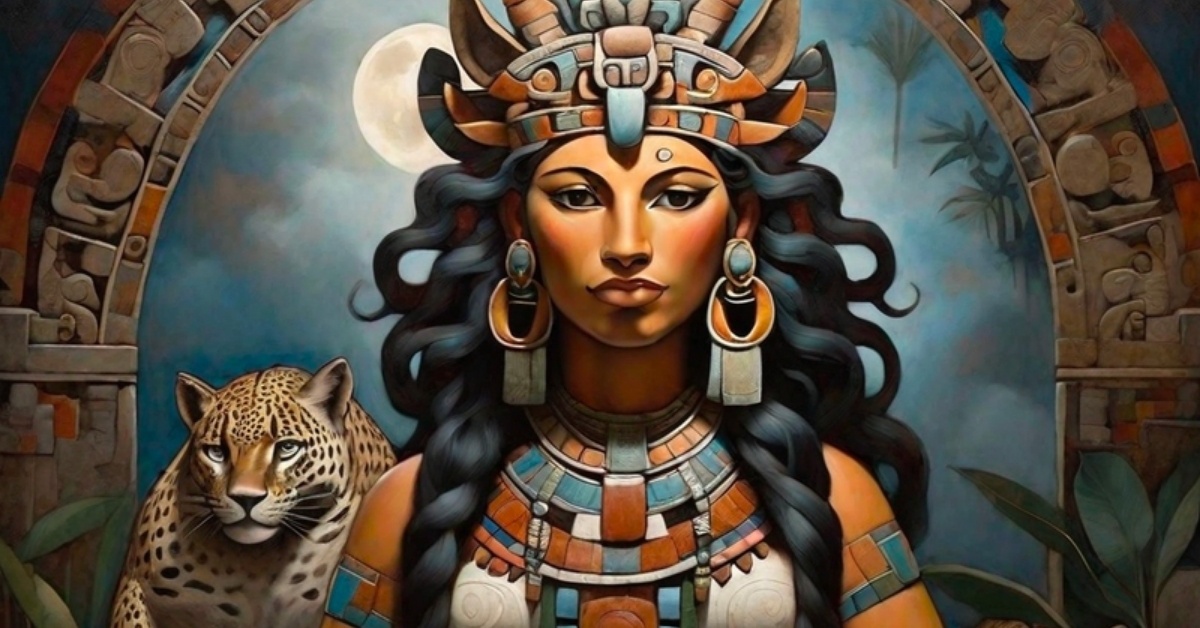
Ix Chel: Maya Goddess of the Moon, Medicine, and the Flood
Ix Chel is the Maya goddess most likely to change while you are looking at her.
Ask for her picture and you might get a young woman at a loom, a rabbit at her feet, ruling over love, weaving, and childbirth. Ask again and you might get an old woman with a jaguar’s claws and a snake coiled in her headdress, tipping a jar of floodwater over a drowning world. Popular tradition has always treated these as one goddess aging the way the moon waxes and wanes. A closer look at what the Maya themselves left behind is not so sure, and the argument over whether Ix Chel is one goddess wearing two faces, or two goddesses later folded into one, is still open among the scholars who study her.
Either way, she was one of the most-visited deities in the whole Maya world, and people are still making the journey to her island today.
Overview of Ix Chel
Ix Chel’s name is Yucatec Maya for something close to “Lady Rainbow,” from ix (“she” or “lady”) and chel (“rainbow” or “light”). In the codices she is more often labeled Chak Chel, “Great Rainbow” or “Red Rainbow,” which modern scholarship treats as a related but not necessarily identical name. She was worshipped across the Yucatán and inland among the Poqom people of Verapaz, in what is now Guatemala, under names and forms that were not always perfectly consistent from region to region (Wikipedia; Taube).
Her clearest domains are medicine, midwifery, and weaving. The Spanish friar Diego de Landa, writing in the 1560s, called her the goddess “of making children” and recorded that physicians and midwives kept small idols of her among their medicine bundles (Relación de las cosas de Yucatán). She is paired, in her aged form, with rain and flood: the Dresden and Madrid Codices show her overturning a water jar, unleashing the storms that the Maya read directly off the codices’ own rain-prediction tables. She is often pictured alongside the Chaacs, the four rain gods of the cardinal directions, her flood the sister force to their lightning.
Titles
- Ix Chel / Ixchel — “Lady Rainbow”
- Chak Chel — “Great Rainbow,” her name in the Dresden and Madrid Codices
- Goddess O — the designation Paul Schellhas gave her aged form in his 1904 classification of the codex deities
- Goddess I — the separate, younger figure sometimes merged with her (see below)
- “She of the Pale Face” — an epithet recorded alongside her rainbow names
Iconography: two ages, maybe two goddesses
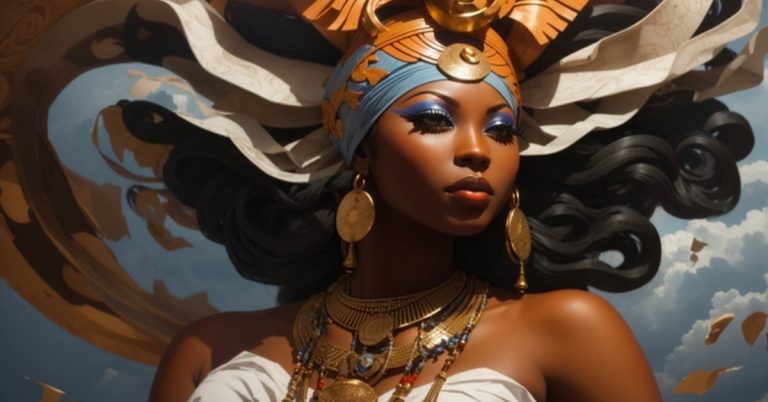
Ix Chel’s two most common forms could not look less alike. The younger form is a beautiful woman, sometimes shown with a rabbit, the animal the Maya saw in the moon’s own face rather than a man. The older form, Goddess O, could be a different goddess: jaguar ears, clawed hands and feet, a serpent draped through her headdress, and a skirt marked with crossed bones. A rarer middle form shows her at a backstrap loom, weaving.
Abilities
- Medicine and midwifery: her idols anchored the medicine bundles of Maya physicians, and she governed safe childbirth
- Weaving: patroness of the backstrap loom and the textile arts
- Flood and storm: in her Goddess O form she pours out the water that ends one cycle so another can begin
- Fertility: petitioned for conception and for the sex of a child
Symbols
- The rainbow, source of her name
- The water jar, overturned in flood
- The backstrap loom
- The rabbit, companion of her younger form
- Serpents and crossed bones, marking her aged form
- The colors red, black, white, and yellow, tied to the four cardinal directions
Traits
Ix Chel is remembered as generous and dangerous by turns: a healer who could just as easily send the sickness she cured, a mother-figure whose floods cleared the world so it could grow again.
Festivals and pilgrimage
The Maya month called Zip carried her most important yearly rite. Landa records physicians and shamans marking Zip with the feast Ihcil Ixchel, bringing out their divination stones and the medicine bundles that held her idols.
Her greatest sanctuary stood offshore, on the island the Maya called Cuzamil (today’s Cozumel). Landa describes a well-worn road running from every village to the coast, funneling pilgrims toward a shrine so important it ranked second only to Chichén Itzá as a Maya pilgrimage site. A hidden priest spoke through the statue itself, delivering oracles to women seeking a healthy pregnancy or a cure. A second shrine stood on the island that the Spanish, on finding it full of goddess figurines, promptly named Isla Mujeres, “Island of Women.”
That pilgrimage still happens. Every year around the night of the full moon in May, hundreds of paddlers cross from the mainland to Cozumel by canoe in a modern reenactment called the Sacred Maya Journey, tracing the same crossing Maya women once made twice in a lifetime: once as a girl with her mother, once as a mother with her own daughter.
Legends associated with Ix Chel
Very little of Ix Chel’s own mythology survives in writing, which makes what does survive worth handling carefully rather than padding out with borrowed detail.
The thirteen sons
The one written myth that names her directly comes down through the Spanish missionary Bartolomé de Las Casas, who recorded a tradition from the Verapaz region: Ix Chel and her consort Itzamná, a sky and creator god, together had thirteen sons, two of whom went on to make heaven and earth themselves. It is a spare story, but it is the only piece of Ix Chel’s own narrative mythology that reaches us in anything like its original form, rather than through her images alone.
The flood from her jar
The codices tell no story in words here, only in pictures, but the picture repeats often enough to count as a myth in its own right. In the Dresden Codex’s rain almanacs, Goddess O appears again and again inverting her water jar over the earth. Modern readings tie this to the almanac’s own rainy-season predictions: a scheduled event, the flood that clears a cycle so the next one can begin, the same logic behind a controlled burn.
The moon’s wandering heart
The best-known Ix Chel story in modern retellings is a romance. The moon goddess loved the sun. A jealous relative struck her down with lightning. Dragonflies sang over her body for 183 days until she revived, and she returned to the sky forever chasing, and forever missing, her sun. Versions add a jaguar transformation, a jealous husband, a flight to a Temple of the Night.
It is a genuinely old and widespread motif in Maya oral tradition, closely tracking a Sun-and-Moon myth that the Maya scholar J. Eric Thompson collected among the Q’eqchi’ of the Guatemalan highlands, a different Mayan-speaking people from the Yucatec lowlanders who left the Ix Chel of the codices. Popular websites tell it as Ix Chel’s own story. The more careful answer is that it likely belongs to a related but separate highland tradition about the moon, later merged with Ix Chel in retellings because both are, loosely, “the Maya moon goddess.” Worth telling for what it is: a real and beautiful piece of Maya storytelling, just probably not evidence for what the Yucatec Maya themselves believed about her marriage.
One goddess, or two?
This is the part of Ix Chel that resists a tidy answer, and it deserves to stay that way rather than get flattened into a single storyline.
Schellhas’s 1904 classification, still used today, split the codex goddesses into a young Goddess I, tied to the waxing moon and human fertility, and an old Goddess O, tied to floods, medicine, and midwifery. Popular tradition and a good deal of scholarship, including Gabrielle Vail and Andrea Stone’s survey of Postclassic and colonial Maya women, read the two as age-graded aspects of one figure: a goddess who moves from maiden to crone like the moon itself, gathering everything Ix Chel is known for into a single life story.
Karl Taube’s stricter reading, in The Major Gods of Ancient Yucatan, pulls the two apart. He points out that colonial and ethnographic sources never call the aged Goddess O a moon goddess in so many words. It’s a fair question whether the lunar identity Ix Chel carries today comes from ancient testimony at all, or from a much later habit of calling any prominent Maya goddess “the moon goddess” by default, then working backward to fit her into that role. In Taube’s account, Goddess O and the lunar Goddess I may originally have been distinct figures the codices simply happened to place near each other, later merged by scholars and popular writers looking for a single, tidy Maya moon goddess to set beside Selene or Chang’e.
Neither reading has won outright. What both agree on is rarer than it looks: this is a goddess whose aged form governs birth, medicine, and the flood that renews the world, whether or not she was ever, technically, the moon herself.
Ix Chel today
Ix Chel outlasted the empire that first prayed to her. Her sanctuary town on Cozumel is a tourist site now, and the Sacred Maya Journey draws paddlers every year to retrace the pilgrimage her worshippers once made, the same twice-in-a-lifetime crossing recast as an open, annual event.
She keeps company today with other goddesses who share pieces of her portfolio without ever being her: Isis, another ancient healer and protector of women whose worship also outlived her original empire, and Yemaja, a newer-world mother goddess of water and childbirth whose devotees never stopped arriving. Ix Chel sits alongside the wider array of moon goddesses in name about as often as in certainty, which, for a goddess this old, might be exactly the point.
Final thoughts
Ix Chel refuses to resolve into one clean story, and maybe that is the most honest thing that can be said about her. She heals, and she floods. She is a beautiful young weaver and a clawed old woman pouring out the water that ends an age. Scholars cannot even agree whether she was ever the moon at all, or whether that title arrived later, borrowed from a neighbor figure and never given back. What survives without argument is the shrine on her island, the pilgrims who still cross the water to reach it, and a goddess who has been asked, for well over a thousand years, to preside over the exact moment life begins.
Bibliography
- “Ixchel”. Wikipedia.
- “Ixchel”. Encyclopaedia Britannica.
- “San Gervasio (Maya site)”. Wikipedia.
- “Ix Chel: The Maya Moon Goddess of Medicine, Fertility, and the Cosmic Feminine”. Mayan.org.
- “Maya moon goddess Ixchel: a benevolent deity with a dark side”. Mexico News Daily.
- Taube, Karl A. The Major Gods of Ancient Yucatan. Dumbarton Oaks Studies in Pre-Columbian Art and Archaeology, no. 32. Dumbarton Oaks Research Library and Collection, 1992.
- Schellhas, Paul. Representations of Deities of the Maya Manuscripts. Papers of the Peabody Museum of American Archaeology and Ethnology, Harvard University, 1904.
- Vail, Gabrielle, and Andrea Stone. “Representations of Women in Postclassic and Colonial Maya Literature and Art.” In Ancient Maya Women, edited by Traci Ardren. AltaMira Press, 2002.
- de Landa, Diego. Relación de las cosas de Yucatán. c. 1566.
- Las Casas, Bartolomé de. Verapaz-region tradition of Ix Chel and Itzamná’s thirteen sons, as discussed in Taube, The Major Gods of Ancient Yucatan (1992).
- Thompson, J. Eric S. Maya History and Religion. University of Oklahoma Press, 1970.
- Aveni, Anthony F. Skywatchers of Ancient Mexico. Rev. ed. University of Texas Press, 2001.
- Roys, Ralph L. The Ethno-Botany of the Maya. Tulane University, Department of Middle American Research, 1931.