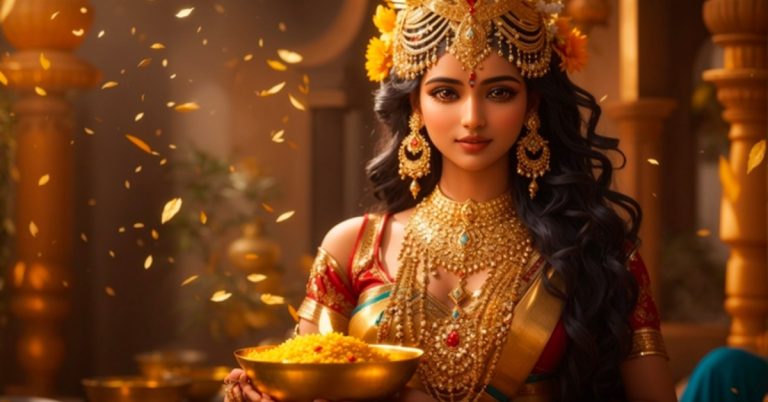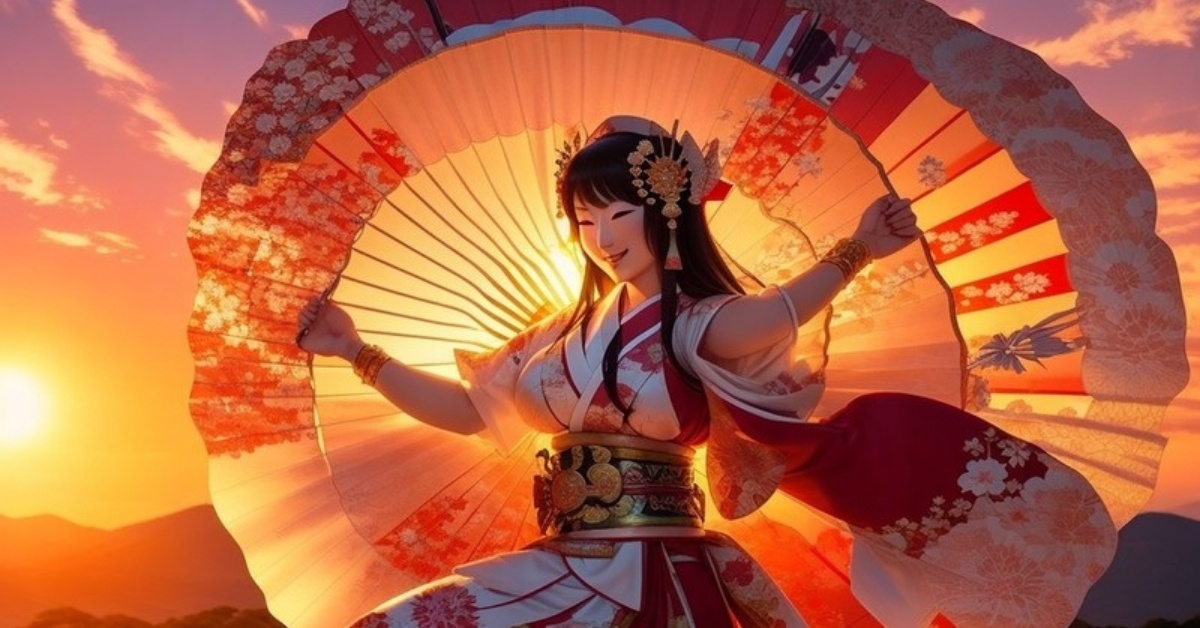
Ame-no-Uzume: Japanese Goddess of Dawn and Dance
The sun had shut herself in a cave, and eight million gods stood outside it in the dark, arguing.
They tried roosters. They forged a mirror. They hung jewels in a tree and read a liturgy. Then one goddess flipped a tub upside down, climbed on top of it, and started to dance.
That was Ame-no-Uzume, and her dance is the most famous thing anyone in Japanese myth has ever done on a tub. It brought the sun back. By Japan’s own reckoning, it also invented the theater.
Overview of Ame-no-Uzume
Ame-no-Uzume-no-Mikoto is the Shinto kami of dawn, mirth, and dance, and the patron of everyone who performs for a living. She comes to us from Japan’s two oldest chronicles, the Kojiki of 712 and the Nihon Shoki of 720, which were compiled at the imperial court to record the age of the gods and the descent of the emperors from them. She appears in both, and she steals every scene she is in.
The chronicles give her no parents. Many of the great kami are born of the creator pair Izanagi and Izanami, or spring from Izanagi’s purification afterward. Uzume simply turns up at the cave, fully herself, when the moment calls for her. Her name is old, and its meaning is still argued over. The scholar Basil Hall Chamberlain, who made the first English translation of the Kojiki, rendered it “Heavenly Alarming Female,” reading uzume as a formidable or dreadful woman. Japan’s Encyclopedia of Shinto adds another possibility: the word may refer to the hair ornaments worn by women who served as mediums for the gods. Either reading fits her.
Her worship is alive. She is enshrined across Japan, from the cave-mouth shrine at Takachiho in Kyushu to the Sarume Shrine at Ise, and the sacred dance she is said to have started, kagura, is still danced at shrines every year.
Titles
- Ame-no-Uzume-no-Mikoto (the full honorific form of her name)
- The Heavenly Alarming Female (Chamberlain’s rendering)
- The Great Persuader
- Sarume-no-Kimi, “Chief of the Sarume,” the title she wins on earth
- Ōmiyanome-no-Ōkami, the name under which she is worshipped at Fushimi Inari
- Okame, her name on the comic stage
Characteristics
How Ame-no-Uzume tends to be shown:
- A young woman mid-dance, arms flung wide, head thrown back
- Crowned with a headdress of leaves, the spindle tree or sakaki of the Kojiki
- A sash of club moss, and a bunch of bamboo grass held in her hands
- Standing on an overturned tub, or on a wooden sounding board
- Loose, open robes, in keeping with a goddess famous for shedding them
- In kagura, a shrine dancer with a fan and a cluster of bells
- As Okame, a round, rosy, dimpled face with a wide grin, the mask of good luck
Abilities
- Divine possession — the Kojiki says she danced “as if possessed by a Deity,” the oldest description of a trance dance in Japanese writing
- Dance and performance — the founding ancestor of kagura, and through it of the Japanese stage
- Laughter — she made eight million gods laugh at once and shook heaven doing it
- Persuasion — the goddess sent to talk when every other god was too afraid to
- Facing down gods — the Kojiki calls her “a Deity who conquers in facing Deities”
Symbols
- The overturned tub — her improvised stage and drum
- The mirror — the sacred mirror hung in the tree to catch the sun’s face
- The sakaki branch — the evergreen of Shinto ritual, worn in her hair
- Bamboo grass — the leaves she held while she danced
- The kagura fan and bells — the tools of the shrine dancers who follow her
- The Okame mask — her smiling face, sold at festivals for luck
- The dawn — the light she called back into the world
Traits
- Fearless, and funniest when everyone else is frightened
- At ease in her own body, with no shame in it
- Quick, practical, and inventive under pressure
- Loyal to the sun goddess she serves
- Sharp-edged when crossed, as one sea slug discovered
Festivals and Rituals
Ame-no-Uzume is worshipped in the present tense. Kagura, the sacred dance offered at Shinto shrines, traces itself straight to her tub, and the word itself means “seat of the gods,” the place a kami is invited to descend and be entertained. The most celebrated form is the Takachiho yokagura in Miyazaki, an all-night cycle of thirty-three dances performed from November through February that ends with the cave story itself. The government lists it as an Important Intangible Folk Cultural Property.
At Amano Iwato Shrine in Takachiho, the cave itself is the object of worship. The shrine’s two halls face each other across a gorge, and a short walk upstream is Amano Yasukawara, the riverbed where the gods are said to have held their council. Kagura is offered there at the spring festival in May, the autumn festival in September, and on Culture Day, November 3.
At Ise, the Sarume Shrine stands inside the grounds of the Sarutahiko Shrine, her husband’s house, and performers, dancers, and people seeking a good match come to her there. The Tsubaki Grand Shrine in Suzuka enshrines the couple together and holds its main festival on October 11; its daughter shrine, the Tsubaki Grand Shrine of America, carried her worship across the Pacific to the United States. At Fushimi Inari in Kyoto she is one of the five kami honored under the name Ōmiyanome, alongside Inari and Sarutahiko. And every November at the Tori-no-ichi fairs, her grinning Okame face is sold on masks and rakes as a charm for good fortune.
Legends associated with Ame-no-Uzume
Uzume’s stories are few, and both of them turn on the same move: everyone else is stuck, and she does something outrageous that works. The first is the cave. The second is the crossroads.
The sun goes into the cave
The trouble started with a brother. Susano-o, the storm god, had come up to heaven to visit his sister Amaterasu, the sun, and once there he behaved like weather. He broke down the ridges between her rice fields and filled in the irrigation ditches. He fouled the hall where she was to taste the first fruits. Finally he skinned a piebald colt backward and flung it through the roof of the sacred weaving hall, where Amaterasu and her women were weaving the gods’ garments. One of the weavers, in her fright, struck herself on the loom shuttle and died.
Amaterasu had made excuses for her brother until then. Now she went into the Heavenly Rock Cave, Ama-no-Iwato, pulled the stone door shut behind her, and stayed.
The sun was gone. The Plain of High Heaven went dark, and so did the Central Land of Reed Plains below it. The Kojiki says that eternal night reigned, that the voices of mischievous spirits rose in the dark like flies in the fifth month, and that every kind of calamity broke loose.
So the eight hundred myriad kami, which is the chronicle’s way of saying all of them, gathered in the dry bed of the Tranquil River of Heaven to work out what to do. The god of wisdom, Omoikane, made the plan. They collected the long-crowing birds of eternal night, the roosters, and set them crowing at the cave as though morning had come. They had the smith-goddess Ishikoridome forge a mirror from the iron of the heavenly mountains. They had the jewel-maker Tamanoya string five hundred curved jewels on a cord eight feet long. They uprooted a sakaki tree with five hundred branches from Mount Kagu and stood it before the door, jewels in its upper branches, the mirror in the middle, and white and blue cloth offerings hung below. The priest Futodama held the offerings up and Ame-no-Koyane intoned the grand liturgy. Ame-no-Tajikarao, the god whose name means Hand-Strength, hid himself beside the door.
It was a complete ritual, beautifully done. The door stayed shut.
The dance on the tub
Then Ame-no-Uzume got dressed for a different kind of ceremony.
She tied the club moss of Mount Kagu around her as a sash. She bound the leaves of the spindle tree into a headdress. She gathered bamboo grass into a bunch for her hands. She turned a tub upside down in front of the cave door, or in the Nihon Shoki‘s telling, kindled fires around it, and she climbed up.
She stamped until the tub boomed. The Kojiki says she danced “as if possessed by a Deity,” and then it says exactly what the possessed goddess did: she pulled out the nipples of her breasts and pushed her skirt cord down below her private parts. Chamberlain, translating in 1882, lost his nerve at this point and put the last phrase in Latin. The Nihon Shoki adds that she carried a spear wound with grass, and that in her trance she “gave forth a divinely-inspired utterance.”
The eight hundred myriad kami looked at their most solemn ritual and at the goddess dancing half naked on a tub in the middle of it, and they laughed. All of them, together, so hard that the Plain of High Heaven shook.
Read that laughter carefully. These are gods in the dark at the end of the world, and the sound that carries through the stone is joy.
The mirror and the rope
Inside the cave, Amaterasu heard it, and it made no sense to her.
She cracked the door and spoke through the gap. She had hidden herself, and heaven and earth should be in darkness. How then could Uzume be making merry, and why were all the gods laughing?
Uzume had her answer ready. “We rejoice and are glad,” she said, “because there is a Deity more illustrious than Thine Augustness.”
While she spoke, Ame-no-Koyane and Futodama lifted the mirror and held it to the opening. Amaterasu saw a shining face in it and did not know it for her own. She leaned closer to look at this rival sun, and then a little closer, and as she did Tajikarao stepped out from beside the door, took her by the hand, and drew her the rest of the way out. Futodama stretched a rope of straw across the cave mouth behind her, the shirikume-nawa, and told her she could go no farther in than that.
Light came back to heaven and to the earth beneath it. Susano-o was fined a thousand tables of offerings, had his beard cut and his fingernails and toenails pulled, and was thrown out of heaven. The rope across the cave mouth is the ancestor of the shimenawa, the twisted straw rope that still marks sacred space at every shrine in Japan. The mirror became the Yata no Kagami, one of the three imperial regalia. And the dance became kagura.
The god at the crossroads
Uzume’s second scene comes generations later, when Amaterasu sends her grandson Ninigi down from heaven to rule the earth and found the imperial line.
Ninigi’s party was ready to descend when word came of a god standing at the eight-forking crossroads of heaven, the junction where the sky road meets the earth. His light shone upward to the Plain of High Heaven and downward to the land of reed plains. The Nihon Shoki describes him: a nose seven hand-spans long, a back more than seven fathoms, eyes that glowed red like an eight-hand mirror, and a light shining from his mouth and from his rear. Among the eighty myriad gods, none would go and ask him what he wanted.
So Amaterasu and the high god Takamimusubi turned to Uzume. Go and ask him, they said, because you are “a Deity who conquers in facing Deities.” The Nihon Shoki puts it in plainer terms: she was superior to all the others in the power of her looks.
She went. The Nihon Shoki says she bared her breasts, pushed the band of her garment down below her navel, and confronted the giant with a mocking laugh. Then she asked him who he was and why he was standing in the road of the heavenly grandchild.
He answered at once. He was Sarutahiko, a great god of the earth. He had heard the child of the heavenly gods was on his way down, and he had come to go ahead of him as his guide. The monster in the road was a welcoming party. Uzume was the only one who had bothered to ask.
Sarutahiko led Ninigi down to the peak of Takachiho in Kyushu, then went home to the upper waters of the Isuzu River at Ise.
The sea slug and the name Sarume
Ninigi had one more instruction for Uzume. Since she was the one who had found Sarutahiko out and brought him forward, she should escort him back to Ise, and she should take his name as her own. So the Heavenly Alarming Female became Sarume-no-Kimi, chief of the Sarume, and the Kojiki notes that the Sarume line carried the name of the male god Sarutahiko ever after, though the title belonged to its women.
The chronicles stop at the name. The wedding comes from later tradition, and Japan has honored the two as husband and wife for centuries; they share the Tsubaki Grand Shrine, and her shrine at Ise sits inside his. Their descendants, the Sarume clan, became the court’s sacred dancers and ritualists, the women who performed at the rites where the gods were called down.
Sarutahiko’s own end is a strange one. Fishing at Azaka, he caught his hand in a shellfish and drowned, and his spirit took three names for the three stages of his sinking: Bottom-Touching Spirit, Bubble-Rising Spirit, and Bubble-Bursting Spirit.
Uzume, meanwhile, had work to do. She herded together every creature of the sea, “the things broad of fin and the things narrow of fin,” and asked whether they would serve the child of the heavenly gods. All of them said yes. The sea slug said nothing. “Ah,” said Uzume, “this mouth is a mouth that gives no reply,” and she slit it open with her knife. That, the Kojiki says, is why the sea slug’s mouth is split to this day, and why, when the first fruits of the sea from Shima are presented at court, a share goes to the Sarume. Even her etiology has a punchline.
An older Ame-no-Uzume?
The Kojiki uses a technical term for what Uzume does on the tub. The word is kamugakari, divine possession: a god descending into a human body and speaking or moving through it. In historical Japan that was the job of the miko, the women who served as spirit mediums at shrines, going into trance to deliver the words of the kami. The anthropologist Carmen Blacker, in her study of Japanese shamanism, traced that role back through the centuries to prehistoric women prophets, and Uzume’s dance reads like their charter myth. A woman dressed in evergreen, stamping on a resonant board, carrying a branch and a spear, falling into trance, speaking with the voice of a god: every element of the scene is standard miko equipment.
The chronicles themselves make the connection. Both name Uzume as the ancestress of the Sarume, and Japan’s Encyclopedia of Shinto records that her performance at the cave was held to be the origin of the chinkonsai, the court’s rite of spirit-pacification, which the Sarume performed. That rite fell in the eleventh month of the old calendar, in the darkest weeks of the year, and its purpose was to settle and strengthen the emperor’s soul; a number of scholars tie its timing to the weakening of the sun. On this reading the cave myth describes a ritual before it describes an event. A shamaness dances the sun back at midwinter, and the story of Amaterasu in the cave is the story of what the dance is for.
The Harvard Indologist Michael Witzel has pushed the comparison further. In a 2005 study he set the Iwato myth beside the Vedic Vala myth of the Rigveda, in which the dawn and the sun’s cattle lie shut inside a rock until song and ritual release them, and argued that the two share too many details to be coincidence, including a dawn goddess whose exposed breast is a sign of welcome. He reads both as winter-solstice myths tied to real ceremonies for the return of the light, and sets Uzume beside Ushas, the Vedic dawn. The proposed family tree is debated; the ritual reading of Uzume’s dance stands on its own.
The joke matters here too. What draws the sun out is laughter, and what causes the laughter is a woman showing her body without shame. Comic and erotic performance to make the gods laugh, and thereby to bring back life and light, is one of the oldest ritual patterns on record, and Uzume is its clearest Japanese face. The Okame mask that grins from festival stalls every November may be a memory of that: a sacred clown whose exposure once turned the year.
Ame-no-Uzume across cultures
Uzume belongs to a small, distinguished company of goddesses who fix a cosmic crisis with a dirty joke.
In Greece, the grieving Demeter, who had shut herself off from the world in mourning for her lost daughter, was coaxed back to eating and laughing by Baubo, an old woman who lifted her skirt in front of the goddess. The Homeric Hymn tells a tamer version with a joking servant named Iambe. Scholars read the episode as an origin story for the ritual obscenity of the Eleusinian Mysteries, much as Uzume’s dance is the origin story for kagura. In Egypt, when the sun god Ra withdrew from the tribunal of the gods in a sulk, his daughter Hathor exposed herself to him, and Ra laughed and went back to work. A sun withdrawn, a goddess who bares herself, laughter, and the return of the light. The pattern runs from the Nile to Eleusis to Takachiho.
Her role as patron of the arts has a neighbor at home, too. Benzaiten, the Buddhist goddess of music, eloquence, and everything that flows, arrived in Japan from India and became the deity most musicians and geisha pray to. She and Uzume divide the performing arts between them, the refined and the raucous, the lute and the tub. And as a dawn goddess, Uzume has cousins in Eos and Aurora and Ushas, though none of them ever had to get the sun out of a cave.
Final thoughts
The gods had a mirror, a liturgy, a hidden strongman, and five hundred jewels. What worked was a woman on a tub who refused to be dignified.
That is Uzume’s whole lesson, and Japan has taken it seriously for thirteen hundred years. Its sacred dances descend from her, its comic theater borrowed her face, and its shrines still rope off holy ground with the straw cord first stretched behind the sun. She is the goddess of the moment when solemnity has failed and someone has to make everyone laugh, and she is proof that the someone can be holy.
When the light goes out in your own life, which do you reach for first, the liturgy or the dance?
Bibliography
- Chamberlain, Basil Hall, trans. Kojiki, Section XVI: “The Door of the Heavenly Rock-Dwelling” (1882). Wikisource.
- Chamberlain, Basil Hall, trans. Kojiki, Section XXXIII: “The August Descent from Heaven”, Section XXXV: “The Duchess of Saru”, and Section XXXVI: “The Deity Prince of Saruta at Azaka”. Wikisource.
- Aston, W. G., trans. Nihongi: Chronicles of Japan, Book I and Book II (1896). Wikisource.
- Kokugakuin University. “Amenouzume.” Encyclopedia of Shinto.
- Cartwright, Mark. “Amaterasu.” World History Encyclopedia.
- “Amenouzume.” Encyclopaedia Britannica.
- “Ame-no-Uzume.” Mythopedia.
- Witzel, Michael. “Vala and Iwato: The Myth of the Hidden Sun in India, Japan, and Beyond.” Electronic Journal of Vedic Studies 12, no. 1 (2005).
- Blacker, Carmen. The Catalpa Bow: A Study of Shamanistic Practices in Japan. Routledge.
- Ise City Tourism Association. “Sarume Shrine.”
- Japan National Tourism Organization. “Amano Iwato Kagura.”
- “Ame-no-Uzume,” “Kagura,” “Miko,” “Sarutahiko Ōkami,” “Amano-Iwato,” and “Tsubaki Grand Shrine.” Wikipedia.
- “Inari Ōkami,” “Baubo,” and “Hathor.” Wikipedia.