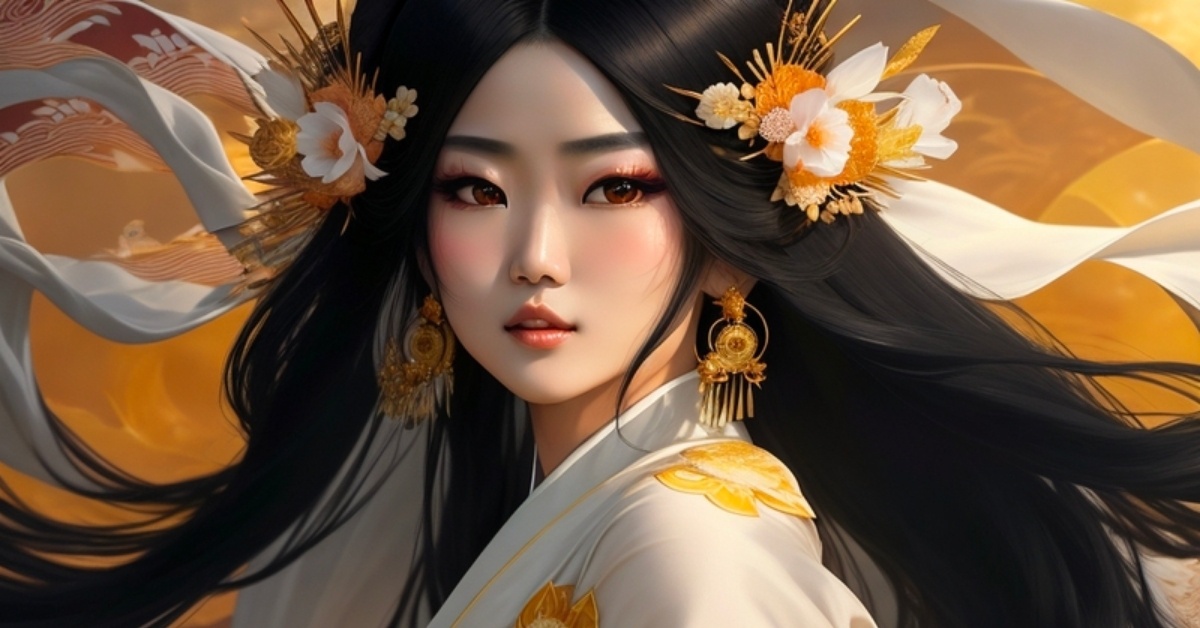
Amaterasu: Sun Goddess & Ruler of Heaven and Earth
The greatest goddess in Japanese myth once got so hurt that she quit.
She walked into a cave, rolled a boulder across the door, and let the whole world go dark.
Amaterasu is the sun itself made into a goddess: the light that heaven and earth are arranged around, the ancestor the emperors of Japan trace their bloodline back to, and the deity still honored at the most sacred shrine in the country. Her mirror sits in its innermost sanctum to this day.
She is also the goddess who shows that even the sun can have a bad enough week to walk out. What makes her story worth keeping is what happens next: the gods who coax her back, and the light that returns.
Overview of Amaterasu
Amaterasu Ōmikami, whose name means roughly “the great divinity who illuminates heaven,” is the chief deity of Shinto and the ruler of Takamagahara, the High Plain of Heaven where the gods dwell. An older name for her, Ōhirume no Muchi, is usually read as something like “the Great Sun Woman.”
She governs the kami, the vast company of Japanese spirits and gods, and her light is treated not as one of her gifts but as the thing she is. Without her, the old texts say plainly, growing things stop growing.
Two ancient chronicles carry almost everything we know about her: the Kojiki, finished in 712, and the Nihon Shoki, finished in 720. Both were assembled at imperial command, and both build toward the same point: the emperors of Japan descend directly from the sun. That gave Amaterasu a role no other goddess in this collection quite shares. She is a goddess of light, and she is also the root of a dynasty.
Titles
- The Great Divinity Who Illuminates Heaven (the meaning of her name)
- Ōhirume no Muchi, the Great Sun Woman
- Ruler of Takamagahara, the High Plain of Heaven
- Queen of the kami
- Ancestress of the imperial line
Characteristics
How Amaterasu tends to be imagined, in art and in the texts:
- Radiance first: she is the sun, so light pours off her rather than shining on her
- Regal and composed, the eldest and highest of her divine siblings
- A weaver, working a sacred loom in a hall in heaven
- Attended by other kami, rarely alone
- More often suggested than drawn: classic Shinto pictures her through her mirror and her shrine rather than a fixed human face
Abilities
- Light and life — as the sun, she sustains every growing thing on earth
- Sovereignty — she rules Takamagahara and the host of kami
- Weaving — she works the heavenly loom, tied to the making of cloth and order
- Cultivation — she is linked to rice and the ordered turning of the agricultural year
- Founding a line — through her grandson she begins the imperial dynasty
Symbols
- The rising sun — her most direct emblem, still on the national flag
- The mirror (Yata-no-Kagami) — the treasure that drew her from the cave, now her sacred embodiment at Ise
- The curved jewels (magatama) — the comma-shaped beads woven into her story
- The sakaki tree and the shimenawa — the evergreen hung with offerings and the sacred rope that sealed the cave
- The rooster — the long-crowing birds set out to call back the dawn
- Rice — the first fruits still offered to her each autumn
Traits
- Life-giving and generous with her light
- Orderly, a keeper and maker of order in heaven
- Deeply feeling, capable of real hurt and real withdrawal
- Forgiving in the end: she comes back, and she pardons
- Sovereign, carrying her rule without needing to raise her voice
Festivals and Rituals

Source: Wikimedia Commons (MaedaAkihiko, CC0)
The heart of Amaterasu’s worship is the Grand Shrine of Ise, in Mie Prefecture. Its Inner Shrine, the Naikū, is dedicated to her, and her mirror is said to rest within it, screened from every eye but the highest priests and the imperial family.
The most striking thing about Ise is that it is rebuilt. Every twenty years the shrine is taken down and raised again on an adjacent plot, perfectly renewed, in a ceremony called the Shikinen Sengū. The custom is traced back to the late seventh century. The rebuilding in 2013 was the sixty-second; the next is due around 2033. The shrine is ancient and brand new at the same time, which is a fitting thing for the sun.
For centuries pilgrims have made their way to Ise at least once in a lifetime, a journey so popular in the Edo period that it became a kind of national pastime.
Her great seasonal rite is the Kanname-sai in October, when the first new rice of the harvest is offered to her, echoed by the Niiname-sai in late November. Both turn on the same idea: the sun fed the crop, so the crop returns to the sun.
There is also a long folk habit of linking her cave story to the winter solstice, the darkest point of the year giving way to returning light. That reading is a lovely one, though it belongs to folklore and interpretation rather than to the formal shrine calendar.
Legends associated with Amaterasu
The lists above tell you what Amaterasu is. The stories tell you who she is: a daughter born from grief, a sister pushed past her patience, and a goddess whose absence the entire world had to bargain to end.
Born from a god’s grief

Source: Wikimedia Commons (Shunsai Toshimasa, 1889, public domain)
Amaterasu’s parents are Izanagi and Izanami, the divine pair who made the islands of Japan and many of its gods. Their story turns dark before hers begins. Giving birth to the fire god Kagutsuchi, Izanami was burned so badly that she died and passed into Yomi, the land of the dead.
Izanagi went after her. He found her in the underworld, already changed and decaying, and fled in horror when she would not, could not, follow him back. Escaping to the world above, he stopped at a river to wash the filth of the dead from his body.
The cleansing made gods. As he rinsed his left eye, Amaterasu was born, blazing. From his right eye came Tsukuyomi, the moon. From his nose came Susanoo, the storms. Izanagi looked at his radiant first daughter and gave her the High Plain of Heaven to rule.
That is the account in the Kojiki, the one most people tell. The Nihon Shoki keeps several other versions side by side. In one, Izanagi and Izanami make her together; in another, Izanagi holds up a white-copper mirror and she springs from his reflection. Accounts differ, and the texts were honest enough to leave the differences standing.
Why the sun and the moon never meet
In one old story, Amaterasu and her brother Tsukuyomi, the moon, once shared the sky as equals.
She sent him in her place to a feast given by Uke Mochi, the goddess of food. Uke Mochi welcomed him and began to lay out the meal, but the way she produced it turned his stomach: she brought forth rice, game, and fish from her own mouth and body. Disgusted, Tsukuyomi drew his sword and killed her.
When Amaterasu heard what he had done, something in her closed. She called him a wicked god and said she would never look on him face to face again. From then on the sun and the moon kept to separate halves of the day, and that, the tale says, is why we never see them sharing the sky for long.
There is a tangle here that trips up many retellings. This sword-and-feast story, with Tsukuyomi as the killer, is the Nihon Shoki version. The Kojiki tells a similar tale with a different cast entirely: there it is Susanoo who kills a food goddess named Ōgetsuhime, and Amaterasu has no part in it. In both, crops grow from the slain goddess’s body. The two stories are cousins, often confused, and Amaterasu kills no one in either.
A contest in heaven
Susanoo, the storm brother, was trouble from the start.
Before being banished from heaven for his wildness, he climbed up to say goodbye to his sister, and he came up so violently that the mountains shook. Amaterasu did not trust the visit. She tied up her hair like a warrior, slung two great quivers on her back, and went out to meet him armed.
To prove he meant no harm, Susanoo proposed they make children together as a kind of oath. Amaterasu took his sword, broke it, chewed the pieces, and breathed out three goddesses. Susanoo took the curved jewels from her hair, chewed them, and breathed out five gods.
Then they argued over the score. By the rule that a child belongs to the owner of the object it came from, the five gods born from her jewels were hers, and the three goddesses born from his sword were his. Susanoo decided this proved his heart was pure, and declared himself the winner. Drunk on the victory, he went on a rampage across heaven, and that is what finally drove his sister into the dark.
The day the sun hid
This is Amaterasu’s most famous story, the legend of Ama-no-Iwato, the Heavenly Rock Cave.
Susanoo’s rampage turned cruel. He smashed the ridges between her rice paddies and filled in the irrigation ditches. He fouled the hall where the first fruits were offered. Worst of all, he flayed a dappled heavenly horse and hurled it through the roof of the sacred weaving hall where Amaterasu and her women worked. In the shock and chaos, one of the weaving maidens was killed.
Amaterasu had reached her limit. She withdrew into the rock cave, sealed the entrance, and refused to come out. With the sun shut away, heaven and earth fell into total darkness, and every kind of trouble crept in with the night.
So the eight hundred myriad gods gathered in the dry bed of the heavenly river to plan. A wise god named Omoikane worked out what to do. They gathered the long-crowing roosters to call the dawn. They forged a great mirror and strung curved jewels, and hung both, with cloth offerings, on a sakaki tree set before the cave. One god chanted sacred words; another held up the offerings.
Then the goddess Ame-no-Uzume turned over a tub, climbed on, and danced. Her dance grew wild and comic and immodest, and the assembled gods roared with laughter until heaven itself shook.
Inside the cave, Amaterasu was puzzled. How could they be laughing with the sun gone and the world in ruin? Curiosity got the better of her, and she edged the cave door open to peek.
There, facing her, was her own face, blazing in the mirror. Drawn toward the light she had forgotten was hers, she leaned out a little further. That was the moment the strong-armed god Ame-no-Tajikarao had been waiting for. He seized her hand and pulled her clear of the cave, and another god stretched a sacred rope across the entrance so she could not slip back in.
The world filled with light again. The sun had been coaxed, not commanded, back into the sky.
The mirror, the sword, and the line of emperors
The cave story leaves three objects glinting at its center, and they did not stay in heaven.
After his exile, Susanoo slew a monstrous eight-headed serpent and found a marvelous sword in its tail. He sent it up to his sister as a peace offering. That sword, the mirror that drew her from the cave, and a string of curved jewels became the Three Sacred Treasures of Japan.
When Amaterasu sent her grandson Ninigi down from heaven to rule the islands, she sent the three treasures with him, the mirror standing in for her own presence. Ninigi’s descendants became, by tradition, the emperors of Japan, with the legendary Jimmu as the first. To this day the mirror is kept at Ise, the sword at Atsuta Shrine, and the jewels at the imperial palace. A goddess of light became, through those objects, the founder of a throne.
Another way of seeing her
One quiet detail tends to catch people who go looking: across the world, the sun is usually imagined as a man and the moon as a woman. Japan reversed the pattern, and it is far from alone in doing so. Other traditions, with no contact between them, arrived at a sun who is female: in the Baltic, in the old Norse north, among the Hittites, here and there in Celtic lands. These are echoes, not borrowings, separate peoples reaching independently for the same image of a mothering, life-giving sun.
There is also an older layer some scholars suspect beneath Amaterasu’s serene supremacy. Her cult at Ise seems to have been raised to its towering height in the same decades the chronicles were written, when a ruling house had good reason to want a sun goddess at the top of its family tree. A few interpreters go further and read her oldest name, the Great Sun Woman, as the trace of an early priestess who served the sun before she was remembered as the sun. None of this is settled, and the texts as we have them simply call her the goddess of light. But the layering is part of what makes her feel so deep: a state deity, a folk sun, and perhaps an older woman tending a fire, all wearing the same name.
Final thoughts
Amaterasu endures because her story holds a comfort most of us need at some point: that withdrawing into the dark is not the end of the story.
She is the sun, and even she had a day she could not face. What saved the world was not a god strong enough to drag her out by force, though one was standing by. It was the others making a light worth coming back for, and her own curiosity turning her toward it.
Light a thought toward her the next time the morning comes up over the horizon. That returning sun is the oldest happy ending there is, and she has been keeping it for a very long time.
Bibliography
- Aston, W. G., trans. Nihongi: Chronicles of Japan from the Earliest Times to A.D. 697. Book I, “The Age of the Gods.”
- Chamberlain, Basil Hall, trans. The Kojiki: Records of Ancient Matters.
- Hardacre, Helen. Shinto: A History. Oxford University Press.
- Leeming, David A. The Oxford Companion to World Mythology. Oxford University Press.
- Monaghan, Patricia. O Mother Sun! A New View of the Cosmic Feminine. Crossing Press.
- Teeuwen, Mark, and John Breen. A Social History of the Ise Shrines: Divine Capital. Bloomsbury.
- Cartwright, Mark. “Amaterasu”. World History Encyclopedia.
- “Amaterasu”. Encyclopaedia Britannica.
- “Basic Terms of Shinto”. Kokugakuin University.
- “Does Food Originate from a Murdered Goddess?”. Kokugakuin University.
- “Amaterasu”. New World Encyclopedia.
- “About Ise Jingu”. Ise Jingu (official site).