Jabmiidahkka: The Sami Goddess of the Dead
When a Sámi person fell seriously ill, the first question was where their soul had gone.
The usual answer was down. Beneath the tents and the reindeer trails lay a second country, ruled by an old woman, where the dead carried on much as they had in life and now and then grew lonely for the people they’d left behind. That country was Jábmiidáibmu, and the old woman was Jábmiidáhkká.
Getting a soul back from her took a specialist, a drum, and a price.
Overview of Jabmiidahkka
Jábmiidáhkká rules the land of the dead in the pre-Christian religion of Sápmi, the Sámi homeland that runs across the north of Norway, Sweden, Finland, and Russia’s Kola Peninsula. Her name is her job description. Jábmek means “the dead,” from jápmit, “to die,” and áhkká is the word for an old woman or grandmother. She is the Old Woman of the Dead.
She belongs to a family of áhkkás. At the birth end of Sámi life stand Máttaráhkká and her daughters, Sáráhkká among them, who shape a child and see it safely into the world. Jábmiidáhkká holds the other end. Same title, same underground address, opposite door.
The Sámi world had a top as well as a bottom. The sun goddess Beaivi rode the sky and greened the pastures for the reindeer; Jábmiidáhkká kept the country under everyone’s feet. By most accounts that country, Jábmiidáibmu, was an ordinary place where the dead kept their reindeer and their work. In some tellings they lived a mirrored life, walking sole to sole against the feet of the living above them. What they lacked was company, and that homesickness is where Jábmiidáhkká’s real power begins.
One more thing belongs up front. Nearly everything written about her comes from Christian missionaries and crown officials of the 1600s and 1700s who were working to end her worship. That filter shapes every section below, and it gets its own section further down.
Titles
- Jábmiidáhkká, “the Old Woman of the Dead” (Northern Sámi)
- Jábmeáhkká, Jabme-akka, Jabmeakka, and Jabmiakka in older spellings
- Yambe-Akka, the form Philip Pullman borrowed for His Dark Materials
- Mistress of Jábmiidáibmu, the land of the dead
Characteristics
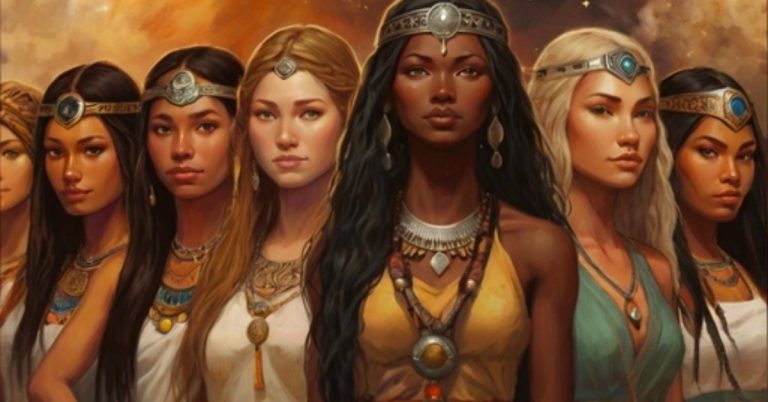
No image of her survives from Sámi hands. The missionary record leaves her without a face, and the drums show her country and leave her person out. What can be said:
- Imagined as an áhkká, an old woman, in the tradition of the underground grandmothers
- Dwelling beneath the surface of the earth, under the feet of the living
- Present on Sámi drums as the country drawn in the lower band of the drumhead, sometimes with the dead sketched inside it
- Impartial; she keeps what falls to her and releases it for a price
Abilities
- Keeping the dead — every soul that finishes its life comes down to her
- Reaching up — she can allow the dead to sicken the living, or to draw a living soul down
- Holding a soul — a person whose soul has sunk to her lies in a coma or a wasting illness
- Releasing it — she sends a soul back once the offering satisfies her
Symbols
- The drum — the noaidi’s road to her country, with Jábmiidáibmu marked on the lower skin
- The underground — earth, stone, and the space beneath the tent floor
- Black animals — the cats and roosters that sources say she preferred as offerings
- The stone cairn — the heap under which a rooster was buried for her
Traits
- Exacting; she gives back only what has been paid for
- Fair by her own measure: a life for a life
- Sovereign over a country the living enter in trance or in death
- Patient, in the way the ground is patient
Festivals and Rituals
She had no festival. Her rituals were the sickbed and the grave.
When someone fell gravely ill, the family sent for a noaidi, the Sámi ritual specialist. He drummed and sang until he dropped into trance, then traveled down to Jábmiidáibmu to learn what the dead were missing and what the old woman would take in exchange for the soul. The answer was usually an animal, promised on the spot and paid later. The sources single out black animals, cats and roosters especially, and describe the rooster buried alive under a pile of stones.
The dead themselves were fed and remembered. Sources describe Sámi graves holding gifts: a staff and gear for a man, ornaments for a woman, and shoes of birch bark for the walk. In some districts the mourners drank beer and shared a meal to send the person off. A relative who was properly sent off stayed a relative. One who was neglected might come back resentful, and Jábmiidáhkká would let them.
Legends associated with Jabmiidahkka
She has no story cycle. The missionaries recorded procedures; any myth of how she came to rule the dead went unwritten, and the Sámi who knew were careful about what they told a pastor. What we have instead is a set of practices, described by outsiders watching them work. Read together, they tell a story of their own.
The soul that sank
Sámi thinking gave a person more than one soul. The body soul stayed with the flesh and died with it. The free soul could leave, in dreams, in trance, and in sickness. A serious illness was that free soul slipping away toward Jábmiidáibmu, sometimes on its own, sometimes because a dead relative, lonely for the family, had reached up and taken hold.
A patient in that state was caught between two countries. The body still breathed above ground while the soul stood in the old woman’s territory. Any cure had to happen down there.
The noaidi’s journey
The noaidi was the community’s specialist in exactly this crossing. Samuel Rheen, a Swedish priest writing from Jokkmokk in 1671, listed curing disease among the drum’s main uses. Nicolaus Lundius around 1670, Isaac Olsen in 1717, and Jens Kildal around 1730 all described noaidis whose free spirit traveled into the other worlds to negotiate with the powers of death, and above all with Jábmiidáhkká, over who would live.
The mechanics are consistent across the accounts. The noaidi drummed and joiked until he fell, apparently lifeless, while helpers kept up the song that would guide him home. Below, he found the dead, found the old woman, and asked her terms.
The price of a life
Her terms were a substitution. The sick person’s soul came back up when something else went down: a reindeer, a black animal, and in the gravest cases a life for a life. The offering was promised during the trance and paid afterward, and the sources agree that a broken promise brought the sickness back.
A parallel rite handled a different power. Rota, or Ruohtta, was the personification of sickness and death who rode a horse, an animal the Sámi otherwise distrusted, and who ruled a harsher underworld called Rota-áibmu. When his kind of disease struck, the community killed and buried a horse so the sickness could ride it back where it came from. Whether Rota’s country lay below Jábmiidáhkká’s, beside it, or was one region’s name for the same dark depends on which missionary you read.
The homesick dead
Underneath all of this sits one idea: the living and the departed were two halves of a single family. The dead had reindeer to tend and relatives to miss, and their missing could turn dangerous. Jábmiidáhkká presides over that ache. She permits disease, letting the dead reach up when the living forget them. Feed the graves, keep the names, and the old woman leaves you alone.
An older Jabmiidahkka?
The part of Sámi religion the missionaries most wanted gone was the noaidi’s journey to the dead, which put Jábmiidáhkká at the center of the target.
Samuel Rheen’s 1671 treatise on the Sámi and “their superstitions” was commissioned by the Swedish crown; it fed straight into Johannes Schefferus’s Lapponia two years later, the book that introduced Sámi religion to the rest of Europe. Johan Randulf’s Nærøy manuscript of 1723 was written while the missionary Thomas von Westen toured his parish interviewing Sámi families; its full title promises an account of “their idolatry and worship of Satan.” Hans Skanke wrote from inside von Westen’s mission around 1730. Von Westen himself confiscated something like a hundred drums, which he called the Sámi Bible. A generation earlier, in 1692, a Sámi man named Anders Poulsen had been put on trial in Vadsø with his drum entered as evidence of sorcery. Even Lars Levi Læstadius, the Lutheran pastor who gathered his Fragments of Lappish Mythology between 1838 and 1845, admitted that a great deal stayed hidden from him, because the Sámi kept their beliefs to themselves.
That is the record. It is partial, it is regional, and it disagrees with itself. The map of the dead shifts from source to source: Jábmiidáibmu here, Rota-áibmu there, in some districts a mountain-country called sáivu where the dead lived on under the fells. Her name shifts with the dialect that was being interrogated. The vivid ritual details, the black cat and the rooster under the stones, come from one strand of testimony; the ransom logic comes from another. And every Sámi answering a pastor’s questions had good reason to say less than they knew, or to shape the answer to what the pastor could accept.
Scholars have worked at the filter from both sides. Drawing on Uno Holmberg’s 1915 study and Risto Pulkkinen’s 2011 survey, some suggest that a female ruler of the dead may be a later idea, an inversion of the birth goddesses to make the underworld their opposite, with a parallel in Louhi, the mistress of Pohjola in Finnish tradition. Olof Pettersson argued in 1987 that even where the Sámi borrowed Norse or Christian words for the afterlife, they filled those words with their own north Eurasian content. The missionaries, for their part, recast Jábmiidáibmu as a purgatory and in some districts folded the old woman into the Virgin Mary. Håkan Rydving’s name for the whole period is the end of drum-time.
What sits under the filter is the oldest pattern in the northern world: a ritual specialist who goes down to the country of the dead to bargain for a soul, and a power there who can be bargained with. Sámi tradition names that power an old woman. Whether it always did, the missionaries left no way to check, and that uncertainty belongs to her story.
She is also a living matter. In January 2022 the National Museum of Denmark transferred ownership of Anders Poulsen’s drum to RiddoDuottarMuseat, the Sámi museum in Karasjok, where an exhibition called RUOKTOT, “homeward,” opened that April. Sámi religion, the noaidi’s craft, and the drum are being reclaimed by the people they were taken from, and the goddess who lives on the lower skin is coming home with them.
Jabmiidahkka across cultures
Her nearest neighbor is Norse. Hel, daughter of Loki, keeps a hall for the dead beneath the roots of the world tree, and the Norse and Sámi lived close enough for centuries that scholars still argue over who borrowed what. The resemblance runs deeper than a shared word, though. Both goddesses run an underworld that works as a second home, and both hold what they hold by right, without malice.
Finnish tradition offers Louhi, the mistress of Pohjola, the cold north country that lies where the Sámi lands lie. She is a hard bargainer too, setting impossible prices for what the heroes of the Kalevala ask of her, and some scholars read the Sámi old woman and the Finnish one as answers to the same northern question.
The bargaining shaman is wider still. Across Siberia, among the Evenki, the Yakut, and the Nenets, the shaman’s journey to the lower world to recover a stolen soul is the core of the healing craft, and the powers down there ask a price. Jábmiidáhkká is the western edge of that map.
And one writer carried her a long way from Sápmi. In Philip Pullman’s His Dark Materials, the witches of the far north die into the arms of Yambe-Akka, a goddess who comes for them smiling and merry. Serafina Pekkala impersonates her once, to end a tortured witch’s suffering. It is a different old woman from the one the missionaries wrote about, and in its own way a truer one, because it remembers that being received by her was a comfort.
Final thoughts
The old woman under the ground keeps a ledger.
She holds the dead, lets them reach for the living when they are forgotten, and hands a soul back to anyone willing to send something down in its place. That is a religion built around remembering your relatives, and Jábmiidáhkká holds the accounts. The men who set out to erase her left us the only record of her, and the people she belonged to are taking their drums back.
When you picture the country under your own feet, is it a place of loss or a place where somebody is waiting?
Bibliography
- “Jábmiidáhkká”. Wikipedia, citing Risto Pulkkinen, “Saamelaisten etninen uskonto” (2011), and Uno Holmberg, Lappalaisten uskonto (1915).
- “Sámi drum”. Wikipedia: Rheen, Lundius, Olsen, Kildal, Skanke, Randulf, and Læstadius on the noaidi’s journeys to Jábmeáhkká; von Westen’s drum confiscations.
- “Samuel Rheen” and “Nærøy manuscript”. Wikipedia.
- “Ancient Sámi religion” and “Ruohtta”. Wikipedia.
- Læstadius, Lars Levi. Fragments of Lappish Mythology. Ed. Juha Pentikäinen, trans. Börje Vähämäki. Aspasia Books, 2002.
- Pettersson, Olof. “Old Nordic and Christian Elements in Saami Ideas about the Realm of the Dead”. Scripta Instituti Donneriani Aboensis 12 (1987): 69–80.
- Rydving, Håkan. The End of Drum-Time: Religious Change among the Lule Saami, 1670s–1740s. Almqvist & Wiksell, 1993.
- Bäckman, Louise, and Åke Hultkrantz. Saami Pre-Christian Religion: Studies on the Oldest Traces of Religion among the Saamis. Almqvist & Wiksell, 1985.
- Eliade, Mircea. Shamanism: Archaic Techniques of Ecstasy. Princeton University Press.
- “Jabmiakka”. Godchecker.
- “Sami Beliefs: The New Era”. University of Texas at Austin, Sámi Culture.
- “Denmark Gives up Ownership of Rare Sami Drum to Norway”. High North News, 2022.
- “RUOKTOT – The Travelling Exhibition”. RiddoDuottarMuseat.
- “Yambe-Akka”. His Dark Materials Wiki.