Devi: The Great Goddess of Hinduism
Ask a devotee of the Goddess which of India’s goddesses is the greatest, and the answer can sound like a riddle. All of them, because there is only one.
Her name is Devi. The word means “goddess,” and Hindus use it for hundreds of them. Add maha, “great,” and it becomes the title of a single Goddess who stands above the gods and holds every other goddess inside her. Durga, Kali, Lakshmi, Saraswati, Parvati: her faces.
She has her own scripture, her own Gita, and a nine-night festival kept across the Hindu world. What follows is how one small word came to mean everything.
Overview of Devi
Devi is Sanskrit for a goddess, the feminine of deva, “god,” and any goddess in India is a devi. Written with a capital and read through the Shakta tradition, the branch of Hinduism that takes the Goddess as supreme, it names one being: Mahadevi, the Great Goddess, whom her devotees also call Adi Parashakti, the primordial supreme power.
Her home is the whole subcontinent. Her worship runs deepest in Bengal, Assam, Nepal, and the Himalayan foothills, and her seats are scattered across the map: the Shakti Pithas, where a piece of the Goddess is said to rest in the earth. Kamakhya, on a hill above the Brahmaputra in Assam, is among the most revered.
Her territory is everything. In Shakta theology she is Brahman, the ultimate reality of the Upanishads, wearing a woman’s face. She creates the universe, keeps it running, and takes it apart again. The gods draw their strength from her, and without her they sit inert. She is also Mahamaya, the great power of appearance, the one who makes the world look solid and then, when she chooses, lets a devotee see through it.
That power in the abstract, the energy that moves Shiva and every other god, is Shakti, and it has its own post. This one is about the person who wields it.
Her charter is the Devi Mahatmya, “The Glory of the Goddess,” seven hundred verses composed around the fifth or sixth century CE and folded into the Markandeya Purana. It is the first Sanskrit text to put a single Goddess at the top of the cosmos. Centuries later the Devi Bhagavata Purana built a whole scripture on that claim, and inside it sits the Devi Gita, the Goddess’s answer to the Bhagavad Gita, spoken in her own voice.
Her great festival is Navaratri, the nine nights.
Titles
- Mahadevi (“the Great Goddess”)
- Adi Parashakti (“the primordial supreme power”)
- Mahamaya (“the great illusion,” the power that makes the world appear)
- Jagadamba and Jaganmata (“Mother of the World”)
- Ambika (“Mother,” her name through much of the Devi Mahatmya)
- Chandika (“the Fierce One”)
- Bhuvaneshvari (“Lady of the Worlds,” the form she takes in the Devi Gita)
- Lalita Tripurasundari (“the Playful One, Beautiful in the Three Worlds,” her supreme form in the Sri Vidya tradition)
Characteristics
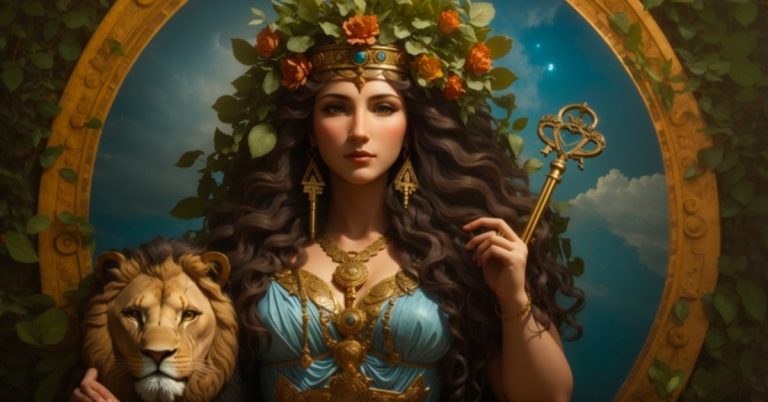
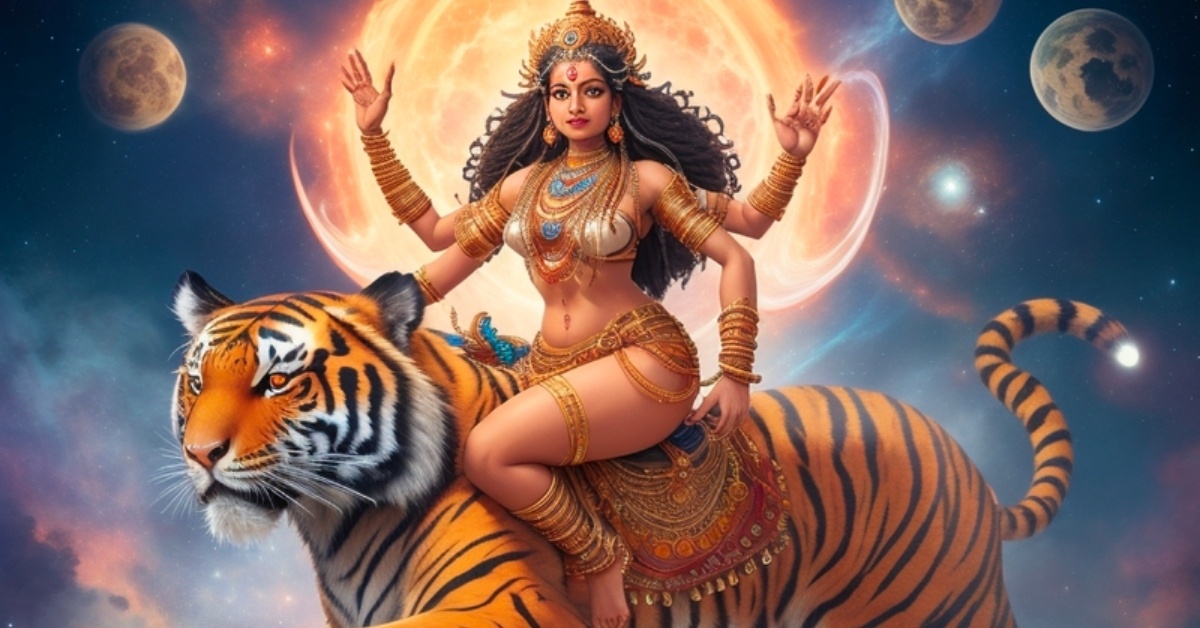
Every goddess is her portrait, which makes a single one hard to draw. When artists set out to show the Great Goddess herself, they tend to show:
- A woman of overwhelming radiance, often described as brighter than a thousand suns
- Many arms, each holding a weapon or emblem that belongs to one of the gods
- A lion or tiger beneath her, the form she borrows from Durga
- Red garments and a jeweled crown, especially as Bhuvaneshvari and Lalita
- A lotus seat, or a throne whose legs are the great gods themselves
- In the Devi Gita, a cosmic body in which the gods see all the worlds at once
Abilities
- Creation, preservation, and dissolution — she does all three, the jobs the Puranas split among Brahma, Vishnu, and Shiva
- Maya — she veils reality and unveils it; the world is her appearance
- Empowerment of the gods — every god’s strength is on loan from her
- Endless forms — she takes any shape the moment calls for, mild or terrible
- Liberation — knowing her, the Devi Gita says, is knowing Brahman, and that knowledge frees the soul
Symbols
- The lotus — her seat and her sign, purity rising from the mud
- The lion — sovereignty, borrowed from her warrior face
- The weapons of all the gods — the trident, discus, conch, bow, and thunderbolt, held together in her many hands
- The Sri Chakra — the nine-triangle diagram that maps her as the cosmos itself
- The color red — her garments, her flowers, the vermilion of her worship
- The number nine — her nights, her forms, and the nine triangles of her diagram
Traits
- Sovereign, answerable to no god
- Motherly toward those who call on her, terrible toward what threatens them
- Playful, treating creation as her lila, her game
- Self-sufficient, needing no consort to act
- Both halves of every pair at once: gentle and fierce, near and beyond reach
Festivals and Rituals
The heart of Devi’s worship is Navaratri, “nine nights,” kept in spring and, above all, in autumn, when it is called Sharada Navaratri. Across those nights the Goddess is honored in her nine forms, the Navadurga, or in three groups of three: Durga first, then Lakshmi, then Saraswati, so that the festival itself teaches the doctrine that they are one.
The Devi Mahatmya is recited through the nine nights, in homes and temples, often in a single sitting. In Bengal the festival becomes Durga Puja, with clay images of the Goddess built over months and carried to the river at the end. Many families keep kanya puja, in which young girls are seated, fed, and worshipped as living embodiments of the Goddess. The tenth day is Vijayadashami, the day of victory.
Beyond the calendar, her worship turns on the Shakti Pithas. At Kamakhya, the Goddess is honored as the earth’s own womb, and the annual Ambubachi Mela marks her menstruation, when the temple closes for three days and reopens to enormous crowds. Devotees of the Sri Vidya tradition worship her as Lalita through the Sri Chakra, chanting her thousand names.
Legends associated with Devi
Devi’s legends do something different from most goddess myths. Her faces, Durga and Kali above all, fight the great battles, and those stories belong to their own posts. The stories that belong to the Great Goddess herself are about who she is, and each one makes the same argument from a different angle: whatever you thought was highest, she is above it.
The Goddess who put Vishnu to sleep
The Devi Mahatmya opens on a scene before creation. Vishnu lies asleep on the cosmic ocean, coiled on the serpent Shesha, and two demons, Madhu and Kaitabha, climb out of the wax in his ears and go for Brahma, who is sitting on the lotus that grows from Vishnu’s navel.
Brahma cannot wake Vishnu, so he does the only thing left. He prays to the sleep itself.
That sleep, the text says, is the Goddess. She is Yoganidra, the trance that holds the greatest of the gods, and she is Mahamaya, the power that keeps the whole universe under its spell. Brahma calls her the one who creates, sustains, and devours the worlds, and asks her to let Vishnu go. She withdraws from his eyes, his limbs, his heart. Vishnu wakes and kills the demons.
Read that again. The god who preserves the universe cannot open his eyes until the Goddess allows it. The Devi Mahatmya puts that scene first on purpose. Before any battle, before any of her famous forms, the reader learns where the power sits.
The gods learn who really won
The idea has roots older than the Devi Mahatmya. The Kena Upanishad, composed somewhere around the middle of the first millennium BCE, tells a small, sharp story.
The gods have won a victory over the demons, and they are pleased with themselves. Brahman, the ultimate reality, appears before them as a strange spirit, a yaksha, and the gods do not recognize it. Agni, god of fire, goes to find out what it is. “I can burn anything on earth,” he boasts. The spirit lays a blade of grass in front of him. He cannot scorch it. Vayu, god of wind, goes next. “I can carry anything away.” He cannot lift the straw.
Then Indra, king of the gods, approaches, and the spirit vanishes. In its place stands a woman, radiant, richly adorned: Uma, daughter of the Himalaya. She tells Indra what the spirit was. It was Brahman, and the gods’ victory was Brahman’s all along.
The Upanishad is about knowledge, and Uma is the one who has it. A thousand years later the Shakta writers would take that scene and read it as a portrait of the Goddess herself, the one who knows Brahman because she is Brahman.
“I alone exist”
The Devi Mahatmya’s longest episode saves its biggest moment for a claim.
In the final war, the Goddess has multiplied herself. Kali has sprung from her forehead, and seven Mothers, the Matrikas, have poured out of the gods to fight beside her, each carrying a god’s power in a woman’s body. The demon king Shumbha watches this crowd of goddesses and calls her a cheat. Fight me alone, he says, without leaning on the strength of others.
She answers him. “I am alone here in the world. Who else is there besides me? Watch these, my powers, entering back into me.” And the Mothers, Kali, every one of them, dissolve into her body until only one Goddess stands on the field.
That is the theology of Devi in a single scene. The many goddesses are real, and they are all her. The Shakta tradition took the line and ran with it: every goddess, and by extension every god, is a power the Great Goddess has sent out and can call home.
The Goddess who becomes the harvest
Near the end of the Devi Mahatmya, the Goddess makes promises about the future. Whenever the world is in trouble, she says, she will come back, and she lists the shapes she will take.
One stands apart from the rest. When the rain fails for a hundred years and the world is dying, she will appear, born from no womb, and she will feed every living thing from vegetation grown out of her own body. For that she will be called Shakambhari, “she who bears vegetables.” In the same breath she names Raktadantika, whose teeth turn red as pomegranate flowers, and Bhramari, who will come as a swarm of bees.
Shakambhari is the face of Devi that village India would recognize. A goddess who is the crop, whose body is the food. The greatest text of the Goddess tradition, having spent twelve chapters on her cosmic majesty, ends by promising that she will be a garden.
The Goddess sings her own Gita
The Devi Bhagavata Purana, written somewhere between the ninth and twelfth centuries, gives her the last word.
The gods, worn down by a demon, gather to worship her, and she appears in a blaze of light as Bhuvaneshvari, red-clad and four-armed, holding a noose and a goad and raising her hands in blessing. The mountain king Himalaya, father of Parvati, asks her to explain what she is.
Her answer is the Devi Gita, ten chapters spoken by the Goddess. She says it plainly: before creation there was only her, and she was Brahman. The world is her maya, her own appearing. Then she shows them what Krishna showed Arjuna, the cosmic form, and the gods see the whole universe inside her body, every world and every creature, and they beg her to make it stop.
She does, and then she teaches. Yoga, devotion, knowledge, the disciplines that lead a soul back to her. The text quotes the Bhagavad Gita openly and turns each idea toward the Goddess. Where Krishna says he is the Self in every heart, she says the same of herself, and the gods bow.
An older Devi?
The oldest Hindu scriptures barely notice her, and that is the surprise.
The Rigveda, composed around 1500 to 1200 BCE, is a book of gods. Its goddesses are few and small: Ushas, the dawn, gets some twenty lovely hymns; Aditi, the mother of the gods, is named about sixty times and never given a hymn of her own; Vac, speech, and Prithvi, the earth, appear in passing. No great Goddess sits above them. There is one flash of what was to come, a hymn in the tenth book in which a female seer, Vac Ambhrni, speaks as the Goddess herself: “I am the queen, the gatherer of treasures.” Later Shaktas would take that hymn, the Devi Sukta, as the Goddess’s charter and recite it beside the Devi Mahatmya. In its own day it stood nearly alone.
So where did the Great Goddess come from? The scholarly answer is that she came up from below. Across village India, then as now, people worshipped local goddesses, the gramadevatas, each the mother of one place. They guard boundaries, send and cure fever, bring rain, and fill the fields. Many have no husband and no place in the Sanskrit pantheon; they receive offerings of blood and rice at the edge of the village, and their names, Mariamman, Shitala, Manasa, and thousands more, belong to their districts. Their worship is older than any Purana.
The Devi Mahatmya is the moment those many mothers were gathered into one. Thomas Coburn, the text’s leading modern translator, called it the “crystallization” of the Goddess tradition: the composer took names that had lived apart, Ambika, Chandika, Durga, Kali, the seven Matrikas, and made them into one Goddess who declares that she alone exists. David Kinsley, in his standard study of the Hindu goddesses, reads the Mahadevi the same way, as a theology built on top of a much older and much more local devotion to female divinity, and the Shakambhari promise, the Goddess who feeds the world from her body, is the clearest sign of where that devotion lived.
How far back does it go? Here the evidence turns uncertain. When John Marshall excavated Mohenjo-daro in the 1920s, he found small terracotta figures of women and named them “Mother Goddesses,” seeds of the later cult of Devi. That reading held for decades and shows up in textbooks to this day. Archaeologists who have studied the figurines closely, Sharri Clark and Shereen Ratnagar among them, argue that nothing in the finds themselves supports it; the figures turn up in houses and rubbish heaps, they vary widely, and the Indus script remains unread, so the goddess is in the eye of the excavator. Some may be toys, portraits, or household charms. Others may be exactly what Marshall thought. The honest position is that the question stays open.
What the record does support is the direction of travel. India’s Great Goddess was assembled from small ones. The Sanskrit tradition, which began with almost no room for her, ended by making her the ground of everything, and it did that by opening its doors to the goddesses the villages had been feeding all along.
Devi across cultures
The idea that one Goddess wears every goddess’s face has occurred to other people.
In the second century CE, a Roman North African named Apuleius wrote a novel, The Golden Ass, whose narrator prays to the moon and gets an answer. The goddess who rises from the sea tells him that the Phrygians call her the Mother of the Gods, the Athenians Minerva, the Cypriots Venus, the Cretans Diana, the Sicilians Proserpina, the Eleusinians Ceres, and that others call her Juno, Bellona, or Hecate; the Egyptians, who know best, call her Queen Isis. She calls herself the one form of all the gods and goddesses. A Shakta could have written the speech.
Devi herself traveled east. By the seventh century the Puranas had reached Cambodia and Java, and the Goddess in her warrior form was carved in Khmer sandstone and Javanese stone alongside Shiva and Vishnu; in Bali she guards graveyards and crossroads to this day. The name Tara belongs to two religions at once, a great goddess of compassion in Buddhism and one of Devi’s ten Mahavidyas in Hindu Tantra, and scholars argue over which tradition lent her to the other.
In the modern West the same instinct resurfaced as “the Goddess,” singular, of Wicca and the Goddess movement, one divine woman behind all the old names. Whatever history makes of that reading of the ancient world, India got there first, and wrote it down.
Final thoughts
Devi is the rare deity whose central myth is an argument.
Most goddesses are known by what they did. She is known by what she is, and the texts that praise her spend their best lines on a single point: the gods run on her power, the world is her appearance, and the goddesses you already know are her, walking around under other names. That is a large claim for a word that started out meaning any goddess at all.
It leaves a question for anyone drawn to more than one of her faces. When you call on Durga for courage or Saraswati for the right words, do you feel you are speaking to different beings, or to one who answers to whatever name you use?
Bibliography
- Coburn, Thomas B. Devī-Māhātmya: The Crystallization of the Goddess Tradition. Motilal Banarsidass, 1984.
- Coburn, Thomas B. Encountering the Goddess: A Translation of the Devī-Māhātmya and a Study of Its Interpretation. SUNY Press, 1991.
- Brown, C. Mackenzie. The Devī Gītā: The Song of the Goddess. SUNY Press, 1998.
- Brown, C. Mackenzie. The Triumph of the Goddess: The Canonical Models and Theological Visions of the Devī-Bhāgavata Purāṇa. SUNY Press, 1990.
- Kinsley, David. Hindu Goddesses: Visions of the Divine Feminine in the Hindu Religious Tradition. University of California Press, 1986.
- Cartwright, Mark. “Devi”. World History Encyclopedia.
- Yokochi, Yuko. “Devī Māhātmya”. Oxford Bibliographies: Hinduism.
- “The Devi Mahatmya”. Mahavidya, University of Regina.
- “Devi Mahatmya”, “Devi Bhagavata Purana”, “Mahadevi”, “Devīsūkta”, “Kena Upanishad”, and “Navaratri”. Wikipedia.
- Clark, Sharri R. “The Magic in the Image: Women in Clay at Mohenjo-daro and Harappa”. Harappa.com.
- Ratnagar, Shereen. “A Critical View of Marshall’s Mother Goddess at Mohenjo-Daro”. Studies in People’s History 3, no. 2 (2016).
- Apuleius. The Golden Ass, Book XI. Trans. A. S. Kline.