Aphrodite: Greek Goddess of Love and Beauty
The first thing Aphrodite ever touched was a beach on Cyprus, and grass sprang up under her feet.
That’s Hesiod’s telling. She grew inside a ring of sea-foam, drifted past the island of Kythera, and stepped ashore at Paphos already a woman, with Love and Desire falling in beside her. No mother, no childhood, no father she ever had to obey.
She’s the goddess of love, beauty, and desire, and the Greeks knew exactly how dangerous that made her. The dove, the scallop shell, and a war started by one apple all trace back to her.
Overview of Aphrodite
Aphrodite is one of the twelve Olympians, the goddess of love, beauty, sexual desire, and procreation. Her home is the whole Greek world, but her heart is Cyprus. The sanctuary at Paphos was her oldest and greatest, and “Kypris,” the Cyprian, is the name the poets reach for most.
Her territory looks narrow beside Athena’s and turns out to be enormous: the pull between two people, the wedding night and the fertility of the bride, safe sailing for anyone who remembered she rose from the sea, and whatever it is that makes a person want something badly enough to upend a life. The Iliad, read one way, is a poem about what happens when she wins an argument.
Her name resists explanation. Hesiod derived it from aphros, “foam,” and told the birth story to match. Most modern scholars treat that as folk etymology and suspect a non-Greek, possibly Semitic, source. She is also missing from the Bronze Age Linear B tablets, where Athena, Hera, and Poseidon already appear. Hold onto that clue.
Her great festival was the Aphrodisia, celebrated across Greece, with the largest gatherings at Athens and Corinth.
Titles
- Kypris (“the Cyprian”)
- Kythereia (“of Kythera”)
- Ourania (“the Heavenly”)
- Pandemos (“of all the people”)
- Philommeides (“smile-loving”)
- Euploia (“of fair sailing”)
- Areia (“the warlike”)
Characteristics
How Aphrodite tends to be shown in art:
- Dressed in early Greek art; nude or nearly so after Praxiteles carved his Aphrodite of Knidos around 340 BCE
- Golden-haired, hence Homer’s favorite line for her, “golden Aphrodite”
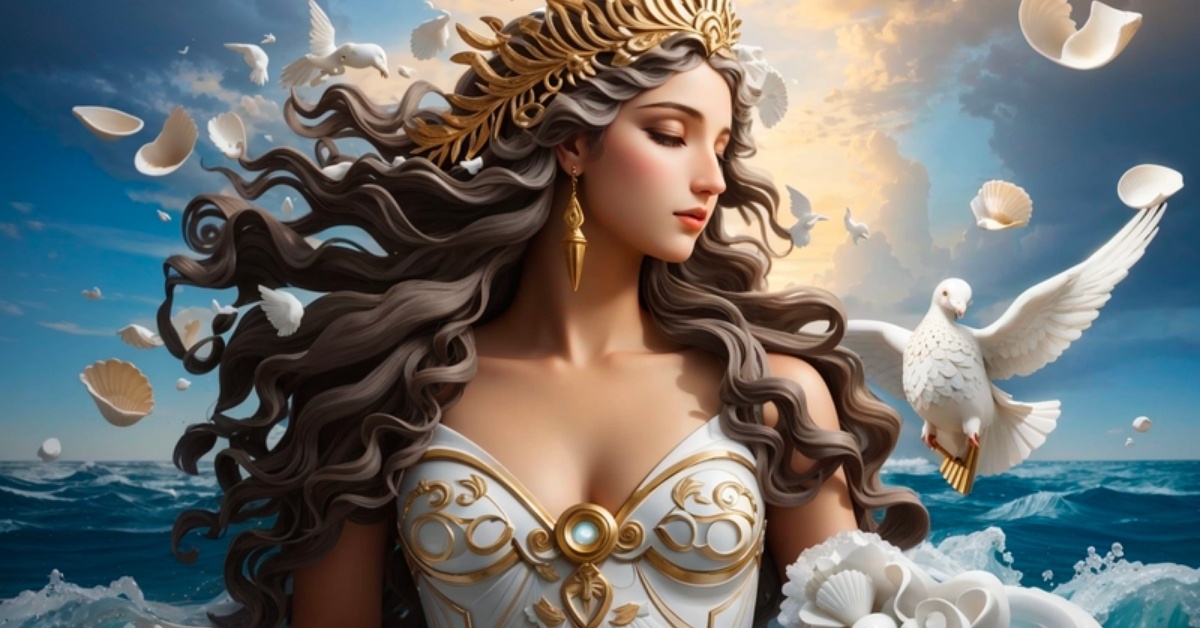
- Rising from the water, wringing out her hair, or balanced on a scallop shell
- Wearing the kestos himas, an embroidered band that makes its wearer irresistible
- Holding a mirror, an apple, or a dove
- Accompanied by Eros, her winged son, and the Graces
Abilities
- Desire — she can make anyone fall in love, god or mortal, and she used it on the gods so often that Zeus turned it back on her
- The girdle — Hera borrows it in the Iliad to seduce Zeus and swing the Trojan War for an afternoon
- Marriage and fertility — one of the gods of the wedding rite; brides sacrificed to her the night before
- Safe passage at sea — as Euploia she had a temple at the harbor of Piraeus
- Wrath — Hippolytus, Myrrha, the women of Lemnos, and Psyche all learned what refusing her costs
Symbols
- The dove — her bird, sacrificed at her temples and carried in her hand
- The scallop shell — the sea she was born from
- The myrtle and the rose — her plants, worn at weddings
- The apple — the prize she won from Paris
- The mirror — beauty looking back at itself
- The girdle — desire made wearable
Traits
- Generous with those who honor her, merciless with those who refuse her
- Vain in the way only a goddess of beauty can afford to be
- Laughing and teasing, the “smile-loving” goddess of Homer
- A poor fit for the battlefield, where Diomedes wounds her and Zeus sends her off to “the works of marriage”
- Devoted, past all sense, to her mortal lovers
Festivals and Rituals
The heart of her worship was the Aphrodisia, held every year across Greece. Athens kept it on the fourth day of the summer month Hekatombaion, and priests purified her temples with the blood of a sacrificed dove.
The Adonia was stranger. Women of every class, citizen and foreigner, wife and courtesan, climbed to the rooftops with broken pots of lettuce and fennel seed. The “gardens of Adonis” sprouted fast and died fast, and the women wailed over them as they wailed for the goddess’s dead lover, then carried the withered pots and little effigies down to the sea. It stands alone in Greek religion, and most scholars think it came, like Adonis himself, from the Near East.
At Paphos on Cyprus, her oldest sanctuary, pilgrims anointed a tall black cone of stone in place of a statue. Tacitus saw it in the first century CE and admitted it looked nothing like a woman.
Legends associated with Aphrodite
Aphrodite’s myths run on a single engine: desire is stronger than anyone, and the goddess who wields it catches it herself.
Born of the sea-foam
Her story starts with a crime against the sky.
Ouranos, the Sky, lay on Gaia, the Earth, and would let none of their children out into the light. So Gaia forged a sickle and gave it to her son Kronos, who ambushed his father and cut off his genitals. Kronos flung them into the sea.
Hesiod says white foam gathered around them, and inside the foam a girl grew. She floated first to Kythera, then to Cyprus, and walked out of the shallows with grass rising under her feet. Eros and Himeros, Love and Longing, joined her on the spot. The gods called her Aphrodite, “foam-born,” and Kythereia and Kypris after the two islands.
Homer disagrees. In the Iliad she has a mother, the goddess Dione, and a father, Zeus, and she runs to them for comfort when she gets hurt. The Greeks kept both stories, and we’ll see what they made of the contradiction below.
The judgment of Paris
The most consequential beauty contest ever held began at a wedding.
Peleus and Thetis were marrying, and every god was invited except Eris, Discord. She came anyway and rolled a golden apple across the feast inscribed “to the fairest.” Hera, Athena, and Aphrodite each claimed it. Zeus, sensibly, refused to judge and had Hermes take the three goddesses to a Trojan prince named Paris, tending flocks on Mount Ida.
Each goddess made him an offer. Hera promised kingship over Asia. Athena promised wisdom and victory in every battle. Aphrodite promised him the most beautiful woman alive.
Paris handed her the apple. The woman was Helen of Sparta, already married to King Menelaus, and Paris carried her off to Troy. Every Greek king who had once sworn to defend Helen’s marriage sailed after her, and the war lasted ten years.
Pygmalion and the ivory girl
Here’s the story that shows what her favor looks like when she’s pleased.
Pygmalion was a sculptor on Cyprus who had sworn off women after watching the Propoetides, the first women to sell themselves, harden into stone under Aphrodite’s curse. He carved a girl out of ivory, so lifelike that he forgot she was ivory. He brought her gifts, dressed her, laid her on a couch, and kissed her.
At the goddess’s festival he made his offering and asked, carefully, for a wife “like my ivory girl.” He went home and kissed the statue, and her lips were warm. The ivory softened under his fingers like wax in the sun.
Ovid, who tells it in the Metamorphoses, leaves her nameless; “Galatea” was attached centuries later. Their daughter was Paphos, and the goddess’s holiest city was named for her.
Aphrodite and Adonis
And here’s what her love looks like when it ends badly.
It started with an insult. The queen of Cyprus boasted that her daughter Myrrha outshone Aphrodite, and the goddess answered by filling Myrrha with desire for her own father. The girl tricked her way into his bed, was found out, and fled. The gods turned her into a myrrh tree, and in time the bark split and a baby came out. That baby was Adonis.
Aphrodite hid him in a chest and handed it to Persephone in the underworld for safekeeping. Persephone opened the chest. When Adonis grew into the most beautiful youth on earth, both goddesses claimed him, and Zeus split the year in three: a third with Aphrodite, a third with Persephone, a third wherever Adonis chose. He chose Aphrodite.
She begged him to stay away from dangerous game. He went hunting anyway, and a boar, sent by a jealous Ares in some tellings, gored him. He died in her arms, and where his blood fell the anemone grew, a flower that opens and drops in a single season. The Greek women on their rooftops were mourning him every year. So, long before them, were the women of Mesopotamia, wailing for Inanna’s lost shepherd Dumuzi.
An older Aphrodite?
Under the girl on the shell stands a much older goddess, and the Greeks themselves half remembered her.
Start with the silence. Athena, Hera, Poseidon, and Dionysus all appear on the Bronze Age Linear B tablets; Aphrodite is absent. When she arrives in Greek writing, in Homer and Hesiod around the eighth century BCE, she comes with an eastern address. Pausanias, the ancient travel writer, says the Assyrians worshiped her first, then the people of Paphos on Cyprus, then the Phoenicians at Ascalon, who taught her cult to Kythera. Herodotus names the same Syrian city as her oldest temple. Modern scholars mostly agree: her cult seems to have reached Greece by way of Phoenician Cyprus, and behind the Phoenician Astarte stands the Mesopotamian Ishtar, who is Inanna under an Akkadian name.
Ishtar was a goddess of love and of war, and that second half traveled too. In Sparta she was worshiped as Aphrodite Areia, “the warlike,” with two temples in the city. Pausanias saw ancient cult statues of her armed at Sparta, at Kythera, and at Corinth, and inscriptions back him up. Scholars such as Stephanie Budin and Monica Cyrino read the armed Aphrodite as the Near-Eastern warrior goddess showing through her Greek costume. The goddess Zeus laughs off the battlefield in the Iliad had, in her own oldest temples, never put the spear down.
The two birth stories fit the same pattern. Hesiod’s foam-born daughter of the Sky is a goddess from before the Olympians, older than Zeus. Homer’s daughter of Zeus and Dione is a goddess folded neatly into his family. Plato, in the Symposium, resolved the clash by declaring there were two Aphrodites: Ourania, the Heavenly, born of the sky, and Pandemos, the Common, born of Zeus and Dione. One tradition holds that the older, stranger goddess got a second, tidier genealogy when she joined the pantheon.
There’s a more sweeping view as well. Monica Sjöö and Barbara Mor, in The Great Cosmic Mother, read the Olympian goddesses as fragments of one earlier Great Goddess of Crete, and the judgment of Paris as those fragments “set at war with each other.” Few classicists go that far. But the armed statues at Sparta and the black stone at Paphos do suggest that the Aphrodite of the poets is the youngest version of someone much older.
Aphrodite across cultures
What Aphrodite stands for keeps surfacing under other names, and in her case the family tree is partly real.
The Romans took her whole. Their Venus, once a modest goddess of gardens, absorbed Aphrodite’s myths and even her son. Aeneas, whom she bore to the shepherd Anchises, founded the Roman line, and Julius Caesar built a temple to Venus Genetrix, “Venus the Mother,” as his own ancestor. Her Roman name is the one that stuck to Botticelli’s painting and to the Ice Age carvings archaeologists call Venus figurines, made more than twenty thousand years before either goddess had a name.
Farther off, the resemblances are convergence rather than descent. The Greeks in Egypt recognized Hathor, goddess of love, music, and joy, as their own Aphrodite. The Norse Freya rules love and beauty and also claims half the warriors who die in battle, the same love-and-war pairing that Ishtar carried and Sparta kept. The Yoruba Oshun is a goddess of rivers, sweetness, and beauty who belongs to fresh water the way Aphrodite belongs to salt. Each arose on its own. People everywhere seem to have decided that desire is a power, and that a power deserves a face.
Final thoughts
Aphrodite is the patron of the one thing nobody governs.
The other Olympians rule domains you can plan around. Hers is the moment a plan dissolves because someone walked into the room. She gave a sculptor his heart’s desire and a prince the war that burned his city, and by her lights both were the same gift. Twenty-seven centuries on, she is still the goddess you pray to knowing exactly what the answer might cost.
Bibliography
- Atsma, Aaron J. “Aphrodite”. Theoi Greek Mythology.
- Cartwright, Mark. “Aphrodite”. World History Encyclopedia.
- Kapach, Avi. “Aphrodite”. Mythopedia.
- Hesiod. Theogony, lines 176-206 (the birth). Trans. Evelyn-White, via Theoi.
- Ovid. Metamorphoses, Book X (Pygmalion, Myrrha, Adonis). Trans. via Theoi.
- Pausanias. Description of Greece 3.15.10 (the armed Aphrodite at Sparta). Perseus Digital Library.
- Budin, Stephanie L. The Origin of Aphrodite. CDL Press.
- Cyrino, Monica S. Aphrodite. Routledge.
- Sjöö, Monica, and Barbara Mor. The Great Cosmic Mother. HarperOne.
- “Aphrodite”, “Aphrodite Areia”, and “Adonia”. Wikipedia.
- “Adonis”, “Pygmalion (mythology)”, and “Judgement of Paris”. Wikipedia.
- “The Cult Statue of Aphrodite at Palaepaphos: A Meteorite?” Academia.edu (on the aniconic cone and Tacitus, Histories 2.3).