Aurora: The Roman Goddess of Dawn
Every morning she opens the gates of the east so the sun can drive through. The Romans gave her a Latin name, Aurora, and a Latin poetry to live in, but the goddess they were naming was already ancient when Rome was a cluster of huts on seven hills. Her Greek counterpart was Eos. Older than either was a dawn goddess whose name the first Indo-Europeans spoke thousands of years before a word of Latin existed.
Aurora is what dawn looks like when a whole culture decides it is a person: rose-colored, in a hurry, and, underneath the beauty, grieving.
Overview of Aurora
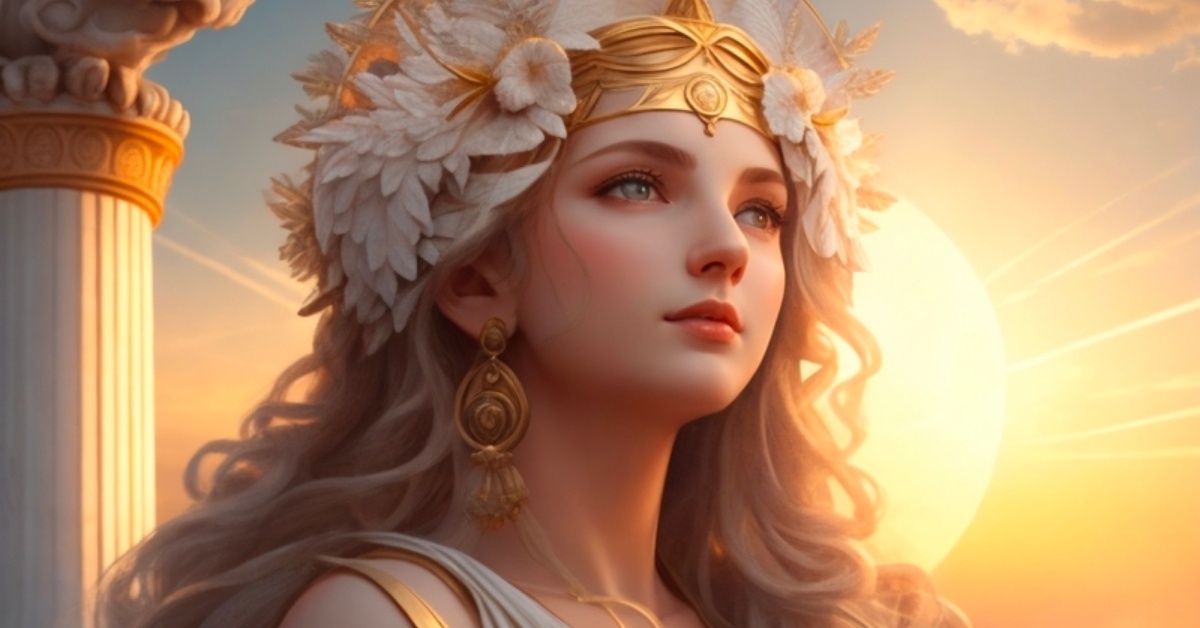
Aurora is the Roman goddess of the dawn, the light that comes before the sun and announces it. Her name is simply the Latin word for daybreak, and Roman poets used the two almost interchangeably, so that “before Aurora” and “before first light” meant the same thing. She rises out of the ocean at the edge of the world each morning, climbs into a chariot, and rides up the sky ahead of her brother the sun, opening the day for gods and mortals alike.
The Romans received her ready-made. When Roman writers took up Greek myth, they folded the Greek dawn goddess Eos into their own Aurora, keeping every story intact and only changing the names, the way Zeus became Jupiter and Aphrodite became Venus. Almost everything told about Aurora was first told about Eos, which is why the two share a family, a chariot, and the same handful of doomed love affairs.
Her family places her at the center of the sky. She is the daughter of the Titan Hyperion and the Titaness Theia, and the sister of Sol, the sun, and Luna, the moon, whom the Greeks called Helios and Selene. The three of them divide the heavens between night and day. By the god of the dusk winds, Astraeus, Aurora became the mother of the four winds and of the stars, including the morning star that still rises just ahead of the dawn.
Titles
- Rosy-fingered (Homer’s constant epithet for the dawn, carried into Latin verse)
- Saffron-robed (for the yellow-gold band of light along the horizon)
- Bringer of light
- Mother of the winds and the stars
- Daughter of Hyperion
Characteristics
How Aurora tends to be shown in art and verse:
- A young woman rising from the sea or from her bed at the eastern edge of the world
- Riding a chariot, most often drawn by two horses, sometimes winged herself
- Robed in saffron and rose, scattering flowers or dew as she goes
- Her fingers or her whole figure tinted rose, the color the sky turns just before sunrise
- Flying ahead of the sun’s chariot to open the gates of the east
Symbols
- The dawn light itself — the rose-and-saffron band on the horizon is her signature and her body
- Dew — the moisture on the morning grass, which one myth reads as her daily tears
- The chariot and horses — the vehicle that carries the light up out of the ocean
- The morning star — her son by Astraeus, rising just before her to herald the coming day
The myths Rome told about Aurora
Aurora’s stories almost all turn on the same painful fact: she is a goddess who keeps falling in love with mortal men, and mortal men do not last. Three of her myths follow that thread to three different heartbreaks.
Tithonus, the man who could not die
Aurora fell in love with Tithonus, a prince of Troy, and could not bear the thought of losing him to age and death. So she went to Jupiter and begged him to make Tithonus immortal, and Jupiter granted it. She had asked for the wrong gift. She asked that Tithonus never die, but forgot to ask that he never grow old.
The “Homeric Hymn to Aphrodite,” the oldest full telling, describes what followed. For a while the two of them lived happily. Then the first gray hairs came, and Tithonus kept aging, and aging, with no end in sight, until he was so shrunken and frail that Aurora shut him away in a chamber where his voice went on babbling endlessly and his limbs had no more strength. Later writers gave the story a last mercy: Aurora turned the withered, chirping Tithonus into a cicada, the insect whose thin song still rises with the summer heat. Alfred, Lord Tennyson built his poem “Tithonus” around the horror at its heart, a man pleading to be allowed, at last, to die. It is the sharpest warning in Greek and Roman myth about asking the gods for the wrong thing.
The curse of Venus, and a hunter named Cephalus
There is a reason Aurora’s affections keep landing on mortals. In one strand of the tradition, Venus caught Aurora in bed with Mars, the war god Venus considered her own, and cursed her in revenge: Aurora would burn forever with desire for young mortal men. Her string of abductions, in this telling, is Venus’s punishment at work.
The most developed of those affairs is the one Ovid tells in Book Seven of his Metamorphoses. Aurora carried off Cephalus, an Athenian hunter newly and happily married to a woman named Procris. Cephalus pined for his wife the whole time and would not be consoled, so Aurora finally let him go, but not before dropping a poisoned hint that Procris might not have been so faithful in his absence. The doubt did its work. Cephalus tested his wife, the marriage cracked, and it ended in the worst way: out hunting, Cephalus heard a rustle in the brush, threw the javelin that never missed, and killed Procris, who had followed him in secret. The spear is Cephalus’s, but the sorrow starts with Aurora.
Memnon, and the dew that is grief
Aurora and Tithonus had a son, Memnon, who grew up to be king of the Aethiopians and one of the great warriors of his age. When the Trojan War called, Memnon led his army to Troy’s defense and fought brilliantly, until he met Achilles on the field and was killed. Aurora, watching her son die from the sky, was inconsolable. In some tellings she persuaded Jupiter to grant Memnon a form of immortality, and the sparks of his funeral pyre rose as a flock of birds. In others, the meaning is quieter and closer to home: the dew that beads on the grass every single morning is Aurora’s tears, wept fresh for Memnon at every dawn. The goddess who brings the light is also the one who cries at daybreak, and the myth ties the two together so that you cannot have the one without the other.
An older dawn
Behind Aurora and behind Eos stands a much older goddess, and this is where the story gets genuinely strange.
Linguists who reconstruct Proto-Indo-European, the ancestor language that gave rise to Latin, Greek, Sanskrit, and most of the languages of Europe and northern India, have recovered the name of a dawn goddess from it: something close to Hausos. She is one of the few deities they can reconstruct with real confidence, because her name and her stories survive, recognizably, in culture after culture that split apart thousands of years ago. Aurora in Rome, Eos in Greece, Ushas in the Vedic hymns of ancient India, Aušrinė among the Baltic peoples, all descend from the same divine figure, each people carrying her along as they moved and settled. She is, in a real sense, the same goddess told four different ways.
The thread reaches into English, too. The direction “east,” the place where the dawn happens, comes from the same root as her name. So, most likely, does the word “Easter,” by way of a spring goddess the medieval historian Bede recorded among the Anglo-Saxons under the name Eostre, though how much can be built on Bede’s single sentence is still debated by scholars. What is not in doubt is the underlying pattern: wherever these related peoples went, they kept a goddess of the dawn, and they kept calling her by versions of one old name.
Aurora across cultures
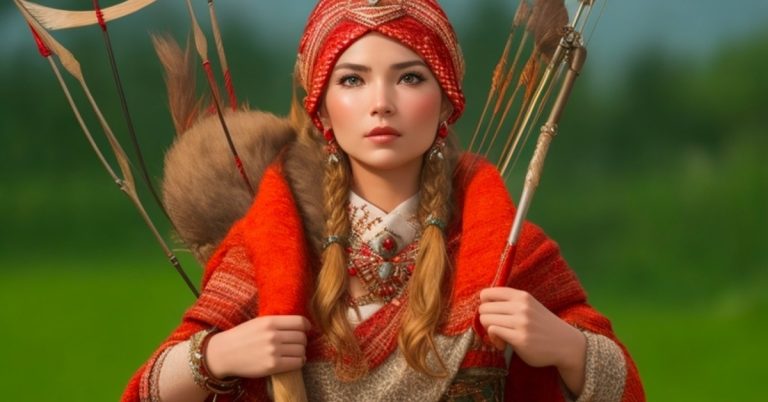
Her Vedic sister Ushas shows how little the core figure changed across enormous distances. In the Rig Veda, Ushas is a radiant young woman who opens the gates of the sky each morning, rides in a shining chariot, and reveals the world by uncovering it in light, exactly the role Aurora plays over the Mediterranean. The hymns to Ushas are among the oldest religious poetry in the world, and reading them beside the Roman and Greek dawn goddesses is like hearing the same melody in three keys.
Aurora also outlived her own religion in a way few gods manage. When astronomers in the seventeenth century needed a name for the shimmering lights that flood the northern sky, they reached back and called them the aurora borealis, “the northern dawn,” after her and after Boreas, the north wind. The southern version became the aurora australis. Every time those lights are named, a Roman goddess is invoked, most often by people who have no idea they are doing it. She kept her contrast with the night, the domain the Greeks personified as Nyx: where the goddess of night gathers the dark, the goddess of dawn takes it apart.
Final thoughts
Aurora is the goddess of the moment the sky turns from black to rose, and the Romans understood that moment as both a gift and a wound. She opens the gates every morning without fail, faithful past exhaustion, and she weeps every morning too, for a son she could not save and for lovers who aged and died while she stayed young. The oldest layer of her, the dawn goddess the first Indo-Europeans carried out of the steppe, has never actually left. She is still overhead at the start of every day, and still lighting up the far north under a name that means her.
If the gods granted you one wish and, like Aurora, you had to word it exactly right, what would you make certain to ask for?
Bibliography
- “Homeric Hymn to Aphrodite”, on Aurora (Eos) and the aging of Tithonus. Trans. via Theoi.
- Ovid. Metamorphoses, Book 7, on Aurora, Cephalus, and Procris. Trans. via Theoi.
- Hesiod. Theogony, on the parentage of Eos and her children by Astraeus. Trans. via Theoi.
- Homer. Odyssey, Book 5, on Eos and Orion (Calypso’s complaint). Trans. via Theoi.
- Tennyson, Alfred. “Tithonus”. Poetry Foundation.
- Atsma, Aaron J. “Eos”. Theoi Greek Mythology.
- Cartwright, Mark. “Eos”. World History Encyclopedia.
- Kapach, Avi. “Eos”. Mythopedia.
- “*Hausos” (Proto-Indo-European dawn goddess). Wikipedia.
- “Ushas”. Wikipedia.
- “Aurora (mythology)”. Wikipedia.