Nyx: Greek Goddess of the Night
Zeus once woke from a trick sleep in a rage, ready to fling the god who had lulled him off the edge of heaven and into the sea. Then Sleep ran to his mother’s house, and Zeus stopped at the door.
The mother was Night. Homer says the king of the gods held back, angry as he was, because he was afraid of doing anything to displease her.
She is the oldest goddess the Greeks had a name for. Older than the Olympians, older than the Titans, older than the sky. Even Zeus knew to leave her alone.
Overview of Nyx
Nyx, called Nox by the Romans, is the Greek personification of night itself. Her name is the Greek word for night, and she belongs to the Protogenoi, the “first-born” gods who existed before the world had a shape. In Hesiod’s Theogony, the oldest Greek account of how the cosmos began, she is a daughter of Chaos, born alongside Erebus, the darkness under the earth. That makes her a generation older than the Titans and two older than Zeus.
She rarely acts in the myths. Night is a condition the other gods live inside, and the Greeks treated her accordingly: wary respect, a handful of small cults, an oracle or two, and a strong sense that she was best left alone.
Her honors were small, and mostly local.
Titles
- Nyx, “Night”
- Nox, her Roman name
- Protogenos, one of the “first-born” gods
- Euphrone, “the kindly one,” a soothing name used to keep her sweet
- “She who subdues both gods and men,” Homer’s phrase for her in the Iliad
Characteristics
How Nyx tends to be shown in art:
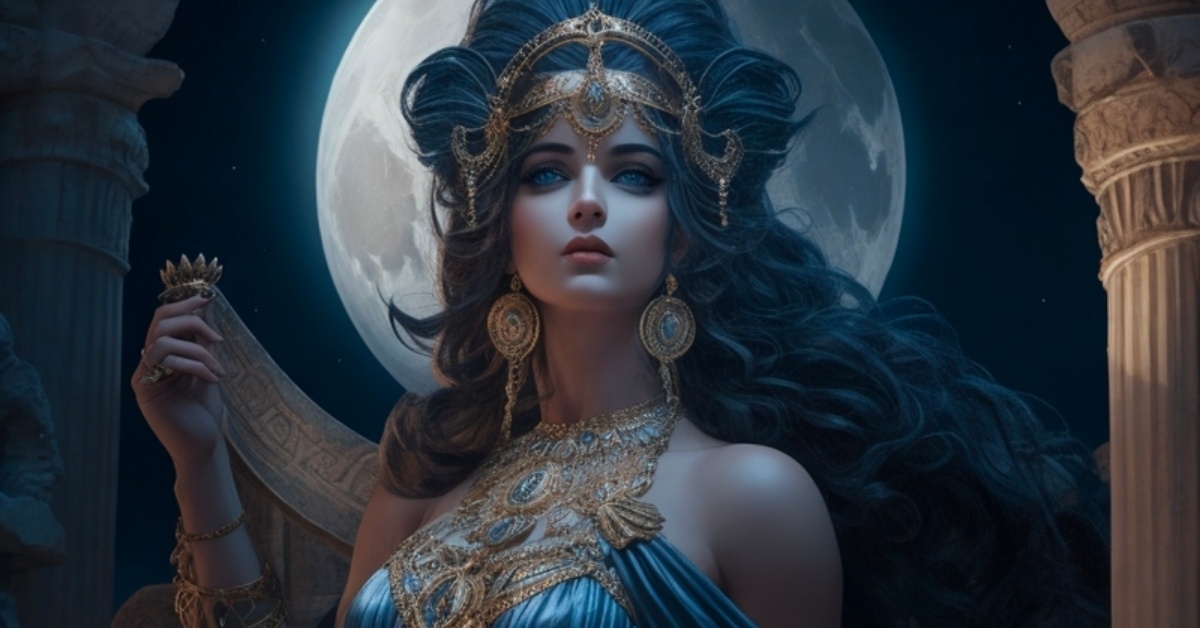
- A winged woman, or a woman driving a chariot drawn by two or four horses
- Robed in black, or in a dark cloak studded with stars
- A veil of darkness arched over her head like a canopy
- Often riding alongside Helios, Selene, and Eos, the other sky-travelers, so closely that scholars struggle to tell them apart
- On the ancient Chest of Cypselus, cradling two infants in her arms: Sleep and Death
Abilities
- Dominion over night — she draws darkness across the earth every evening, without exception
- Power over the gods — the one being Zeus himself left alone
- Mother of forces — she gives birth, alone, to sleep, death, dreams, fate, and strife
- Prophecy — in the Orphic tradition she gives oracles from a cave and counsels Zeus
- Sanctuary — her house at the edge of the world is a refuge even the king of the gods respects
Symbols
- The starry cloak — the night sky, worn as a garment
- The chariot — her nightly crossing of the heavens
- Black wings — her oldest form, a great dark bird
- The black rooster — the animal sacrificed to her, along with black sheep and bulls
- The cosmic egg — in the Orphic telling, the source of everything
Traits
- Ancient and self-contained, older than the drama of the gods
- Feared more than loved, and she earns the fear by existing
- Protective of her children, above all of Sleep
- Impartial: she brings the same night to gods, kings, and beggars
- Wise, in the Orphic strand, the counselor of the kings of heaven
Festivals and Rituals
Nyx had no calendar festival. Her worship was chthonic, the kind reserved for the powers under the earth: black animals, especially black roosters, sacrificed and burned, the offerings buried in pits rather than shared at a feast.
The traveler Pausanias found an oracle of Night on the acropolis of Megara, beside a temple of Dionysus Nyktelios, “the Nocturnal.” One ancient commentator claimed Night held the oracle at Delphi before Themis and before Apollo. In the great Temple of Artemis at Ephesus stood a statue of her by the sculptor Rhoecus.
Night also shaped the mystery rites. The climax of the Eleusinian Mysteries, held for Demeter and Persephone, came in the dark, the initiates walking by torchlight toward a revelation of light. The night belonged to Nyx, named or unnamed.
Legends associated with Nyx
Nyx’s stories are few, and they all say the same thing in different ways: she was here first, and everything, the gods included, moves inside her.
The first of the first-born
Hesiod begins the world with Chaos, a yawning gap. From Chaos come Erebus, the darkness under the earth, and black Night. Night lies with Erebus and bears their opposites: Aether, the bright upper air, and Hemera, the Day. Light is born from darkness, and it goes on being born from her every morning.
Then Hesiod gives her a second list of children, the one that unsettles. These she bears alone: Doom, Fate, and Death; Sleep and the tribe of Dreams; Blame and painful Woe; the Hesperides, who guard the golden apples in the far west; the three Fates, who hand out good and evil at birth; Nemesis, the retribution that comes for the arrogant; and Deceit, Friendship, hateful Old Age, and hard-hearted Strife.
Read it as a list of what the dark holds. Everything that comes for a person unseen, sleep, death, fate, the reckoning, was Night’s child.
The night Zeus backed down
Her one scene in Homer is short, and it’s the most-quoted thing about her.
In the Iliad, Hera wants Zeus asleep so she can tilt the Trojan War her way. She goes to Hypnos, Sleep, and asks him to do it. He refuses, and he tells her why. He did it once before, when Heracles sailed home from Troy, and Zeus woke in a fury. He flung the gods around his hall and went looking for Sleep, to hurl him out of heaven and into the deep for good.
Sleep ran to his mother. Zeus stopped at her door. Homer says he held back, angry as he was, “for he had awe lest he do aught displeasing to swift Night.”
That’s the whole episode, and it’s enough. Zeus, who overthrew his own father and swallowed his first wife, stopped at the threshold of Night. Hera gets her way in the end, by promising Sleep one of the Graces as a bride, and the war turns on it.
Mother of Sleep and Death
Of all her children, two travel with her.
Hypnos, Sleep, and Thanatos, Death, are brothers in Hesiod, born of Night alone, and they live in her house. They’re alike in origin and opposite in temper. Sleep wanders the earth and the wide back of the sea, kind to everyone he touches. Death has a heart of iron and a spirit pitiless as bronze. Whoever he takes, he keeps, and even the deathless gods hate him.
Greek art remembered the pairing. The Chest of Cypselus, an ancient carved cedar box displayed at Olympia, showed Night as a woman with two sleeping boys in her arms, one white and one black, their feet turned different ways. The white one was Sleep. The black one was Death. Sleep, Death, and the dark that holds them both: it was the Greeks’ most honest picture of what night is.
The house at the edge of the world
Nyx has an address, and Hesiod gives directions.
Go past the ends of the earth and the sea, past the gates of Tartarus, to the place where Atlas stands holding up the sky. There is the house of Night, wrapped in dark clouds. She shares it with her daughter Day, and only one of them is ever home. Every evening, at the great threshold of bronze, one goes in as the other comes out. Day carries light for the people of earth. Night carries Sleep in her arms, the brother of Death.
Later myth gives the morning to Eos, the rosy dawn in her chariot. In Hesiod it’s simpler. Morning is the moment Night hands the world over on her doorstep and goes inside.
An older Nyx?
Hesiod’s Nyx is old. There’s a strand of Greek religion in which she is older still, and in charge.
The Orphics were a mystery movement who traced their teachings to the poet Orpheus, and they told the beginning of the world their own way. In several Orphic cosmogonies, Night is the first thing that exists: a great black-winged bird brooding in the dark before anything else. She lays an egg. From it hatches Phanes, also called Protogonos, “First-born,” and identified with Eros, a golden-winged being of light who is the source of all creation. In the Derveni papyrus, the oldest surviving Orphic text, Night lays the egg from which Protogonos rises, and he then brings forth Ouranos and Gaia, the sky and the earth. In the later Orphic Rhapsodies, Phanes hands his scepter to Nyx, and she becomes the second ruler of the universe, passing power in turn to Ouranos, to Cronus, and finally to Zeus.
She stays in the story. In the Derveni account she nurses the infant Zeus, and when he takes power she becomes his oracle, prophesying from her cave and telling him how to bind the cosmos together under his rule. In this telling, Zeus’s kingship was a gift of Night’s advice.
The tradition was well enough known that Aristophanes could joke about it. In his comedy The Birds, staged in Athens in 414 BC, the chorus of birds claims the Orphic egg as its own pedigree: black-winged Night laid a “germless egg” in the deeps of Erebus, out of it sprang golden-winged Eros, and Eros fathered the birds before any god existed.
Scholars read this Orphic Night in different ways. Some see an older Greek layer that Hesiod’s tidy genealogy pushed to the margins. Others see the Orphics reworking Hesiod for their own purposes. Either way, this strand of myth gives Nyx what the rest of the tradition only hints at: a first place, a scepter, and a voice.
Nyx across cultures
Night is universal, and so is the goddess who wears it.
The Romans called her Nox and kept her much as she was, a name for the night and the dread that comes with it. In Egypt, the sky itself was a goddess. Nut arched over the earth with stars along her body; each evening she swallowed the sun, and each morning she gave birth to it again. Egyptian tomb ceilings were painted deep blue and studded with stars so the dead could rest beneath her. The Norse had Nótt, “Night,” a dark daughter of a giant, who rides the sky on a horse named Hrímfaxi, Frost-Mane, whose foaming bit drops the morning dew. The Prose Edda says Odin set Nótt and her son Dagr, Day, in the sky to circle the earth in turn, the same handoff Hesiod described at the bronze threshold.
Closer to home, the Greeks had other faces of the dark, and they’re easy to confuse with her. Selene drives the moon across Nyx’s sky. Hecate, torch-bearing goddess of the crossroads, rules the night’s magic and its ghosts, and she’s the one people prayed to when they wanted something from the dark. Nyx was the dark itself.
Final thoughts
Nyx’s authority runs deeper than any story the Greeks told about her.
The other gods fight, scheme, and fall. Night comes anyway, every evening, over all of them. The Greeks understood that, and gave her the one tribute that mattered: their king, who feared nothing, stepped back from her door. She was here before the gods, and she will be here after the last lamp goes out.
Bibliography
- Hesiod. Theogony, lines 116-125, 211-232, and 736-766. Trans. Hugh G. Evelyn-White. Perseus Digital Library.
- Homer. Iliad, Book 14, lines 231-291. Trans. A. T. Murray. Perseus Digital Library.
- Aristophanes. The Birds, lines 685-702. Perseus Digital Library.
- Pausanias. Description of Greece, Book 1 (Megara) and Book 5 (the Chest of Cypselus). Trans. W. H. S. Jones. Perseus Digital Library.
- Atsma, Aaron J. “Nyx”. Theoi Greek Mythology.
- Miate, Liana. “Nyx”. World History Encyclopedia.
- Kapach, Avi. “Nyx”. Mythopedia.
- Tolentino, Cierra. “Nyx: Greek Goddess of the Night”. History Cooperative.
- “Nyx”, “Phanes”, and “Orphic Egg”. Wikipedia.
- “Nótt” and “Nut (goddess)”. Wikipedia.