Selene: Greek Goddess of the Moon
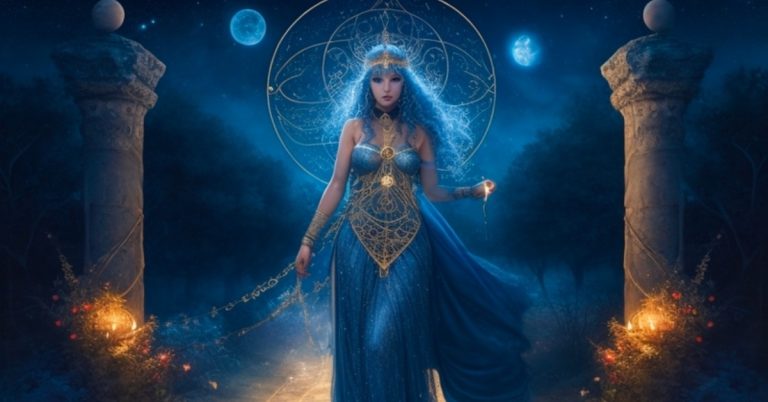
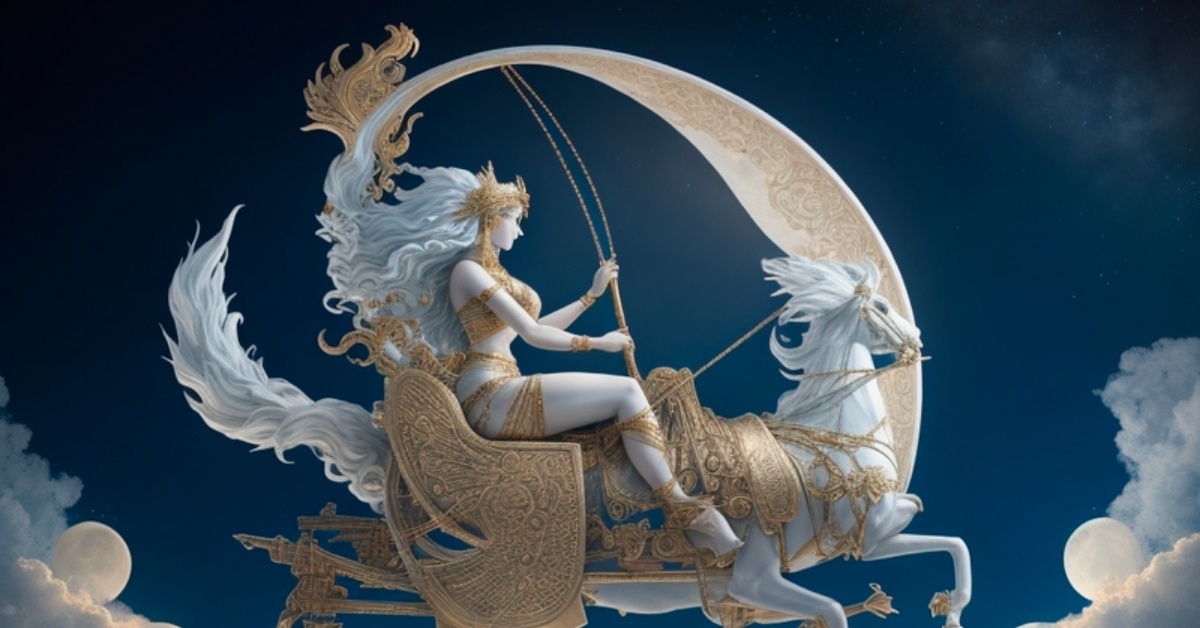
The moon, to the Greeks, is a woman with a job. Each dusk she climbs out of the ocean, puts on a gleaming dress and a gold crown, and yokes two horses to a chariot.
Then she drives it across the sky. Selene was the moon, the actual light overhead, and the oldest poems describe her doing her rounds the way you’d describe a neighbor leaving for work.
What they say she did on her nights off is the interesting part.
Overview of Selene
Selene is the Greek personification of the moon, and she belongs to the generation before the Olympians. In Hesiod’s Theogony she’s the daughter of the Titans Hyperion and Theia, sister to Helios the sun and Eos the dawn. The three of them are the sky’s shift workers: dawn opens the day, the sun crosses it, and the moon takes the night.
Her name comes from selas, the Greek word for light or brightness. The Greeks also called her Mene, their plain word for “moon” and “month,” and that second name is the clue to how old she is. More on that later.
Other poets shuffled her family tree. The Homeric Hymn to Hermes gives her a father named Pallas, and Euripides makes Helios her father rather than her brother. Hesiod’s version stuck.
Her worship was thin compared to her brother’s, and thinner still compared to the goddesses who eventually absorbed her, Artemis and Hecate. But the Romans knew her as Luna, gave her a temple on the Aventine, and Monday still carries her name in half the languages of Europe.
Titles
- Mene (“Moon”)
- Phoebe (“the Bright One,” borrowed from Artemis)
- Cynthia (“of Mount Cynthus,” also borrowed from Artemis)
- Pasiphaë (“All-Shining,” her name at the oracle of Thalamai)
- “White-armed goddess, bright-tressed queen” (the Homeric Hymn to Selene)
Characteristics
How Selene tends to be shown in art:
- A beautiful woman with a crescent moon on her brow, often drawn as two small horns
- Wings, in the earliest descriptions; the Homeric Hymn calls her “long-winged”
- A billowing veil arched over her head, the sign of something that moves through the sky
- Riding a two-horse chariot, or sometimes sidesaddle on a horse or a bull
- Carrying a torch
- A halo or disk of light behind her head
Abilities
- The moon’s light — she is the moon, so she carries the night sky’s only lamp
- Timekeeping — her phases set the month, and “mid-month” in the old poems means her full night
- Sway over childbirth — the full moon was believed to ease labor, which tied her to Artemis and Hera
- Love magic — Theocritus has a lovesick girl invoke Selene in a spell, and Plutarch says women prayed to her for help in love
- Going dark — the one time the Olympians needed her, what they needed was for her to switch off
Symbols
- The crescent — worn as a crown or as horns
- The chariot — silver in most accounts, gold in Pindar, drawn by two horses (Ovid makes them snow white)
- Oxen and bulls — her other draft animals, and the reason the crescent reads as horns
- The torch — light carried through darkness
- The veil — the arc of cloth that marks a sky god in motion
Traits
- Reliable to the point of being a calendar
- Ruled by longing; Plutarch says she yearns for the sun the way lovers yearn
- Willing to bargain with Zeus for what she wants
- Fierce when cornered; she took scars fighting Typhon
- Fond of watching, in a way that is either romantic or unsettling depending on the story
Festivals and Rituals
Selene’s worship stayed small and personal: cakes, prayers, and a few altars shared with the other sky gods.
Athenians made her wineless offerings alongside the other sky gods, and baked flat round cakes called selenai, moon cakes, in her honor. The Athenian festival of the Pandia, named for her daughter by Zeus, was held for Zeus but likely fell on the full moon. Every Monday was hemera Selenes, the day of the Moon.
At Thalamai in Laconia she had an oracle, where she went by the name Pasiphaë and answered questions in dreams. Pausanias saw stone images of her and Helios in the marketplace at Elis, his with sun rays and hers with horns. At Pergamon she shared an altar with Helios and Nyx in the sanctuary of Demeter, probably as part of the Orphic mysteries.
Legends associated with Selene
Selene’s stories are love stories, almost all of them, and in every one she’s the one doing the wanting.
The children of Hyperion
Selene’s own story starts before the Olympians existed.
Hyperion was the Titan of light itself and Theia the shining blue of the upper air. Their three children divided the sky between them. Helios drove the sun by day. Eos, rosy-fingered, opened the gates of morning. Selene took the night.
The Homeric Hymn to Selene gives us her routine in full. She bathes in the waters of Ocean, puts on her far-gleaming robe, and yokes her strong-necked, shining team. Then she drives her long-maned horses at full speed across the sky, and the air, unlit before, glows with the light of her golden crown. At mid-month, the poem says, her orbit is full and her beams shine brightest. “So she is a sure token and a sign to mortal men.”
That’s the whole of her original job description: a sure token, something you can set your calendar by.
Selene and Endymion
Then she looked down one night and saw a sleeping man.
Endymion was a shepherd, or in some tellings a king of Elis, or in Pliny’s version the first human being to study the movements of the moon, which would explain why she noticed him. He was lying asleep in a cave on Mount Latmos in Caria, and he was beautiful. Selene fell hard. Apollonius of Rhodes, the oldest surviving source, calls it a mad passion.
What happened next depends on who’s telling it.
In Apollodorus, Zeus offered Endymion any gift he wanted, and Endymion chose to sleep forever, ageless and undying. In other accounts Selene did the asking: she loved the look of him asleep so much that she begged Zeus to keep him that way. Cicero says it plainly. She put him to sleep herself, so she could kiss him whenever she liked.
Either way, the result is the same. Endymion sleeps on forever. Every night the moon comes down from the sky to the cave on Latmos and lies beside a man who sleeps through every visit, and every morning she goes back to work.
The Greeks found this as strange as we do. Lucian wrote a dialogue in which Aphrodite and Selene compare notes on their doomed mortals, and Selene admits she fell for Endymion while watching him sleep. In another, Aphrodite scolds her son Eros for dragging the Moon down out of the sky.
The fifty daughters
The affair had consequences, which is the part most retellings skip.
Pausanias reports that Selene bore Endymion fifty daughters, the Menae. Fifty is a specific number, and scholars from Frazer onward have read it as the fifty lunar months of an Olympiad, the four-year cycle between the games at Olympia, where Endymion was said to have ruled. Her daughters are the months themselves.
Nonnus, writing in the fifth century AD, added one more child to the pair: Narcissus, the boy who fell in love with his own reflection. It’s a late invention, and other poets give Narcissus different parents. But there’s a rightness to it. The son of a woman who loved a sleeping face, and a man who slept through her love, spends his life staring into still water.
Pan and the fleece
Selene’s next lover took a different approach.
Virgil, in the Georgics, says that Pan, the goat-legged god of the wild, seduced the Moon with what he calls “a snowy bribe of wool.” The ancient commentators fill in the trick. Pan wrapped himself in a bright white sheepskin, hiding the goat underneath, and lured her down from the sky into the woods.
It’s a story about the moon being fooled by something that shines. It’s also the origin of an old habit in Greek and Roman poetry of imagining the moon among the flocks at night, tangled up with shepherds and sheep, a goddess of the sky who keeps ending up in the pasture.
Zeus and the daughter of the full moon
Selene’s third love was Zeus, and this one produced a goddess.
The Homeric Hymn to Selene ends with it: “Once the Son of Cronos was joined with her in love; and she conceived and bare a daughter Pandia, exceeding lovely amongst the deathless gods.” Pandia means “all-brightness,” and the mythographer Kerényi thought the name meant exactly what it says, the brightness of a full-moon night. She may have started as a title of Selene herself before she became a daughter.
Alcman, in the seventh century BC, gave the pair a second daughter, Ersa, whose name means “dew,” the moisture that settles on grass under a clear night sky. Later sources add a third, Nemea, the nymph of the valley where Heracles killed his lion.
Which brings us to the lion.
A lion from the moon
Here’s the strangest thing the Greeks said about Selene.
The Nemean lion, the monster whose hide Heracles wore for the rest of his life, fell out of the moon. The philosopher Anaxagoras reported the tradition, and the poet Epimenides put it in Selene’s own mouth: “For I am sprung from fair-tressed Selene the Moon, who in a fearful shudder shook off the savage lion in Nemea.” Hyginus says she nursed the beast in a cave with two mouths, one in and one out, which is how it slipped every hunter before Heracles.
The ancients left the story unexplained. But it makes the moon a place, with animals living on it, two thousand years before anyone looked through a telescope.
The night she went dark
Selene’s one battlefield story is about her light, and about taking it away.
When the Giants rose against the Olympians, Gaia went looking for a certain herb that would make her children invincible. Zeus got there first. He ordered Helios, Eos, and Selene to stop shining, and in the total dark he harvested the plant himself before the earth could find it. The moon’s contribution to the war was a blackout.
The sculptors of the Great Altar at Pergamon gave her a more active role. On the frieze she rides into the fight sidesaddle, in a woolen tunic and cloak, alongside Helios, Eos, and their mother Theia. Nonnus went further still. In his telling the monster Typhon hurled bulls at the moon, and Selene, horned herself, met him head on and locked horns with him. She carried the scars, he says, ever after. The marks on the moon’s face are her wounds.
An older Selene?
Her second name gives her away. The Greeks called her Mene, and Mene is the same word as English moon and month, Latin mensis, Norse Máni, Lithuanian Mėnuo, Latvian Mēness, Persian Mah, and the Phrygian moon god Men. Linguists trace all of them to a Proto-Indo-European word, reconstructed as *mēh₁n̥s, built on a root meaning “to measure.” The moon is the measurer. Its phases were the first calendar, and its name says so in a dozen languages.
Two things stand out about that reconstruction. First, it’s older than Greece. Selene’s job, marking the month, was the moon’s job in the parent culture, and the Homeric Hymn‘s “sure token and sign to mortal men” is that ancient idea, still intact. Second, the reconstructed moon was masculine. Most of Selene’s cousins are gods, and the Greeks appear to have made their moon a goddess because their word for it, selene, happens to be a feminine noun. Selene is the moon’s oldest name in Greek and, in the strict sense, the only Greek deity who simply is the moon. Artemis and Hecate carry lunar associations; Selene is the light itself.
That distinction mattered less over time. She was a Titan, and the Titans lost. From the classical period on, poets and cult tended to fold her into Artemis, the way Helios was folded into Apollo, and the borrowed titles Phoebe and Cynthia came with the merger. Hecate was drawn in too, and by the late Roman period the commentator Servius could write that a single goddess bore three names, Lucina, Diana, and Hecate, with three powers, “birth, growth, and death,” matched to the crescent, half, and full moon. The philosopher Porphyry had already said the moon is Hecate, her phases the source of the goddess’s power.
That three-in-one lunar goddess is the ancestor of the modern Triple Goddess, maiden, mother, and crone. But the classicist Jane Ellen Harrison and, after her, Robert Graves built that figure in the twentieth century out of a handful of late antique passages, and academics file Graves’s version under poetry. What the sources show is simpler. There was a moon. Its Greek name was Selene. Every later moon goddess, Artemis and Hecate included, is wearing her light.
Selene across cultures
Selene’s Roman twin, Luna, kept her chariot and her crescent and picked up a religion. The Romans gave her a temple on the Aventine, dedicated on March 31, and a night shrine on the Palatine under the name Noctiluca, “Night-Shiner.” Varro put her among the twenty principal gods. In the underground shrines of Mithras she appears in her two-horse biga, one horse pale and one dark, the waxing and waning halves of the month.
Then her family gets stranger. Her linguistic cousins across the Indo-European world, Máni, Mēness, Men, and Mah, are nearly all male, and so are the moons of Egypt, where Thoth and Khonsu keep the calendar, and of Japan, where the moon god Tsukuyomi is the sun goddess’s brother. The Greeks are the odd ones out. When they made the moon a woman, they set the pattern the West has taken for granted ever since.
And on the other side of the world, that pattern turns up independently. The Maya moon goddess Ix Chel governs weaving, childbirth, and the tides, three of Selene’s own concerns, and the Aztec Coyolxauhqui is the moon dismembered in a war among the gods, which puts a different light on Selene’s scars. For more of the ways a culture can imagine the moon as a woman, start with the moon goddesses of the world.
Final thoughts
Strip away the borrowed titles and the late syncretism, and what’s left is a goddess who keeps perfect time and breaks the rules for love.
She keeps time for the whole world, and she leaves her post every night for a man who sleeps through every one of her visits. She is a Titan who outlasted the fall of the Titans by turning into other goddesses. And she is still up there, doing the rounds the Homeric Hymn described, a sure token and a sign to mortal men.
Which makes me wonder: if you had Zeus’s offer, would you take Endymion’s deal and sleep forever in the moonlight, or would you rather stay awake for it?
Bibliography
- Atsma, Aaron J. “Selene”. Theoi Greek Mythology.
- Miate, Liana. “Selene”. World History Encyclopedia, 23 Jan. 2023.
- Kapach, Avi. “Selene”. Mythopedia, 7 Dec. 2022.
- Dhar, Rittika. “Selene: The Titan and Greek Goddess of the Moon”. History Cooperative, 10 Mar. 2025.
- Homeric Hymn 32, To Selene. Trans. Hugh G. Evelyn-White. Perseus Digital Library.
- Apollonius of Rhodes. Argonautica, Book IV. Trans. via Theoi.
- Virgil. Georgics, Book III. Perseus Digital Library.
- Pausanias. Description of Greece, 5.1 (Elis). Trans. W.H.S. Jones. Perseus Digital Library.
- Kerényi, Karl. The Gods of the Greeks. Thames & Hudson.
- Mallory, J. P., and D. Q. Adams. The Oxford Introduction to Proto-Indo-European and the Proto-Indo-European World. Oxford University Press.
- West, M. L. Indo-European Poetry and Myth. Oxford University Press.
- “Selene”, “Endymion (mythology)”, and “Pandia”. Wikipedia.
- “*Seh₂ul and *Meh₁not” and “Luna (goddess)”. Wikipedia.
- “Triple Goddess (Neopaganism)”. Wikipedia.