Gefion: Norse Goddess of the Plow
A king in Sweden once promised a stranger as much land as she could plow in a day and a night. He meant a field.
She took an island.
Her team was her own four sons, turned into oxen, and when they stopped, a piece of Sweden was sitting in the sea off Denmark. That piece is Zealand, and Copenhagen stands on it today. The stranger was Gefion, and her name comes from the word for giving. What she gave the Danes was the ground under their feet.
Overview of Gefion
Gefion, spelled Gefjun or Gefjon in the Old Norse texts, is one of the goddesses Snorri Sturluson counts among the Æsir, the ruling family of the Norse gods. Her home is Scandinavia, and one place above all: the Danish island of Zealand (Sjælland in Danish), which she made with her own plow and where, by one account, she settled as a queen at Lejre, the old royal seat of the Danes.
She is a goddess of the plow, of turned earth, and of the giving that a good field does every year. Her name comes from the Old Norse gefa, “to give,” and it sits right beside Gefn, one of the names of Freya. Modern retellings sometimes make her a daughter of the sea god Ægir and his wife Ran. The medieval sources give her no parents at all.
What they do give her is a small, sharp set of scenes. The Prose Edda opens with her. Heimskringla marries her into the line of Danish kings. Three stanzas of the Poetic Edda put her in a shouting match with Loki. An Icelandic tale has a farm girl swear by her name, and a single verse by Bragi Boddason, the oldest skald whose work survives, was already singing her plowing in the ninth century. No festival of hers is recorded. Her great monument is modern: the bronze Gefion Fountain on Copenhagen’s harbor front.
Titles
- Gefjun, Gefjon, “the Giver”
- The Wandering Woman (farandi kona, Snorri’s first words for her)
- The Fourth Goddess (she stands fourth in Snorri’s list of the Ásynjur)
- The Maiden (Snorri calls her a virgin, attended by all who die unmarried)
- Queen at Lejre (Ynglinga saga)
Characteristics
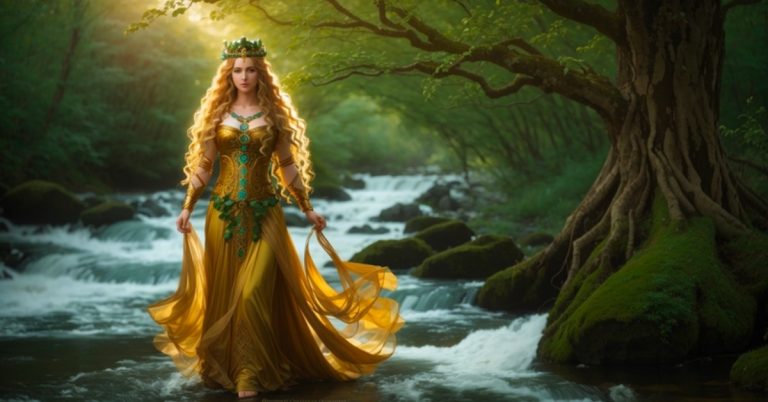
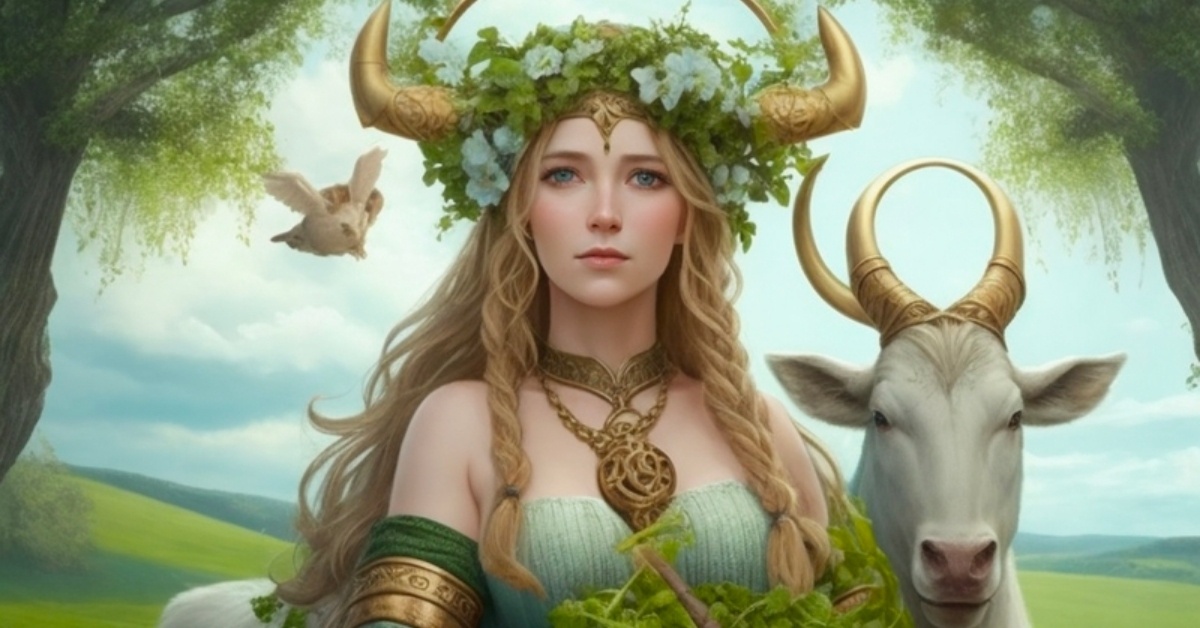
The medieval texts say nothing about her face. What we have comes from what she does, and from the artists who pictured it:
- A woman on foot behind a plow, shoulders set, hair streaming back
- Driving four enormous oxen, goad or whip raised
- Bare-armed and powerful, her whole body leaned into the work
- Water churning around her, the sea she dragged the land into
- In later art, crowned or wreathed with grain
Abilities
- Land-shaping — she plowed an island out of a kingdom in a single day and night
- Shape-changing — she turned her four sons into oxen for the job
- Foreknowledge — Odin himself says she sees the fate of all people as well as he does
- Fertility of the soil — the giver whose name is in the giving
- A hard tongue — in Lokasenna she is the one who stands up to Loki
Symbols
- The plow — her one tool, and the shape of her whole myth
- Four oxen — her sons, eight-eyed and four-headed in Bragi’s verse
- Zealand and Lake Mälaren — the island she made and the hole she left behind
- The necklace — the jewel Loki throws in her face
- The furrow — turned earth, the first mark of a claim
Traits
- Tireless, driving a team through a day and a night without stopping
- Shrewd, hearing a king’s offer for the loophole it holds
- Willing to use everything she has, her own children included
- Independent, a maiden by Snorri’s count who still bore four sons and later chose a husband
- Outspoken in a hall full of gods
Festivals and Rituals
No feast day of Gefion survives from the Viking Age. A few websites give her a holiday on January 8, and none of them cite an old source for it, so treat that date as a modern invention.
What the old texts do preserve is an oath. In Völsa þáttr, a fourteenth-century Icelandic tale, a farm family in northern Norway passes a preserved horse phallus around the table each evening, chanting verses to it as a fertility charm. When it reaches the farmer’s daughter she swears “by Gefjun and the other gods” that she handles it unwillingly. It is a strange little scene, and it is the only glimpse we get of her name in a living rite, invoked at a farmhouse fertility ritual by a woman.
Modern Heathens honor her at spring plowing and at harvest. Denmark honors her in stone and bronze. The Gefion Fountain beside the Kastellet in Copenhagen, sculpted by Anders Bundgaard between 1897 and 1899 and switched on for the first time on July 14, 1908, was a gift from the Carlsberg Foundation for the brewery’s fiftieth anniversary. It shows her mid-stride behind four straining oxen, whip up, water pouring over the team. Visitors pass it on the walk out to the Little Mermaid. That is as close as she gets to a temple.
Legends associated with Gefion
Every story we have about Gefion pulls toward the same three things: land, giving, and a woman who collects on what she is promised.
The king’s careless promise
Snorri opens the Gylfaginning with a king, and the king is about to lose a coastline.
Gylfi ruled the land that men now call Sweden. A wandering woman came to his hall and entertained him. Snorri’s word is skemtun, which can mean song, storytelling, or simply good company, and the text leaves it at that. In return, Gylfi promised her plow-land in his realm: as much as four oxen could turn up in a day and a night.
Read the offer the way he meant it and it is a shrewd gift: four oxen, one day, one generous field.
The woman was of the kin of the Æsir. Her name was Gefjun. She thanked him and went north.
Four sons, four oxen
She went to Jotunheim, the land of the giants, and came back with a team of her own blood.
Snorri says she took four oxen “which were the sons of a certain giant and herself.” She had borne them to a giant, and now she changed them into beasts and yoked them to a plow. Bragi’s verse, the oldest thing we have about her, lingers on the sight: eight eyes gleaming like moons under four brows, four heads bent to the work, sweat reeking off the running beasts.
Whatever a mother feels at a moment like that, she kept to herself. The sons pulled.
The land that walked into the sea
The plow bit so wide and so deep that it loosened the land itself.
The oxen dragged it west, out of Sweden, into the sea, and kept going until they stopped in a sound. There Gefion set the land down and gave it a name, Selund. That is Zealand, the largest of the Danish islands, the one Copenhagen sits on. Bragi calls it “Denmark’s increase.” Gylfi, we can assume, called it something else.
Where the land had been torn up, water rushed in. Snorri says the spot is now the lake the Swedes call the Lögr, which is Lake Mälaren, the great inland water by Stockholm. Then he adds the detail that makes the story feel like a map: “bays lie in that lake even as the headlands in Selund.” The lake and the island are a jigsaw pair. Pull one out of the other and the coastlines match.
They match loosely, in fact, and some scholars think the story was first told about Lake Vänern, farther west, and moved to Mälaren later. Either way, somebody looked at a lake full of bays and an island full of headlands and decided they had once been the same piece of ground.
Ynglinga saga, Snorri’s history of the Swedish and Norwegian kings, tells the same tale with a colder frame. There, Gefion is an agent. Odin, settling his people in the north, sends her across the water to look for land. She charms Gylfi, plows out Zealand, and then marries Skjöld, Odin’s own son. The two of them make their home at Lejre, the ancient seat of the Danish kings, and the royal house of the Skjöldungs descends from that marriage. Odin, meanwhile, takes Sigtuna for himself, on the shore of the lake his goddess left behind. Gylfi gave away a field and lost a country to a family.
Gefion at Ægir’s feast
The Poetic Edda gives her three stanzas, and they earn every line.
Lokasenna is the poem where Loki crashes a feast in the hall of the sea god Ægir and insults every god and goddess in turn. He has just finished with Idun, calling her the most man-hungry of women, when Gefion cuts in. Why, she asks, are you two raising hatred here? Everyone knows Loki loves a jeer and hates the gods.
Loki turns on her. Be silent, Gefjun, he says. I know who led you to lust: the fair-skinned youth who gave you a necklace, and you laid your leg over him.
It is Odin who answers, and he answers with a warning. You are mad, Loki, and out of your wits, to rouse Gefjun’s anger. She sees the fate of all people as clearly as I do.
Take that in. Odin, who hung on the tree and gave an eye for wisdom, puts Gefion’s knowledge of destiny level with his own. Gefion is the only one at that table he speaks for. When Loki turns on Frigg a few stanzas later, Freya is the one who steps in to defend her, and Odin keeps his seat. Whoever Gefion was to the poet of Lokasenna, she was someone the Allfather handled with care.
An older Gefion?
Snorri’s tidy list has a crack in it. His fourth goddess is a maiden, “and they that die maidens attend her.” His first goddess in the Gylfaginning, the one who plows, is the mother of four giant-blooded sons, and in Heimskringla she is the wife of Skjöld. Both are called Gefjun. One name is carrying at least two women, and scholars have spent a long time asking which is the older.
Some of the tension may be in the translation. The Old Norse mær means an unmarried woman as often as it means a virgin, and a goddess who has borne sons to a giant and not yet married anyone is, by that reading, still a maid. That is the softest fix. It leaves the odder fact untouched: the goddess who receives all the unmarried dead is also a goddess of the plowed field. Death and fertility in one pair of hands is one of the oldest pairings in religion.
The name pulls the same direction. Gef-, “give,” is the root of Gefn, one of Freya’s own names, and Loki’s jab about a necklace bought with sex is the accusation the tradition usually aims at Freya, who won the necklace Brísingamen by sleeping with the dwarves who made it. Rudolf Simek treats Gefion as possibly a hypostasis of Freya, one face of the great giving goddess of fertility, split off and given a story of her own, and John Lindow weighs the same link. Philologists have set her name beside the Rhineland altars to the Matronae, the mother-goddesses some Germanic peoples called the Gabiae and Alagabiae, “the givers.” Hilda Ellis Davidson places her among the local goddesses of the farm and the district, in the tradition of the Nerthus that Tacitus describes, an Earth Mother worshiped on an island in the northern sea. In that frame Gefion is a land-mother, a goddess of Zealand itself, later filed among the Æsir.
Her myth reads like two practical stories wearing one costume. The first is an etiology, an explanation of the land. A Swedish lake full of bays and a Danish island full of headlands ask for an explanation, and a goddess plowing one out of the other accounts for both. Bragi’s verse proves the story was already old in the ninth century. The second is a land claim. Icelandic law, as recorded in the Landnámabók, allowed a woman to claim as much land as she could lead a two-year-old heifer around in a spring day between sunrise and sunset; a man’s claim was measured by fire carried in a day. Gefion’s bargain with Gylfi is that rule made divine: one day’s daylight, a beast on the move, and the ground you circled is yours. Davidson connects it further to the ceremonial plowing customs recorded across northern Europe, the ritual first furrow that opened the season and was thought to bless the fields and drive off disease. A goddess who plows land into being would be, in her words, a fitting patroness of rites like that.
There is even an argument that she reached England. Frank Battaglia has proposed that geofon, an Old English poetic word for the sea that appears five times in Beowulf, preserves her name, and that the poem’s monsters, Grendel’s mother above all, carry the memory of an older goddess of the waters and the land being pushed aside by a new order of warrior kings. Most scholars file it under possibilities.
Whether Gefion is Freya under another name, a Zealand land-mother absorbed into the Æsir, or an independent goddess whose stories simply thinned to a handful, the texts leave open. What they show is a giver who is also a taker, a maiden who is also a mother, and a keeper of the unmarried dead who makes the living soil. The older the layer, the more those look like a single job.
Gefion across cultures
A goddess who wins land by the span of a single day belongs to a wider family of stories, and most of them turn on the same trick.
When the Phoenician queen Dido landed on the coast of North Africa, the local king offered her as much land as an oxhide could cover. She cut the hide into a single thread-thin strip and enclosed the whole hill on which Carthage rose. The Romans remembered the citadel as Byrsa, “hide.” Romulus, founding Rome, yoked a bull and a cow to a bronze plowshare and drove the furrow that marked the city’s sacred boundary, lifting the plow only where the gates would stand. In India, King Janaka was plowing a field for a fertility rite when the blade turned up an infant girl in the furrow; he named her Sita, which means “furrow,” and she grew up to be the heroine of the Ramayana and a goddess in her own right. In England, Plough Monday, the first Monday after Twelfth Night, opened the farming year with a decorated plow dragged through the village to bless the coming season, and villages still revive it.
Oxhide, furrow, heifer, a day’s light. Each of these grew on its own soil, and the same instinct keeps surfacing: the earth is a woman, the plow is how you speak to her, and a claim is only real once you have worked it with your own hands. Gefion is the Scandinavian answer, and she is the only one of the group who did the plowing herself.
Final thoughts
Gylfi thought he was paying an entertainer. He was signing over a coastline.
That is the shape of Gefion’s whole story, and it is why she still lands. She takes an offer made carelessly and holds the giver to its letter, and she does it with a plow, the plainest tool a farming people had. Every Dane who looks across the Øresund toward Sweden is looking at the hole she left. Every field turned in spring is, by the oldest version of the rite, a small repetition of what she did in one night.
She is a giver who had to take her own gift, a maiden with four sons, a goddess Odin was careful with. The sources leave her as two or three women under one name, and which of them you see is your call. When you picture her behind that plow, is she Freya in a working dress, an island’s own forgotten mother, or someone the Eddas only caught in passing?
Bibliography
- Snorri Sturluson. Gylfaginning, chs. 1 and 35, in The Prose Edda. Trans. Arthur Gilchrist Brodeur, 1916. Also at Sacred Texts.
- Snorri Sturluson. Ynglinga saga, ch. 5, in Heimskringla. Trans. Samuel Laing, 1844.
- Lokasenna, stanzas 16-29, in The Poetic Edda. Trans. Henry Adams Bellows, 1936.
- “Völsa þáttr” and “Landnámabók”. Wikipedia.
- Davidson, Hilda Ellis. Roles of the Northern Goddess. Routledge, 1998.
- Lindow, John. Norse Mythology: A Guide to the Gods, Heroes, Rituals, and Beliefs. Oxford University Press, 2001.
- Simek, Rudolf. Dictionary of Northern Mythology. Trans. Angela Hall. D. S. Brewer, 1993.
- McCoy, Daniel. “Gefjun”. Norse Mythology for Smart People.
- “Gefjon”. Encyclopaedia Britannica.
- “Gefjon” and “Gefion Fountain”. Wikipedia.
- Plutarch. Life of Romulus, ch. 11. Trans. Bernadotte Perrin, Loeb Classical Library.
- “Byrsa”, “Sita”, and “Plough Monday”. Wikipedia.