Luna: Roman Goddess of the Moon
Two thousand years ago, a small shrine on the Palatine Hill in Rome glowed after dark.
The scholar Varro, who wrote the best guide to Latin words that survives, explained the goddess who lived there in one line. She was called Luna, he said, because she alone shines at night. And on the Palatine they called her Noctiluca, “she who shines by night,” because that was what her shrine did.
Rome borrowed most of its gods from Greece. The moon was one it already had, with a lamp burning in the window.
Overview of Luna
Luna is the Roman moon, the goddess and the disk in the sky at once. Her name is the ordinary Latin word for the moon, and it comes from the same root as lux and lucere, “light” and “to shine.” The Romans heard the meaning every time they said it. To call the moon Luna was to call her the bright one.
The scholars of the late Republic took her seriously. Varro listed her among the twenty di selecti, the “select gods” who mattered most to the Roman state, and grouped her with Sol, the sun, as one of the gods you could see with your own eyes. She belonged to the sky, to the calendar, and to the racetrack, and she had two temples in the city and a shrine on its oldest hill.
Her Greek twin is Selene, and when Roman poets wanted a family tree for Luna they borrowed Selene’s: the Titans Hyperion and Theia for parents, Sol and Aurora for siblings. Her Roman story runs on different fuel. It lives in temple records, calendars, coins, and the carved corners of underground shrines.
Her great days were the last of March, when her Aventine temple kept its birthday, and the end of August, when the whole city went to the circus for her and for the sun.
Titles
- Luna Noctiluca (“she who shines by night,” her name on the Palatine)
- Siderum regina bicornis (“two-horned queen of the stars,” in Horace’s Carmen Saeculare)
- Lucina (“she who brings to light,” a name Cicero says the Romans gave the moon as a goddess of childbirth)
- Diva triformis (“the three-formed goddess,” her identity as one face of Diana)
- Trivia (“of the three ways,” the name of her crossroads self)
Characteristics
How Luna tends to be shown in Roman art:
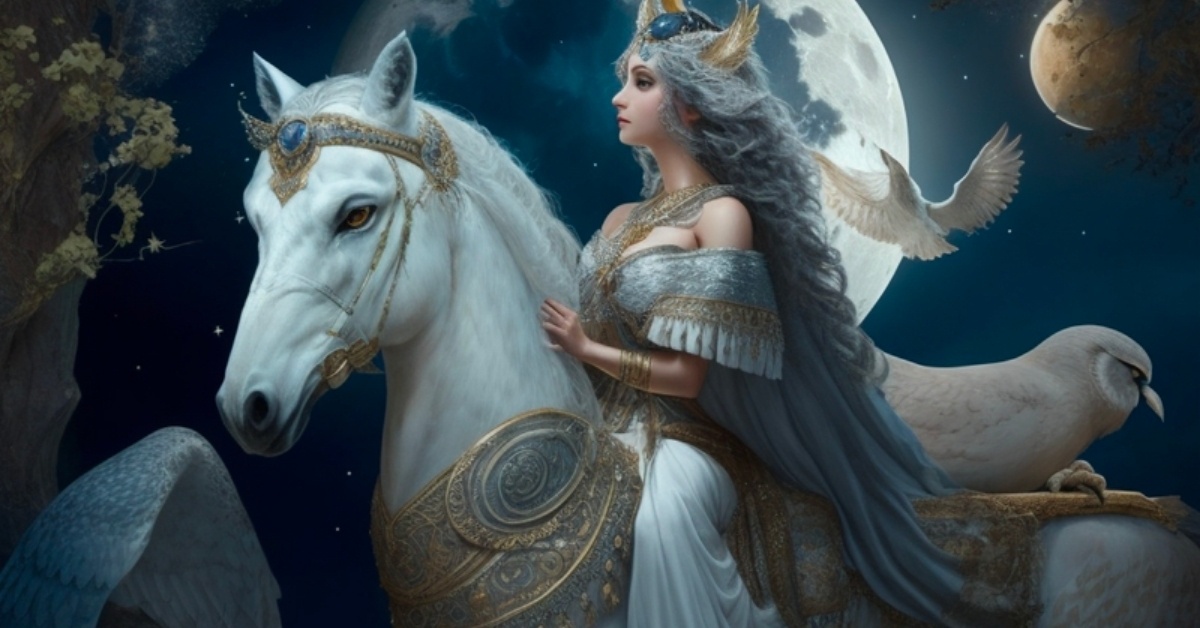
- A crescent moon behind her shoulders or on her brow, drawn as two small horns
- A veil billowing in an arc over her head, the sign of a god in motion across the sky
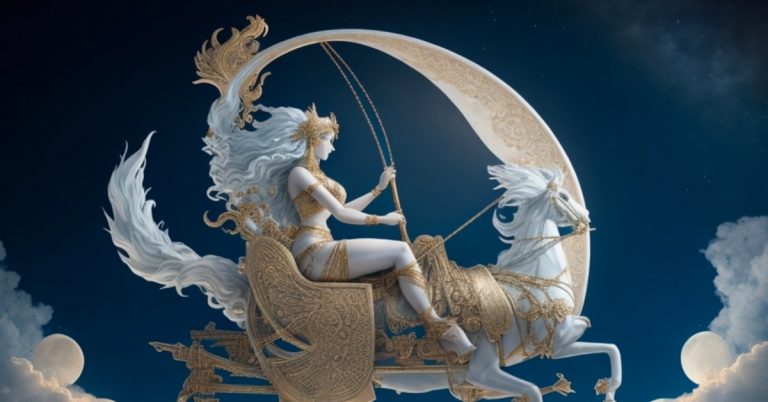
- Standing in a two-horse chariot, the biga, one horse pale and one dark
- Holding a torch or a whip
- In the corner of a Mithraic relief, opposite the sun, descending as he rises
- On coins, as Diana with a torch, the moon’s light in a huntress’s hand
Abilities
- Ruling the months — “Luna rules the months,” Ovid wrote, and the Roman calendar began each month when her crescent appeared
- Light after dark — she is the night’s only lamp, which is why Varro derived her name from shining
- Moving the sea — Pliny the Elder credited the moon with the tides, and Roman sailors planned by her phases
- Bringing children to light — as Lucina she oversaw childbirth, the moon’s oldest job in Italy
- Being pulled down — Roman poets loved the idea that a Thessalian witch could drag the moon out of the sky with a spell, and Luna is the goddess they dragged
Symbols
- The crescent — worn as horns, and the reason Horace called her “two-horned”
- The biga — the two-horse chariot, against the sun’s four
- The white horse and the black horse — the waxing and waning halves of the month, yoked together
- The torch — light carried through darkness, shared with Diana
- The lamp — the light that burned in her Palatine shrine
Traits
- Reliable enough to build a calendar on
- Paired with the sun in almost everything: temples, games, and stone
- Patient with sleepers, at least the handsome ones
- Vulnerable to witches, at least in poetry
- Willing to share a body with two other goddesses and still keep her name
Festivals and Rituals
Luna’s worship followed the Roman year, and its dates are on the surviving stone calendars.
March 31 was the anniversary of her temple on the Aventine, and Ovid closed the third book of his Fasti on it: “Luna rules the months; this month’s time also ends with Luna, to be worshiped on the Aventine ridge.” August 24 brought a sacrifice to Luna at the Graecostasis, the platform in the Forum where foreign envoys once stood. Four days later, on August 28, the Circus Maximus held games for Sol and Luna together, the sun and the moon sharing a day at the races.
Then there was the monthly rite nobody thought of as hers, because it was simply how time worked. Every month began on the Kalends, and the Kalends began when a junior priest, the pontifex minor, spotted the new crescent. He reported it to the rex sacrorum, the king of sacred rites, and the people were called together to hear how many days remained until the Nones. The word Kalends comes from calare, “to call out.” Rome’s month started with a man watching the sky for Luna.
Legends associated with Luna
Luna has fewer stories than most goddesses, and the ones she has were mostly written by historians rather than poets. Rome told her legend in buildings.
The shrine that glowed at night
The oldest trace of Luna in the city is the strangest.
On the Palatine Hill, where Romulus was said to have built his hut and where the emperors later built their palaces, there was a shrine to Luna Noctiluca. Varro is the only writer who describes it, and he does so to explain the name: the shrine “shines at night.” Something burned there after dark, a lamp or a fire, and it was visible enough that the whole neighborhood knew the goddess by it.
That is all that survives of it, with no date, no founder, and no plan. But a light kept burning through the night on Rome’s founding hill, in honor of the moon, is the kind of detail that says how far back her worship goes. The Palatine was old ground, and Noctiluca was there before anyone thought to write down why.
The temple on the Aventine
Her main temple stood on the Aventine, the hill of the plebs.
The Aventine sat outside the pomerium, the sacred boundary of the old city, and it was the working-class quarter of Rome, the home of the common people and their gods. Luna’s temple stood at its north end, near the Porta Trigemina, above the temple of Ceres, the great plebeian sanctuary. Tacitus says king Servius Tullius dedicated it, which places its founding in the sixth century BC, though the attribution is tradition rather than proof.
Its history is a run of accidents. In 182 BC, Livy reports, a windstorm of such force struck the city that it tore the doors off Luna’s temple and hurled them into the back wall of the temple of Ceres below. In 146 BC the general Lucius Mummius, fresh from destroying Corinth, dedicated part of the spoils there. In 84 BC lightning struck it on the day the popular leader Cinna was murdered, and the priests read the omen accordingly.
Then, in AD 64, Nero’s fire took it. Tacitus lists the temple of Luna among the losses of the great fire, alongside the altar of Hercules, the temple of Jupiter Stator, and the house of Vesta, as one of the holy places the city could never replace. It was never rebuilt.
The moon at the races
Luna’s most public appearance in Rome was at the chariot races.
The Circus Maximus, the great racetrack in the valley between the Palatine and the Aventine, sat between her two sacred hills. And the circus, the Christian writer Tertullian complained, was a religious building from end to end. It was consecrated above all to the Sun, whose temple stood in the middle of the track, and the whole apparatus of racing carried a divine meaning. “The chariot and four to the sun; the chariot and pair to the moon.” The sun drove a quadriga, four horses for the four seasons. Luna drove a biga, two horses for the two halves of the month, the waxing and the waning.
Every race in Rome, in other words, restaged the movement of the sky. When the games for Sol and Luna were held on August 28, the drivers were the sun and moon’s own stand-ins, and the crowd in the stands, a hundred and fifty thousand strong on a good day, was cheering for the heavens.
That is the goddess the ordinary Roman knew. She was the reason the small chariots ran.
The moon in the Mithraeum
Underground, she took the same chariot into a different religion.
The cult of Mithras, the soldiers’ mystery religion of the empire, built its shrines in caves and cellars. The central image in every one was the tauroctony, Mithras killing the bull. And in the two upper corners of that scene, on relief after relief, stand Sol and Luna. Sol rises on the left in his four-horse chariot, crowned with rays. Luna descends on the right in her biga, a crescent behind her shoulders, sometimes led down by a boy with a lowered torch, the evening star guiding her off duty.
One of the finest of these reliefs was found in a Mithraeum dug beneath the Circus Maximus itself, so the racetrack goddess and the cave goddess were, in one spot, the same Luna, a few meters apart. The Mithraists took her white horse and her black horse and gave them a meaning the church encyclopedist Isidore of Seville later spelled out: the biga belongs to the moon because she keeps a twin course with the sun, seen by day and by night, “for they yoke together one black horse and one white.”
Endymion, told in Latin
The one love story Luna has, she borrowed, and the Romans used it in a strange way.
The Greeks told how the moon fell for the sleeping shepherd Endymion and kept him asleep forever in a cave on Mount Latmos. Roman poets retold it under her Latin name, and they treated it as a figure of speech. Propertius, writing about his own love affairs, brings up Endymion lying naked to Luna as proof that beauty is best seen uncovered. Ovid, in the Heroides, has Leander swimming the Hellespont by night and begging the moon to light his way, reminding her that she once loved a mortal too.
Cicero did the oddest thing with it. In the Tusculan Disputations, arguing that death might be no worse than sleep, he reaches for Endymion: Luna put him to sleep on Latmos, he writes, so that she could kiss him while he slept, and in all that time he has felt nothing. For Cicero the story is a thought experiment about the afterlife. The goddess kissing the sleeping man is a philosopher’s example.
Three goddesses in one
Luna’s last story is about disappearing into a bigger goddess, and it ends with her name intact.
From the late Republic onward, Roman writers folded the moon into Diana, the huntress, and Diana into the crossroads goddess Hecate. Catullus, in a hymn to Diana, addresses her as Latonia, Juno Lucina, Trivia, and Luna in a single poem. Horace calls her diva triformis, the three-formed goddess. The commentator Servius set the three out as a map: Luna in the sky, Diana on earth, and Proserpina below it.
There was a cult image to match. At Diana’s ancient sanctuary on Lake Nemi, the archaic statue showed three figures joined by a bar, and in 43 BC a Roman moneyer put it on a coin: three Dianas standing in a row, one of them the moon with her crescent. This is Diana Triformis, and she is the ancestor of every triple goddess in Western esoteric tradition. But look at what the Romans did when they merged her. They kept her name. On the coin, in the hymn, in Servius’s diagram, the moon is still Luna. She became one third of Diana, and that third still answered to Luna.
An older Luna?
The Roman antiquarians were sure of one thing about the moon: she was in Rome before the Greek stories arrived.
Their evidence was a king. Varro, listing the gods whose altars carried “a scent of Sabine speech,” says that Titus Tatius, the Sabine king who ruled Rome jointly with Romulus in the city’s first generation, vowed altars to a set of old Italian gods, and Sol and Luna are on the list next to Saturn, Ops, Flora, and Vulcan. Dionysius of Halicarnassus repeats the tradition. Tacitus gives her Aventine temple to the sixth king, Servius Tullius. These are legends about the regal period, and the altars of Tatius exist only on the page. But they show what Romans of Varro’s day believed: that the moon’s cult belonged to the Sabine and Latin countryside, and that it was among the first things the city took in.
The language agrees with them. Luna is a native Italic word. It descends from an older form scholars reconstruct as louksnā, “the shining one,” and it has cousins across the Indo-European world that have nothing to do with Greece: Old Prussian lauxnos for “stars,” Avestan raoxšna for “shining.” Selene arrived in a city that already had a word for the bright thing in the sky, and the word was hers.
The calendar is the strongest witness. The old Roman month was lunar. It opened on the Kalends with the first sighting of the crescent, reached the Nones at the first quarter, and peaked at the Ides on the full moon. A priest whose job was to watch for the new moon and call the people together when he saw her is a priest of Luna in all but name, and that office was ancient by the time anyone wrote about it. Ovid’s “Luna rules the months” was, for the early city, a plain description of how the year was kept.
What this older layer looks like is hard to say, and honest writers say so. She was a light in a shrine, a name in a king’s vow, a crescent a priest watched for. The Greek myths gave her a face and a lover later. Under them is an Italic goddess of the visible moon, tied to the count of days, who was worshiped on Rome’s two oldest hills before Rome could write.
Luna across cultures
Luna’s closest relatives are the ones she absorbed and the one she was absorbed into.
Selene gave her a chariot, a lover, and a family tree, and the two became so interchangeable that Roman poets used the names as synonyms. Diana’s Greek mirror, Artemis, carried the moon in Greece the way Diana came to carry it in Rome, so that the huntress and the moon became one figure on both sides of the Adriatic. For the many other ways a culture can picture the moon as a woman, start with the moon goddesses of the world.
The closest match to Luna’s Roman story, a state goddess with a temple and a calendar, is on the other side of the world. The Inca moon, Mama Killa, was the wife and sister of the sun god Inti, and her temple in the Coricancha at Cusco was sheathed in silver where his was sheathed in gold. She governed the calendar, and the great festivals of the Inca year were timed by her phases. Sun in gold, moon in silver, the pair of them setting the year for an empire: that is a Roman arrangement, arrived at independently in the Andes.
And Luna left a legacy on every calendar in Romance-speaking Europe. The Romans named the second day of the week dies Lunae, the day of the Moon. It is still lunedì in Italian, lundi in French, lunes in Spanish, and the English Monday is the same idea translated. Most of the Western world still says her name once a week.
Final thoughts
Every goddess in this collection has a story. Luna has a city.
Her shrine glowed on the Palatine, her temple burned on the Aventine, and her chariot ran in the valley between them. A priest watched the sky for her every month for centuries, and the number of days in Rome’s calendar began with him. She was carved into the corner of every cave where soldiers worshiped Mithras and pressed onto the coins of the Republic. She survived being merged into Diana with her name still on the label. Then Rome fell, and the day of the week she named kept going.
So here is a question about how goddesses last. Selene has the better myths; Luna has a Monday. Which one is the more durable kind of immortality, a story people keep telling, or a word people keep saying without remembering why?
Bibliography
- Varro. On the Latin Language, Book V (5.68 on Noctiluca; 5.74 on the altars of Titus Tatius). Trans. Roland G. Kent. ToposText.
- Tacitus. Annals, 15.41 (the temple of Luna in Nero’s fire). Trans. Church and Brodribb. Perseus Digital Library.
- Livy. History of Rome, Book 40 (40.2, the storm of 182 BC). The Latin Library.
- Ovid. Fasti, Book III (lines 883–884, “Luna regit menses”). The Latin Library.
- Tertullian. De Spectaculis (The Shows), chapters 8–9. Trans. S. Thelwall. Tertullian.org.
- Cicero. Tusculan Disputations, Book I (1.92, Endymion). Trans. C. D. Yonge. Attalus.
- Horace. Carmen Saeculare. The Latin Library.
- Macrobius. Saturnalia, Book I (1.15 on the Kalends and the new moon). LacusCurtius.
- Pliny the Elder. Natural History, Book II (the moon and the tides). LacusCurtius.
- Augustine. City of God, Book VII (Varro’s twenty select gods). New Advent.
- Pearse, Roger. CIMRM 435-436: Tauroctony, Circus Maximus Mithraeum, Rome. The Roman Cult of Mithras.
- “Luna”. Digital Maps of the Ancient World.
- “Luna (goddess)”, “Temple of Luna”, and “Roman festivals”. Wikipedia.
- “Diana (mythology)”, “Tauroctony”, and “Mama Killa”. Wikipedia.