The Morrigan: Irish Goddess of War, Fate, and Sovereignty
A warrior rides out to battle and passes a woman at the ford, washing clothes in the river. The water runs red. The clothes are his.
That is how the Morrigan announces a death. The blow is still hours away, and she has already watched it land.
She is Ireland’s goddess of war and fate, the crow over the battlefield, the shapeshifter who fought the greatest hero of Ulster as an eel, a wolf, and a cow. Read the oldest texts closely and she turns out to be something larger than war.
Overview of the Morrigan
The Morrigan belongs to the Tuatha Dé Danann, the divine race of Irish myth, the people of the goddess Danu. The medieval Book of Invasions names her a daughter of Ernmas and gives her two sets of sisters. The first three are Ériu, Banba, and Fódla, the goddesses whose names are names for Ireland itself. The second three are Badb, Macha, and the Morrigan herself, the three who share the work of the battlefield. Together they are the Morrígna, and the texts treat them sometimes as three sisters and sometimes as three faces of one goddess. Nemain, a spirit of battle panic, gets folded into the trio by later writers, though the medieval evidence for her is thin.
She rules war on her own terms. Her weapons are words and shapes. She prophesies the outcome, heartens one side, terrifies the other, and tilts the odds with magic. She changes shape at will, most famously into a crow or raven. And she chooses heroes and kings, and unmakes the ones who refuse her.
Her name is a puzzle scholars still argue over, and that argument gets its own section further down. The two readings on the table are “Great Queen” and “Phantom Queen.”
The surviving texts tie her to one night above all: Samhain, the turn of the Irish year, when her most famous meeting takes place.
Titles
- The Morrígan, or Morrígu (the Old Irish forms)
- Mór-Rígan, “Great Queen”
- “Phantom Queen,” the reading most linguists now prefer
- Anand, or Anu, the name the Book of Invasions says was also hers
- The Morrígna, the plural, for the three sisters together
- Daughter of Ernmas
Characteristics
How the texts and later art show her:
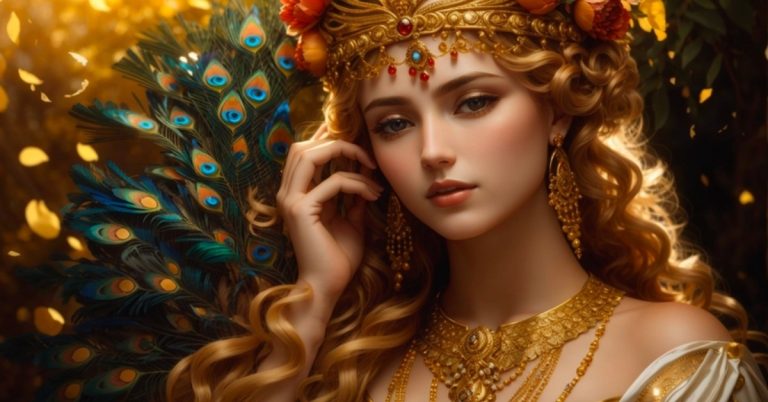
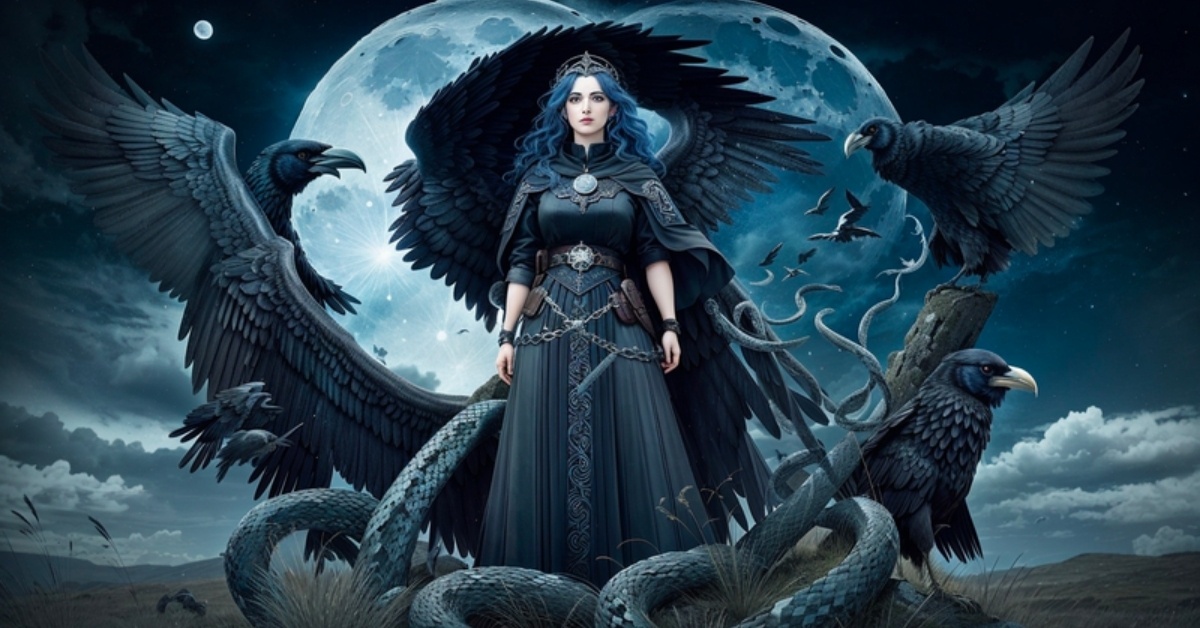
- A crow or raven, black against the sky over a battle
- A beautiful young woman in a many-colored cloak, offering herself to a hero
- An old woman by the roadside, one eye ruined, milking a cow with three teats
- A washerwoman at a ford, scrubbing blood from the gear of a man still alive
- A woman straddling a river, one foot on each bank, her hair in nine loose tresses
- An eel, a she-wolf, a red-eared heifer
Abilities
- Prophecy — she sees the end of a battle before a sword is drawn
- Shapeshifting — bird, beast, maiden, crone, at will
- Incitement — a poem chanted from her mouth breaks an army and drives it into the sea
- Sovereignty — she chooses who holds the land and withdraws her favor when she chooses
- Battle magic — she can take the courage out of a king’s body before he ever reaches the field
Symbols
- The crow and the raven — the birds that feed on a battlefield, and the shape she wears above one
- The ford — the crossing between life and death, where she washes the clothes of the doomed
- The cow — the red-eared heifer of the otherworld, and the milk she offers as a hag
- The river at Samhain — the Unshin in County Sligo, where she straddled the water to meet the Dagda
- The number three — three sisters, three shapes, three wounds, three blessings
Traits
- Proud, and unforgiving of any man who turns her down
- Loyal to her own people, the Tuatha Dé, above everything
- Cunning over strength; she wins by prophecy, terror, and trickery
- Double-natured: guardian of the land in one breath, its scourge in the next
- Honest to a fault; her prophecies come true, including the ugly ones
Festivals and Rituals
The medieval scribes wrote down her stories and left out her rites, so we have myths and place-names in place of a calendar.
Samhain, the feast that opened the Irish winter on the night of October 31, is her night in the myths. The Second Battle of Moytura turns on a Samhain meeting between the Morrigan and the Dagda, and the fate of Ireland is settled in the days that follow. Modern devotees of the Morrigan still keep Samhain as her feast for that reason.
Her geography is real and you can walk it. Two hills near the great passage tombs of the Boyne are Dá Chích na Morrígna, “the two breasts of the Morrigan.” A burnt mound in County Tipperary is Fulacht na Mór Ríoghna, her cooking hearth. And tradition makes the cave at Cruachan in Roscommon, Oweynagat, her doorway between the otherworld and this one. These are the marks of a goddess who owned land, and that detail matters later.
Legends associated with the Morrigan
Her stories come from two great cycles of Irish literature. In the Mythological Cycle she fights for the gods against the Fomorians. In the Ulster Cycle she tangles with a mortal hero, and loses her temper. Both cycles keep coming back to one scene: a man meets a woman, fails to recognize her, and pays for it.
The washer at the ford
Cormac Connloinges, a prince of Ulster in exile, was riding home to claim his father’s throne. On the road his company came to a river crossing, and at the ford stood a woman with a red mouth, washing a chariot and its harness in the stream. The water ran red around her hands. She stood on one foot, with one eye closed, half in this world and half out of it.
Cormac’s men asked what she was doing. She told them. She was washing the gear of a king who would die that night, and the gear was Cormac’s.
He rode on anyway, to a hostel called Da Choca’s, where his enemies caught him before dawn. The text names the washer as the Badb, and Irish tradition keeps Badb and the Morrigan tangled together; they are the same terror wearing two names. The scene became one of the most durable images in Irish story, the bean nighe, the washing woman, who scrubs the shirt of the man about to die. Fold that figure forward a thousand years and you get the banshee.
The Second Battle of Moytura
The Tuatha Dé Danann had lost their kingship to the Fomorians, the monstrous sea-people, and were gathering to take it back. The Dagda, their great father-god, had a meeting to keep first.
On the eve of Samhain he went to the river Unshin in Sligo and found the Morrigan there, standing astride the water with one foot on each bank and nine loosened tresses down her back. They lay together on the riverbank, and the place kept the name Lige ina Lánamhnaib, “the Bed of the Couple,” ever after.
Then she gave him what he had come for. She told him where the Fomorians would land. She promised to destroy their king, Indech mac Dé Domnann, and to take from him “the blood of his heart and the kidneys of his valour.” She kept the promise. Before the battle she gave two handfuls of that blood to the hosts of the Tuatha Dé waiting at the ford, and the Fomorian king marched onto the field with his courage already gone.
When the war-leader Lugh went around the assembled gods asking each what power they brought to the fight, the Morrigan answered like a hunter: she would pursue what was watched, she would kill, she would destroy. On the day itself she came onto the field and chanted a poem to hearten the Tuatha Dé, and the battle broke. The Fomorians were driven into the sea.
Afterward she sang twice more. The first song announced peace to the heights and rivers of Ireland, “peace up to heaven, heaven down to earth.” The second looked further ahead, into a world with nothing in it she loved: summer without blossom, cattle without milk, women without modesty, men without valor, kin betraying kin. Her prophecy of victory and her prophecy of ruin come out of the same mouth in the same hour. That is the whole goddess in miniature.
A cow, a chariot, and a black bird
Long before the great cattle raid, the young Cú Chulainn was woken one night by a terrible noise and went out to find its source. What he found was a chariot pulled by a one-legged horse, with a red-haired man walking beside it and a red woman riding in it, driving a cow. He challenged her. The cow, he said, belonged to Ulster, and he was Ulster’s watchman. She said she was a poet and the cow was her fee, and she mocked him for it.
He lost his temper and leapt at the chariot. The woman, the horse, the man, and the cow all vanished, and in their place a black bird sat on a branch above him.
Now he knew her. She told him she was taking the cow to be bred by the Brown Bull of Cooley, and that the war which would follow would be his to fight. She promised to meet him in it as an eel, as a wolf, and as a heifer. He promised to break the eel’s ribs, burst the wolf’s eye, and shatter the heifer’s leg. Both of them kept their word.
Eel, wolf, and heifer
When Queen Medb of Connacht marched on Ulster to steal the Brown Bull, the men of Ulster were flat on their backs under a curse laid on them by Macha, one of the Morrigan’s own sisters. Only the teenage Cú Chulainn was spared, so he held the border alone, meeting Medb’s champions one at a time at the fords.
Into this exhausted vigil drove a young woman in a chariot, wrapped in a cloak of many colors. She said she was the daughter of a king called Búan, that she had fallen in love with him for the stories of his deeds, and that she had brought her treasure and herself. He told her, in plain words, that he was fighting for his life and had no time for a woman’s body. She said she would hinder him, then, in the shapes she had once promised. And she vanished.
The next champion at the ford was Lóch, and in the middle of the fight an eel wrapped itself three times around Cú Chulainn’s legs and threw him on his back in the water. Lóch cut him open while he was down. He got up, seized the eel, and crushed its ribs. A she-wolf came next, stampeding a herd of cattle across the ford at him. He put out her eye with a sling stone. Then a hornless red heifer led the herd at him one more time, and he broke her leg with another stone. Lóch died on the hero’s barbed spear, and Cú Chulainn stood in the ford with his enemy dead and the goddess of war limping away with three wounds.
The old woman and the three blessings
Wounded, filthy, and desperate for a drink, Cú Chulainn came upon an old woman milking a cow with three teats. She was blind in one eye and lame, and the wounds on her body matched the wounds he had given the eel, the wolf, and the heifer. He asked her for milk.
She gave him a drink from the first teat, and he blessed her, and her eye was healed. She gave him a drink from the second, and he blessed her, and her ribs were whole. She gave him the third, and he blessed her, and her leg was sound.
Then he saw whom he had healed. Had he known it was her, he said, he never would have done it. The Morrigan had gotten her healing out of the one man in Ireland who had a reason to refuse it, and she did it with a bowl of milk.
The crow on his shoulder
Years later Medb’s plotting caught up with him. She gathered the sons of every champion he had killed and the sorcerer-children of Calatín, and they drew him out of Emain Macha to a battle he had been forbidden to fight.
The Morrigan tried to stop him. The night before, she broke his chariot, because she knew he would never come home. He had it repaired and rode out. On the way three hags cooked a dog on rowan spits and shamed him into eating it, breaking the geis of a man whose name meant the Hound of Culann. At the ford he saw a maiden washing bloodstained armor and weeping. The armor was his.
He fought the plain of Muirthemne red. When Lugaid’s spear opened his belly, he asked leave to drink from the lake, and then strapped himself by his belt to a standing stone so he could die on his feet, facing his enemies. For a long while nobody dared come near. Then a crow settled on his shoulder, and the enemy knew. The text names the bird: the Morrigan and her sisters in the form of scald-crows. Lugaid took his head.
The goddess who had offered him her love at the first ford came to collect at the last one. Everything she took from him at the end, he had refused from her at the beginning.
An older Morrigan?
Start with the name, because the scholars do.
The medieval scribes wrote it Mórrígan, with a long ó, and read it as mór plus rígan: “Great Queen.” That is the meaning most books repeat. But the earliest manuscripts spell the first syllable short, mor, and Whitley Stokes, the great nineteenth-century editor of Irish texts, called “Great Queen” a false etymology. The alternative traces mor- to an old Indo-European root for terror or phantom, the same root behind the Old English mære that survives in our word nightmare and the Scandinavian mara. On that reading her name reconstructs as “Phantom Queen,” and it is the reading most linguists now favor, Rosalind Clark among them.
The oldest written uses of the word point the same way. In the ninth-century Cormac’s Glossary, the plural morrígna explains a word for specters. Another ninth-century gloss, on the Book of Isaiah, renders the Latin lamia, a night-monster, as “a monster in female form, that is, a morrígan.” Before she was a character in a story, the word was a common noun for a thing that comes in the dark.
The second debate is about what she is for. In 1870 W. M. Hennessy published a study called The Ancient Irish Goddess of War, and the title stuck; for a century she was the war goddess of Ireland and little else. More recent Celtic scholars read the same texts and see a different shape. Máire Herbert argues that war is a secondary part of her role and that her real function is tutelary: she watches over the land, its livestock, and its people. Proinsias Mac Cana describes the Irish goddess as concerned above all with the prosperity of the territory, its fertility, its animals, and its security. In that reading the Morrigan is a sovereignty goddess, the land itself in the shape of a woman, who grants kingship by taking a king as her partner and withdraws it by turning her face away.
The evidence for that older figure is in the stories you just read. Her sisters are Ériu, Banba, and Fódla, the three names of Ireland. Her body is written on the map, in the two hills called her breasts and the mound called her hearth. She lies with the Dagda at Samhain, the year’s hinge, on the eve of the battle that decides who holds Ireland, and the land’s fertility and the land’s security turn out to be the same promise. Cú Chulainn refuses her love, and from that refusal a straight line runs to the washer at the ford and the crow on his shoulder. On this reading war and sovereignty are two faces of one goddess: the land protects those it accepts and destroys those who reject it.
The two readings sit side by side, and the scholars who prefer the sovereignty goddess still call her a goddess of battle. But it changes what the crow means. Read as a war goddess, the bird on the shoulder is a scavenger claiming the dead. Read as the land, it is the country itself taking back a king who was hers all along.
The Morrigan across cultures
A goddess who watches battles from the air and chooses who falls turns out to be a widespread idea.
The nearest cousin is on the Continent. A Roman-era inscription from Mieussy in the French Alps records a dedication to Cathubodua, “battle crow,” a Gaulish goddess whose name is the exact linguistic ancestor of Badb Catha, the Irish battle-crow. The crow goddess is older than Ireland; she flew over Celtic battlefields from the Alps to the Atlantic. Further north, the Norse Valkyries ride over the slain and decide which warriors die, and the god who commands them, Odin, keeps two ravens that fly over the world and report back. The pairing of prophecy, battle, and black birds is older than any one people.
Her other face travels too. The Irish otherworld is full of women who foretell a death, from the washer at the ford to the banshee who keens outside a family’s window, and Clíodhna, the fairy queen of Munster, was remembered as the chief of them. And the Morrigan is one half of a pair within her own pantheon. Brigid, her fellow daughter of the Tuatha Dé, holds the hearth, the forge, and the poem. Between the two of them the Irish gave their goddesses the whole of life. The Morrigan holds the sharp end.
Final thoughts
Every story about the Morrigan has a man in it who fails to recognize her until it is too late.
The Dagda knew her, and the Tuatha Dé won Ireland. Cú Chulainn turned her down at a ford, and she walked beside him for the rest of his life, as a bird, a beast, a beggar, and finally a washerwoman scrubbing his own blood out of his own shirt. Everything she did to him was a warning. She showed him what was coming, every time.
That is the difference between a goddess of slaughter and a goddess of fate. Take the scholars’ reading, that she was the land before she was the battlefield, and the crow on the shoulder becomes the oldest kind of justice there is: the country deciding who gets to keep it. Which raises the question the old texts leave open. When the Morrigan offered Cú Chulainn her love and he refused, was she testing him, or was she offering him a way out?
Bibliography
- Cartwright, Mark. “The Mórrigan”. World History Encyclopedia.
- Williams, Anne. “Morrigan”. Mythopedia.
- Jones, Mary. “Morrigan”. Jones’s Celtic Encyclopedia.
- Gray, Elizabeth A., trans. Cath Maige Tuired: The Second Battle of Mag Tuired. Irish Texts Society, 1982; via CELT, University College Cork.
- O’Rahilly, Cecile, trans. Táin Bó Cúailnge, Recension I. Dublin Institute for Advanced Studies, 1976; via CELT.
- “The Death of Cu Chulainn”. Celtic Literature Collective.
- “Bruiden Da Choca”. CODECS: Online Database and e-Resources for Celtic Studies.
- Hennessy, W. M. The Ancient Irish Goddess of War. Revue Celtique 1, 1870.
- Clark, Rosalind. The Great Queens: Irish Goddesses from the Morrígan to Cathleen ní Houlihan. Colin Smythe, 1991.
- Herbert, Máire. “Transmutations of an Irish Goddess”. In The Concept of the Goddess, ed. Sandra Billington and Miranda Green. Routledge, 1996.
- Mac Cana, Proinsias. Celtic Mythology. Hamlyn, 1970.
- “The Morrígan”, “Aided Con Culainn”, and “Cathubodua”. Wikipedia.